
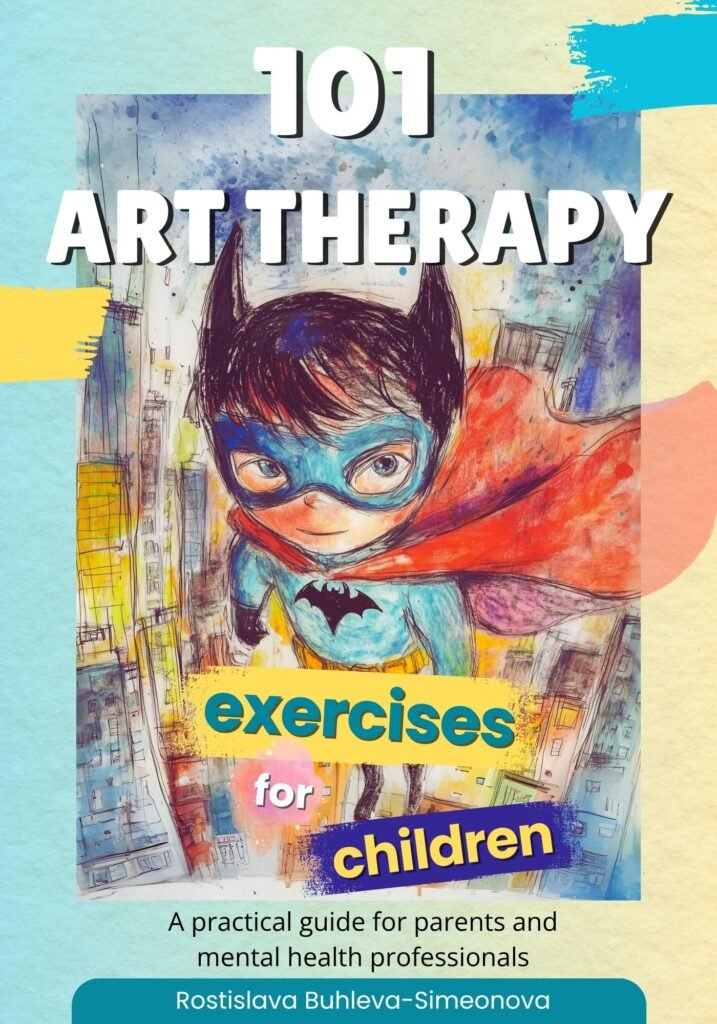
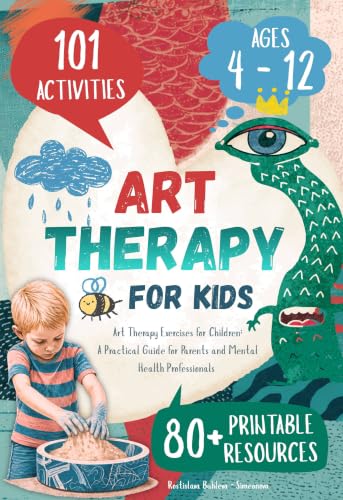
In a time when child development is increasingly shaped by global “epidemics”—diminished opportunities for creativity and critical thinking, the dominance of digital engagement, and a growing emotional disconnect between children and caregivers—101 Art Therapy Exercises for Children arrives as both a timely and deeply necessary resource. Written by a certified art therapist and parenting expert, this book offers a comprehensive, evidence-based response to these modern challenges through joyful, age-appropriate, and profoundly effective art therapy practices.
At its core, the book recognizes that children do not primarily communicate through words, but through play, images, symbols, and movement. Art therapy, a well-established branch of play therapy, aligns naturally with children’s developmental processes, making it especially effective for young children, children with special needs, and those who have experienced trauma. Drawing, painting, and sculpting are not simply creative outlets—they are children’s native language. For children who struggle to verbalize complex emotions such as fear, grief, anger, or anxiety, art becomes a bridge between inner experience and external expression.
What distinguishes 101 Art Therapy Exercises for Children is its strong grounding in neuroscience and psychological research. Each activity is informed by validated studies demonstrating how creative engagement alters brain physiology, strengthens neural flexibility, and enhances emotional regulation. Research shows that art-making activates the right hemisphere of the brain, engages the limbic system, and supports the parasympathetic nervous system—reducing stress while fostering adaptability, focus, and resilience. Rather than offering abstract theory alone, the book integrates this scientific foundation directly into practical, clearly structured sessions, ensuring therapeutic goals are supported by evidence-based practice.
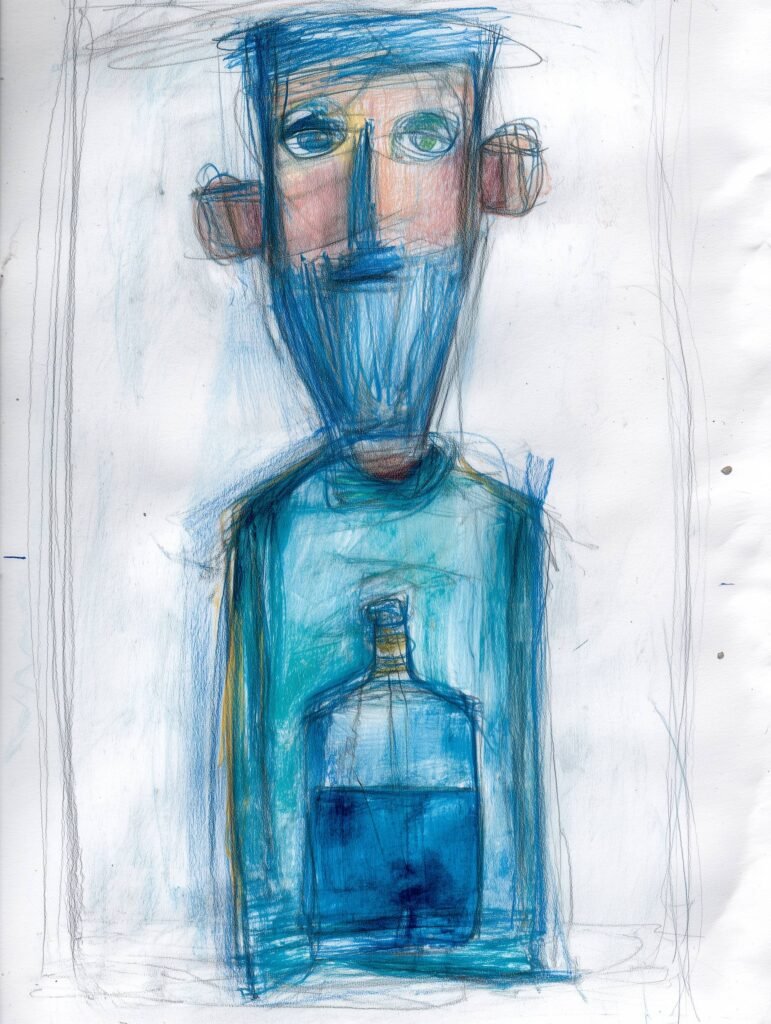
“A Genie from a Bottle”
The book serves a dual function: it is both a therapeutic toolkit and a preventative resource. Parents, caregivers, educators, counselors, and mental health professionals are given gentle, non-intrusive methods to observe a child’s emotional world over time. Too often, adults are forced to respond only once emotional or behavioral difficulties escalate. The activities in this collection provide a proactive means of supporting emotional processing, while also offering subtle insights into a child’s inner landscape—without judgment, pressure, or diagnosis.
Beyond emotional regulation, the book’s second major emphasis is on cognitive development, imagination, and critical thinking. Art-making strengthens memory, attention, and problem-solving through multisensory engagement. Children are encouraged to make choices, experiment, revise, and reflect—skills that directly translate into analytical thinking and adaptability. Imagination is treated not as a luxury, but as a developmental necessity: a space where abstract ideas are explored, identity is shaped, and internal strengths are discovered.
The third foundational pillar of the book is relational connection. 101 Art Therapy Exercises for Children powerfully demonstrates how shared creative experiences deepen bonds between children and caregivers. Collaborative or side-by-side art-making creates a safe relational space where trust, emotional attunement, and open communication can flourish. Research consistently shows that joint creative activities improve attachment security, reduce conflict, and increase emotional awareness within families. This relational dimension transforms the book from a collection of activities into a meaningful child-rearing guide—one that nurtures both the child and the relationship supporting them.
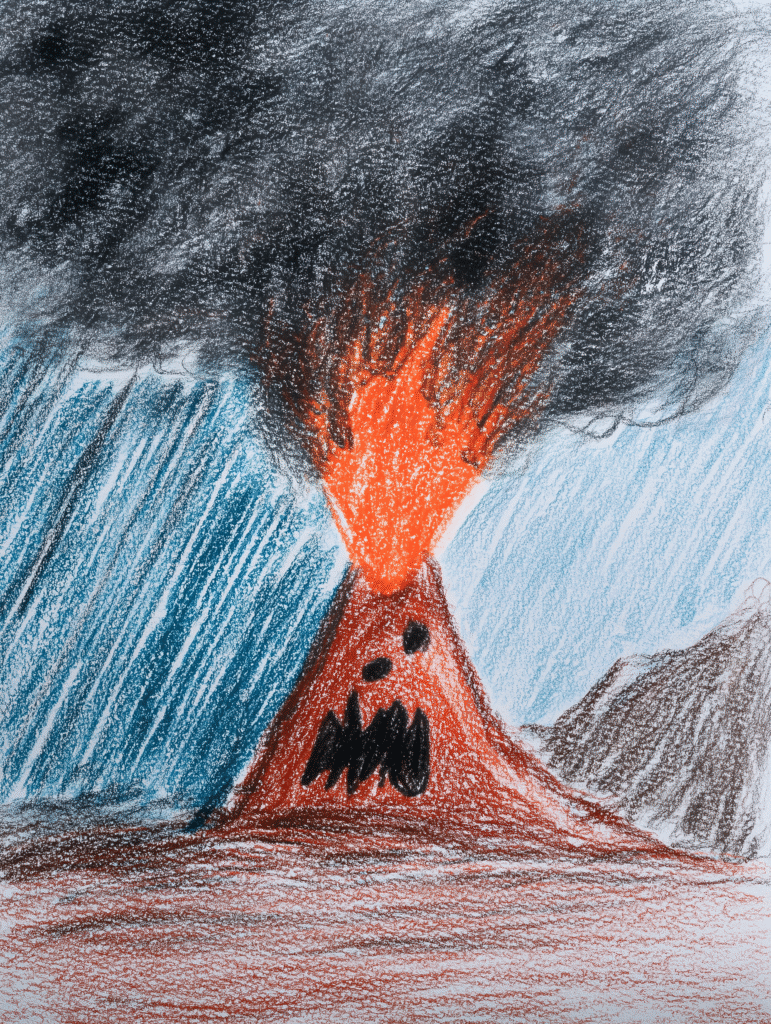
“Anger Volcano”
Importantly, the book approaches interpretation with care and ethical clarity. While artwork can offer valuable emotional clues, caregivers are repeatedly reminded that they are not therapists and should never diagnose based on a child’s creations. Instead, the book promotes curiosity, neutrality, and open-ended dialogue. Children remain the ultimate authorities on their artwork’s meaning. Parents are guided to observe objective features—such as size, placement, repetition, and intensity—while prioritizing the child’s narrative and emotional experience. When concerns arise, the book emphasizes seeking professional support rather than relying on untrained interpretation.
A notable strength of this collection is its flexible, developmentally informed structure. Activities are grouped by age ranges—4–6, 7–9, and 10–12—while remaining intentionally adaptable. Art therapy prompts are designed to evolve with the child, allowing repetition across developmental stages to reveal new insights as emotional and cognitive capacities mature. Many exercises are equally suitable for adults, inviting caregivers to participate alongside children. This shared engagement not only strengthens bonding, but also reduces performance pressure, models vulnerability, and enhances emotional openness for both child and adult.
The book includes exemplary sessions that embody its philosophy. A warm-up exercise such as “Drawing with Eyes Closed” gently dismantles perfectionism, promotes creative freedom, and reduces anxiety through playful, sensory engagement. This prepares children for deeper work, such as “A Rabbit Lost in the Forest,” a powerful session that fosters confidence and self-awareness. Through imaginative role creation, children connect with their internal resources, explore resilience, and symbolically rehearse coping with challenges—all within a joyful, empowering framework.

“Drawing with Eyes Closed”
Warm-up Exercise: Drawing with Eyes Closed
Purpose:
The “Drawing with Eyes Closed” exercise invites children to step away from perfectionism and embrace spontaneity, encouraging creative freedom and reducing self-criticism. Rooted in the art therapy principles of Edith Kramer, who valued the process of creation over the final product, this activity builds self-confidence (Kramer, 1971). Psychologically, it taps into the concept of “flow” as described by Csikszentmihalyi (1990), where immersion in an activity helps reduce anxiety and enhances enjoyment. By drawing without relying on visual control, children connect with their imagination and intuition, aligning with Erikson’s stage of initiative vs. guilt, where exploration leads to purpose (Erikson, 1963). A 2017 study demonstrated that non-directive, sensory-based art activities boosted children’s creative confidence by 20%, as shown by their increased willingness to try new things (Lee & Kim, 2017). This warm-up exercise helps children relax, take risks, and prepare for more structured art therapy work.
Materials Needed:
- White paper (8.5×11 inches)
- Crayons, markers, or colored pencils
- Optional: Blindfold or scarf (if preferred)
Session Description:
Introduction (1–2 minutes):
Set a playful, easy-going tone. Explain that the goal of this exercise is to have fun while drawing with closed eyes to see what comes out. Encourage them to move their hand freely on the paper, making lines and shapes without worrying about what they “should” create. Reinforce the idea of letting go of control, saying something like, “Let your hand wiggle and dance across the paper—let’s see what happens!”
Drawing (3–4 minutes):
Distribute the paper and a few drawing tools. Ask the child to close their eyes (or use a blindfold if they prefer). Prompt them to move their hand in any direction, drawing freely without peeking. Stay engaged, offering supportive comments like, “Where’s your hand going now?” or “Let’s try making a big swirl!” If they hesitate, encourage them to start with simple, bold motions.
Reflection (2–3 minutes):
Invite the child to open their eyes and take a look at their creation. Ask, “What do you see here? Does it remind you of anything?” or “What was it like drawing without looking?” Celebrate whatever they’ve created, even if it’s abstract. For example, “I love how those zigzags turned out!” If they seem unsure, gently point out any interesting shapes or patterns to spark their imagination.
Closure (1 minute):
Praise their courage for trying something new. Ask if they’d like to keep their drawing or move on to the next activity.
How it helps:
- Overcoming Perfectionism: Encourages children to let go of “perfect” results, fostering creative exploration.
- Building Confidence: Supports risk-taking, especially for children who are hesitant to draw for fear of making mistakes.
- Stimulating Imagination: Encourages creative thinking through abstract interpretation of their marks.
- Preparing for Future Art Tasks: Helps children loosen up and get comfortable for more focused art therapy activities.
- Reducing Anxiety: Provides a low-pressure, playful way for children to relax and explore creatively.
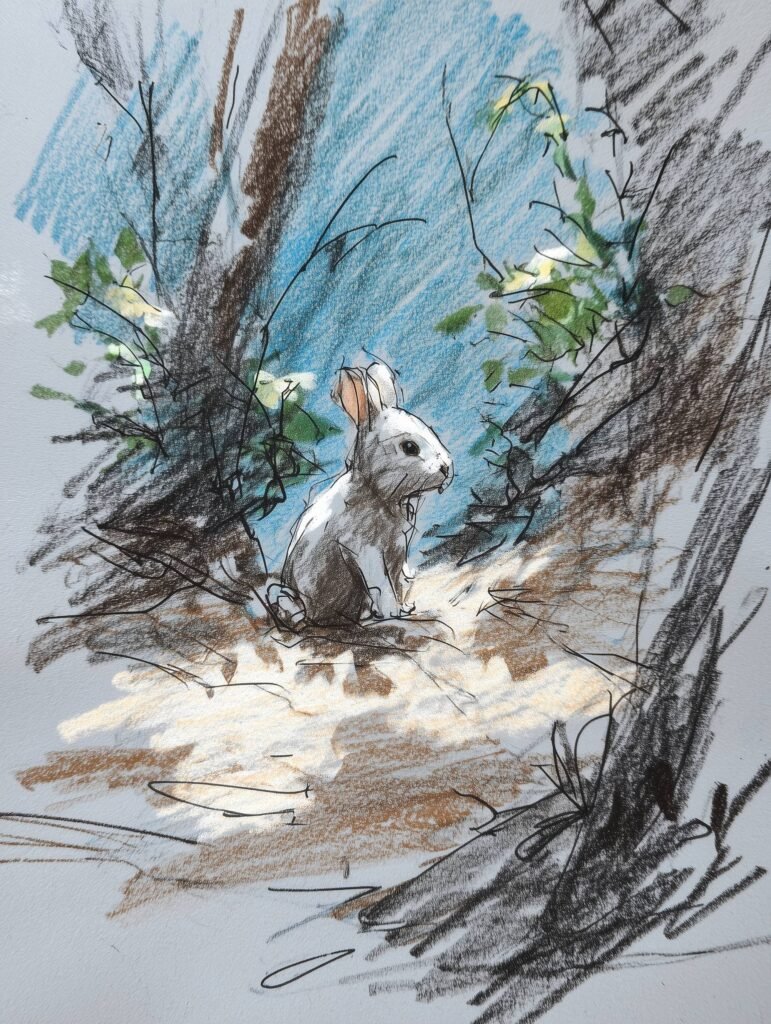
“Rabbit Lost in the Forest”
Art Therapy Session: Rabbit Lost in the Forest
Purpose
The “Rabbit Lost in the Forest” session encourages children to explore emotions such as uncertainty, fear, or curiosity through a narrative-based art activity, fostering emotional expression, resilience, and problem-solving. This activity draws on narrative art therapy approaches, similar to those developed by Judith Rubin, who used storytelling in art to help children externalize feelings (Rubin, 2005). Psychologically, it aligns with Erikson’s stage of initiative vs. guilt, where young children develop purpose through imaginative exploration (Erikson, 1963). By creating a story about a rabbit navigating a forest, children can process feelings related to transitions or challenges in a safe, playful way. Research supports this approach: a 2018 study found that narrative-based art activities increased emotional awareness in preschoolers by 29%, as measured by caregiver reports (Green & Taylor, 2018). This session empowers children to articulate emotions, imagine solutions, and build confidence through a whimsical, creative process.
Materials Needed
- White paper (8.5×11 inches or larger, for storytelling scenes)
- Crayons, markers, colored pencils, and watercolors
- Paintbrushes and sponges
- Optional: Stickers (e.g., animals, trees, stars) for forest elements
Session Description
Introduction (5–7 minutes) Begin with a short, engaging story: “Once upon a time, a little rabbit hopped into a big forest and got lost…” Explain that they’ll draw or paint a picture of a rabbit lost in a forest, imagining its adventure, who it meets, and how it finds its way. Emphasize that their rabbit’s story can be anything they dream up—fun, magical, or scary.
Creating the Rabbit’s Adventure (15–30 minutes) Lay out the paper and a variety of art supplies. Invite the child to draw or paint their rabbit in a forest, suggesting they show where the rabbit is, what it sees, and what happens next. Prompt with open-ended questions to inspire creativity: “What does the forest look like?” “What’s the rabbit doing?” “Does the rabbit meet anyone?” Observe the artwork’s characteristics (e.g., size and positioning of the rabbit and remaining characters) and the child’s behavior (e.g., excitement, hesitation) to gauge emotional engagement, noting for reflection. Stay engaged but non-directive, praising their creativity.
Reflection (5–7 minutes) Sit with the finished artwork and explore the rabbit’s story together. Ask open-ended questions to encourage emotional awareness: “Can you tell me about your rabbit and what’s happening in the forest?” “How does the rabbit feel?” “What’s your favorite part of the story?” “Does this adventure remind you of anything in your life?” Listen attentively, reflecting their excitement, curiosity, or bravery. If they share feelings, like being scared in new places, validate them gently. To foster resilience, suggest modifications: “What could help the rabbit feel even safer?” or “What might the rabbit do next?” If they’re reluctant to share, affirm their effort and point out a fun detail (e.g., “I love how your rabbit has a fluffy tail!”) to encourage openness.
Closure (3–5 minutes) Celebrate their creation with enthusiasm: “Your rabbit’s forest adventure is so amazing and full of surprises!” Ask if there’s anything they’d like to change or add to the picture (e.g., “Would you add anything to help the rabbit?”). Offer to display the artwork in their room, store it in a special folder, or keep it private, respecting their choice.
Pivotal Moments
- Expressing Emotions: Helps children articulate feelings like fear, curiosity, or relief, fostering emotional literacy.
- Building Resilience: Encourages imagining solutions to challenges, like finding a path, aligning with problem-solving skills at ages 4–6.
- Coping with Transitions: Supports processing changes, such as starting school or moving, by visualizing a safe journey.
- Fostering Imagination: Sparks creative storytelling through a whimsical animal narrative, key for young children’s development.
- Developing Initiative: Reinforces a sense of agency as children guide the rabbit’s adventure, aligning with Erikson’s developmental stage.
- Managing Anxiety: Provides a safe outlet for fears of being lost or alone, symbolized by the rabbit’s journey.
Conclusion
101 Art Therapy Exercises for Children brings together science, creativity, and relational wisdom to offer a practical and deeply compassionate approach to supporting children’s emotional, cognitive, and social development. Rooted in evidence-based art therapy and developmental psychology, the exercises in this book honour children’s natural ways of communicating—through images, symbols, movement, and play—while providing caregivers with gentle, non-intrusive tools to support emotional expression and growth.
Across the sessions, art is presented not as a product to be judged, but as a process through which children build self-regulation, confidence, imagination, and resilience. The activities encourage critical thinking, emotional insight, and flexibility, while remaining adaptable to each child’s developmental stage, temperament, and lived experience. Repetition, openness, and creative freedom allow meaning to emerge over time, making each session relevant and responsive to the child’s evolving inner world.
Equally important is the book’s emphasis on connection. By inviting parents and caregivers to participate alongside children, these exercises foster trust, attunement, and meaningful communication. Shared art-making creates space for emotions to surface safely, strengthens relational bonds, and helps prevent unspoken struggles from going unnoticed.
Ultimately, this book is both a preventative resource and a supportive companion through life’s everyday challenges. It empowers adults to nurture emotionally healthy, confident, and creatively engaged children—while reminding us that healing, growth, and understanding often begin not with words, but with a simple mark on paper.

Rostislava Buhleva-Simeonova is a psychologist, art therapist, and gamificator. She has worked with children, adults, and the elderly within various therapeutic programmes over the past eight years, all the while providing the much-needed playful twist that art and gamified experiences can bring to this sometimes uneasy setting. But it wasn’t until the birth of her daughter, Aurora, that this work took on an even deeper personal meaning. With her academic and real-life experience, honed through numerous trainings and sessions, she is currently authoring books and articles in the field of child psychology and development, offering expertise in art and play therapy to guide parents and caregivers, as well as professionals in the fields of social work and mental health, throughout various pivotal moments in children’s lives. Last but not least, all of her books have been “peer-reviewed” by her daughter, who testifies to the efficiency of these methods.