
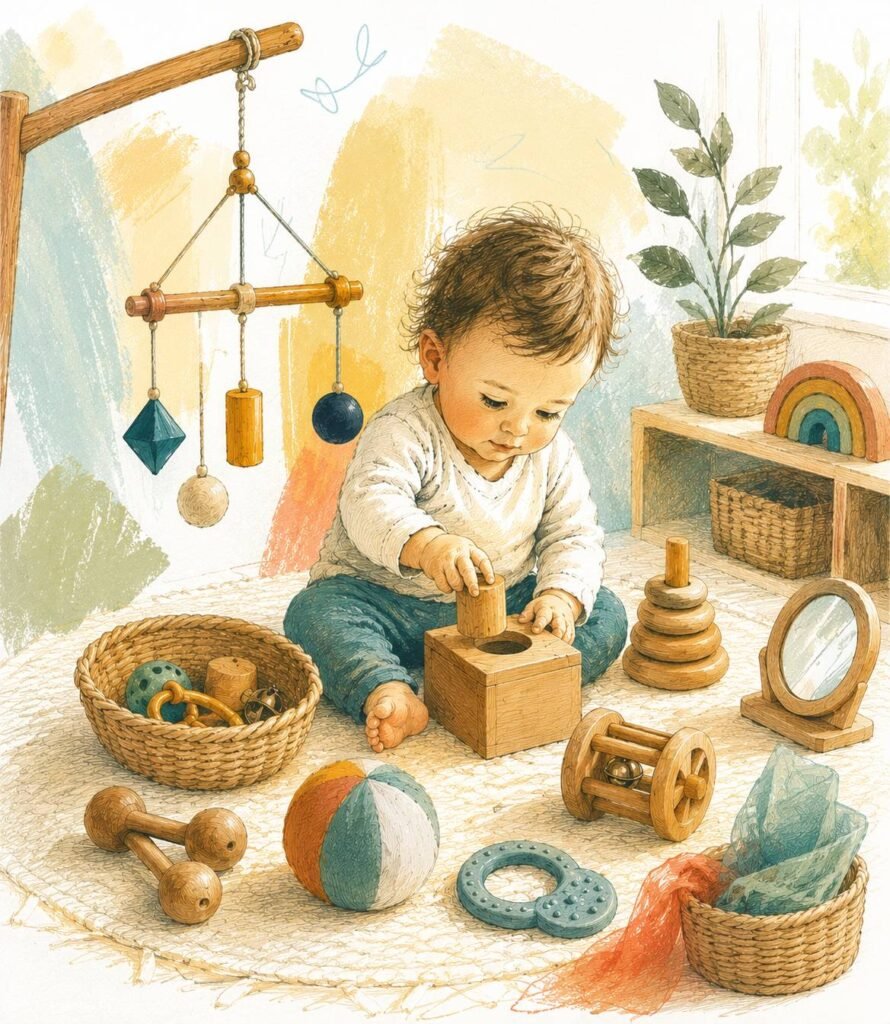
The popularity of Montessori toys for babies has grown for a reason: the method is rooted in careful observation, respect for the child, and a deep understanding of early development. Yet many mothers feel overwhelmed. The market is saturated with “Montessori-inspired” labels, making it difficult to choose what truly supports development. Many products promise stimulation or faster learning, but not all reflect how babies actually grow. In practice, infants benefit more from materials that invite exploration at their own pace than from toys that constantly direct attention.
As a psychologist, art and play therapist, and mother, I’ve learned that clarity matters. Therefore, this guide not only curates the best options but also organizes them by age, making it easier to select the right tools at the right time. The goal is not to create a perfect Montessori nursery or buy every recommended item. Rather, it is to understand which developmental needs are emerging during each stage of infancy. When parents have that framework, choosing becomes simpler and more meaningful.
Why Montessori Toys for Babies Support Early Development
Montessori philosophy emphasizes independence, sensory exploration, and purposeful movement. During the first year, the brain develops rapidly. Because of this, babies benefit from simple, engaging materials rather than overstimulating toys. Every repeated movement, gaze, and reach helps build neural connections. In turn, simple materials allow babies to notice patterns, practice coordination, and remain engaged for longer periods. When toys do less, babies often do more.
Research in developmental psychology shows that infants learn through interaction. For example, grasping and tracking strengthen neural pathways linked to coordination and cognition. As a result, Montessori materials—designed to isolate one skill—encourage focus and deeper learning. This matters especially during the first year, when attention is still emerging. A toy that offers one clear challenge allows babies to repeat an action, observe results, and gradually refine their abilities. Often, repetition rather than novelty is where the richest learning takes place.
How to Choose Montessori Toys for Babies Without Overwhelm
Choosing Montessori toys for babies becomes easier when you follow a few principles. First, opt for natural materials that provide rich sensory feedback. Next, prioritize toys that require active participation. Materials such as wood, cotton, silicone, and metal offer varied textures, temperatures, and weights. As a result, babies learn not only by looking, but also by touching, mouthing, shaking, and moving objects. The more responsive the material, the richer the sensory experience becomes.
Equally important, match toys to developmental stages. A younger baby needs visual stimulation, while an older one seeks problem-solving challenges. Therefore, rotating toys helps maintain engagement without overwhelming your child. A small, intentional selection is often more effective than a crowded play area. When too many toys are available, babies may shift attention quickly without engaging deeply. By contrast, rotation preserves novelty while supporting focus and emotional regulation.
Montessori Toys for Babies by Age (1–12 Months)
0–3 Months: Building Visual Focus and Awareness
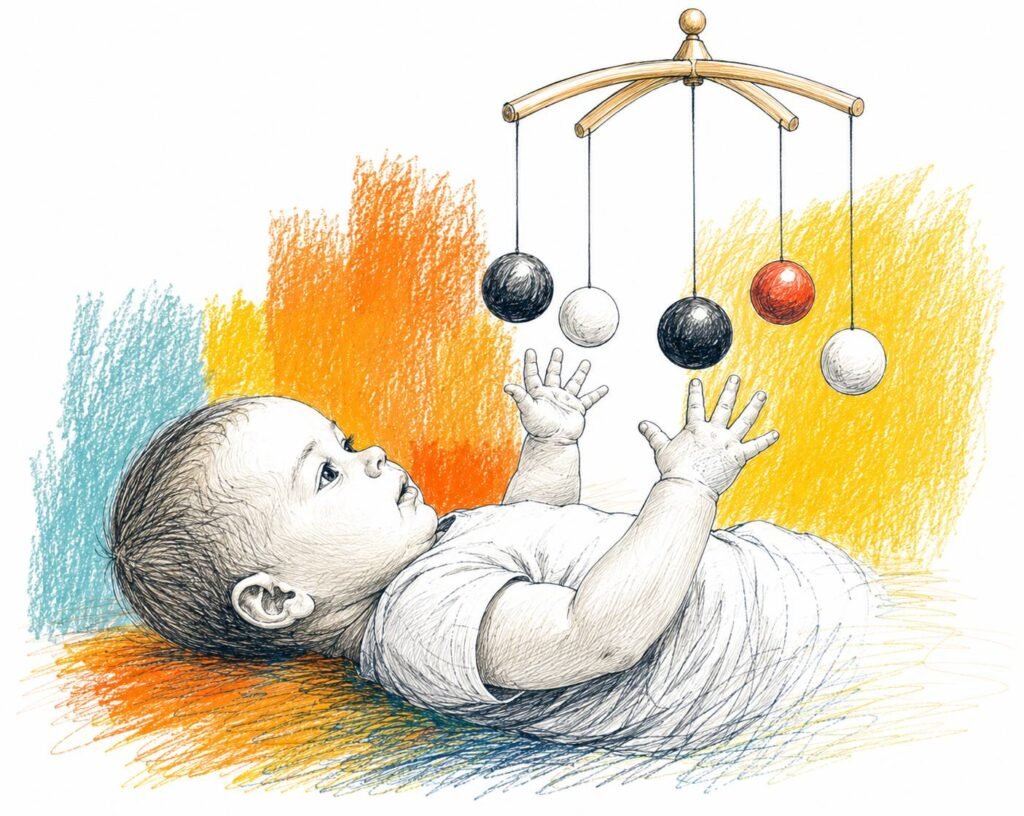
At this stage, babies are developing their vision and beginning to engage with the world. Therefore, toys should support tracking and attention. Newborns see best at close distances and are especially sensitive to contrast, movement, and faces. Because their visual system is still organizing itself, calm and focused stimulation is ideal.
Montessori Mobile
High-contrast or gently moving mobiles encourage babies to follow objects with their eyes. As a result, this strengthens visual tracking and concentration. In addition, mobiles can support early attention span by inviting sustained visual engagement without overwhelming the nervous system. Over time, babies begin anticipating movement and refining visual control.
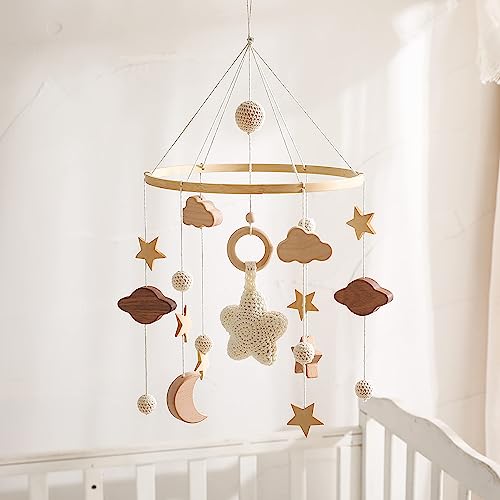
- ✨GENDER NEUTRAL BABY MOBILE – Warm beige, soft whites, and natural wood designed for a modern “Starry Night” aesthetic. …
- ✨ NATURAL & HANDCRAFTED – Crafted from hand-crocheted cotton and FSC-certified wood with a natural beech wood look. Each…
- ✨ PROMOTES HEARING AND VISUAL DEVELOPMENT – Designed to attract baby’s attention and exercise hearing through gentle, no…
Mirror Toy
Babies are naturally drawn to faces. A safe mirror promotes visual engagement and early social awareness, even before self-recognition develops. Furthermore, mirrors invite repeated observation of facial movement, light, and changing expressions. Even before understanding that the reflection is their own, babies often find this deeply engaging.

- Make Tummy Time More Engaging:This tummy time mirror gives baby something interesting to look at, helping hold attention…
- Clear, Undistorted Reflection:The large acrylic baby mirror provides a clear, undistorted view of faces and movement, gi…
- Adjust the Mirror, Not Your Baby:The adjustable wooden frame offers an approximately 0–90° viewing range, making it easy…
2–5 Months: Encouraging Grasping and Sensory Exploration
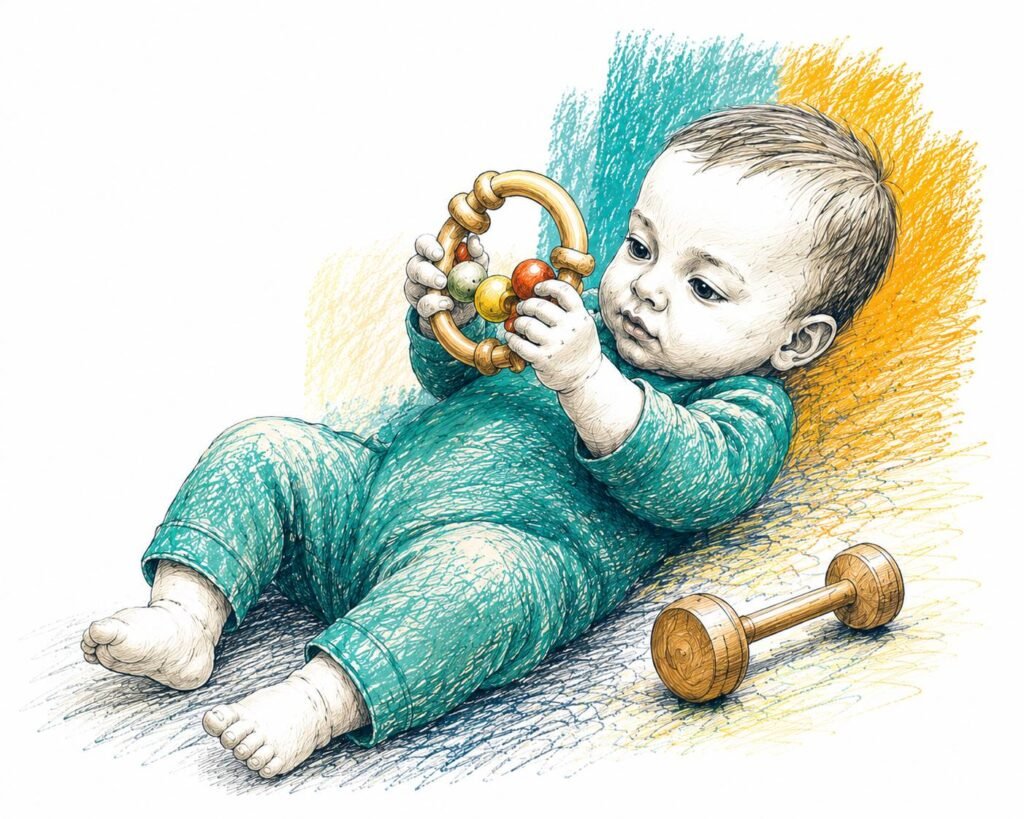
As reflexes become intentional movements, babies begin reaching and grasping. Consequently, toys should support motor control. This stage marks an important shift from passive reflexes to purposeful action. At the same time, babies begin experimenting with how their bodies move and how movement affects the environment.
Wooden Grasping Toy
This helps babies transition from reflexive to voluntary grasping. In turn, it builds coordination and body awareness. Repeated practice strengthens hand muscles and supports the connection between vision and movement. Gradually, babies learn to adjust their reach, grip, and release.
Wooden Rattle
Gentle sound feedback teaches cause and effect. When babies shake the rattle, they begin to understand their actions have outcomes. This discovery is developmentally significant because it introduces agency. As a result, babies become more curious and motivated to experiment.

- Wooden Baby Toys Sets: includes 5 different wooden sensory toys: bead rattle, rolling car, ring teether, shaking rattle,…
- Safe Material: these wooden baby toys are made from beech wood, sturdy, reliable and safe, no paint and smell, smooth an…
- Baby Design: each baby wooden toys is ergonomically designed for infants aged 0-12 months; Easy to grip, shake, and roll…
3–6 Months: Supporting Oral and Physical Development
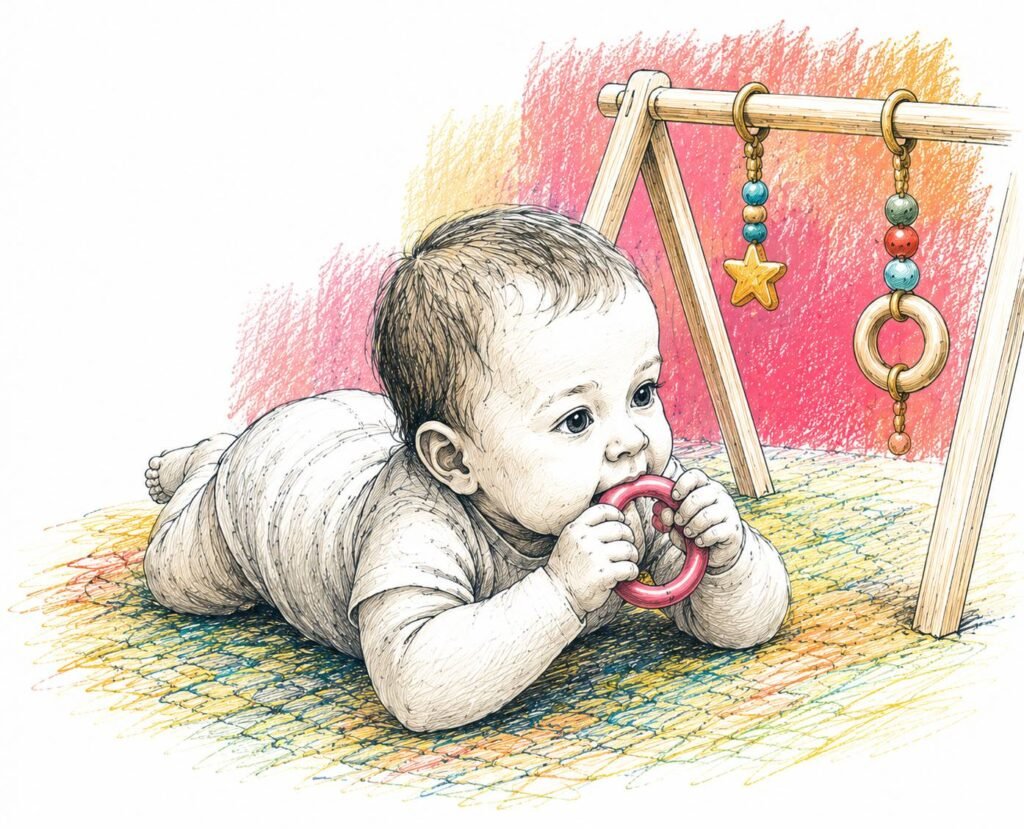
During this phase, babies explore the world through their mouths and movements. Therefore, sensory-rich toys are essential. Mouthing is not only soothing but also a major way infants gather sensory information. Meanwhile, rolling, stretching, and pushing against surfaces become more frequent.
Silicone Teething Ring
Teething toys soothe discomfort while supporting oral exploration. Importantly, they also contribute to sensory integration. Different textures and resistance levels offer valuable sensory input to both the mouth and hands. Consequently, babies begin organizing tactile information and strengthening body awareness.

- ✨ PREMIUM QUALITY: Moonkie’s 7-piece stacking ring toys are made of high-quality food-grade silicone, without any filler…
- ✨ EDUCATIONAL DEVELOPMENT: Our stacking toys are designed to help develop fine and gross motor skills in babies. As they…
- ✨ VERSATILE TEETHING TOY: Moonkie’s baby teething rings are not only great for stacking games but also serve as a safe a…
Montessori Play Gym
A simple play gym encourages reaching, kicking, and stretching. As a result, babies build strength and spatial awareness. Repeated movement under a play gym also supports bilateral coordination and early motor planning. In this way, babies begin exploring how their bodies relate to the space around them.
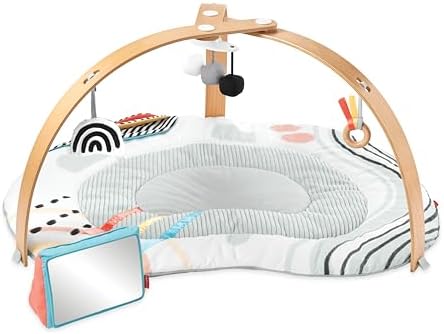
- Montessori-inspired design: Developed in collaboration with Montessori education experts, our Discoverosity Play Gym off…
- Supports Fine & Gross Motor Skills: Our baby play gym promotes fine motor skills, gross motor development and hand-eye c…
- High-Contrast Developmental Toys: Four nature-inspired toys are designed to enhance sensory exploration, encourage grasp…
4–8 Months: Developing Coordination and Curiosity
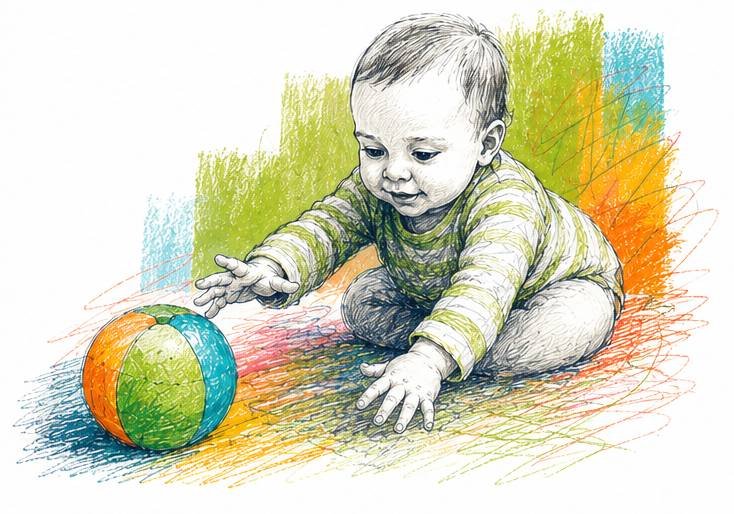
Babies now begin rolling, reaching, and exploring more actively. Because of this, toys should encourage movement and problem-solving. At this stage, curiosity increasingly motivates physical effort. Babies often shift position, pursue objects, and experiment with distance and movement.
Soft Fabric Ball
Easy to grasp and roll, this toy promotes coordination. Additionally, it introduces early problem-solving as babies chase movement. Because the ball moves unpredictably, babies are encouraged to track it visually and adjust their body movements. Through repeated attempts, they begin developing persistence and flexibility.

- 100% Polyester
- Imported
- PERFECT BABY TOYS 6 TO 24 MONTHS: The HABA Rainbow baby ball toy is designed to captivate and delight infants with its s…
6–12 Months: Building Cognitive Skills and Independence
At this stage, babies start understanding object permanence and experimenting with their environment. Therefore, toys should encourage thinking and exploration. They also become more motivated to repeat actions, test possibilities, and observe outcomes. As a result, concentration and persistence often grow noticeably.
Object Permanence Box
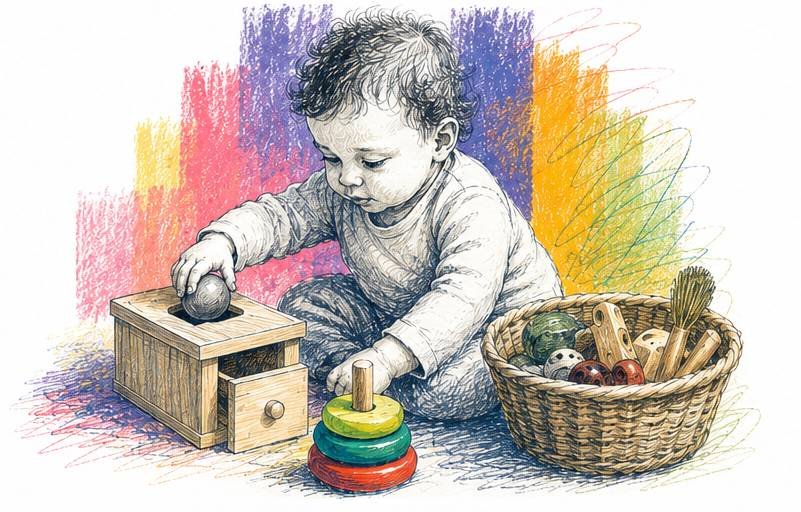
This classic Montessori material teaches that objects still exist when hidden. According to developmental theory, this is a major cognitive milestone. Repeating this action helps babies form mental representations beyond immediate perception. In turn, it strengthens attention, memory, and early problem-solving.

- 🌱【Promotes Cognitive Development】: The Montessori Object Permanence Box with Tray and Three Balls is a valuable learning…
- 🌈【Engages Sensory Exploration】: The Montessori Object Permanence Box stimulates sensory exploration through the use of v…
- 👶【Enhances Fine Motor Skills】: This Montessori toy encourages the development of fine motor skills in young children. Wi…
Stacking Rings
Stacking supports sequencing and hand-eye coordination. Over time, babies begin experimenting, which strengthens logical thinking. At first, they may simply grasp or knock over the rings. Gradually, however, they begin comparing sizes, testing order, and noticing patterns.
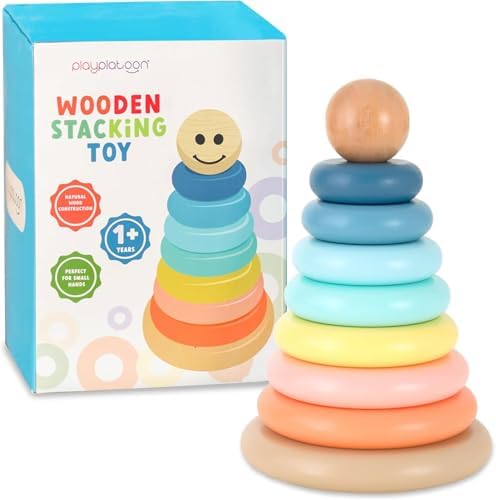
- CHARMING STACKING TOY: Play Platoon’s wooden stacking toy for babies and toddlers combines natural wood construction wit…
- DESIGNED FOR LITTLE HANDS: With 7 rings plus a wooden head, this toy is crafted to be baby-friendly. The rings are perfe…
- FUNCTIONAL AND DECORATIVE: Beyond play, these stacking rings also serve as delightful nursery decor. Their vibrant color…
Treasure Basket
A curated basket of safe household objects offers rich sensory play. From a therapeutic perspective, it fosters independence and creativity. Because there is no single “correct” way to play, babies can explore textures, weights, sounds, and shapes through self-directed discovery. This often supports sustained attention and intrinsic motivation.

- Multi-function Basket: The multi-function storage basket is very suitable for playroom. It is cute and sturdy, and it ca…
- Unique Amimal Design: Made from soft coiled rope, this animal storage bin with a playful bear face adds sweet flair to t…
- The Cute Size: 8.5 inches (H) x 10.5 inches (D), is a small basket that can be easily moved, great for storing of small …
Final Thoughts on Montessori Toys for Babies
Choosing Montessori toys for babies becomes much simpler when you follow your child’s developmental rhythm. Rather than buying more, focus on selecting better. Often, one well-chosen material offers more developmental value than several highly stimulating toys. Observation becomes the most useful guide. When parents notice what captures attention, invites repetition, and supports calm engagement, choices become more intuitive.
In my experience, thoughtfully chosen materials lead to deeper engagement and more meaningful learning. Ultimately, Montessori toys for babies are tools that support natural curiosity, helping your child grow with confidence and independence. The most valuable gift is not constant stimulation but space to explore, repeat, and discover. When we offer developmentally appropriate materials with patience and attention, babies often show us exactly what they are ready to learn.
Some of the links on this blog are affiliate links, which means I may earn a commission if you make a purchase using the link. This comes at no additional cost to you. I only recommend products or services that I believe in and think will be valuable to my readers. Thank you for supporting this blog!

Rostislava Buhleva-Simeonova is a psychologist, art therapist, and gamificator. She has worked with children, adults, and the elderly within various therapeutic programmes over the past eight years, all the while providing the much-needed playful twist that art and gamified experiences can bring to this sometimes uneasy setting. But it wasn’t until the birth of her daughter, Aurora, that this work took on an even deeper personal meaning. With her academic and real-life experience, honed through numerous trainings and sessions, she is currently authoring books and articles in the field of child psychology and development, offering expertise in art and play therapy to guide parents and caregivers, as well as professionals in the fields of social work and mental health, throughout various pivotal moments in children’s lives. Last but not least, all of her books have been “peer-reviewed” by her daughter, who testifies to the efficiency of these methods.