
Every parent has stood in that split second — their child in front of them, fear written clearly across their face, doing their best but wishing they had a little more to go on. The worry about school that arrives every Sunday evening without fail. The question “what if something bad happens?” asked not once but in a loop, circling back before the previous answer has had time to land. You have tried reassurance. You have tried logic. You have tried simply sitting alongside them. And the fear is still there, patient and persistent, because it has not yet found the right container.
Childhood fear and anxiety are not signs of weakness. They are signs of an intelligent, sensitive nervous system doing exactly what it was built to do — scanning the environment for uncertainty, flagging what feels unsafe, preparing the child for difficulty it believes may be coming. The problem is rarely the fear itself. The problem is that the fear has no form, no boundary, no edges. And without edges, it cannot be approached, examined, or gradually made smaller.
A well-designed kids anxiety worksheet gives the fear edges. And once a fear has edges, a child can begin to process it.
What Fear Does to the Body and Brain
When a child encounters something frightening — whether the threat is real, imagined, or anticipated — the amygdala fires, the sympathetic nervous system activates, and the body moves into the fight, flight, or freeze response before the thinking brain has had a chance to evaluate the situation. This is not a malfunction. It is the nervous system operating exactly as designed, prioritising survival over reflection. The problem for anxious children is that this system activates not only in the presence of genuine danger but in the presence of uncertainty, novelty, social scrutiny, and the vast range of what-ifs that a child’s imagination — vivid, concrete, and as yet uncalibrated by years of accumulated evidence — can generate with extraordinary efficiency.
Perfectionism, social anxiety, separation anxiety, generalised worry, specific fears — these are all variations on the same underlying dynamic: a nervous system that has learned to treat uncertainty as threat, and that has not yet accumulated enough evidence that uncertainty is survivable. What the best kids anxiety worksheet understands is that the route through this is not persuasion or reassurance. It is repeated, gentle, play-based experience of approaching the fear from the outside — naming it, containing it, and discovering, through the process, that it is smaller than it looked from the inside.
Why the Dragon Works
There is something therapeutically specific about the dragon as a vehicle for anxiety work with children — something that goes beyond the general effectiveness of monster-based externalisation tools. The dragon is a creature of extraordinary power. In most of the stories children know, the dragon is the thing to be feared — the source of fire and danger and the challenge the hero must overcome. Inverting that completely — making the dragon the ally, the protector, the creature that specifically seeks out fears and gobbles them up — does something quietly significant to the child’s relationship with their own anxiety.
If the dragon, the most fearsome creature in the story, is on the child’s side — then perhaps the child is more powerful than they thought. And if their fears are the dragon’s favourite meal — then perhaps the fears are not as invincible as they felt. This is narrative reframing at its most elegant: achieved not through explanation or persuasion but through the logic of the story itself, which the child absorbs without needing to be told what to make of it.
This is what distinguishes the best kids anxiety worksheet from a simple worry list. The frame is doing therapeutic work that the prompts alone could never do.
Free Kids Anxiety Worksheet: The Worry-Eating Dragon
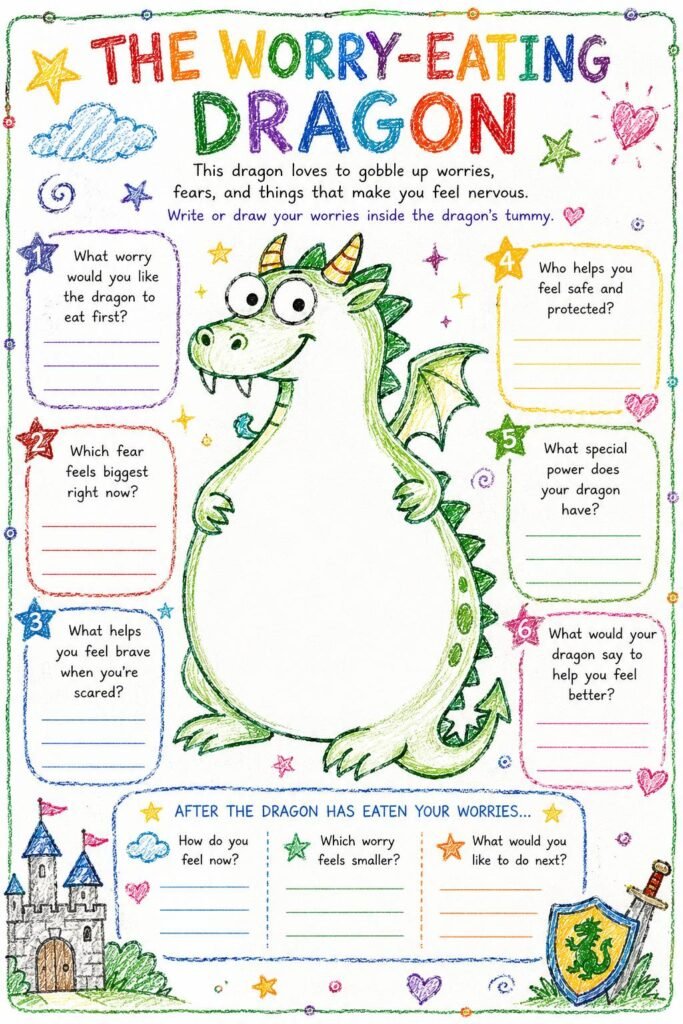
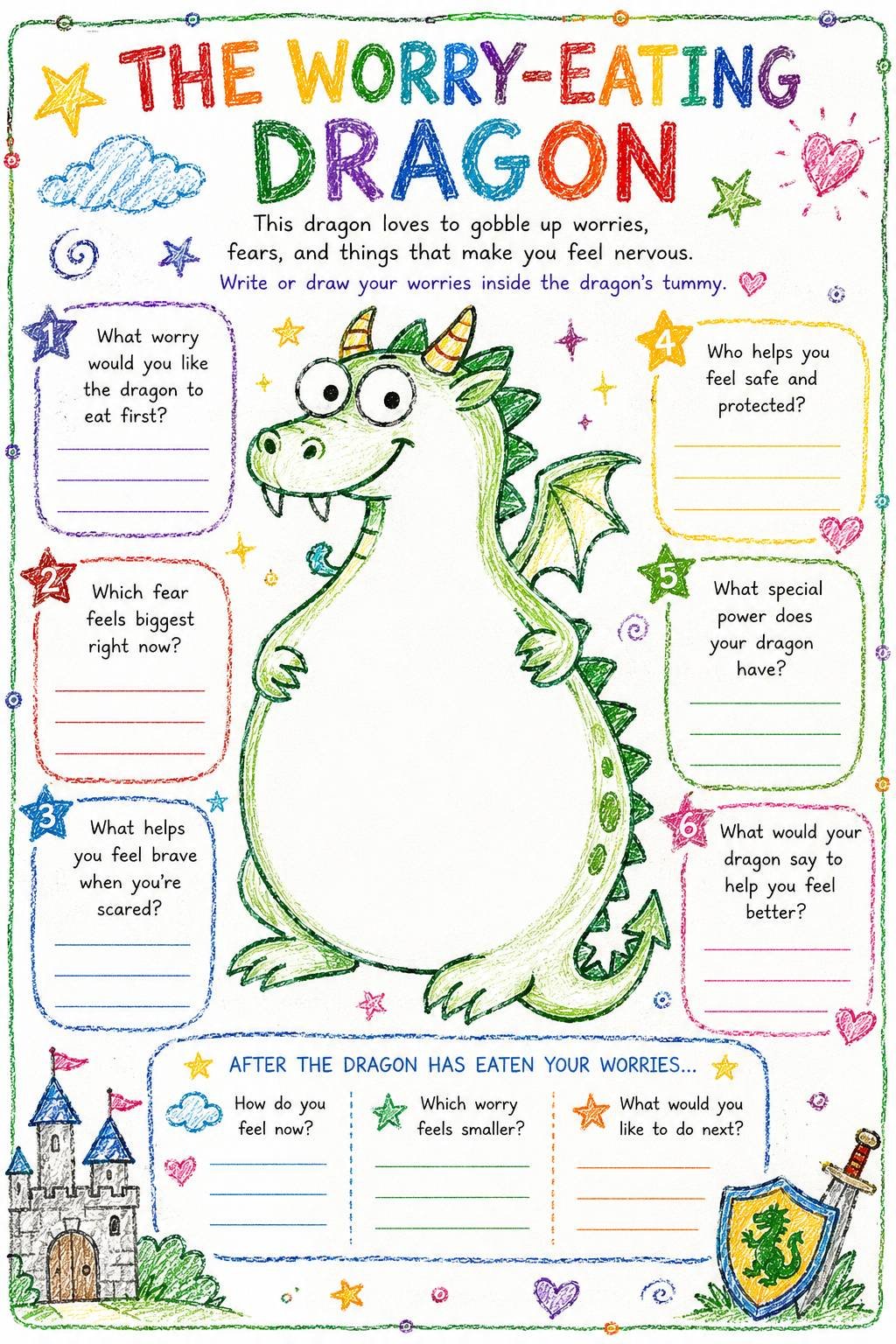
The worksheet below — The Worry-Eating Dragon — is a free resource you can use with your child today. It is suitable for children aged approximately 6 to 12, and works equally well at home, in school, or in a therapeutic setting. It is richly illustrated, warmly framed, and structured around six reflective prompts that move the child through the full arc of anxiety work — from naming the fear, through identifying what helps, to checking in on how things feel once the dragon has done its work.
What makes this a genuinely effective kids anxiety worksheet is the arc it traces. It begins with externalisation — naming and placing the worry outside the child — moves through resourcing — identifying what helps, who is safe, what bravery already looks like — and closes with reflection — noticing the shift, however small, that has occurred in the process of working through it. This is not a list of worries. It is a complete, structured therapeutic experience.
How to Use It
Place the worksheet in front of your child with a warm, simple introduction — open enough to invite without directing: “This dragon loves to eat worries — the bigger the better. I wonder if you have anything he could gobble up today.” Then step back. Give the child time and space to engage without commentary or suggestion. You can prompt gently with open-ended questions but do not direct the process in one way or another. What appears in the dragon’s tummy, which prompts they answer fully and which they leave brief, whether they draw or write or do both — all of it is information worth holding gently.
Work through the six prompts at whatever pace the child sets. Some will move quickly. Others will sit with a single prompt for longer than you expect — and that pause is often where the most important work is quietly happening. Once the dragon has eaten and the closing section is complete, explore it together:
- Which worry do you think the dragon enjoyed eating most?
- Was there a fear that felt smaller once you wrote it down?
- The dragon has a special power — do you think you have a special power too?
- Who do you go to when you feel scared?
- How does your body feel now compared to when we started?
The most important thing is not the answers. It is the quality of attention you bring to hearing them.
For Deeper Work: The Play Therapy Toolbox
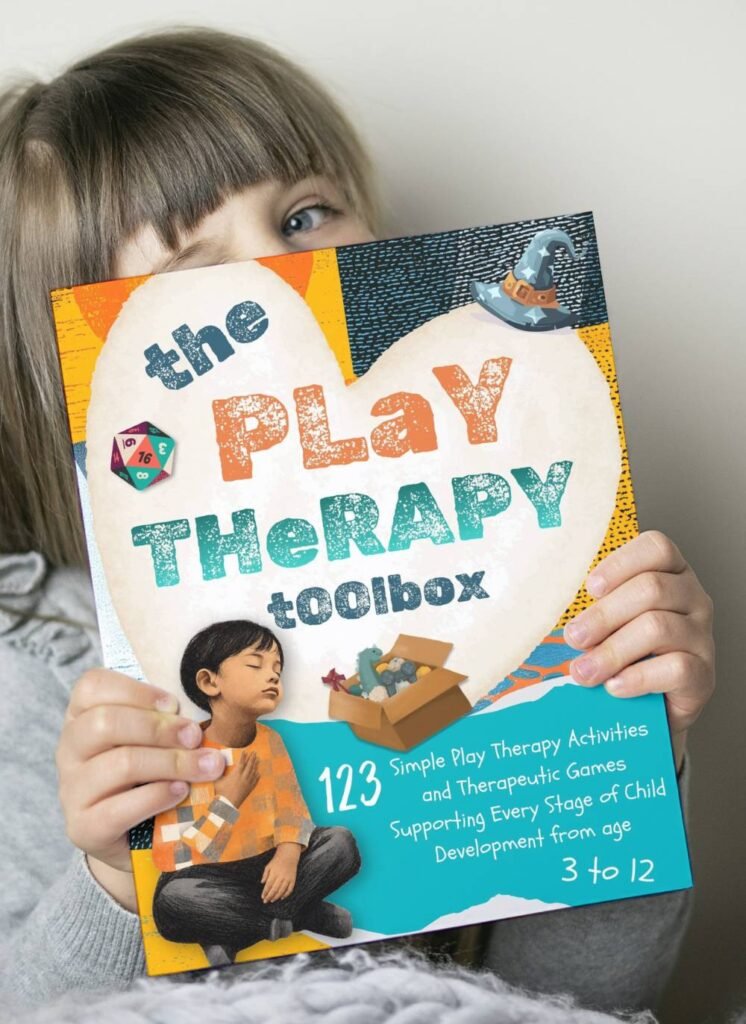
The Worry-Eating Dragon is one example of the kind of structured, narrative-based anxiety tool that sits at the heart of The Play Therapy Toolbox: 123 Simple Play Therapy Activities and Therapeutic Games Supporting Every Stage of Child Development from Age 3 to 12 — a book built around the understanding that children speak in a language adults often forget they once spoke fluently themselves.
The book contains 123 activities spanning role-play, enactment, fantasy storytelling, somatic exercises, and gamified experiences, alongside 75+ printable, downloadable, full-colour worksheets designed to support and extend each activity. Every activity comes with a therapeutic rationale grounded in peer-reviewed research, step-by-step guidance on how to conduct the session and what to say, questions to use with the child, and a parent guidance note written in the same warm, accessible language as this article.
The anxiety chapter alone covers the full range of presentations children bring — separation anxiety, social anxiety, perfectionism and OCD tendencies, generalised worry, specific fears, school refusal, performance anxiety, and the particular anxieties generated by family transitions, bereavement, and the pressures of contemporary childhood. Every activity is cross-referenced in a comprehensive annex by presenting condition, age group, and page number — so you can navigate directly to the right tool for the right child at the right moment, without searching.
Three Things Worth Knowing Before You Begin
Naming the fear is already half the work.
Any kids anxiety worksheet used well begins from this understanding: the act of writing or drawing a worry — giving it a place to live outside the child’s body and mind — reduces its subjective intensity before any further therapeutic work is done. The child who fills the dragon’s tummy is not simply completing an exercise. They are already doing the most important thing: moving the fear from inside, where it is formless and large, to outside, where it has edges and can be looked at.
The dragon’s special power belongs to the child.
Prompt five — what special power does your dragon have? — is doing something quietly significant. It is asking the child to attribute power to the creature that is on their side. And in doing so, it is also, indirectly, asking the child to locate power in themselves. Whatever the child gives the dragon is something they already understand about strength, protection, and the capacity to face what is frightening. Receive it with genuine interest.
You are the most important tool in the room.
Children disclose fear and anxiety most readily within the safety of a warm, regulated, genuinely curious relationship with a trusted adult. Sit down. Write something in a bubble of your own. Let them see that even grown-ups have fears that need somewhere to go — and that the dragon, fortunately, has an excellent appetite.
Available Now for $5.99 — For a Limited Time
If this free kids anxiety worksheet gave you a sense of what becomes possible when children are met in their own language, The Play Therapy Toolbox gives you 123 more tools built on the same foundation. The ebook is available now on Amazon at $5.99 for a limited time — with immediate access to 123 activities and 75+ full-colour printable worksheets for children aged 3 to 12.
Play is not preparation for life. It is life — in its most honest, most essential, most healing form.

Disclaimer: This article is intended as an educational and supportive resource for parents, caregivers, educators, and mental health professionals. It is not intended to diagnose, treat, or replace professional therapeutic or medical care. If a child is experiencing significant emotional, behavioural, or developmental difficulties, please seek guidance from a qualified mental health professional.

Rostislava Buhleva-Simeonova is a psychologist, art and play therapist, and gamificator. She has worked with children, adults, and the elderly within various therapeutic programmes over the past eight years, all the while providing the much-needed playful twist that art and gamified experiences can bring to this sometimes uneasy setting. But it wasn’t until the birth of her daughter, Aurora, that this work took on an even deeper personal meaning. With her academic and real-life experience, honed through numerous trainings and sessions, she is currently authoring books and articles in the field of child psychology and development, offering expertise in art and play therapy to guide parents and caregivers, as well as professionals in the fields of social work and mental health, throughout various pivotal moments in children’s lives. Last but not least, all of her books have been “peer-reviewed” by her daughter, who testifies to the efficiency of these methods.