
Every parent has heard it. The quiet, almost throwaway declaration that lands heavier than ever before: I’m not good at anything. Sometimes it arrives after a difficult day at school. Sometimes it surfaces in comparison to a sibling or a friend Sometimes it comes from nowhere in particular — a thought the child has been carrying for a while and has finally said out loud, half to you and half to themselves, in the hope that someone will tell them it is not true.
The instinct is to reassure immediately. Of course you are good at things. You are brilliant at so many things. And the reassurance is offered with complete sincerity, because you believe it entirely. But reassurance, however warm and however genuine, does not build self-esteem. It visits it briefly and then leaves. What builds self-esteem is something slower and more specific: the repeated experience of gathering proof of your own capabilities and self-efficacy.
That is what the best self-esteem activities for kids are designed to do. Not to tell a child they are wonderful. To help them find out for themselves.
What Self-Esteem Actually Requires
Erik Erikson described the central developmental tension of middle childhood as industry versus inferiority — the child’s ongoing, urgent internal reckoning with whether they are capable, whether they measure up, whether they have something worth offering to the world. This question is not asked once. It is asked continuously, across every new challenge, every unfamiliar situation, every moment of comparison with a peer who appears more confident, more competent, or simply more certain of their own worth.
The answers a child accumulates across these moments become the story they tell about themselves. And that story, once established, is remarkably resistant to reassurance — because the child’s nervous system trusts their own accumulated experience far more than it trusts the well-intentioned opinion of an adult who loves them.
What shifts the story is not being told a different one. It is being given the experience, repeated and specific, of discovering evidence that contradicts the negative version. A child who has been helped to identify, name, draw, and articulate their own genuine strengths — not generic praise, but specific, recognised, personally meaningful qualities — begins to build an internal evidence base that the story of inadequacy cannot easily dismiss.
This is what the best self-esteem activities for kids actually do. They are not exercises in positive thinking. They are exercises in looking carefully at what is already there.
The Language Children Were Born Speaking
Children do not build self-esteem through reflection alone. They build it through doing — through drawing and making and imagining, through the physical experience of putting something on paper and watching it take shape in their own hands. Abstract praise — you are kind, you are clever, you are creative — slides off a child’s sense of self without purchase, because it is too large and too general to feel specifically true.
But ask a child to draw what their superpower looks like when they use it — and something different happens. The question is specific enough to require genuine thought. The drawing is concrete enough to feel real. And the act of making something visible and named and permanently on the page does something that verbal reassurance simply cannot: it creates an artefact. Something the child can return to. Something that exists in the world as evidence that this quality is real, is theirs, and has been seen.
The developing brain processes identity-related experience through imagination and image long before language is sophisticated enough to carry it. Self-esteem activities for kids that work through drawing, naming, and visual reflection honour this — meeting the child where their sense of self is actually being built, rather than where we wish it were.
Free Self-Esteem Activities for Kids: The Superpower Without the Cape
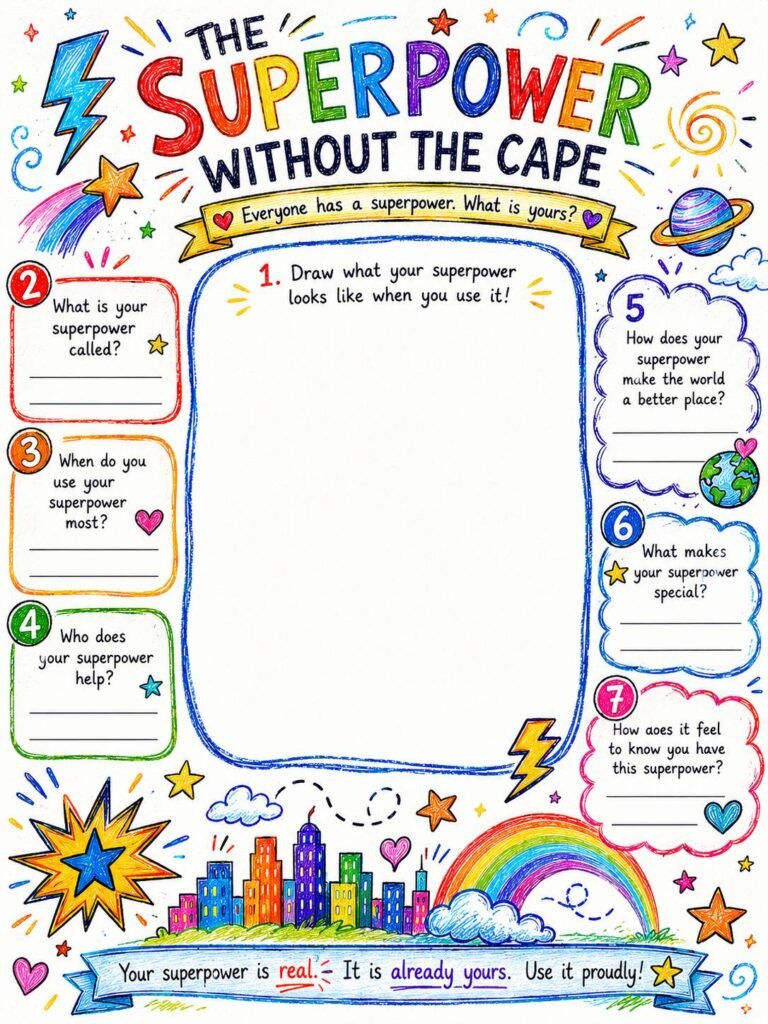
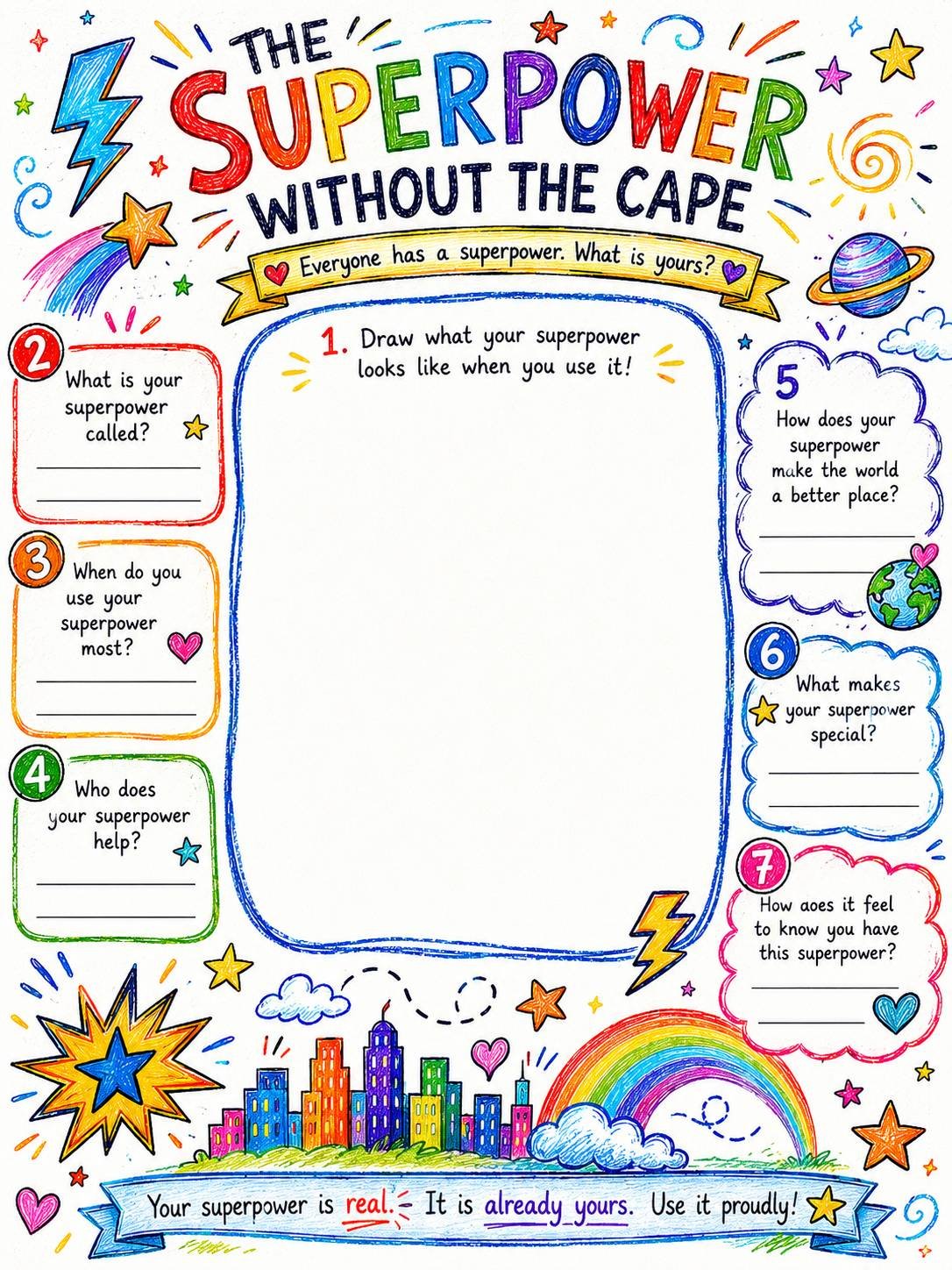
The worksheet below — The Superpower Without the Cape — is a free resource you can use with your child today. It is suitable for children aged approximately 6 to 12, and works equally well at home, in school, or in a therapeutic setting. It is joyful, visually rich, and built around a reframe that is both simple and therapeutically powerful: the qualities a child already possesses, presented as superpowers they were born with and have been using all along.
What makes this one of the most effective self-esteem activities for kids is the cumulative effect of moving through all seven elements. By the time a child has drawn the superpower, named it, identified when they use it, named who it helps, articulated why it matters, and described how it feels to have it — they have constructed a detailed, specific, personally meaningful account of a genuine quality they possess. That account is far harder to dismiss than a parent’s reassurance, because the child built it themselves.
How to Read the Superpower Choice
Before the how-to-use section, it is worth pausing here — because the superpower a child identifies is rarely arbitrary, and learning to receive it with the right kind of attention is one of the most clinically useful skills an attuned adult can develop.
A child who names their superpower as kindness or caring is telling you something about how they locate their worth — in relationship, in the experience of being needed and valued by others. A child who names it as being funny or making people laugh may be telling you something about the role humour plays in their social survival. A child who names it as being brave or never giving up may be speaking from a place of genuine hard-won experience — this quality has been tested and has held. And a child who struggles significantly to name a superpower at all, who sits with the question and finds nothing, is giving you some of the most important information of all: the internal evidence base has not yet accumulated enough to produce an answer, and the therapeutic work begins precisely there.
None of these observations should be offered directly to the child. The skill is not interpretation but curiosity — staying genuinely interested in the superpower without directing, evaluating, or supplementing it with your own suggestions before the child has had full time to find their own.
How to Use It
Place the worksheet in front of your child with a warm, open introduction — genuinely curious rather than instructional: “This is about something you already have — not something you need to get or earn. I wonder what yours is.” Then step back. Give the child time and space to think and draw without commentary or suggestion. The thinking phase — the pause before the pencil moves — is not hesitation. It is the child doing the most important work.
Once the drawing is complete and the prompts are answered, explore the superpower together:
- When was the last time you used this superpower without realising it?
- Is there someone in your life who has noticed this superpower in you?
- Has your superpower ever helped you get through something difficult?
- If you could teach this superpower to someone else, how would you explain it?
- What would you like to do with this superpower next?
The most important thing is not the answers. It is the quality of attention you bring to hearing them — and the message that attention carries: this quality you have identified is real, it matters, and it has been seen.
For Deeper Work: The Play Therapy Toolbox
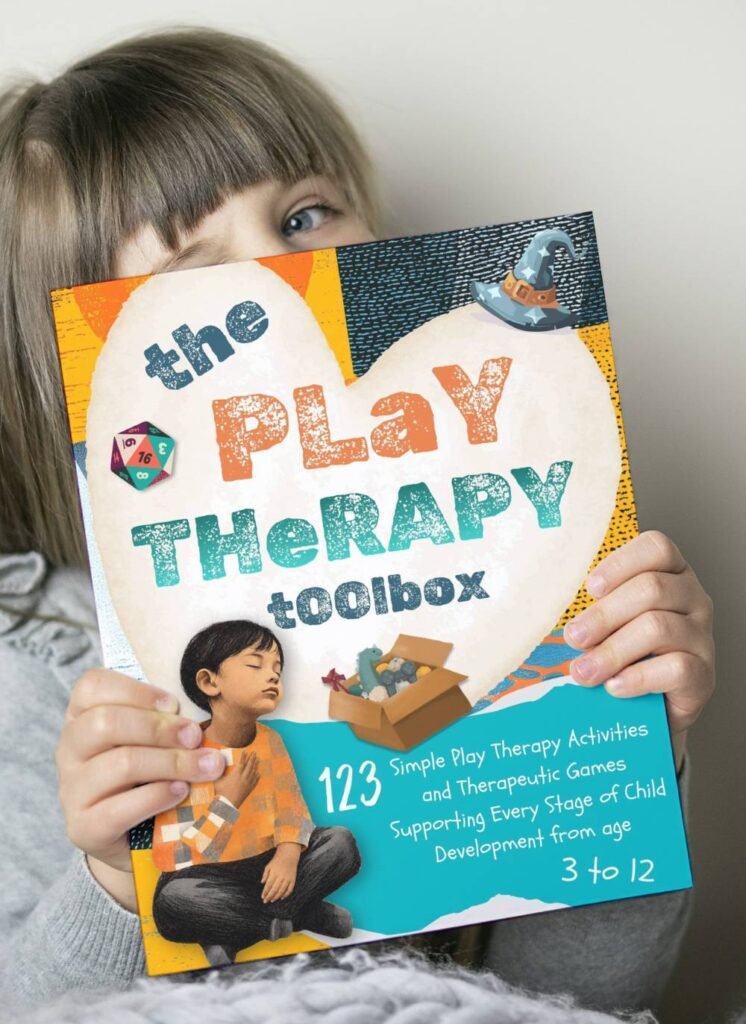
The Superpower Without the Cape is one example of the kind of strengths-based, identity-focused tool that sits at the heart of The Play Therapy Toolbox: 123 Simple Play Therapy Activities and Therapeutic Games Supporting Every Stage of Child Development from Age 3 to 12 — a book built around the understanding that children speak in a language adults often forget they once spoke fluently themselves.
The book contains 123 activities spanning role-play, enactment, fantasy storytelling, somatic exercises, and gamified experiences, alongside 75+ printable, downloadable, full-colour worksheets designed to support and extend each activity. Every activity comes with a therapeutic rationale grounded in peer-reviewed research, step-by-step guidance on how to conduct the session and what to say, questions to use with the child, and a parent guidance note written in the same warm, accessible language as this article.
The self-esteem and identity chapters cover the full range of presentations — perfectionism, shame, the inner critic, social comparison, body image, belonging, and the particular challenges of building a stable sense of self in a world that quantifies worth in likes, grades, and performance. Every activity is cross-referenced in a comprehensive annex by presenting condition, age group, and page number — so you can navigate directly to the right tool for the right child at the right moment, without searching.
Three Things Worth Knowing Before You Begin
The superpower must be the child’s own.
The most important thing an adult can do during this exercise is resist the urge to supply the answer. A child who is told their superpower is kindness by a parent, however lovingly, has received a piece of information. A child who identifies kindness themselves, draws it, names it, and articulates exactly how and when they use it, has built a piece of identity. The difference between those two experiences is the difference between being told and knowing. Self-esteem activities for kids work when the child is the author of the discovery.
Regular use builds more than crisis use.
Strengths-based exercises work best when they are an ordinary, unhurried part of a child’s emotional life — not only reached for when self-esteem is visibly low. A child who regularly identifies, articulates, and reflects on their own genuine qualities builds an internal evidence base that becomes increasingly resistant to the inevitable comparisons and disappointments of growing up. By the time something genuinely difficult arrives, the evidence is already there.
You are the most important tool in the room.
The worksheet identifies the superpower. You are the reason the child believes it is real. Children build self-esteem primarily through the eyes of the adults who matter most to them — through the experience of being seen specifically, valued consistently, and told, through small repeated acts of genuine attention, that what they bring to the world is worth bringing. Fill in your own worksheet. Show them yours. Let them see that even grown-ups are still discovering what their superpower is — and that the discovering never really stops.
Available Now for $5.99 — For a Limited Time
If this free collection of self-esteem activities for kids gave you a sense of what becomes possible when children are helped to see what is already there, The Play Therapy Toolbox gives you 123 more tools built on the same foundation. The ebook is available now on Amazon at $5.99 for a limited time — with immediate access to 123 activities and 75+ full-colour printable worksheets for children aged 3 to 12.
Play is not preparation for life. It is life — in its most honest, most essential, most healing form.

Disclaimer: This article is intended as an educational and supportive resource for parents, caregivers, educators, and mental health professionals. It is not intended to diagnose, treat, or replace professional therapeutic or medical care. If a child is experiencing significant emotional, behavioural, or developmental difficulties, please seek guidance from a qualified mental health professional.

Rostislava Buhleva-Simeonova is a psychologist, art and play therapist, and gamificator. She has worked with children, adults, and the elderly within various therapeutic programmes over the past eight years, all the while providing the much-needed playful twist that art and gamified experiences can bring to this sometimes uneasy setting. But it wasn’t until the birth of her daughter, Aurora, that this work took on an even deeper personal meaning. With her academic and real-life experience, honed through numerous trainings and sessions, she is currently authoring books and articles in the field of child psychology and development, offering expertise in art and play therapy to guide parents and caregivers, as well as professionals in the fields of social work and mental health, throughout various pivotal moments in children’s lives. Last but not least, all of her books have been “peer-reviewed” by her daughter, who testifies to the efficiency of these methods.