
Every parent has had that moment. Your child comes home from school quieter than usual, or flinches at something that seems small, or says yes to something they clearly did not want — and you are standing there, wishing you had given them better language for what just happened. Not because you have failed them. But because the language of boundaries — of what feels okay and what does not, of where I end and you begin — is not something children arrive with already formed. It is something they need to be taught, carefully and early, by the adults who love them most.
Personal boundaries are not a concept for older children or adolescents. They are a developmental necessity from the moment a child begins to navigate relationships beyond the immediate family — which is to say, from the moment they enter a nursery, a playground, a classroom, or any social world that does not automatically place their comfort and safety at the centre. A child who has never been helped to identify what makes them feel safe, comfortable, and okay — and what crosses that line — is a child who is being sent into the social world without one of the most important tools available to them.
A well-designed boundaries worksheet for kids does not lecture. It does not use clinical language or adult frameworks that sit outside a child’s developmental reach. It asks the child to draw — and in drawing, to discover what they already know.
Why Boundaries Are So Hard for Children to Name
Boundaries are difficult for children to articulate for the same reason that most important emotional experiences are difficult for children to articulate: the feeling comes first, long before the language does. A child who feels uncomfortable when someone stands too close, or who feels wrong when a rule is broken, or who goes quiet when something happens that they cannot quite name — that child is already experiencing their boundaries. They simply do not yet have the framework to understand what they are experiencing, or the language to communicate it to another person.
This matters enormously, and not only in the obvious safeguarding sense. A child who cannot identify what makes them comfortable and what crosses their line is also a child who struggles to assert themselves in peer relationships, to navigate conflict without either capitulating or exploding, to trust their own instincts in ambiguous social situations, and to develop the secure, boundaried sense of self that healthy relationships require at every age.
The research is consistent: children who receive explicit, age-appropriate teaching about personal boundaries demonstrate greater self-confidence, stronger peer relationships, more effective conflict resolution, and — critically — a greater likelihood of disclosing when something has happened that should not have. A boundaries worksheet for kids is not simply a therapeutic tool. In the right hands, used with warmth and consistency, it is a safeguarding one.
The Language Children Were Born Speaking
Children do not build understanding of abstract concepts like boundaries through explanation alone. They build it through doing — through drawing and making and naming, through the concrete, physical experience of putting something on paper and watching it take shape. Tell a child that it is important to know what makes them feel safe and comfortable, and they will nod and move on. Ask them to draw it inside a shield that is specifically theirs — and something different happens.
The shield is not arbitrary. It is one of the oldest and most universally understood symbols of protection available to the human imagination. Every child who has ever played a game involving heroes and villains already knows, at some level, what a shield is for. It keeps the good things in and the threatening things out. It belongs to the person who carries it. And it is made — decorated, personalised, filled with meaning — by the person it protects.
A boundaries worksheet for kids built around the shield frame honours this. It does not ask the child to produce the right answer. It asks them to design something that is entirely theirs — and in designing it, to discover what they already know about what keeps them safe.
Free Boundaries Worksheet for Kids: My Personal Boundaries Shield
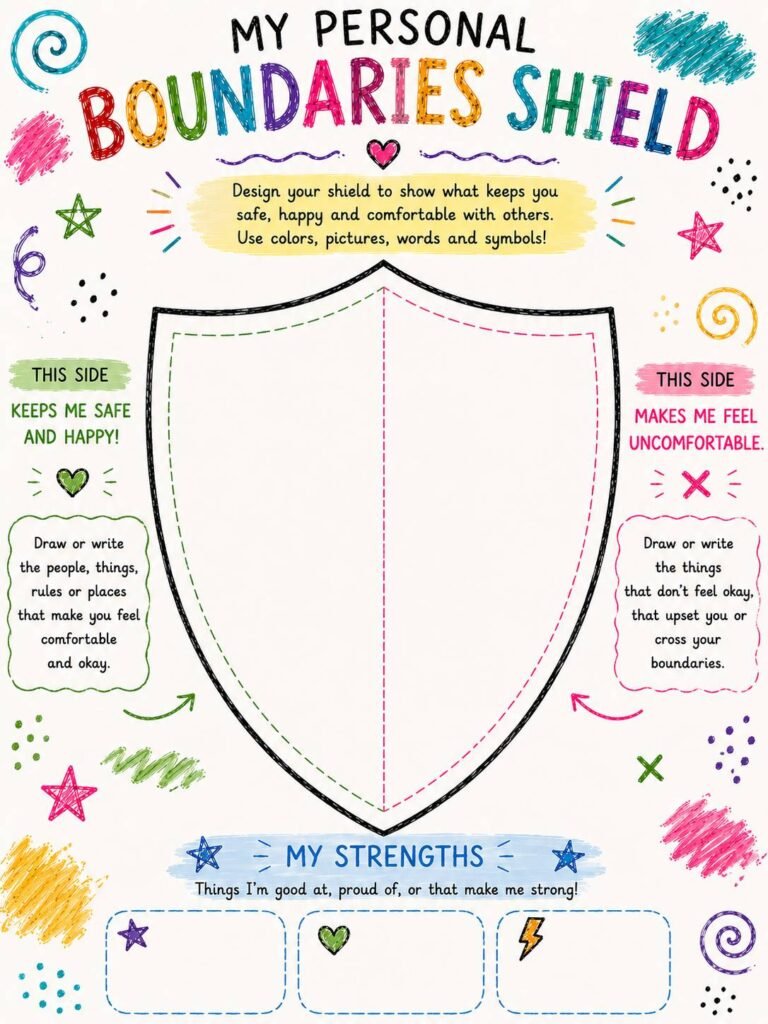
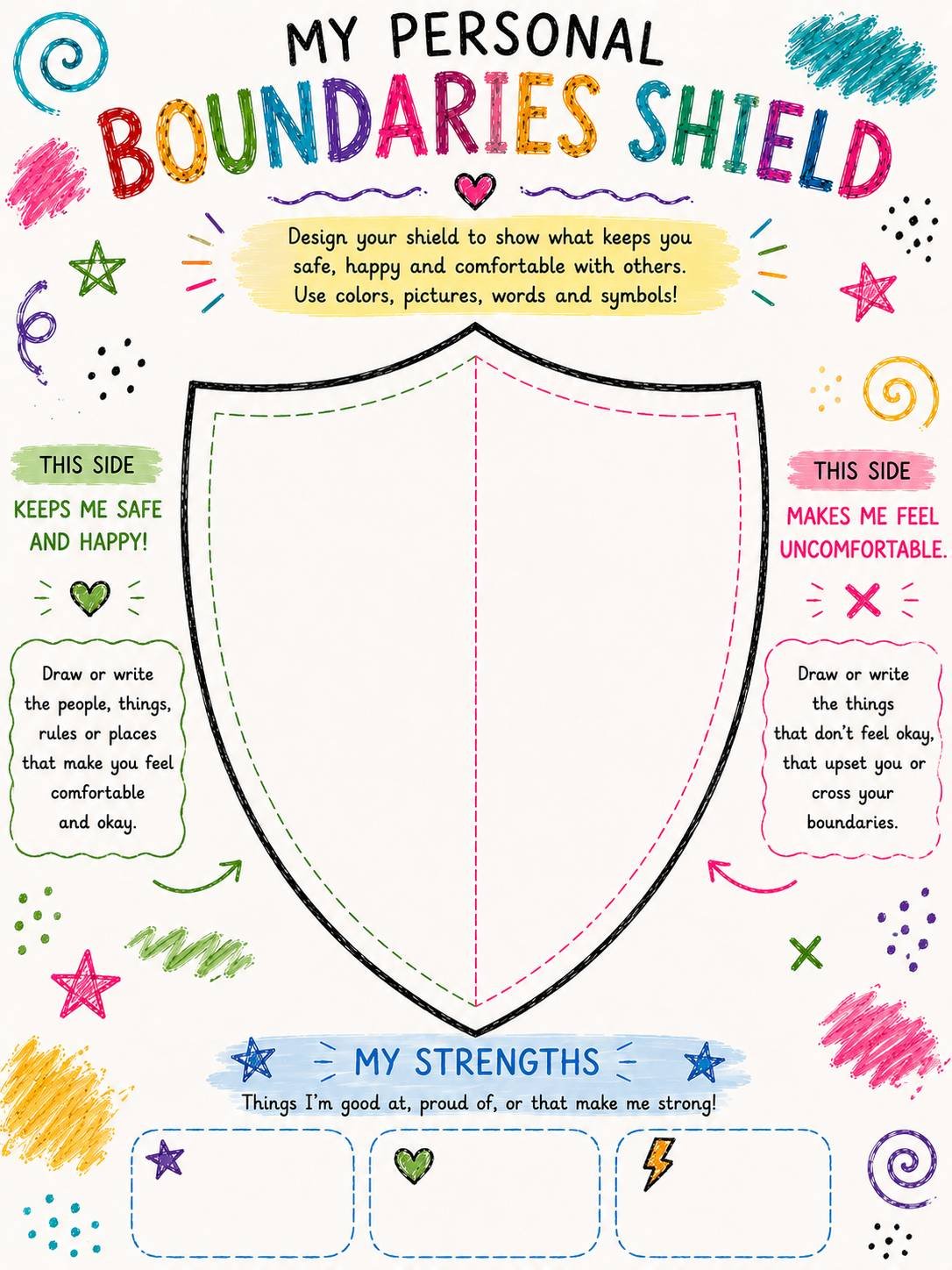
The worksheet below — My Personal Boundaries Shield — is a free resource you can use with your child today. It is suitable for children aged approximately 6 to 12, and works equally well at home, in school, or in a therapeutic or safeguarding setting. It is colourful, visually inviting, and structured around a frame that children grasp immediately and engage with instinctively: a shield that is theirs to design and theirs to carry.
The shield is divided down the centre into two halves, each one approaching the concept of boundaries from a complementary angle. The left side — marked in green — is for the people, things, rules, and places that make the child feel comfortable, safe, and okay. The right side — marked in pink — is for the things that do not feel okay, that upset them, or that cross their boundaries. At the bottom, three boxes invite the child to name their strengths: the things they are good at, proud of, or that make them feel strong.
Together, these three elements trace the full arc of what a child needs to understand about personal boundaries: what to move toward, what to move away from, and what internal resources they already possess for navigating the space between the two.
What makes this one of the most effective boundaries worksheets for kids is the structure of the shield itself. The two halves give equal visual weight to both the positive and the difficult — neither is larger, neither is more prominent. The child is not being asked to focus only on what is wrong or only on what is right. They are being asked to hold both, which is exactly what navigating boundaries in real life requires.
How to Use It
Place the worksheet in front of your child with a warm, simple introduction — open enough to invite without directing: “This is your very own shield — and you get to design it. On this side, we put everything that makes you feel safe and okay. On this side, we put the things that don’t feel okay. And down here, we write what makes you strong.”
Then step back. Give the child time and space to draw and write without commentary or suggestion. Some children will fill both sides quickly and with confidence. Others will spend a long time on one half and barely touch the other — and both responses carry information worth holding gently. You can prompt gently with open-ended questions, but do not attempt to provide the answers for them.
Once the shield is complete, explore it together with open, unhurried questions:
- Is there something on the safe side that surprised you — something you hadn’t thought about before?
- Is there anything on the uncomfortable side that has actually happened to you?
- When something crosses your boundary, what do you usually do?
- Is there a grown-up you would feel comfortable telling if something on the uncomfortable side happened?
- Which of your strengths do you think helps you most when something feels wrong?
That third and fourth question deserve particular care and time. A child who can name what they do when a boundary is crossed — and who they would go to — has two of the most important safeguarding capacities available to any child navigating the social world. Receive whatever they offer without alarm and without rushing to fix it. The most important thing is not the answers. It is the quality of attention you bring to hearing them.
A Note on Interpretation
The shield a child designs can offer genuinely valuable information — and it must be received with care and a clear awareness of the limits of untrained interpretation. Observe what appears on each side without drawing conclusions: notice whether the uncomfortable side is sparse or full, whether specific people or situations appear, whether the child draws something and then covers it or crosses it out.
These are observations, not diagnoses. A full uncomfortable side does not mean a child is in crisis. It may mean they have a well-developed awareness of what does not feel right — which is, in itself, a protective capacity. The child is always the authority on what their shield means. If something appears that gives genuine cause for concern, the appropriate response is to seek professional support rather than to attempt to address it through the worksheet alone.
Here’s the replacement section:
For Deeper Work: 101 Art Therapy Exercises for Children
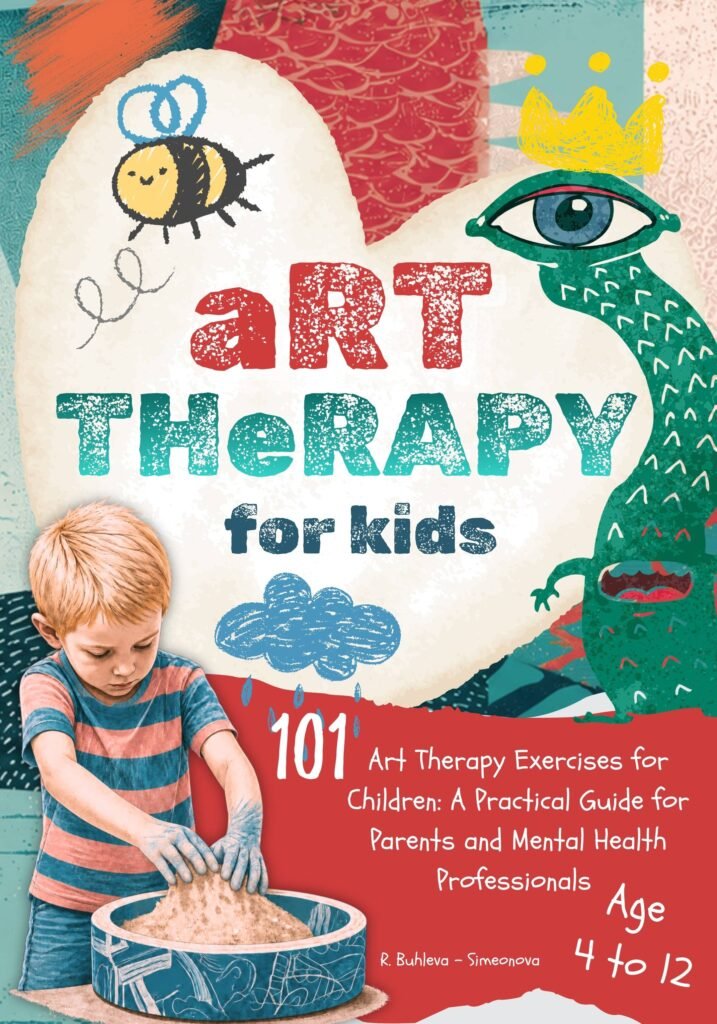
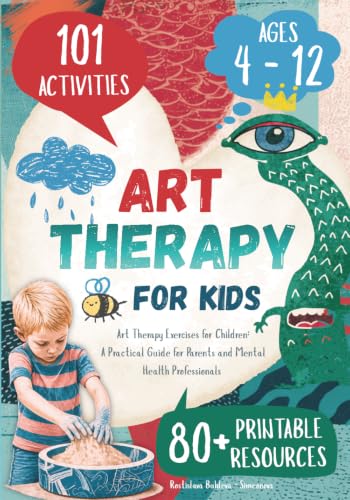
My Personal Boundaries Shield is one example of the kind of identity-centred, safety-focused tool that sits at the heart of 101 Art Therapy Exercises for Children: A Practical Guide for Parents and Mental Health Professionals — a book built around the understanding that children speak in a language adults often forget they once spoke fluently themselves.
The book contains 101 art therapy exercises structured across three age groups — 4 to 6, 7 to 9, and 10 to 12 — each activity informed by validated research demonstrating how creative engagement alters brain physiology, strengthens neural flexibility, and enhances emotional regulation. Every session comes with a clear therapeutic rationale, step-by-step guidance, reflection questions, and guidance on how to observe and respond to what emerges — without diagnosis, without pressure, and without losing sight of the child as the author of their own experience.
The book addresses the full range of emotional, relational, and identity-related presentations children bring — including personal boundaries, body safety, self-esteem, peer relationships, conflict, and the particular challenge of helping a child develop a confident, boundaried sense of self in an increasingly complex social world. Many exercises invite the caregiver to participate alongside the child — because shared creative experience is itself one of the most reliable builders of trust, attunement, and the kind of open communication that makes conversations about boundaries possible in the first place.
Disclaimer: This article is intended as an educational and supportive resource for parents, caregivers, educators, and mental health professionals. It is not intended to diagnose, treat, or replace professional therapeutic or medical care. If a child is experiencing significant emotional, behavioural, or developmental difficulties, please seek guidance from a qualified mental health professional.
Rostislava Buhleva-Simeonova is a psychologist, art therapist, and gamificator. She has worked with children, adults, and the elderly within various therapeutic programmes over the past eight years, all the while providing the much-needed playful twist that art and gamified experiences can bring to this sometimes uneasy setting. But it wasn’t until the birth of her daughter, Aurora, that this work took on an even deeper personal meaning. With her academic and real-life experience, honed through numerous trainings and sessions, she is currently authoring books and articles in the field of child psychology and development, offering expertise in art and play therapy to guide parents and caregivers, as well as professionals in the fields of social work and mental health, throughout various pivotal moments in children’s lives. Last but not least, all of her books have been “peer-reviewed” by her daughter, who testifies to the efficiency of these methods.