
Every parent has watched it happen. A child who will not talk about what is bothering them sits down with a piece of paper and begins to draw — and within minutes, a story emerges. Not the story you asked for. Not the story they would have told if you had pressed. But a truer story than either of those, told in the only language that was available to them in that moment: the language of image, symbol, and imagination.
Children have always used story to make sense of their lives. Long before they have words for what frightens them or what they hope for or what they are quietly working through, they have narrative — the instinctive human capacity to take the raw material of experience and give it shape, sequence, and meaning. A beginning. A path. Challenges along the way. And somewhere at the end, treasure.
This is not metaphor. It is the structure of every story a child has ever loved — and it is also, with remarkable precision, the structure of a childhood. And the best storytelling activities for kids know how to use that structure therapeutically, without the child ever feeling like therapy is what is happening.
Why Story Is the Most Natural Therapeutic Medium Available to Children
Narrative therapy, developed by Michael White and David Epston, is built on a single foundational insight: the stories people tell about their lives shape their sense of identity, possibility, and resilience. When a child’s dominant story is one of being the problem, the difficult one, the one who cannot cope — that story becomes a lens through which every new experience is filtered and interpreted. Therapeutic storytelling introduces alternative narratives — not by overwriting the child’s experience, but by finding within it evidence of strength, resourcefulness, and survival they may not have noticed.
Ann Cattanach called this the ‘as if’ space — the protective frame of story and imaginative play that allows a child to approach what is painful without being overwhelmed, to try different endings, and to step out of the story whenever needed simply by putting down the pencil. For children who find direct discussion too exposing, story offers a way in. For children who love narrative, it is often the most energising and natural therapeutic medium available.
What the best storytelling activities for kids understand is that the story a child tells about an imaginary adventure is rarely entirely separate from the story they are living. The challenges they place on the map, the treasure they choose at the end, the path they draw between the two — all of it carries information about how they see themselves in relation to difficulty, possibility, and their own capacity to find their way through.
The Language Children Were Born Speaking
Children do not process their inner world the way adults do. They do not sit with a difficulty, examine it, and arrive at a considered conclusion through language alone. They give it a character, a setting, a plot, and send it on a journey. The developing brain processes emotional experience through the right hemisphere long before the left hemisphere’s language centres are mature enough to put it into words. Story bypasses the need for that translation entirely.
This is why storytelling activities for kids built around drawing and visual narrative are so consistently effective. They do not ask the child to be vulnerable. They ask them to be imaginative. And in being imaginative, children reveal — through the starting point they choose, the landmarks they draw, the challenges they place along the path, and the treasure they decide is waiting at the end — far more than direct questioning could ever produce.
The map is not a distraction from the child’s real experience. It is the most direct route into it.
Free Storytelling Activities for Kids: My Secret Treasure Map
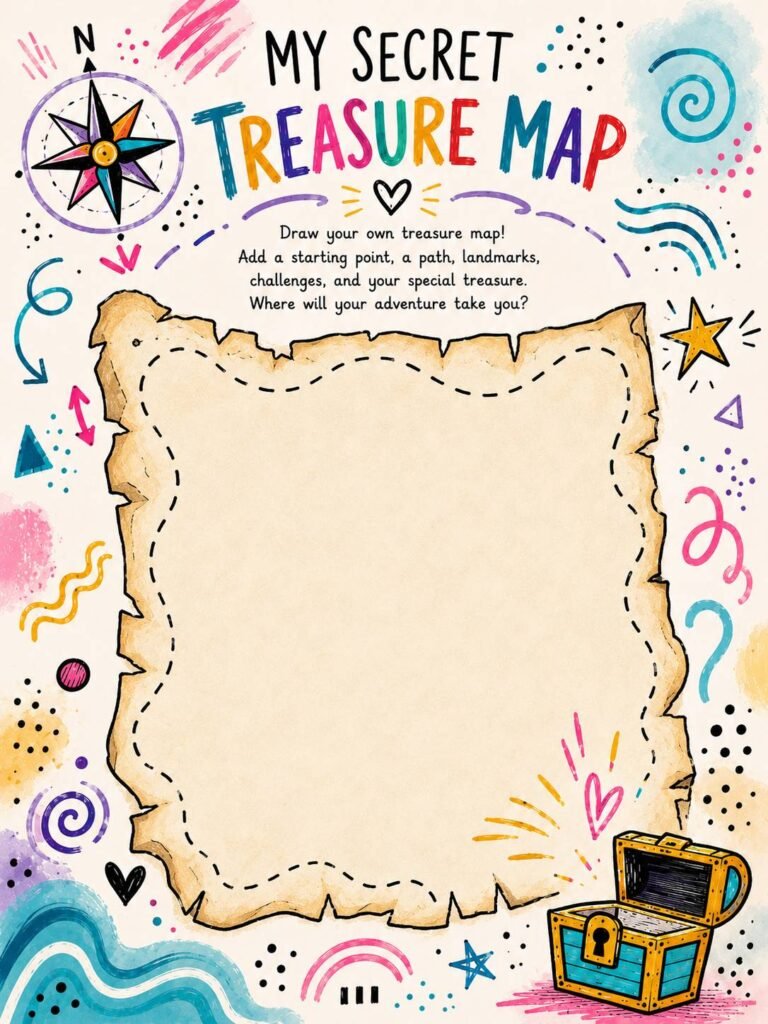
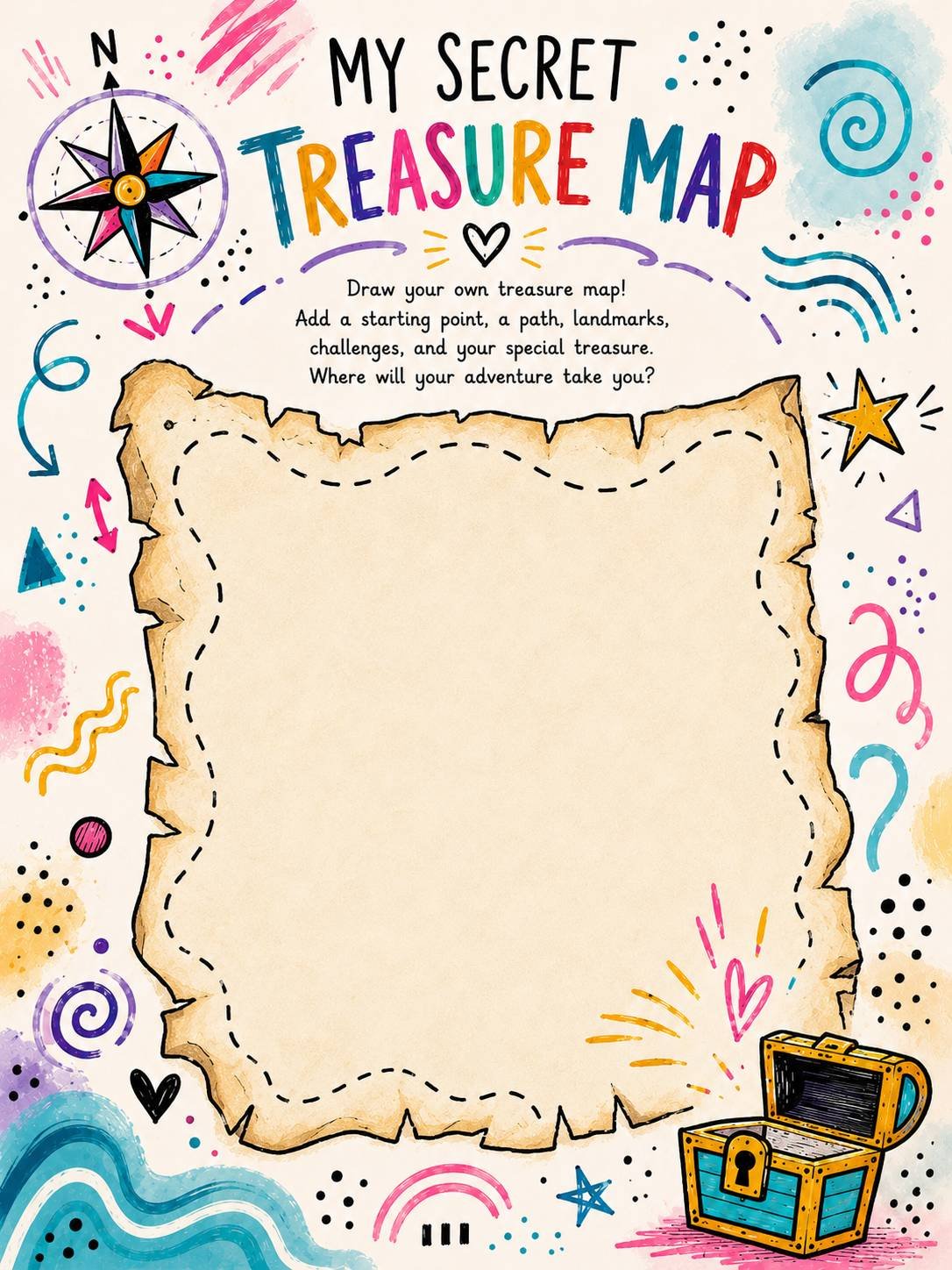
The worksheet below — My Secret Treasure Map — is a free resource you can use with your child today. It is suitable for children aged approximately 5 to 12, and works equally well at home, in school, or in a therapeutic setting. It is richly illustrated, immediately compelling, and built around one of the oldest and most universally resonant storytelling frames available: the treasure map.
The premise is beautifully open. A large, aged parchment — weathered at the edges, warm in colour, surrounded by a compass, a treasure chest, and the markers of adventure — waits to be filled. The instruction is simple and entirely without constraint: draw your own treasure map. Add a starting point, a path, landmarks, challenges, and your special treasure. Where will your adventure take you?
That is all. The child decides everything. The starting point — which is always, at some level, where they are right now. The path — which is always, at some level, how they imagine the journey ahead. The landmarks — the things that matter, the places of safety, the markers that tell them where they are. The challenges — which are always, at some level, the real ones. And the treasure — which is always, at some level, what they are reaching toward.
What makes this one of the most effective storytelling activities for kids is precisely the freedom the open parchment offers. There are no categories, no prompts, no scaffolding beyond the frame itself and the permission it carries. The child is not being guided toward the right story. They are being given the materials to tell their own — and trusted, entirely, to know what belongs on the map.
How to Read the Map
Before the how-to-use section, it is worth pausing here — because the map a child draws is rarely arbitrary, and learning to receive it with the right kind of attention is one of the most useful skills an attuned adult can develop.
The starting point a child chooses tells you something about how they currently experience their own position — whether they begin from somewhere familiar and safe or from somewhere already in the middle of difficulty. The path tells you something about how they imagine progress: is it direct or winding, clear or uncertain, crowded with obstacles or relatively open? The challenges they place along the route — the dragons, the storms, the dark forests, the locked doors — are worth holding with particular care, because they are often the most honest thing on the map. And the treasure at the end tells you what the child is reaching toward: safety, belonging, abundance, power, connection, or something entirely their own that you might not have predicted.
None of these observations should be offered directly to the child. The skill is not interpretation but curiosity — staying genuinely interested in the map without collapsing the story by bringing it too close to reality. The map is a door. The adult’s job is simply to stand at the threshold and ask, with warmth and without agenda, what is on the other side.
How to Use It
Place the worksheet in front of your child with a warm, simple introduction — open and genuinely curious, without direction or suggestion: “This is your very own treasure map — and you get to draw everything on it. A starting point, a path, whatever landmarks and challenges you want, and your special treasure at the end. Where will your adventure take you?” Then step back entirely. Give the child time and space to draw without commentary or suggestion. The drawing phase is not a warm-up to the real activity — it is the real activity. You can prompt with gentle open-ended questions but refrain as best as you can from influencing the process with your own ideas of what should or should not be placed on the map.
Once the map is complete, explore it together with open, unhurried questions:
- Tell me about your map — where does the adventure begin?
- What are the landmarks along the way — what makes them important?
- Which challenge was the hardest to get past?
- How did the adventurer find their way through it?
- What is the treasure — and what makes it worth the journey?
- Is there anything on this map that reminds you of something in your own life?
That last question is offered gently, and never pressed. Some children will answer it immediately and with relief. Others will stay safely inside the story throughout — and both responses are entirely right. The map is a door, not a confession. The most important thing is not the answers. It is the quality of attention you bring to hearing them.
For Deeper Work: 101 Art Therapy Exercises for Children
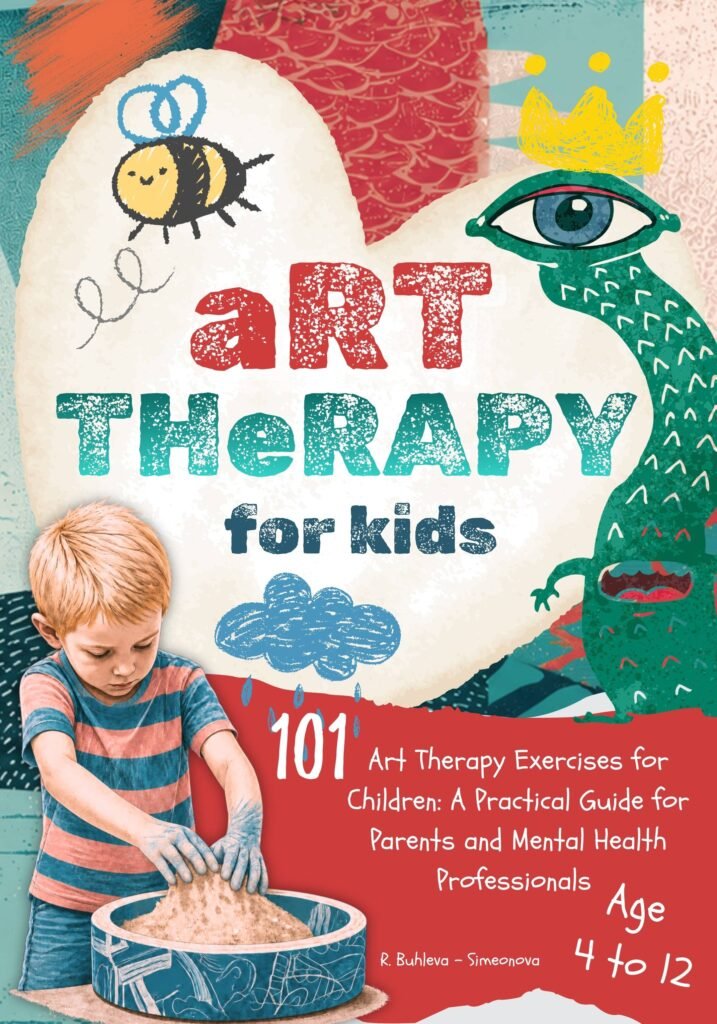
My Secret Treasure Map is one example of the kind of narrative, imaginative, identity-centred tool that sits at the heart of 101 Art Therapy Exercises for Children: A Practical Guide for Parents and Mental Health Professionals — a book built around the understanding that healing, growth, and genuine self-understanding often begin not with words, but with a simple mark on paper.
The book contains 101 art therapy exercises structured across three age groups — 4 to 6, 7 to 9, and 10 to 12 — each activity informed by validated research demonstrating how creative engagement alters brain physiology, strengthens neural flexibility, and enhances emotional regulation. Every session comes with a clear therapeutic rationale, step-by-step guidance, reflection questions, and guidance on how to observe and respond to what emerges — without diagnosis, without pressure, and without losing sight of the child as the author of their own experience.
Beyond emotional regulation, the book places equal emphasis on cognitive development, imagination, and critical thinking — because storytelling activities for kids are not only therapeutic tools. They are developmental ones: building memory, attention, flexible thinking, and the capacity to hold complexity, ambiguity, and multiple possible endings simultaneously. The exercises invite caregivers to participate alongside children — because shared storytelling is itself one of the most reliable builders of trust, attunement, and the kind of open communication that makes the deeper conversations possible.
Three Things Worth Knowing Before You Begin
The story the child tells is always worth taking seriously.
The best storytelling activities for kids work from this position: the adventure on the map is not a fantasy separate from the child’s real experience. It is a version of it — filtered through imagination, given the protective distance of story, and offered to the adult as something the child is willing to share. Receive it as such. The dragon on the path may be entirely imaginary. It may not be. Either way, it deserves the same quality of curious, unhurried attention.
Regular use builds more than crisis use.
Narrative and storytelling exercises work best when they are an ordinary, consistent part of a child’s creative and emotional life — not only reached for when something is visibly wrong. A child who draws maps regularly, who tells stories as a matter of course, who has repeated experience of being listened to with genuine interest, builds a narrative confidence that will be there and ready when something genuinely difficult needs to be mapped.
You are the most important tool in the room.
The map gives the story a place to live. You are the reason the child is willing to tell it. Children engage most honestly with storytelling activities when they are in the company of an attuned adult who has demonstrated, through small repeated moments of genuine attention, that whatever appears on the map will be received with interest rather than alarm. Draw your own map. Show them yours. Let them see that even grown-ups are still somewhere on the path — still navigating challenges, still moving toward treasure, still finding their way.
Ready to Go Further?
If this free collection of storytelling activities for kids gave you a sense of what becomes possible when children are given the materials to tell their own story, 101 Art Therapy Exercises for Children: A Practical Guide for Parents and Mental Health Professionals gives you 101 more tools built on the same foundation — grounded in neuroscience, informed by developmental research, and written for every adult who has ever sat beside a child and wished they had something more to offer than words.
Disclaimer: This article is intended as an educational and supportive resource for parents, caregivers, educators, and mental health professionals. It is not intended to diagnose, treat, or replace professional therapeutic or medical care. If a child is experiencing significant emotional, behavioural, or developmental difficulties, please seek guidance from a qualified mental health professional.

Rostislava Buhleva-Simeonova is a psychologist, art therapist, and gamificator. She has worked with children, adults, and the elderly within various therapeutic programmes over the past eight years, all the while providing the much-needed playful twist that art and gamified experiences can bring to this sometimes uneasy setting. But it wasn’t until the birth of her daughter, Aurora, that this work took on an even deeper personal meaning. With her academic and real-life experience, honed through numerous trainings and sessions, she is currently authoring books and articles in the field of child psychology and development, offering expertise in art and play therapy to guide parents and caregivers, as well as professionals in the fields of social work and mental health, throughout various pivotal moments in children’s lives. Last but not least, all of her books have been “peer-reviewed” by her daughter, who testifies to the efficiency of these methods.