
Every parent has heard it — the cry in the middle of the night, the small figure appearing at the bedroom door, the child who cannot quite say what they saw but cannot quite shake it off either. You bring them back to bed. You check under it. You leave the light on, or the door open, or both. You say the reassuring things, and you mean them completely, and your child nods and tries to believe them — and three nights later, the same dream comes back.
Recurring nightmares are one of the most common and least addressed sleep difficulties in childhood. They are also one of the most misunderstood. The instinct — entirely natural, entirely loving — is to reassure the child that it was not real, that it cannot hurt them, that everything is safe now. And all of that is true. But it does not reach the place where the nightmare actually lives, which is not in the child’s rational assessment of reality but in the body, the nervous system, and the particular emotional territory the dream has staked out and keeps returning to.
Helping kids with nightmares requires something different from reassurance. It requires meeting the nightmare on its own terms — inside the imagination, inside the story, inside the child’s own creative capacity.
What Recurring Nightmares Are Actually Doing
A nightmare is not a malfunction. It is the sleeping brain doing exactly what the waking brain does during the day: processing emotional experience, scanning for unresolved threat, and attempting to find a resolution for something that has not yet found one. The difference is that the sleeping brain does this without the moderating influence of the prefrontal cortex — the part responsible for logic, reality-testing, and the ability to remind oneself that it is only a dream. What remains is the limbic system working at full capacity, and the limbic system thinks in image, sensation, and narrative rather than in reassurance and rational argument.
This is why verbal reassurance, however warm and however sincere, so often fails to reach a child who is frightened by a recurring dream. The reassurance is processed by the part of the brain that was not running the nightmare. The nightmare lives somewhere else — in the body, in the felt sense of threat, in the image that keeps returning because it has not yet been given a different ending.
Recurring nightmares in particular are worth taking seriously, because they are almost always pointing toward something — an unresolved anxiety, a difficult experience, a fear that has not yet found adequate expression during the day. The dream keeps coming back because the emotional material it is processing has not yet been sufficiently worked through. And the most effective way to help is not to dismiss the dream but to engage with it — carefully, playfully, and with the full creative resources of the child’s own imagination.
Why the Imagination Is the Right Tool
The therapeutic approach that has the strongest evidence base for helping kids with nightmares is image rehearsal therapy — a technique developed initially for adults with trauma-related nightmares that has since been adapted, with strong results, for children. The core principle is elegant and counter-intuitive: rather than avoiding the nightmare, the child re-enters it voluntarily during the day, in a safe and supported context, and changes one thing about it. Not everything. Just one thing. And that one change — chosen by the child, applied by the child, drawn or written by the child — is enough, in most cases, to alter the dream’s trajectory when it next arrives.
This works because the brain does not sharply distinguish between a vividly imagined experience and a real one at the level of emotional processing. When a child draws their nightmare, names it, and then draws a change onto the picture — making the monster smaller, giving the running child wings, changing the ending — the brain registers this new version as a real update to the emotional file. The nightmare has been processed. It has been given a different ending. And the next time it arrives, it is more likely to follow the new version than the old one.
This is the neuroscience behind helping kids with nightmares through creative, imaginative engagement. And it is the foundation on which the Nightmare Catcher worksheet is built.
Free Resource for Helping Kids With Nightmares: The Nightmare Catcher
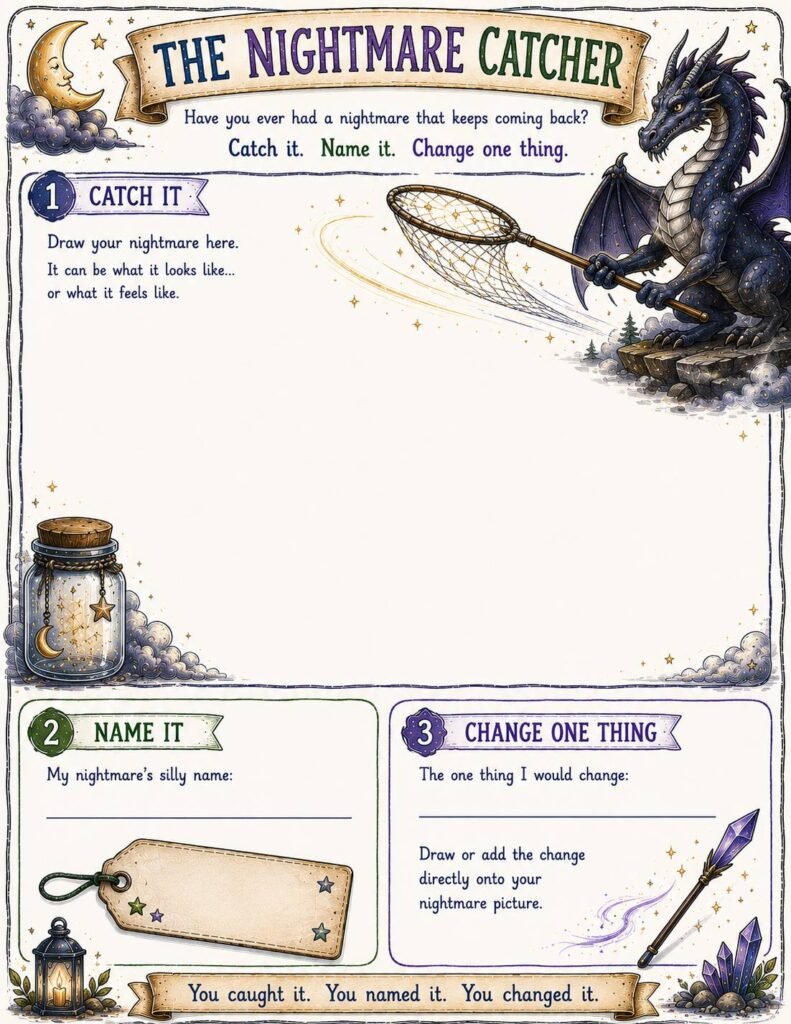
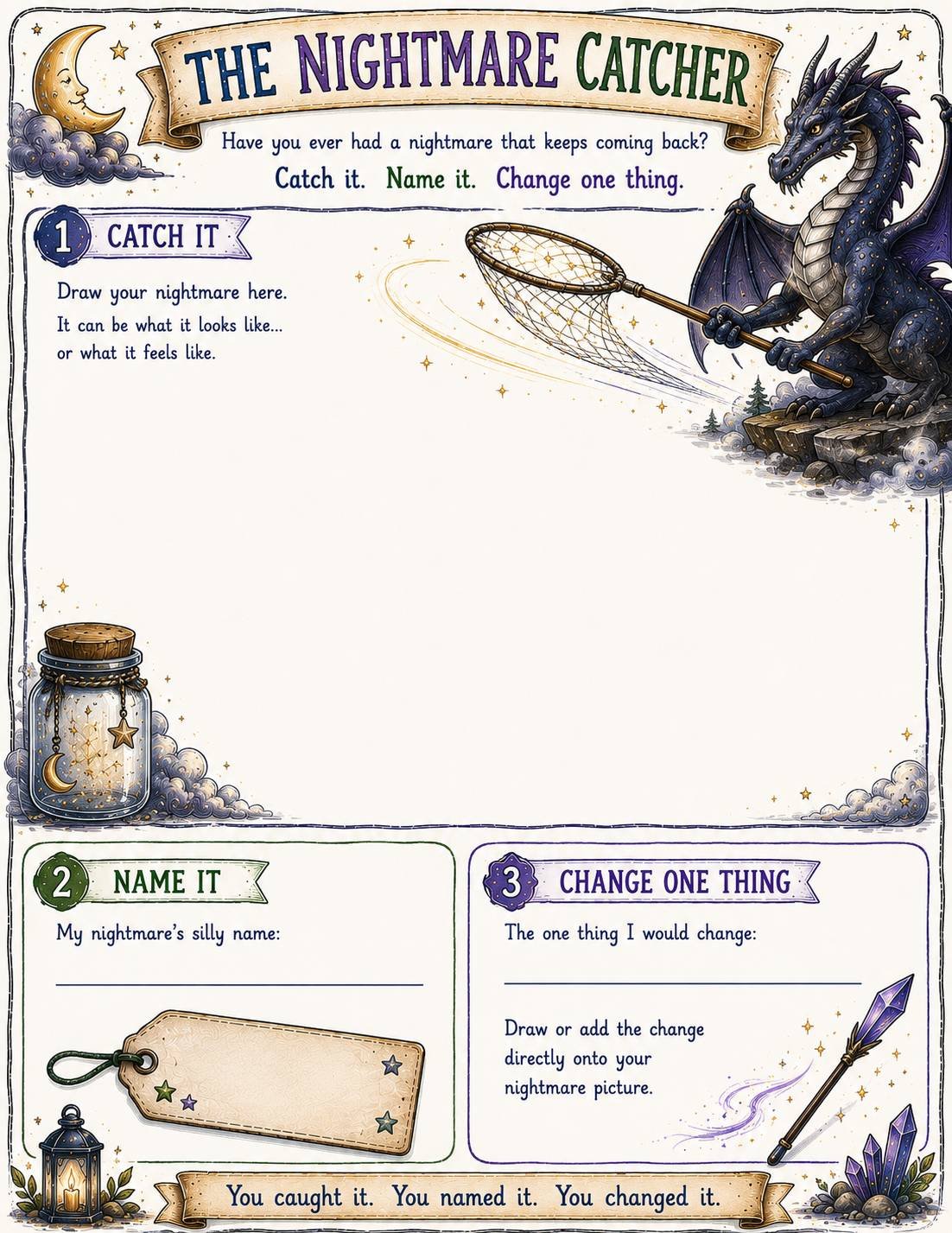
The worksheet below — The Nightmare Catcher — is a free resource you can use with your child today. It is suitable for children aged approximately 6 to 12, and works equally well at home or in a therapeutic setting. It is richly illustrated — a magnificent dragon wielding a golden catching net against a moonlit sky — and built around three steps so simple, so clear, and so immediately actionable that a child can work through them independently once the frame has been introduced.
The three steps are stated at the very top of the worksheet, in language that is both direct and slightly magical: catch it. Name it. Change one thing.
Step one — Catch It — invites the child to draw the nightmare in a large open space. The instruction is deliberately open: it can be what it looks like, or what it feels like. Both are equally valid. Both produce equally useful therapeutic material. The child who draws a literal monster is doing the same work as the child who fills the space with dark colours and jagged lines — both are giving the nightmare a visible, externalised form that can be looked at from the outside rather than endured from within.
Step two — Name It — asks the child for the nightmare’s silly name. This single instruction is doing something quietly significant. A silly name is not a dismissive name — it does not tell the child their fear is trivial or unimportant. What it does is shift the power relationship between the child and the dream. The child is naming it. The child has that authority. And a silly name, specifically, introduces a small but meaningful dose of humour and lightness into a territory that has until now been entirely controlled by fear. A nightmare called something ridiculous is a nightmare that is slightly less frightening than it was before it had a name at all.
Step three — Change One Thing — is the therapeutic heart of the exercise. The child identifies one thing they would change about the nightmare — and then draws or adds that change directly onto the nightmare picture. Not a new picture. The same one. The change is applied to the dream itself, visually and concretely, in the child’s own hand. This is image rehearsal therapy in its most accessible, most child-friendly, most immediately usable form.
And at the bottom, the closing line delivers the most important message of the entire exercise in six words: you caught it. You named it. You changed it.
How to Use It
Introduce the worksheet during the day — not at bedtime, and not immediately after a nightmare, when the nervous system is still activated and the capacity for playful, creative engagement is lowest. A calm afternoon moment works best. Sit with your child and introduce it with warmth and genuine curiosity: “This is a nightmare catcher — and it works like this. We catch the nightmare by drawing it. We give it a silly name so it knows we are in charge. And then we change one thing about it. Just one. Because one change is enough.”
Give the child time and space to draw without suggestion or direction. The catching phase — the drawing — should be completed before any questions are asked. Once the nightmare has a visible form on the page, move to the naming together: “What is the silliest name you can think of for this nightmare?” Accept whatever they offer with genuine amusement and warmth. Write it on the tag.
Then the change. This is where the child’s own imagination does its most important work — and where the adult’s job is to be curious rather than directive: “If you could change one thing about this nightmare — just one — what would it be?” Let the child decide. Accept whatever they choose without evaluation. Let them draw it directly onto the nightmare picture.
Once all three steps are complete, explore the worksheet together:
- How does the nightmare look now that it has been caught?
- Does the silly name make it feel any different?
- Why did you choose that particular change?
- How do you think the nightmare will be different now that you have changed it?
- What would you like to do with this picture — keep it, store it, or let it go?
That last question carries real therapeutic weight. The child who chooses to let the picture go is making an active, agentic choice about their relationship to the nightmare. The child who chooses to keep it is building a record of their own capacity to face something frightening and change it. Both are entirely right.
The most important thing is not the answers. It is the quality of attention you bring to hearing them.
For Deeper Work: The Play Therapy Toolbox
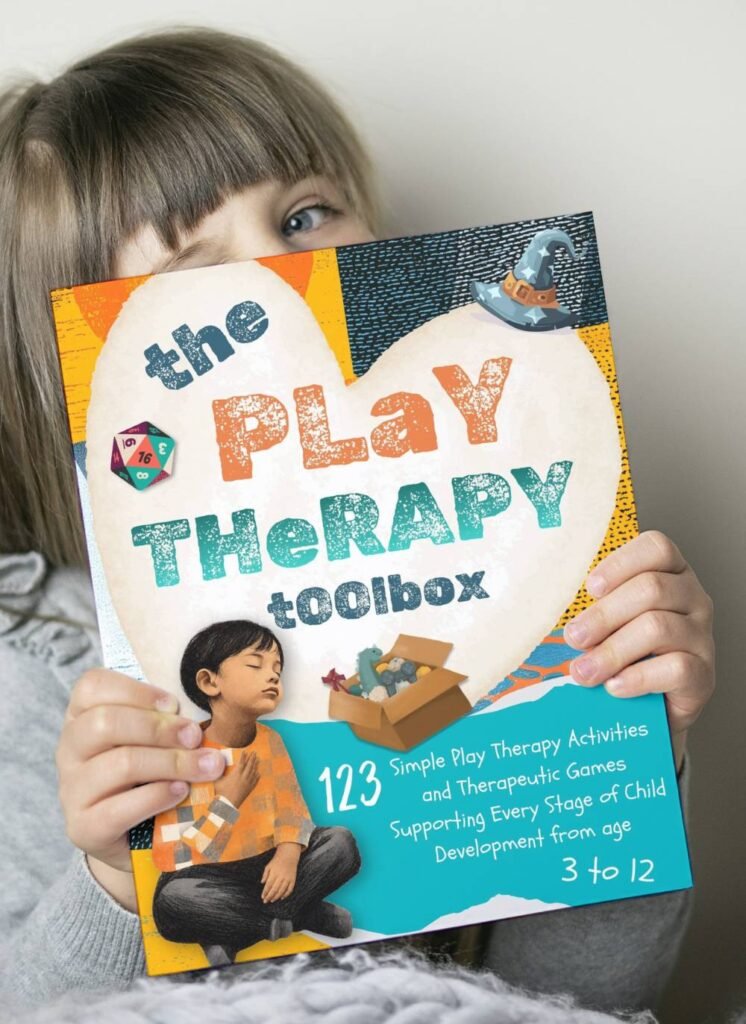
The Nightmare Catcher is one example of the kind of imagination-based, trauma-informed, anxiety-focused tool that sits at the heart of The Play Therapy Toolbox: 123 Simple Play Therapy Activities and Therapeutic Games Supporting Every Stage of Child Development from Age 3 to 12 — a book built around the understanding that children speak in a language adults often forget they once spoke fluently themselves.
The book contains 123 activities spanning role-play, enactment, fantasy storytelling, somatic exercises, and gamified experiences, alongside 75+ printable, downloadable, full-colour worksheets designed to support and extend each activity. Every activity comes with a therapeutic rationale grounded in peer-reviewed research, step-by-step guidance on how to conduct the session and what to say, questions to use with the child, and a parent guidance note written in the same warm, accessible language as this article.
The anxiety, trauma, and sleep-related chapters address the full range of nightmare presentations children bring — recurring nightmares, fear of the dark, sleep anxiety, trauma-related dreams, and the particular challenge of helping a child develop a sense of safety and agency in the one environment where every adult’s capacity to protect them is most limited: the sleeping mind. Every activity is cross-referenced in a comprehensive annex by presenting condition, age group, and page number — so you can navigate directly to the right tool for the right child at the right moment, without searching.
Three Things Worth Knowing Before You Begin
Meet the nightmare inside the imagination — not outside it.
The most common error in helping kids with nightmares is attempting to resolve the fear through rational reassurance delivered in the waking world. It was not real. It cannot hurt you. Everything is safe. All of this is true — and none of it reaches the place where the nightmare lives. The nightmare lives in the imagination. The most effective response meets it there — inside the story, inside the image, inside the child’s own creative capacity to catch it and change it.
One change is enough.
The instruction to change one thing is not a limitation. It is a precision. A child asked to rewrite the entire nightmare may feel overwhelmed by the scope of the task — and may inadvertently reinforce their sense that the nightmare is too large and too powerful to manage. A child asked to change one thing has a task that is specific, achievable, and entirely within their capacity. One change is enough to alter the emotional file. One change is enough to give the dream a different direction. One change, chosen freely by the child and applied in their own hand, is one of the most powerful therapeutic acts available to any child helping kids with nightmares.
You are the most important tool in the room.
Children engage with their most frightening material most readily within the safety of a warm, regulated, genuinely curious relationship with a trusted adult — one who sits beside them in the daytime and helps them discover, repeatedly and specifically, that what visits in the night can be faced in the light. Draw your own nightmare. Give it a silly name. Change one thing about it. Let them see how the process works and that adults too have their own nightmares to face.
Available Now for $5.99 — For a Limited Time
If this free resource for helping kids with nightmares gave you a sense of what becomes possible when children are given the tools to face what frightens them on their own terms, The Play Therapy Toolbox gives you 123 more tools built on the same foundation. The ebook is available now on Amazon at $5.99 for a limited time — with immediate access to 123 activities and 75+ full-colour printable worksheets for children aged 3 to 12.
Play is not preparation for life. It is life — in its most honest, most essential, most healing form.

Disclaimer: This article is intended as an educational and supportive resource for parents, caregivers, educators, and mental health professionals. It is not intended to diagnose, treat, or replace professional therapeutic or medical care. If a child is experiencing significant emotional, behavioural, or developmental difficulties, please seek guidance from a qualified mental health professional.

Rostislava Buhleva-Simeonova is a psychologist, art therapist, and gamificator. She has worked with children, adults, and the elderly within various therapeutic programmes over the past eight years, all the while providing the much-needed playful twist that art and gamified experiences can bring to this sometimes uneasy setting. But it wasn’t until the birth of her daughter, Aurora, that this work took on an even deeper personal meaning. With her academic and real-life experience, honed through numerous trainings and sessions, she is currently authoring books and articles in the field of child psychology and development, offering expertise in art and play therapy to guide parents and caregivers, as well as professionals in the fields of social work and mental health, throughout various pivotal moments in children’s lives. Last but not least, all of her books have been “peer-reviewed” by her daughter, who testifies to the efficiency of these methods.