
Every parent has watched it happen in real time. Something shifts — a frustration, a disappointment, an unexpected change — and the child who was perfectly fine thirty seconds ago is suddenly somewhere else entirely. Not choosing to be difficult. Not deciding to escalate. Simply overwhelmed, in the way that children become overwhelmed, by a feeling that arrived faster than any available tool for managing it. And you are standing there, watching, knowing that what is needed is not a consequence or a lecture but something the child does not yet have: a way back to themselves.
Self-regulation is the capacity to notice what is happening inside, to choose how quickly to react, to calm the body when it is overwhelmed, to focus attention on what matters most, and to reset when things have gone too far. It is, in short, the capacity to be in charge of one’s own control room. And it is not something children arrive with fully formed. It is something they need to be taught — explicitly, patiently, and with the right tools — across the long developmental arc of childhood.
A well-designed self-regulation worksheet for kids does not simply name the skills. It gives them a form the child can inhabit, operate, and return to when the feeling arrives faster than the thinking.
What Self-Regulation Actually Requires
Self-regulation is one of the most researched capacities in developmental psychology — and one of the most consistently underestimated in everyday parenting and educational practice. It is not the same as compliance. A child who sits still because they are frightened of the consequence is not self-regulating. A child who sits still because they have learned to notice their own restlessness and make a conscious choice about what to do with it is.
The distinction matters enormously, because the first produces behaviour that is entirely dependent on external control — the moment the external control is removed, the behaviour disappears — while the second produces something that belongs to the child and travels with them into every new context they encounter. Self-regulation is an internal skill. It is built through repeated, supported practice in safe conditions. And it cannot be installed from the outside through instruction alone.
At the neurological level, self-regulation is primarily a function of the prefrontal cortex — the part of the brain responsible for planning, impulse control, emotional modulation, and the ability to pause between stimulus and response. This region does not complete its development until the mid-twenties. Children are being asked to regulate impulses, manage frustration, sustain attention, and make thoughtful choices under emotional pressure with a tool that is still very much under construction. A self-regulation worksheet for kids that makes this work explicit, structured, and visually concrete is not a simplification. It is a developmentally appropriate response to a genuine neurological reality.
Why the Control Room Frame Works
There is something therapeutically and developmentally precise about placing the child in the driver’s seat of their own mind — and it goes beyond the general appeal of metaphor in children’s therapeutic work. The control room is not a passive space. It has instruments, levers, dials, and buttons — each one doing a specific job, each one available to be used, each one capable of being learned and practised. The child is not at the mercy of their feelings. They are the operator of a room full of tools that can be deployed in the service of those feelings.
This reframe — from feelings-happening-to-me to I-am-the-one-in-charge — is the central therapeutic act of the entire worksheet. And it is delivered not through instruction or persuasion but through the logic of the metaphor itself. A child sitting in the control room chair is already, imaginatively and experientially, in the position the worksheet is trying to help them inhabit. The frame precedes the skill — and that is exactly the right order.
The opening prompt makes this explicit: inside your mind is a control room. You are in the driver’s seat. You have many tools to help you navigate big feelings, tricky moments, and busy thoughts. You don’t have to be perfect — just keep learning and using what helps you. You are in charge of your control room.
That last sentence is the most important thing on the entire page. And it appears before any of the tools are even introduced.
Free Self-Regulation Worksheet for Kids: The Mind Control Room
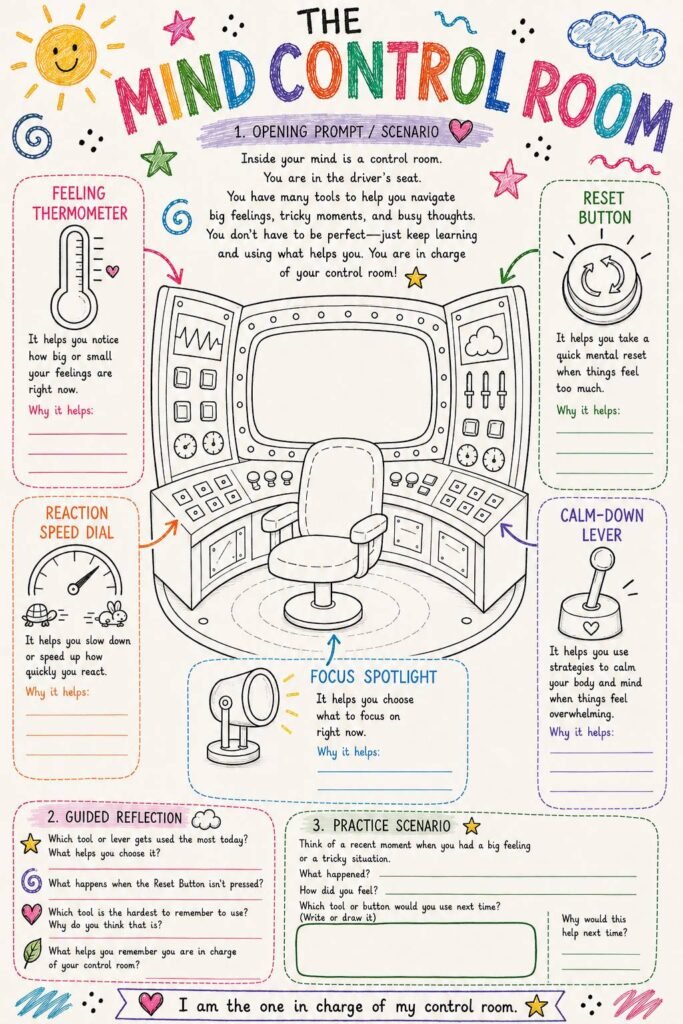
The worksheet below — The Mind Control Room — is a free resource you can use with your child today. It is suitable for children aged approximately 7 to 12, and works equally well at home, in school, or in a therapeutic setting. It is richly illustrated, immediately engaging, and structured around five specific tools — each one named, described, and explained — followed by a guided reflection and a practice scenario that applies the tools to a real situation from the child’s own life.
The five tools are:
The feeling thermometer — it helps the child notice how big or small their feelings are right now. Why it helps: noticing your feelings is the first step to choosing what you need.
The reaction speed dial — it helps the child slow down or speed up how quickly they react. Why it helps: choosing your speed gives you time to think and make a helpful choice.
The reset button — it helps the child take a quick mental reset when things feel too much. Why it helps: resetting your mind helps you feel more clear and ready to try again.
The calm-down lever — it helps the child use strategies to calm their body and mind when things feel overwhelming. Why it helps: calming your body helps your brain feel safe so you can think clearly again.
The focus spotlight — it helps the child choose what to focus on right now. Why it helps: focusing your attention helps you ignore distractions and stay on what matters most.
What makes this one of the most effective self-regulation worksheets for kids is the complete arc it traces — from introducing the tools, through honest reflection on current patterns, to the concrete application of a specific tool to a specific real situation. The child does not simply learn that tools exist. They practise choosing one.
The closing line delivers the therapeutic heart of the exercise with quiet authority: I am the one in charge of my control room.
How to Use It
Introduce the worksheet during a calm moment — not in the immediate aftermath of a dysregulating event, when the capacity for reflection is lowest and the shame of what just happened may make honest engagement difficult. A simple, warm introduction works best: “Inside your mind is a control room — and you are the one in the driver’s seat. This worksheet shows you the tools you already have in there. Let’s figure out how they work.”
Work through the five tools together before moving to the reflection or the practice scenario. Give each tool proper time and attention — ask the child what they already know about each one, whether they have ever used something like it, what it might look like in practice in their own life. The tools should feel familiar and personally meaningful before they are applied to a difficult situation.
Once the tools are established, move to the guided reflection:
- Of the five tools, which one do you reach for most naturally?
- Which one feels least available to you when things get really big?
- What does it feel like in your body when you forget you are in charge?
- What is one thing that could remind you to press the reset button before things go too far?
Then the practice scenario — working through a real recent situation together, identifying the feeling, and choosing a specific tool to apply differently next time. This is the most practically important part of the entire worksheet: the bridge between knowing the tools exist and actually using them when the moment arrives.
Once everything is complete, explore the commitment together:
- Which tool would you like to practise most this week?
- How will you know when you need it?
- What will you say to yourself to remember you are in charge?
The most important thing is not the answers. It is the quality of attention you bring to hearing them — and the consistent, specific, repeated message that the child is not at the mercy of their feelings.
For Deeper Work: The Play Therapy Toolbox
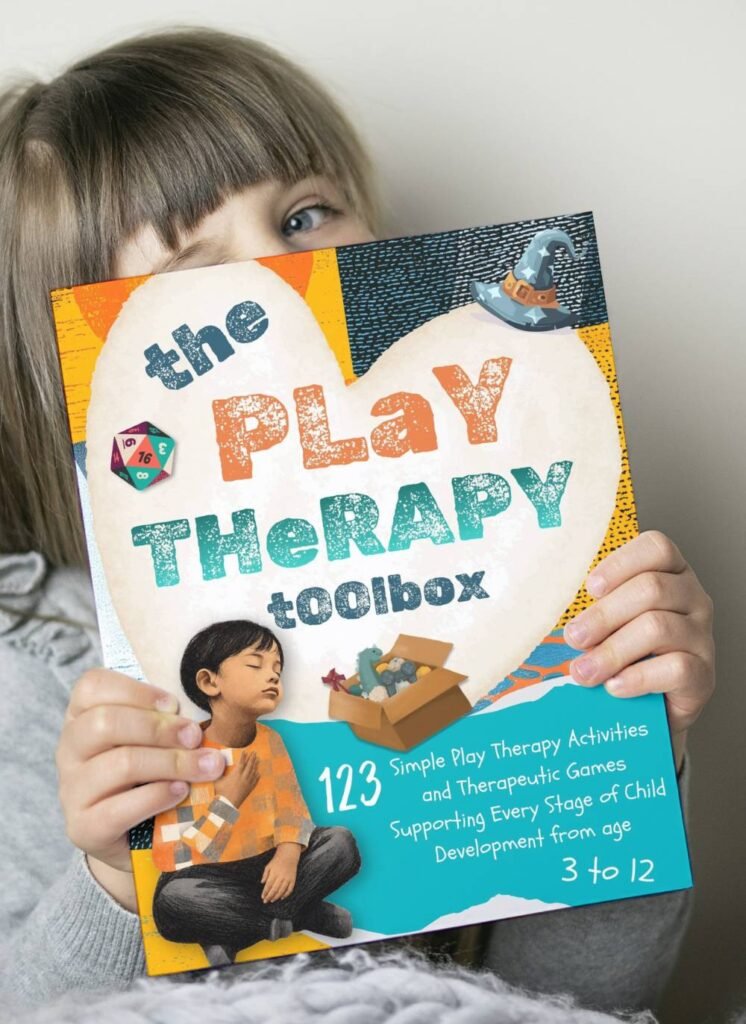
The Mind Control Room is one example of the kind of self-regulation-focused, agency-building, cognitively structured tool that sits at the heart of The Play Therapy Toolbox: 123 Simple Play Therapy Activities and Therapeutic Games Supporting Every Stage of Child Development from Age 3 to 12 — a book built around the understanding that children speak in a language adults often forget they once spoke fluently themselves.
The book contains 123 activities spanning role-play, enactment, fantasy storytelling, somatic exercises, and gamified experiences, alongside 75+ printable, downloadable, full-colour worksheets designed to support and extend each activity. Every activity comes with a therapeutic rationale grounded in peer-reviewed research, step-by-step guidance on how to conduct the session and what to say, questions to use with the child, and a parent guidance note written in the same warm, accessible language as this article.
The emotional regulation and self-regulation chapters address the full range of presentations children bring — impulse control difficulties, emotional flooding, ADHD and executive functioning challenges, perfectionism and rigidity, the particular challenge of regulating in social and academic environments, and the experience of knowing what to do and still being unable to do it in the heat of the moment. Every activity is cross-referenced in a comprehensive annex by presenting condition, age group, and page number — so you can navigate directly to the right tool for the right child at the right moment, without searching.
Three Things Worth Knowing Before You Begin
The tools need to be practised in calm before they can be used in crisis.
The single most common error in using self-regulation worksheets for kids is introducing the tools for the first time during or immediately after a dysregulating event. A child in the grip of a big feeling cannot access the prefrontal cortex reliably enough to choose and deploy a new tool — the very part of the brain that would make that choice is the part most compromised by the emotional intensity. The tools need to be practised repeatedly in calm conditions, until they are familiar enough to be reached for automatically when the moment arrives.
Noticing is the first tool.
Before any of the five instruments in the control room can be used, the child needs to notice that something is happening — to register the feeling before it has fully taken over the room. The feeling thermometer is first on the worksheet for this reason: noticing how big or small the feeling is right now is the prerequisite for every other choice that follows. A child who has learned to pause and check the thermometer before reaching for any other tool has already developed one of the most powerful self-regulation capacities available.
You are the most important tool in the room.
Children develop self-regulation primarily through co-regulation — through the repeated experience of being alongside a calm, attuned adult whose regulated nervous system offers theirs a reference point for safety. When you sit beside your child in the control room, name your own tools, and show them which lever you reach for when things get too much, you are not just modelling. You are offering your own regulated presence as the most powerful regulatory tool available. Fill in your own worksheet. Show them your control room. Let them see that even grown-ups are still learning which buttons to press.
Available Now for $5.99 — For a Limited Time
If this free self-regulation worksheet for kids gave you a sense of what becomes possible when children are helped to see themselves as the operator of their own mind rather than the passenger in it, The Play Therapy Toolbox gives you 123 more tools built on the same foundation. The ebook is available now on Amazon at $5.99 for a limited time — with immediate access to 123 activities and 75+ full-colour printable worksheets for children aged 3 to 12.
Play is not preparation for life. It is life — in its most honest, most essential, most healing form.

Disclaimer: This article is intended as an educational and supportive resource for parents, caregivers, educators, and mental health professionals. It is not intended to diagnose, treat, or replace professional therapeutic or medical care. If a child is experiencing significant emotional, behavioural, or developmental difficulties, please seek guidance from a qualified mental health professional.

Rostislava Buhleva-Simeonova is a psychologist, art therapist, and gamificator. She has worked with children, adults, and the elderly within various therapeutic programmes over the past eight years, all the while providing the much-needed playful twist that art and gamified experiences can bring to this sometimes uneasy setting. But it wasn’t until the birth of her daughter, Aurora, that this work took on an even deeper personal meaning. With her academic and real-life experience, honed through numerous trainings and sessions, she is currently authoring books and articles in the field of child psychology and development, offering expertise in art and play therapy to guide parents and caregivers, as well as professionals in the fields of social work and mental health, throughout various pivotal moments in children’s lives. Last but not least, all of her books have been “peer-reviewed” by her daughter, who testifies to the efficiency of these methods.