

Every parent knows the particular quality of bedtime conversations. Something about the darkness, the stillness, the moment just before sleep when the day’s defences come down. The worry they did not mention at dinner surfaces quietly. The thing that happened at school that they said was fine turns out not to have been fine. The feeling they carried all day without a name finally finds one, just as the light goes off.
This is not accidental. The transition to sleep is a neurologically significant moment — a shift from the active, externally oriented processing of the waking day toward the internally directed, consolidating work of the sleeping brain. Emotional material that was suppressed or simply unattended during the busy hours of the day becomes more available at this threshold. Children who have a structured, warm, consistent way to process that material before they sleep — to name what they felt, release what they are carrying, hold what they are grateful for, and settle into a clear intention for tomorrow — sleep better, wake more regulated, and build, over time, an emotional literacy that no classroom curriculum can replicate.
A well-designed nighttime emotional check-in worksheet for kids does not add to the bedtime routine. It transforms it — from a series of practical tasks into a daily moment of genuine emotional connection between a child and the day they just lived.
Why Bedtime Is the Right Moment for Emotional Processing
The neuroscience of sleep and emotional processing offers a compelling explanation for why bedtime conversations so often carry a different quality from daytime ones. During waking hours, the prefrontal cortex — responsible for executive functioning, impulse control, and the regulation of emotional expression — is actively moderating what the child shows and says. The social demands of the day require a degree of emotional management that, by bedtime, the child’s depleted regulatory resources can no longer sustain. What remains is closer to the unfiltered emotional reality of the day.
At the same time, the sleeping brain is doing something remarkable with the emotional material of the day. Sleep — and specifically REM sleep — plays a critical role in emotional memory consolidation: the process by which the emotional charge of daily experiences is processed, integrated, and either stored or released. Research by Matthew Walker and others has shown that the sleeping brain strips the emotional tone from memories while preserving their informational content — a process sometimes described as overnight therapy. Experiences that feel raw and distressing before sleep often feel more manageable in the morning, not because they have been forgotten but because their emotional charge has been processed during sleep.
What this means practically is that the quality of emotional processing a child does before sleep directly influences what the sleeping brain has to work with. A child who goes to sleep carrying unprocessed emotional material — the unnamed frustration, the unresolved worry, the thing that happened that nobody asked about — gives the sleeping brain more difficult work to do. A child who has named their feelings, released what they are carrying, held what they are grateful for, and settled into a clear and positive intention for tomorrow goes to sleep having already done some of that processing consciously — which the sleeping brain can then build on rather than compensate for.
A nighttime emotional check-in worksheet for kids is, in the most literal neurological sense, preparation for better sleep.
What Emotional Processing at Bedtime Actually Requires
Effective emotional processing at bedtime is not the same as talking about the day. It requires several distinct cognitive and emotional acts — each one doing different therapeutic work, each one contributing to a different aspect of the child’s overnight processing and next-day regulation.
Naming the feeling — identifying and labelling what was felt during the day — activates the prefrontal cortex and reduces amygdala activation, a process sometimes called affect labelling. Research by Matthew Lieberman has shown that the simple act of naming an emotion reduces its subjective intensity and physiological impact. A child who names frustration before sleep is already doing something neurologically significant with that frustration — moving it from the body into language, and in doing so, making it more manageable.
Releasing what needs to be let go — identifying thoughts, worries, or feelings the child does not want to carry into sleep — draws on the therapeutic principle of externalisation: moving something from inside to outside, giving it a form that can be acknowledged and then consciously set down. This is not suppression. It is completion — the deliberate, agentic act of deciding that this particular thing does not need to travel any further tonight.
Holding what is good — noticing a memory worth keeping, naming what was learned, identifying what there is to be grateful for — activates the brain’s reward circuitry and builds the neural pathways associated with positive emotion regulation. The gratitude research is extensive and consistent: regular gratitude practice in children is associated with improved wellbeing, stronger relationships, greater resilience under stress, and measurably better sleep quality.
And setting a clear intention for tomorrow — naming one thing the child will do or focus on — activates the kind of forward-oriented thinking that is associated with hope, agency, and the sense that the future is something worth moving toward. A child who goes to sleep with a specific, personally meaningful intention for tomorrow is a child whose sleeping brain has something constructive to consolidate alongside the emotional material of the day.
Free Nighttime Emotional Check-In Worksheet for Kids: Before I Sleep
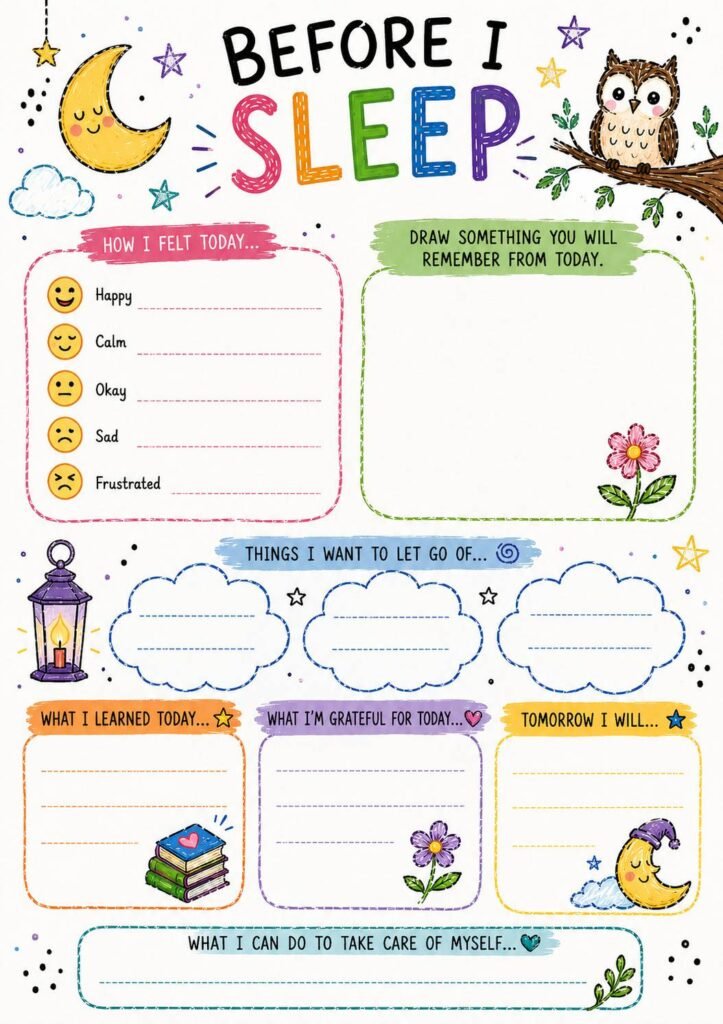
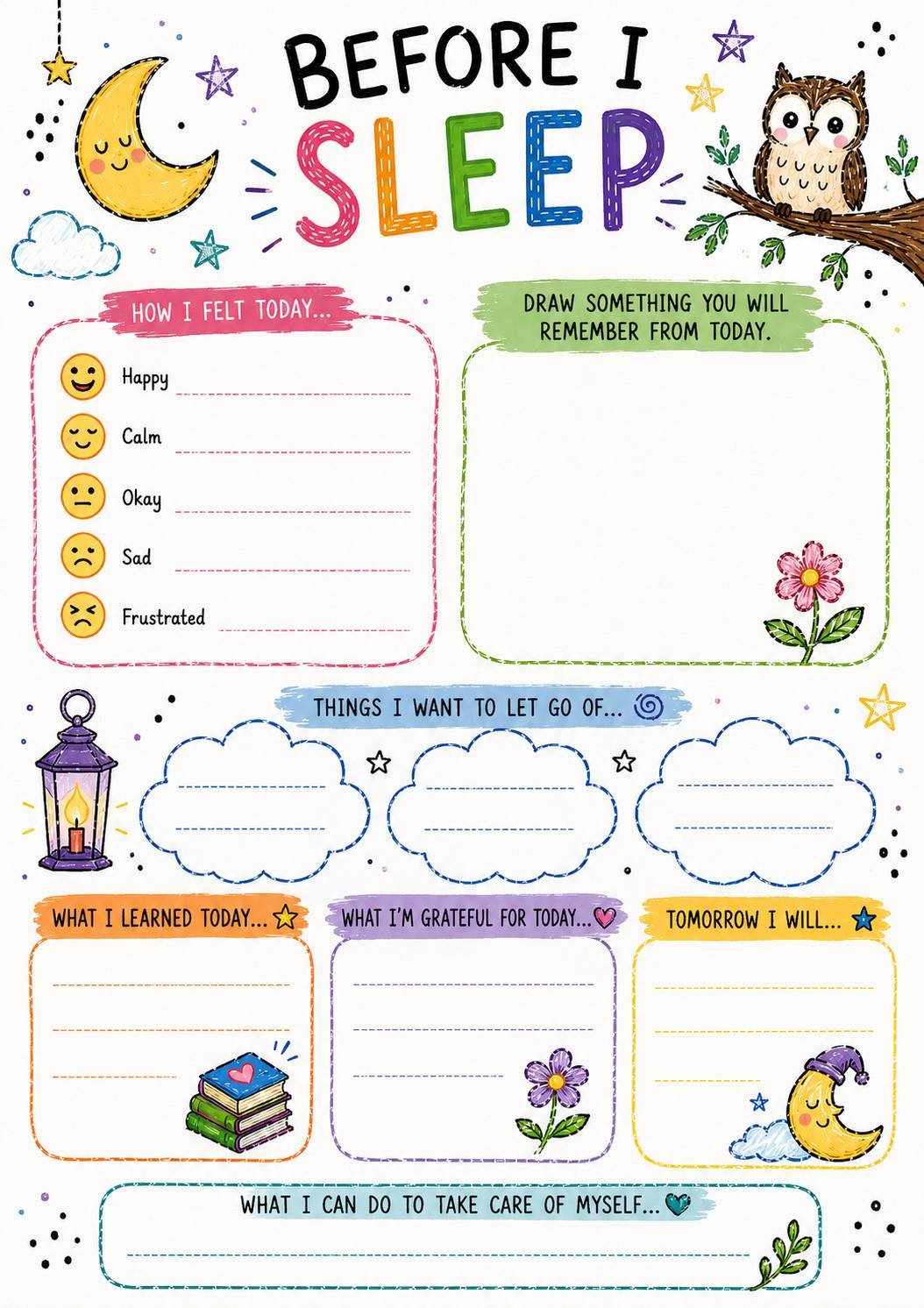
The worksheet below — Before I Sleep — is a free resource you can use with your child today. It is suitable for children aged approximately 5 to 12, and works equally well as a daily home routine, a school-based reflection tool, or a therapeutic homework activity. It is warm, beautifully illustrated and structured around seven distinct sections that move the child through the complete arc of conscious emotional processing before sleep.
Together, these seven sections trace the complete emotional arc of a day — from how it felt, through what is worth keeping and what is ready to be released, to what is worth looking forward to. A child who completes this worksheet before sleep has not simply reflected on their day. They have processed it — consciously, specifically, and in a form that the sleeping brain can build on rather than struggle with.
What makes this one an effective nighttime emotional check-in worksheets for kids is its structure. Each section does a different therapeutic job. None of them is decorative. And the sequence — from feeling, through memory, through release, through learning, through gratitude, through intention, through self-care — is itself therapeutically deliberate: it moves the child from the emotional weight of the day toward something lighter and more forward-facing, so that what they carry into sleep is not only what was hard but also what was good, what was learned, and what tomorrow holds.
How to Use It
Introduce the worksheet as part of an established bedtime routine — not as an addition to an already rushed routine but as a replacement for part of it. A simple, warm introduction works best: “Before you sleep, let’s find out what’s in there — what the day left behind, and what’s worth keeping. Then we’ll let the rest go.”
Work through the sections together, or give the child space to complete them independently and then share. Some sections will come quickly. Others — particularly the things I want to let go of — may need more time. That time is not wasted. The pause before a child names what they are carrying is often the most important moment in the entire exercise.
Once the worksheet is complete, explore it together with open, unhurried questions:
- Of all the feelings you had today, which one was the biggest?
- Is there anything in the letting-go clouds that surprised you — something you didn’t realise you were still carrying?
- What does it feel like to put that in the cloud and decide to leave it there for tonight?
- The memory you drew — what made you choose that one?
- What would it feel like to having already done the thing you wrote down?
That last question is worth sitting with. A child who can already feel the satisfaction of tomorrow’s intention — who has imagined it clearly enough to feel something about it — has done something neurologically significant: they have given the sleeping brain a positive, forward-oriented image to consolidate alongside the emotional material of the day.
The most important thing is not the answers. It is the quality of attention you bring to hearing them — and the consistent, nightly message that the day is worth reflecting on, that feelings are worth naming, and that what happens inside matters as much as what happens outside.
The Letting-Go Section — Why It Matters Most
Of all the sections in the worksheet, the things I want to let go of clouds deserve particular attention — both because they are the most therapeutically significant and because they are the most likely to be rushed.
The letting-go section asks the child to do something that is genuinely cognitively and emotionally sophisticated: to identify something they are carrying, to acknowledge it explicitly, and then to make a deliberate, agentic choice to set it down for the night. This is not suppression — suppression involves pushing something away without acknowledgement. It is completion — the conscious, voluntary act of deciding that this particular thing has been acknowledged and does not need to travel any further into the night.
Research on emotional suppression and sleep consistently shows that attempting to push away or ignore difficult emotional content before sleep increases rather than decreases its intrusive presence during sleep — the sleeping brain keeps working on unfinished emotional business. The letting-go section offers an alternative: not suppression but conscious release, which is neurologically and clinically distinct and produces qualitatively different effects on the quality of overnight processing.
A child who has named what they are letting go, written or drawn it in the cloud, and consciously decided to leave it there for the night has done something powerful: they have acknowledged the difficult material, given it a bounded space, and exercised agency over its relationship to their sleep. That exercise of agency is itself therapeutic — and it is one that no amount of adult reassurance can replicate, because it belongs entirely to the child.
For Deeper Work: The Play Therapy Toolbox
Before I Sleep is one example of the kind of emotionally structured, developmentally grounded, daily-practice tool that sits at the heart of The Play Therapy Toolbox: 123 Simple Play Therapy Activities and Therapeutic Games Supporting Every Stage of Child Development from Age 3 to 12 — a book built around the understanding that children speak in a language adults often forget they once spoke fluently themselves.
The book contains 123 activities spanning role-play, enactment, fantasy storytelling, somatic exercises, and gamified experiences, alongside 75+ printable, downloadable, full-colour worksheets designed to support and extend each activity. Every activity comes with a therapeutic rationale grounded in peer-reviewed research, step-by-step guidance on how to conduct the session and what to say, questions to use with the child, and a parent guidance note written in the same warm, accessible language as this article.
Three Things Worth Knowing Before You Begin
Consistency is the therapeutic ingredient.
A nighttime emotional check-in worksheet for kids used once is a pleasant activity. Used often, it becomes a ritual — and rituals do something that single activities cannot. They build a reliable, predictable, emotionally safe container that the child’s nervous system begins to anticipate and settle into before the first section is even completed. The regularity of the practice is as therapeutically significant as its content.
The letting-go section is not about forgetting.
The things the child places in the letting-go clouds are not being dismissed or minimised. They are being acknowledged — given a form, a space, a conscious moment of recognition — and then released from the obligation to keep circulating until morning. Some of them will need to come back tomorrow and be addressed properly. The letting-go section does not prevent that. It prevents the unprocessed, unnamed version of the difficulty from doing its worst work during the hours when the child has no waking agency over it.
You are the most important tool in the room.
A child who knows that whatever they put in the letting-go clouds will be received without alarm, that whatever they draw in the memory space will be looked at with genuine interest, and that whatever they write for tomorrow will be remembered and asked about — that child is a child who will use the worksheet as the therapeutic tool it is designed to be. Complete your own worksheet. Let them see yours. Let them see that even grown-ups have things to let go of before they sleep — and that the morning is always waiting on the other side.
Available Now for $5.99 — For a Limited Time
If this free nighttime emotional check-in worksheet for kids gave you a sense of what becomes possible when children are given a structured, warm, consistent way to process the day before they sleep, The Play Therapy Toolbox gives you 123 more tools built on the same foundation. The ebook is available now on Amazon at $5.99 for a limited time — with immediate access to 123 activities and 75+ full-colour printable worksheets for children aged 3 to 12.
Play is not preparation for life. It is life — in its most honest, most essential, most healing form.

Disclaimer: This article is intended as an educational and supportive resource for parents, caregivers, educators, and mental health professionals. It is not intended to diagnose, treat, or replace professional therapeutic or medical care. If a child is experiencing significant emotional, behavioural, or developmental difficulties, please seek guidance from a qualified mental health professional.

Rostislava Buhleva-Simeonova is a psychologist, art therapist, and gamificator. She has worked with children, adults, and the elderly within various therapeutic programmes over the past eight years, all the while providing the much-needed playful twist that art and gamified experiences can bring to this sometimes uneasy setting. But it wasn’t until the birth of her daughter, Aurora, that this work took on an even deeper personal meaning. With her academic and real-life experience, honed through numerous trainings and sessions, she is currently authoring books and articles in the field of child psychology and development, offering expertise in art and play therapy to guide parents and caregivers, as well as professionals in the fields of social work and mental health, throughout various pivotal moments in children’s lives. Last but not least, all of her books have been “peer-reviewed” by her daughter, who testifies to the efficiency of these methods.