
Every parent has asked it — the question that seems simple until you watch a child struggle to answer it. Not what do you want for your birthday, or what do you want for dinner, but the larger, more open, more genuinely revealing version: if you could change one thing — about yourself, or about the world — what would it be?
Some children answer immediately, with a clarity and specificity that is itself information. Some go quiet in a way that suggests the question has landed somewhere important. And some deflect — with a joke, with I don’t know, with the particular kind of shrug that means the question felt too large or too exposing to answer directly. Each response is worth attending to, because what a child wishes for — and how willing they are to say it out loud — tells you something significant about how they currently see themselves in relation to their own life and their own capacity to shape it.
A well-designed wishes and goals worksheet for kids does not simply invite the child to dream. It builds a bridge between the dream and the first possible step — and in doing so, it teaches one of the most important things any child can learn: that wishing and doing are not opposites. That imagining something and moving toward it are parts of the same act.
Why Wishes Matter Therapeutically
In positive psychology, the study of hope — defined not as passive optimism but as the active combination of the belief that goals are achievable and the capacity to generate pathways toward them — has produced one of the most robust bodies of evidence in the field. Hope theory, developed by C. R. Snyder, proposes that hope has two components: agency thinking — the belief that one can find the motivation to move toward a goal — and pathways thinking — the belief that one can find ways to get there. Children with higher levels of hope demonstrate greater academic achievement, stronger resilience under adversity, better physical health outcomes, and significantly lower rates of depression and anxiety.
The wish is the entry point into hope. It is where the child locates something they genuinely care about changing — something that matters to them specifically, not abstractly. And the movement from the wish to the first small step is the movement from hoping to doing — from passive longing to active agency.
A well-designed wishes and goals worksheet for kids that takes the child through this movement — from imagining the wish, to understanding why it matters, to visualising what it would look and feel like, to identifying one small concrete step today — is not simply a goal-setting exercise. It is a hope-building intervention. And the research on hope in children is unambiguous: hope can be taught, it can be practised, and its effects on wellbeing are large and lasting.
What the Wish Reveals
One of the most therapeutically significant aspects of the My Wish Snap worksheet is the openness of its central question: with a snap of your fingers, you could change one thing about yourself or the world. What would that be?
The deliberate breadth of this question — yourself or the world — is clinically important. A child who chooses to change something about themselves is telling you something about how they currently experience their own limits or difficulties. A child who chooses to change something about the world is telling you something about their values, their empathy, their sense of what is unjust or painful in the environment around them. And a child who cannot choose — who oscillates between the two, or who says they want to change something about the world but whose answer is clearly also about themselves — is often doing the most interesting and most revealing work of all.
The wish prompt is also projective in the clinical sense: because it is framed as imagination rather than disclosure, it gives the child the protective distance of the hypothetical. They are not being asked to admit that something is wrong with them or wrong with their situation. They are being invited to imagine. And in the imagination, children often say things they could not or would not say directly — revealing needs, fears, longings, and values that a more clinical question would not reach.
The Agency Dimension — and Why It Matters
What distinguishes a wishes and goals worksheet for kids from a simple wish-list exercise is the fourth prompt: what is one small step you can take today that moves you closer to this wish?
This prompt is doing something therapeutically and developmentally precise. It is interrupting the gap that exists, in so many children’s minds, between what they want and what they believe they can do about it. A child who has identified a wish, understood why it matters, visualised what it would look and feel like — and then been asked to name one small concrete step toward it — has crossed a threshold that pure wishing does not cross. They have moved from the position of someone to whom things happen into the position of someone who acts.
The research on the gap between intention and action — what psychologists call the intention-action gap — consistently shows that the gap is most reliably bridged not by stronger motivation but by a specific, concrete, immediately actionable first step. The child who leaves the exercise knowing what they will do today, however small, is a child whose wish has already begun to move from the imagined to the real.
The motivation scale at the bottom of the worksheet — five stars, from not strong to very strong — adds a metacognitive dimension that is particularly valuable for older children. A child who colours a star and then considers what that number means — why is this a three and not a five? What would need to change for it to feel stronger? — is developing the capacity for honest self-assessment that genuine goal pursuit requires.
Free Wishes and Goals Worksheet for Kids: My Wish Snap
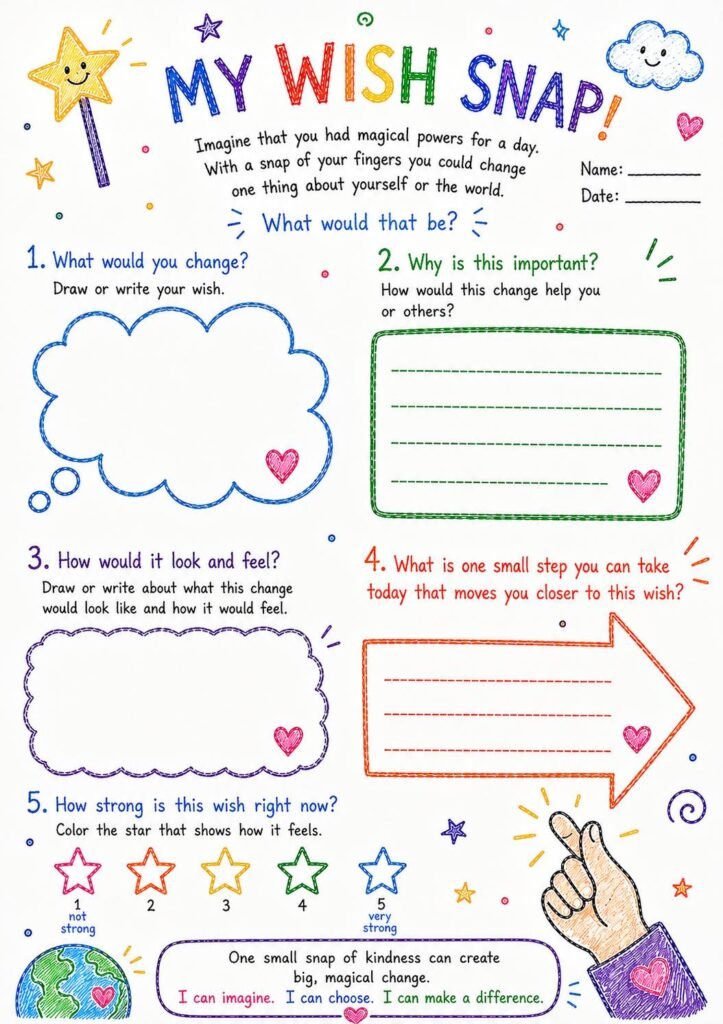
The worksheet below — My Wish Snap — is a free resource you can use with your child today. It is suitable for children aged approximately 6 to 12, and works equally well at home, in school, or in a therapeutic setting. It is joyful, visually engaging, and structured around five prompts that move the child through the complete arc of hope-based goal work — from the imaginative wish, through empathic reasoning, through sensory visualisation, to concrete first action and honest motivation assessment.
The five prompts are:
- What would you change? — a thought bubble for drawing or writing the wish
- Why is this important? — how would this change help you or others?
- How would it look and feel? — drawing or writing about what the change would look like and feel like
- What is one small step you can take today that moves you closer to this wish?
- How strong is this wish right now? — a five-star scale from not strong to very strong
And the closing message anchors the therapeutic heart of the entire exercise in three spare, precise sentences: one small snap of kindness can create big, magical change. I can imagine. I can choose. I can make a difference.
What makes this one of the most effective wishes and goals worksheets for kids is its movement. It begins in the imagination — in the unconstrained, magical space of a single snap — and it ends in the real world, with a specific action the child can take today. That movement, from the imagined to the possible, from the wished-for to the chosen, is the therapeutic arc of hope.
How to Use It
Place the worksheet in front of your child with a warm, genuinely curious introduction — open enough to invite without directing: “Imagine you had magical powers for just one day. With one snap of your fingers, you could change one thing — about yourself or about the world. Just one thing. What would it be?” Then step back. Give the child time and space to think and draw without commentary or suggestion.
The thinking phase — the pause before the pencil moves toward the thought bubble — is often the most important part of the exercise. Do not rush it. A child who is sitting quietly with the question is not stuck. They are doing the most significant cognitive and emotional work of the whole activity: deciding what they genuinely care about enough to wish for.
Once the wish is drawn or written, work through the remaining prompts at the child’s pace. The why is this important prompt deserves particular time and attention — because it is where the wish reveals its emotional root. A child who wishes to be braver and explains that it would help them make a friend is telling you something different from a child who explains that it would help them stand up to someone who is being unkind. Both answers matter. Neither should be redirected.
Once the worksheet is complete, explore it together with open, unhurried questions:
- Of everything you could have wished for, why did you choose this particular thing?
- When you imagine this change having happened — what does that feel like in your body?
- The small step you named — is that something you could actually do today, or does it need to be broken down even smaller?
- If you woke up tomorrow and the wish had come true overnight, what would be the first thing you would notice?
- How does it feel to know that you already took a step toward this today, just by naming it?
That last question is worth sitting with. A child who has named a wish, understood why it matters, visualised it, and identified a first step has already begun the work of making it real. The most important thing is not the answers. It is the quality of attention you bring to hearing them.
For Deeper Work: The Play Therapy Toolbox
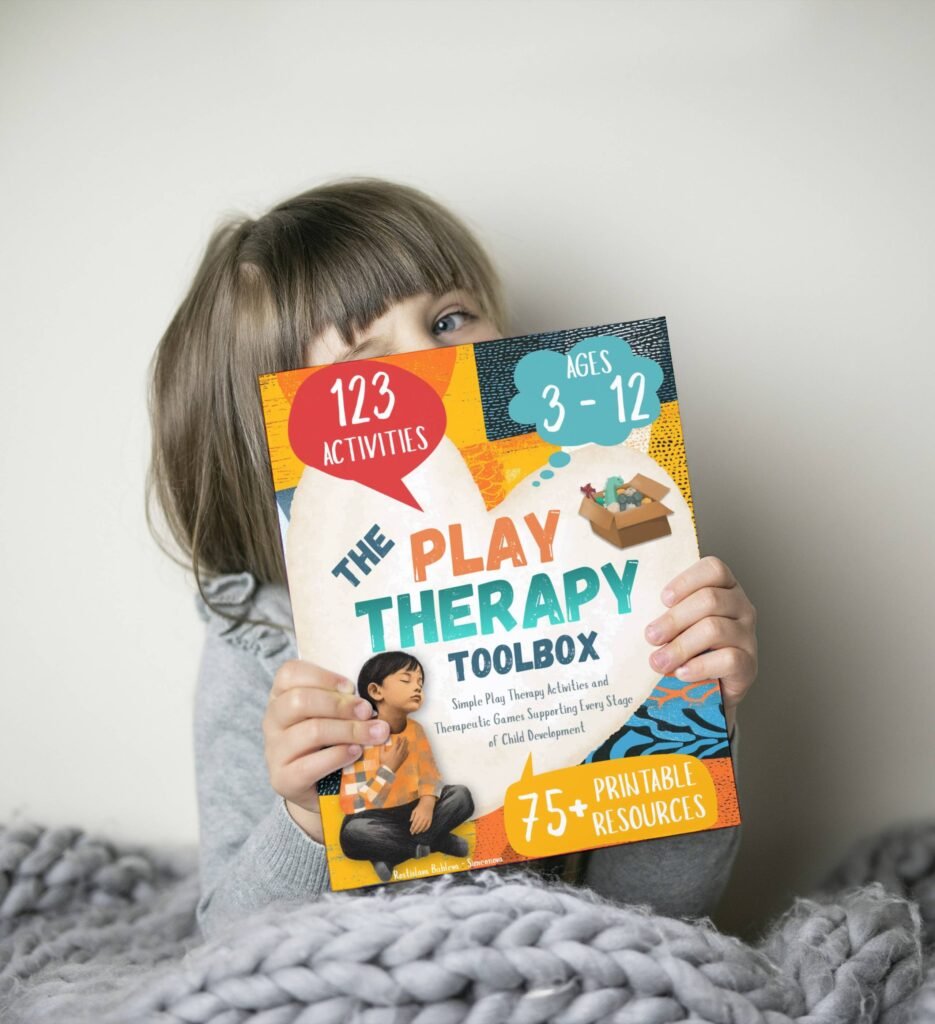
My Wish Snap is one example of the kind of hope-building, agency-developing, values-clarifying tool that sits at the heart of The Play Therapy Toolbox: 123 Simple Play Therapy Activities and Therapeutic Games Supporting Every Stage of Child Development from Age 3 to 12 — a book built around the understanding that children speak in a language adults often forget they once spoke fluently themselves.
The book contains 123 activities spanning role-play, enactment, fantasy storytelling, somatic exercises, and gamified experiences, alongside 75+ printable, downloadable, full-colour worksheets designed to support and extend each activity. Every activity comes with a therapeutic rationale grounded in peer-reviewed research, step-by-step guidance on how to conduct the session and what to say, questions to use with the child, and a parent guidance note written in the same warm, accessible language as this article.
The positive psychology, hope, agency, and goal-oriented chapters address the full range of presentations children bring — the child who cannot identify what they want because wanting has felt too risky; the one whose wishes are all for others because their own needs have not been given adequate space; the one who can imagine beautifully but cannot bridge the distance to action; and the one who acts readily but has never been asked to pause and consider what they are actually moving toward, and why. Every activity is cross-referenced in a comprehensive annex by presenting condition, age group, and page number — so you can navigate directly to the right tool for the right child at the right moment, without searching.
Three Things Worth Knowing Before You Begin
The wish is data, not decoration.
The most important thing any adult can do with a wishes and goals worksheet for kids is resist the instinct to evaluate the wish — to redirect it toward something more realistic, more achievable, or more socially appropriate. The wish a child names is one of the most direct windows into what they currently need, what they currently fear, and what they currently value. Receive it with genuine interest, without judgment, and without the urge to make it smaller than it arrived.
The small step is as important as the wish.
The movement from imagining to acting is the core therapeutic arc of the exercise — and it is where the exercise most easily loses its power if it is rushed. A first step that is too large is not a first step. It is a discouragement. The child who identifies a step that feels genuinely achievable today — however modest — leaves the exercise with something no amount of dreaming alone can provide: the experience of being someone who moves toward what they want. That experience, repeated across sessions and across time, builds the agency and the hope that the research confirms are among the strongest predictors of child wellbeing available.
You are the most important tool in the room.
The worksheet opens the space. You are the reason the child is willing to put something real in it. A child who has been asked what they wish for and had that wish received with genuine, unhurried, specifically curious attention has experienced something that a well-designed worksheet alone cannot provide: the felt sense that what they want matters, that who they are becoming is worth attending to, and that the adults in their world are genuinely interested in what they might snap into existence if they had the chance. That experience — consistent, specific, and warmly offered — is the condition under which hope grows.
Available Now for $2.99 — For a Limited Time
If this free wishes and goals worksheet for kids gave you a sense of what becomes possible when children are helped to move from imagining to choosing to acting, The Play Therapy Toolbox gives you 123 more tools built on the same foundation. The ebook is available now on Amazon at $2.99 for a limited time — with immediate access to 123 activities and 75+ full-colour printable worksheets for children aged 3 to 12.
Play is not preparation for life. It is life — in its most honest, most essential, most healing form.

Disclaimer: This article is intended as an educational and supportive resource for parents, caregivers, educators, and mental health professionals. It is not intended to diagnose, treat, or replace professional therapeutic or medical care. If a child is experiencing significant emotional, behavioural, or developmental difficulties, please seek guidance from a qualified mental health professional.

Rostislava Buhleva-Simeonova is a psychologist and game design specialist. She has worked with children, adults, and the elderly within various therapeutic programmes over the past eight years, all the while providing the much-needed playful twist that art and gamified experiences can bring to this sometimes uneasy setting. But it wasn’t until the birth of her daughter, Aurora, that this work took on an even deeper personal meaning. With her academic and real-life experience, honed through numerous trainings and sessions, she is currently authoring books and articles in the field of child psychology and development, offering expertise in art and play therapy to guide parents and caregivers, as well as professionals in the fields of social work and mental health, throughout various pivotal moments in children’s lives. Last but not least, all of her books have been “peer-reviewed” by her daughter, who testifies to the efficiency of these methods.