
Every parent has stood in the particular silence that follows a loss and wondered what to do. Not the practical silence — that fills quickly enough with arrangements and phone calls and the necessary business of bereavement. But the silence that settles around the child. The one who does not yet have words for what has happened. The one who asks the same question repeatedly, not because they have forgotten the answer but because the permanence the answer implies has not yet fully landed.
Grief in children does not look like grief in adults. It visits in waves, retreating between them in ways that can look, from the outside, like indifference or resilience or recovery when it is often none of these things. And it lives, particularly in young children, in a place that language does not easily reach — in the body, in the imagination, in the images that keep returning.
Art therapy for grief in children works because it meets the child where grief actually lives. Not in the rational mind, where explanation and reassurance operate, but in the felt sense — the sensory, embodied, emotionally charged experience of loss that image and making and creative expression can approach in ways that conversation alone rarely manages.
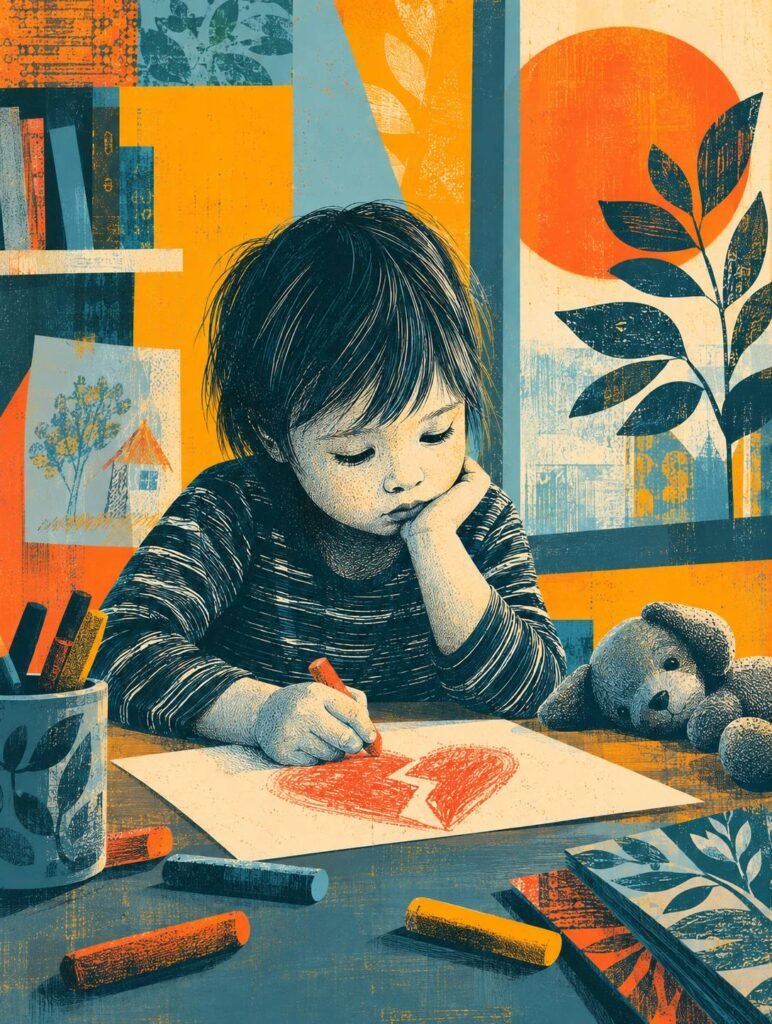
The Dual Process Model — Why Grief Needs Two Kinds of Work
Before exploring what art therapy for grief in children looks like in practice, it is worth pausing on the theoretical framework that gives the most precise account of why art-based approaches are so specifically well-suited to childhood bereavement.
The Dual Process Model of grief, developed by Stroebe and Schut, proposes that healthy grief processing involves oscillation between two orientations: loss-oriented coping — engaging directly with the grief, the pain of missing, the reality of what has been lost — and restoration-oriented coping — adapting to the changes the loss has created, building new routines and meanings, moving toward the life that continues alongside the loss.
Neither orientation alone is sufficient. A child who is only ever engaged in loss-oriented work — who is continuously in the pain of the loss without respite — risks becoming overwhelmed. A child who is only ever restoration-oriented — who moves forward without having adequately processed the grief — risks carrying unresolved loss that surfaces in other forms. Healthy bereavement requires movement between the two: approaching the grief and then stepping back from it, working through it and then resting from it, again and again across the long arc of mourning.
Art therapy for grief in children supports both orientations simultaneously — and often in the same session. The book contains exercises that sit at the loss-oriented end of the spectrum — Fix-It Heart, which works with the image of brokenness; Empty Chest, which gives the child a container for what they want to keep and what they are ready to leave behind; and Letting Go Balloons, which provides a ritualised, symbolic way to begin releasing what no longer needs to be carried. And it contains exercises that sit at the restoration-oriented end — of which the Happy Memory Box, described below, is one of the most therapeutically rich.
Used together across sessions, these exercises provide the oscillation between the two orientations that the Dual Process Model identifies as the mechanism of healthy grief.
What the Research Shows
The research on art therapy for grief in children has grown consistently in recent years — across different populations, different types of loss, and different art therapy modalities — and the findings are both clinically meaningful and practically significant.
A study published in Willow House examined the effect of art therapy on affect in grieving children, applying the Dual Process Model as its theoretical framework. The study confirmed that art therapy with bereaved children produced positive changes in emotional affect — with children demonstrating meaningful shifts in both their engagement with the loss itself and their capacity to move between loss-oriented and restoration-oriented coping. The finding has direct implications for how art-based grief exercises are most effectively structured: not as a single, uniform approach to loss, but as a range of activities that support the child’s movement between the two orientations the model describes.
A 2022 study published in OMEGA — Journal of Death and Dying, examining a combined art and narrative therapy program for individuals experiencing grief and bereavement, confirmed that the program helped participants transform their relationship with loss and build coping skills that outlasted the program itself — including through COVID-19-related losses, which arose during the study period and were integrated into the therapeutic work in real time. The finding that art and narrative approaches build coping skills that persist beyond the intervention is particularly significant for children: grief does not end when the programme ends, and the most valuable outcome is not relief during the sessions but the development of the child’s own capacity to hold and process loss over time.
A 2023 study published in the International Journal of Art Therapy, examining outdoor and nature-based art therapy specifically for traumatic bereavement, confirmed the effectiveness of art-based approaches for the most acute and complex presentations of grief — and identified the particular value of working with natural materials as a medium for externalising and processing loss. The natural world’s own cycles of ending and renewal provide a context for grief that is both emotionally resonant and developmentally accessible to children across a wide age range.
A 2023 pilot study published in OBM Integrative and Complementary Medicine, examining expressive arts for grieving youth, confirmed that creative and expressive approaches produced meaningful improvements in grief-related affect and coping capacity in young participants — and identified the non-verbal, sensory, and imaginative dimensions of art-making as specifically valuable for youth who struggle to engage with more verbally directed grief support.
A 2025 study in the International Journal of Art Therapy explored how art therapy can be adapted to support neurodivergent children and young people whose grief responses are frequently misunderstood or pathologised — confirming that art-based bereavement support is effective and inclusive across diverse presentations, and that the flexibility of the medium makes it particularly well-suited to children whose emotional expression does not follow conventional patterns.
Why Art Is the Right Medium for Children’s Grief
The clinical case for art therapy as the primary medium for grief work with children rests on a straightforward developmental reality: grief, like all significant emotional experience, is embodied before it is verbal. It lives in the body — in the heaviness, the constriction, the physical absence of someone whose presence was a felt reality — before it is ever available to language. And for children, whose verbal capacity for processing complex emotional experience is still actively developing, the gap between what they feel and what they can say about it is wider and more consequential than it is for adults.
Art therapy helps grief by facilitating creative experiences, activating communication, and offering the child a space for work with bereavement that does not depend on verbal articulateness. The child who cannot say I am angry that they left can pound clay, tear paper, or fill a page with colours in ways that give the anger somewhere to go. And the child who cannot say I am also happy sometimes, and that makes me feel guilty can create a Happy Memory Box that holds the good alongside the hard without asking them to resolve the contradiction in words.
The making itself is therapeutic — independent of any reflection or discussion that follows. The focused, absorbing, hand-based engagement of art-making activates the parasympathetic nervous system, reduces cortisol, and creates the conditions of calm within which the nervous system can do its own grief-processing work. The object that is made externalises the internal experience — gives it a form outside the child’s body that can be looked at, returned to, or put away when it becomes too much.
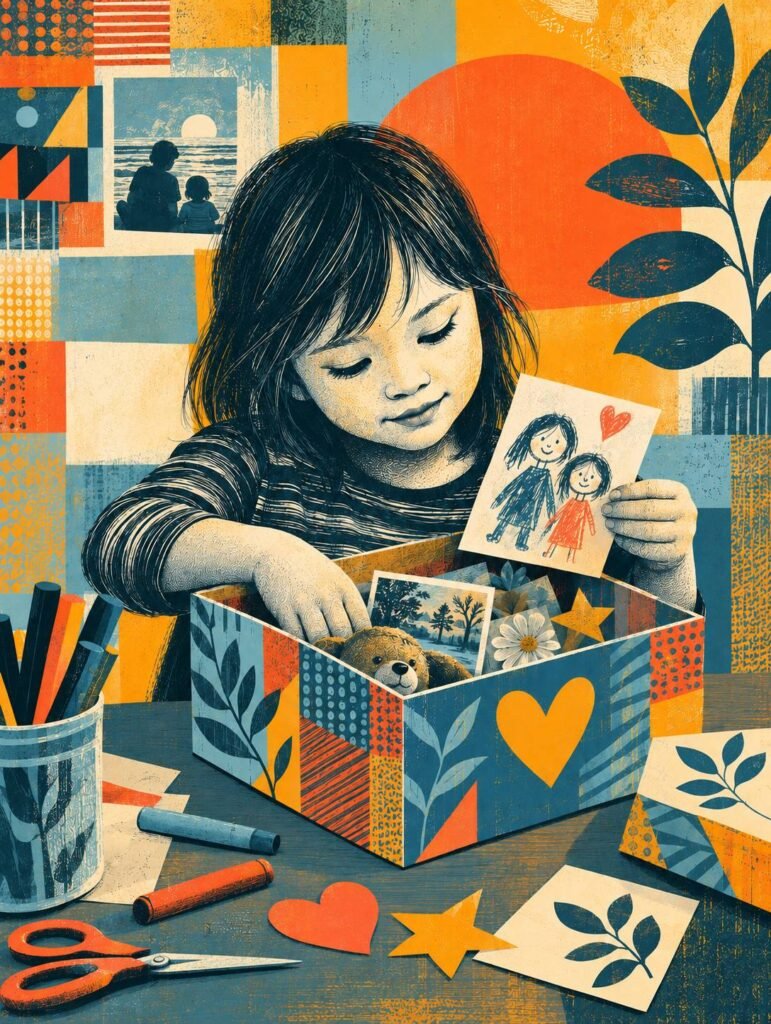
An Art Therapy Exercise for Grief in Children: The Happy Memory Box
The following exercise is drawn from 101 Art Therapy Exercises for Children: A Practical Guide for Parents and Mental Health Professionals — a book built around the understanding that grieving children need tools that meet them in the language their inner experience is actually speaking, within the safety of a warm, attuned, consistently present adult relationship.
The Happy Memory Box sits at the restoration-oriented end of the Dual Process Model — inviting the child to locate the person they have lost not in their absence but in memory, and to build something tangible that holds that memory in a form they can return to, add to, and share when they choose.
The child creates or decorates a physical box — any box, in whatever way feels right to them — and fills it with representations of happy memories of the person they have lost. These can be drawings, words, small objects, photographs, or anything that carries the particular texture of a good memory. The box becomes a portable, tangible, personally meaningful archive of what was good — something the child can return to on difficult days, add to as new memories surface, and share when they choose.
What makes the Happy Memory Box one of the most therapeutically significant exercises in the book is its dual function. It is loss-oriented in that it requires the child to engage with the person they have lost — to actively recall and represent them. And it is restoration-oriented in that it locates the relationship in memory rather than in absence — in what was rather than in what is no longer. The child who has filled their Happy Memory Box has not moved on from the person they loved. They have found a way to carry them forward.
For Deeper Work: 101 Art Therapy Exercises for Children
The Happy Memory Box is one exercise that sits at the heart of 101 Art Therapy Exercises for Children: A Practical Guide for Parents and Mental Health Professionals — a book built around the understanding that grieving children need to be met in the language of image, making, and sensory experience rather than the language of explanation and reassurance.
The book contains 101 exercises structured across three age groups — 4 to 6, 7 to 9, and 10 to 12 — each activity informed by validated research demonstrating how creative engagement alters brain physiology, reduces cortisol, strengthens neural flexibility, and enhances emotional regulation. Every session comes with a clear therapeutic rationale, step-by-step guidance, reflection questions, and guidance on how to observe and respond to what emerges — without diagnosis, without pressure, and without losing sight of the child as the author of their own experience.
The grief and loss chapter addresses the full range of what bereavement looks like in children: the waves of emotion that come without warning and retreat without resolution, the guilt and confusion of the child who sometimes feels fine and wonders what that means, the anger that has no adequate target, the particular grief of the child who is also holding the grief of the adults around them, and the long, quiet, ongoing work of carrying someone forward into a life they are no longer a part of.
Before You Begin: A Note on Professional Support
Before attempting any art therapy grief exercises at home with a child who has experienced a significant loss, I would sincerely recommend consulting a qualified mental health professional experienced in childhood bereavement. The exercises described in this article are offered as a supportive resource — not as a replacement for clinical assessment and ongoing therapeutic care. Where grief is severe, prolonged, or accompanied by significant functional impairment, professional support is essential.
Three Things Worth Knowing
Grief in children oscillates — and that is healthy.
The child who is devastated one moment and playing happily the next is not being callous or resilient or in denial. They are grieving in the developmentally appropriate way that the Dual Process Model describes: moving between loss-oriented engagement and restoration-oriented reprieve, again and again, in the rhythm that healthy bereavement actually follows. Art therapy for grief in children supports both orientations — which is one of the primary reasons it is so specifically well-suited to childhood bereavement.
The making is the medicine — even when there is no discussion.
The most important insight from the research on art therapy for grief in children is that the therapeutic benefit does not depend on the child being able to talk about what they have made or what it means. The act of making — focused, absorbing, hand-based, emotionally engaged — is itself the therapeutic work. A child who completes a Happy Memory Box in silence, without a single word of explanation, has received the full benefit of the exercise. The reflection, when it comes, is a gift. It is not a requirement.
You are the most important tool in the room.
Art therapy for grief in children is not delivered by exercises. It is delivered through the quality of the relationship within which those exercises are offered. A warm, steady, genuinely present adult who does not rush the child toward recovery, who can sit with the sadness without needing to fix it, and who communicates through their own regulated presence that grief is survivable and that the child does not have to carry it alone — that adult is the most powerful bereavement support available. The exercises are the invitation. You are the reason the child is willing to accept it.
Ready to Go Further?
If this exploration of art therapy for grief in children gave you a sense of what becomes possible when grieving children are given the right kind of space to hold what they have lost, 101 Art Therapy Exercises for Children: A Practical Guide for Parents and Mental Health Professionals gives you 101 more tools built on the same foundation — grounded in neuroscience, informed by developmental research, and written for every adult who has ever sat beside a grieving child and wished they had something more to offer than words.
Disclaimer: This article is intended as an educational and supportive resource for parents, caregivers, educators, and mental health professionals. It is not intended to diagnose, treat, or replace professional therapeutic or medical care. If a child is experiencing significant emotional, behavioural, or developmental difficulties, please seek guidance from a qualified mental health professional.

Rostislava Buhleva-Simeonova is a psychologist and game design specialist. She has worked with children, adults, and the elderly within various therapeutic programmes over the past eight years, all the while providing the much-needed playful twist that art and gamified experiences can bring to this sometimes uneasy setting. But it wasn’t until the birth of her daughter, Aurora, that this work took on an even deeper personal meaning. With her academic and real-life experience, honed through numerous trainings and sessions, she is currently authoring books and articles in the field of child psychology and development, offering expertise in art and play therapy to guide parents and caregivers, as well as professionals in the fields of social work and mental health, throughout various pivotal moments in children’s lives. Last but not least, all of her books have been “peer-reviewed” by her daughter, who testifies to the efficiency of these methods.
References
Boyle, M., et al. (2025). Adapting art therapy bereavement services for neurodivergent children and young people: Advancing a neuro-inclusive service. International Journal of Art Therapy, 1–15. https://doi.org/10.1080/17454832.2026.2621549
Garti, H., & Bat-Or, M. (2019). Art therapy helps grief by facilitating creative experiences, activating communication, and offering a space for work with bereavement. Referenced in: Art Therapy With Grieving Children: Effect on Affect in the Dual-Process Model.
Law, M. A., Pastirik, P., & Shamputa, I. C. (2023). Expressive arts for grieving youth: A pilot project. OBM Integrative and Complementary Medicine, 8(1), 009. https://doi.org/10.21926/obm.icm.2301009
Li, Z., Cui, Q., & Liu, X. (2025). Systematic review of the effectiveness of arts therapy for children and adolescents with post-traumatic stress disorder. Frontiers in Psychiatry. https://doi.org/10.3389/fpsyt.2025.1716481
Nelson, K., Lukawiecki, J., Waitschies, K., Jackson, E., & Zivot, C. (2022). Exploring the impacts of an art and narrative therapy program on participants’ grief and bereavement experiences. OMEGA — Journal of Death and Dying, 90(2), 726–745. https://doi.org/10.1177/00302228221111726
Penfold, S. M., et al. (2023). Landscape of loss: Art therapy outdoors and traumatic bereavement. International Journal of Art Therapy, 29(3). https://doi.org/10.1080/17454832.2023.2267109
Stroebe, M. S., & Schut, H. A. W. (1999). The dual process model of coping with bereavement: Rationale and description. Death Studies, 23(3), 197–224.
Weiskittle, R. E., & Gramling, S. E. (2018). The therapeutic effectiveness of using visual art modalities with the bereaved: A systematic review. Psychology Research and Behavior Management, 11, 9–24.
Willow House. (2020). Art therapy with grieving children: Effect on affect in the dual-process model. https://willowhouse.org/downloads_2022/Art_Therapy_with_Grieving_Children__Effect_on_Affect_in_the_Dual_Process_Model.pdf
Zhang, Y., et al. (2025). The effects of mandala group art therapy on bereaved college students: An exploratory study. Arts in Psychotherapy. https://doi.org/10.1016/j.aip.2025.102290