
Every parent who has navigated a major family transition has watched its effects ripple through their child in ways that are both predictable and surprising. The child who becomes suddenly clingy, or suddenly distant. The one who regresses to behaviours they had grown out of. The one who cannot quite put into words what is wrong but whose body and behaviour communicate, with considerable precision, that something significant is happening inside them that has not yet found adequate expression.
Family change — whether that is parental separation, a house move, the arrival of a new sibling, or a parent’s serious illness — represents one of the most consistent sources of childhood stress in the developmental literature. And the specific difficulties it generates in children are not simply reactions to a single event. They are the child’s developing nervous system and sense of identity attempting to reorganise around a changed world: a world where the family looks different, where the future is less certain, and where the people the child most depends on are often themselves under significant strain.
Art therapy for children during family change works because it gives the child something that the transition itself rarely provides: a space that belongs entirely to them, in which the experience can be approached at their own pace, in their own language, without the pressure of managing how the adults around them are doing.
What the Evidence Actually Shows — and Where It Is Thinnest
Before exploring the research on art therapy for children during family change, it is worth being transparent about the state of the evidence — because intellectual honesty in this area is more useful to parents and professionals than overclaiming.
The direct peer-reviewed evidence on art therapy for children during family transitions is thinnest in the area of moving house and new siblings — not because art therapy is ineffective for these transitions but because the research literature has simply not yet produced the controlled studies that would allow strong evidence-based claims. The evidence is considerably stronger for parental divorce and for family adaptation to serious illness — and what the research on those transitions consistently shows is then reasonably extended, by clinical logic, to the broader family change context.
This article is honest about that distinction. Where the evidence directly confirms an effect, it says so. Where it is reasoned extension — the application of what art therapy is known to do in closely related contexts — it says that too.
The Evidence for Divorce and Parental Separation
Parental divorce and separation are among the most researched family transitions in the child psychology literature — and the research on art therapy specifically for children experiencing parental divorce, while still a relatively small literature, is consistent in its findings.
A 2023 study published in the Middle Eastern Journal of Disability Studies, by Zargar, Niazi, and Naami, used a controlled design to examine the effectiveness of group art therapy on coping with divorce in girls aged nine to twelve with divorced parents. The intervention produced significant, follow-up-stable reductions in maladaptive divorce-related beliefs — specifically peer-abandonment fears and self-blame — compared to a control group. These are precisely the cognitive and emotional patterns most predictive of poor long-term adjustment in children of divorce: the belief that friendships will be lost because of the family change, and the belief that the child is in some way responsible for what happened. Art therapy, in this study, reached and shifted both.
A 2026 conceptual-clinical paper published in the Journal of Marital and Family Therapy, examining family art therapy in the context of divorce, confirmed that collaborative art-making fosters communication, resilience, and secure attachment during parental separation — and identified creative therapeutic rituals as particularly valuable for supporting adaptation, reducing emotional distress, and promoting continuity across two homes. The paper’s clinical focus on the family book — a collaborative creative object that functions as both a narrative container and a transitional object — is directly relevant to the Family Portrait exercise described below.
A foundational case study published in Art Therapy: Journal of the American Art Therapy Association, examining a child’s use of transitional objects in art therapy to cope with divorce, established the clinical framework that subsequent research has built on: that art objects created in therapy function as transitional objects in Winnicott’s sense — objects that belong to neither the inner world nor the outer world entirely but mediate between them, providing the child with a physical, portable container for emotional experience that can be carried across the changed landscape of the family.
A theoretical construction paper on art therapy intervention programmes for children affected by divorce, examining art therapy approaches used to treat trauma, anxiety, anger management, and depression in this population, confirmed that art therapy provides a unique and flexible vehicle for addressing the multiple, simultaneous emotional challenges that divorce generates in children — and that group formats produce particular benefits through the normalisation of shared experience.
The Evidence for Families Under Medical Stress
The 2023 scoping review published in PMC, examining arts-based interventions and research methods in families of seriously ill children, provides the strongest broader evidence for art therapy as a family transition tool. The review confirmed that arts-based approaches support whole families — not just the ill child — through the major disruption that serious illness creates in family roles, relationships, and daily life. The finding is significant for the broader family change context: what arts-based approaches do for families navigating a medical transition — provide a shared creative medium for communication, processing, and meaning-making across the family system — is the same thing they do for families navigating any major transition that disrupts established roles and routines.
The Reasoned Extension: Moving, New Siblings, and Other Transitions
The research does not yet provide direct, controlled evidence for art therapy specifically addressing house moves or the arrival of a new sibling. What it does provide — and what allows a reasonable clinical extension — is a consistent account of what art therapy does for children under family stress, and why those mechanisms are relevant regardless of the specific type of change involved.
Art therapy provides externalisation — a way of giving internal experience a visible, workable form outside the child’s body. It provides a protected space — one that belongs to the child rather than to the transition — in which feelings that may be too complex, too mixed, or too potentially burdensome for the adults around them to be expressed freely. It provides the particular benefit of making something — the focused, absorbing, hand-based engagement that activates the parasympathetic nervous system and creates the conditions of calm within which genuine processing becomes possible. And it provides the transitional object function — the art-made object that the child carries forward from the session as a tangible reminder that their experience has been seen, held, and is worth returning to.
These mechanisms do not change based on whether the family change is a divorce, a house move, or a new sibling. The child’s need — for space that belongs to them, for a medium that does not require verbal articulateness, for the felt sense that what they are experiencing is legitimate and worth attending to — is consistent across all of them.
Why Art Is Particularly Well-Suited to Family Change
Family transitions generate a specific emotional complexity that makes art particularly well-suited as a therapeutic medium — and that makes verbal, direct approaches particularly difficult.
When a family changes, children are often holding several incompatible feelings simultaneously: love and anger toward the same person, relief and grief about the same event, excitement and fear about the same future. They may be aware, however implicitly, that some of these feelings are unwelcome to the adults around them — that expressing sadness about the divorce is difficult when one parent is relieved, or that expressing ambivalence about the new baby is difficult when everyone else seems unambiguously delighted. The social pressure on the child’s emotional expression is considerable — and it is most intense precisely in the domain of feelings that most need an outlet.
Art provides an outlet that does not require the child to manage the adult’s response. A drawing can hold contradictory feelings simultaneously without the contradiction needing to be resolved. A collage can contain both the good and the hard without the child having to decide which is more true. A family portrait can include the complexity of the changed family without the child having to deliver a verdict on it. This is the particular value of the art therapy medium for family transitions — and it is why even relatively simple art-based activities, offered in the right relational context, can reach material that conversation cannot.
An Art Therapy Exercise for Children During Family Change: Family Portrait
The following exercise is drawn from 101 Art Therapy Exercises for Children: A Practical Guide for Parents and Mental Health Professionals — a book built around the understanding that children navigating family change need tools that give their experience a form, within the safety of a warm, attuned, consistently present adult relationship.
The Family Portrait asks the child to draw their family — but without any specification of what that family should look like, who should be in it, or how it should be arranged. The child decides everything: who belongs in the portrait, where each person is placed, what they are doing, what colours are used, and what the composition tells. There is no correct answer and no required content.
This openness is therapeutically precise. The family portrait that a child draws without instruction reveals the child’s current internal model of the family — who they experience as central and who as peripheral, who they place close to themselves and who at a distance, who is present and who is absent, and whether the portrait feels whole or fragmented, warm or cold, settled or in motion. These are not interpretations to be offered directly to the child. They are information for the attuned adult — data about how the child is currently making sense of the changed family landscape.
The exercise is also one of the most effective in the book for children navigating the specific complexity of reconfigured families — families that now exist across two homes, that include step-parents or new siblings, that have changed shape in ways the child may not yet have words for. The portrait gives the child permission to draw the family as they experience it, rather than as they think it is supposed to look — and that permission, offered quietly through the openness of the instruction, is itself therapeutically significant.
Once the portrait is complete, explore it together with open, unhurried questions:
- Tell me about your picture — who is in it?
- Is there anyone you thought about including who isn’t there?
- How does this family feel in the picture?
- If you drew this picture again in a year, what do you think might be different?
That last question is worth sitting with. A child who can imagine the family portrait looking different in a year has already begun to develop the temporal perspective that all family transitions ultimately require: the understanding that change is not only loss but also the beginning of something that has not yet taken its final shape.
For Deeper Work: 101 Art Therapy Exercises for Children
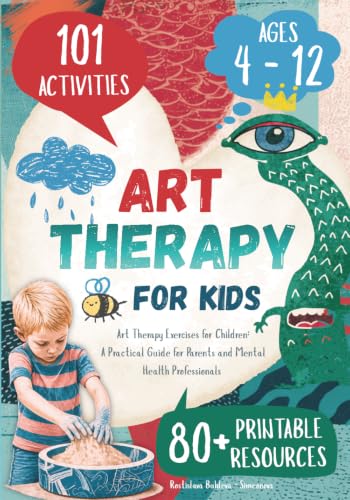
The Family Portrait is one exercise from a chapter on family transitions in 101 Art Therapy Exercises for Children: A Practical Guide for Parents and Mental Health Professionals — alongside Draw a Wall, which gives the child a way to externalise the boundaries and barriers they are experiencing within the changed family; Winds of Change, which invites the child to represent what has shifted and what has remained stable; and Time and Space Machine, which offers a forward-oriented visualisation of the family across time and across the different spaces it now inhabits.
Together, these exercises provide the range of approaches — loss-oriented and restoration-oriented, backward-looking and forward-facing, focused on difficulty and focused on continuity — that comprehensive support for a child navigating family change requires.
The book contains 101 exercises structured across three age groups — 4 to 6, 7 to 9, and 10 to 12 — each activity informed by validated research demonstrating how creative engagement alters brain physiology, reduces cortisol, strengthens neural flexibility, and enhances emotional regulation. Every session comes with a clear therapeutic rationale, step-by-step guidance, reflection questions, and guidance on how to observe and respond to what emerges — without diagnosis, without pressure, and without losing sight of the child as the author of their own experience.
Before You Begin: A Note on Professional Support
Before attempting any art therapy exercises at home with a child who is navigating a significant family transition, I would sincerely recommend consulting a qualified mental health professional. The exercises described in this article are offered as a supportive resource — not as a replacement for clinical assessment and ongoing therapeutic care. Where the transition is accompanied by significant distress, regression, or deterioration in the child’s functioning, professional support is essential.
Three Things Worth Knowing
The child’s portrait of the family is data, not decoration.
The most important thing any adult can do with a Family Portrait exercise is resist the urge to evaluate, correct, or redirect what the child draws. The portrait that does not include a parent, that places the child far from everyone else, that uses dark colours across the whole page — these are not wrong answers. They are the child’s current internal model of the family, expressed in the only language that was available to them in that moment. Receive it with genuine curiosity rather than alarm, and let it inform how you support the child in the weeks that follow.
Family transitions generate emotions that cannot always be said.
The art medium is not a workaround for children who are too young to talk about their feelings. It is the right tool for an emotional situation that is genuinely too complex for language alone — for the simultaneous love and anger, the mixed relief and grief, the feelings that are unwelcome to the adults who are also navigating the transition. Art holds contradictions without demanding they be resolved. That is not a minor convenience. It is the central clinical virtue of art therapy for children during family change.
You are the most important tool in the room.
Art therapy for children during family change is not delivered by exercises. It is delivered through the quality of the relationship within which those exercises are offered. A warm, steady, genuinely present adult who communicates — through their own regulated, non-anxious presence — that the child’s experience of the transition is legitimate and worth attending to, is providing the most powerful support available. The exercises are the invitation. You are the reason the child believes the invitation is safe enough to accept.
Ready to Go Further?
If this exploration of art therapy for children during family change gave you a sense of what becomes possible when children are given a creative space that belongs entirely to them in the middle of a world that has changed, 101 Art Therapy Exercises for Children: A Practical Guide for Parents and Mental Health Professionals gives you 101 more tools built on the same foundation — grounded in neuroscience, informed by developmental research, and written for every adult who has ever sat beside a child navigating change and wished they had something more to offer than reassurance.
Disclaimer: This article is intended as an educational and supportive resource for parents, caregivers, educators, and mental health professionals. It is not intended to diagnose, treat, or replace professional therapeutic or medical care. If a child is experiencing significant emotional, behavioural, or developmental difficulties, please seek guidance from a qualified mental health professional.

Rostislava Buhleva-Simeonova is a psychologist and game design specialist. She has worked with children, adults, and the elderly within various therapeutic programmes over the past eight years, all the while providing the much-needed playful twist that art and gamified experiences can bring to this sometimes uneasy setting. But it wasn’t until the birth of her daughter, Aurora, that this work took on an even deeper personal meaning. With her academic and real-life experience, honed through numerous trainings and sessions, she is currently authoring books and articles in the field of child psychology and development, offering expertise in art and play therapy to guide parents and caregivers, as well as professionals in the fields of social work and mental health, throughout various pivotal moments in children’s lives. Last but not least, all of her books have been “peer-reviewed” by her daughter, who testifies to the efficiency of these methods.
References
Chebotaryova, A. (2009). A child’s use of transitional objects in art therapy to cope with divorce. Art Therapy: Journal of the American Art Therapy Association, 26(1), 19–25. https://files.eric.ed.gov/fulltext/EJ833505.pdf
Exploring the use of arts-based interventions and research methods in families of seriously ill children: A scoping review. (2023). PMC. https://pmc.ncbi.nlm.nih.gov/articles/PMC10629247/
Malchiodi, C. (2011). Handbook of art therapy (2nd ed.). Guilford Press.
Regev, D., & Cohen-Yatziv, L. (2018). Effectiveness of art therapy with adult clients in 2018 — What progress has been made? Frontiers in Psychology, 9, 1531.
Treviño, A. (2026). Creative rituals: Family art therapy in the context of divorce in Mexico. Journal of Marital and Family Therapy. https://doi.org/10.1111/jmft.70107
Versitano, S., Tesson, S., Lee, C., Linnell, S., & Perkes, I. (2025). Art therapy with children and adolescents experiencing acute or severe mental health conditions: A systematic review. Australian & New Zealand Journal of Psychiatry. https://doi.org/10.1177/00048674251361731
Webb-Ferebee, K. L. (2018). Create to thrive during family divide: Construction of an art therapy intervention program for children impacted by divorce. ResearchGate.
Zargar, Y., Niazi, Z., & Naami, A. (2023). The effectiveness of group art therapy on coping with divorce in 9 to 12 years old girls of divorced parents. Middle Eastern Journal of Disability Studies, 13, 42. http://jdisabilstud.org/article-1-2694-en.html