
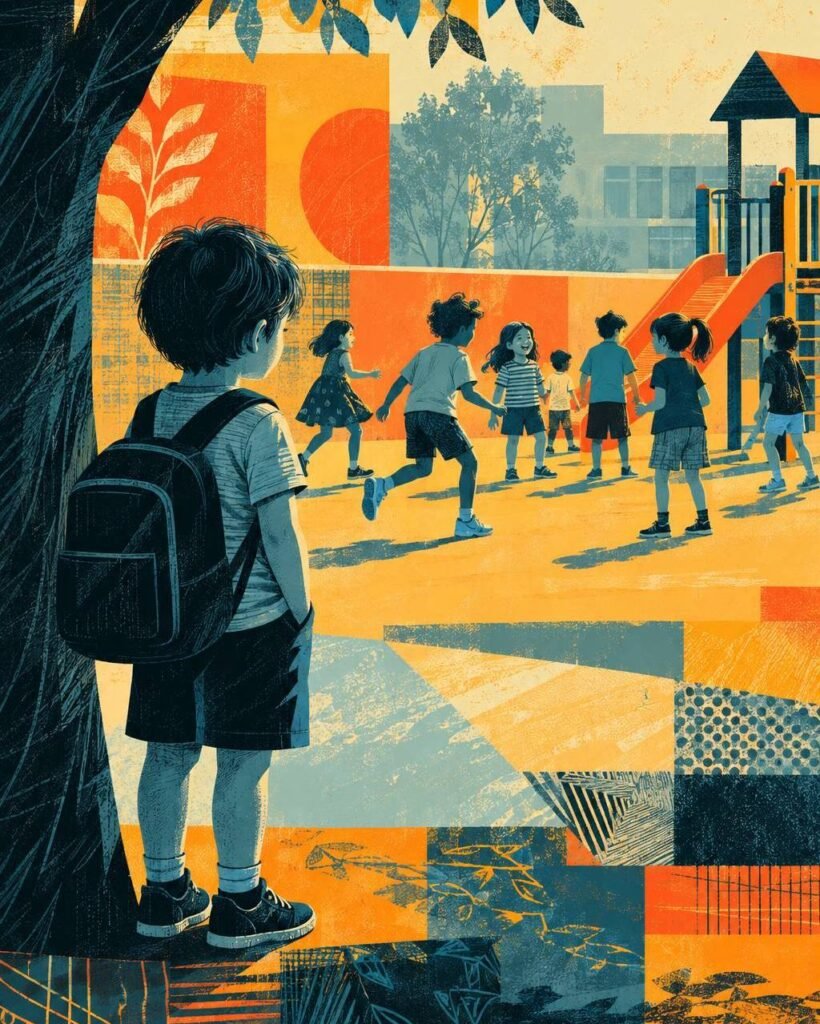
Every parent has watched a child navigate the social world of childhood and felt the particular helplessness of not being able to make it easier. The one who stands at the edge of the playground and cannot find the way in. The one who wants friends but consistently misreads the social signals that would help them find them. The one whose conflict resolution strategy is to either capitulate completely or escalate immediately, with nothing in between. The one who, in a world that feels increasingly connected and simultaneously increasingly lonely, is not quite finding the belonging that childhood is supposed to provide.
Social skills, peer relationships, and the capacity for empathy and conflict resolution are not simply personality traits that children either have or do not have. They are developmental capacities — built through experience, through relationship, through the repeated, supported practice of reading other people’s signals, managing one’s own reactions, and navigating the gap between what one wants from a social interaction and what one is able to produce within it. And they are capacities that, when they are underdeveloped or disrupted, have measurable consequences for the child’s mental health, academic functioning, and long-term wellbeing.
Art therapy for social skills in children addresses this not through instruction or social skills curricula but through the medium that builds these capacities most naturally: creative, group-based, relationally embedded experience that requires and develops the very skills it is intended to build.
A Note on the Evidence
Before exploring the research, it is worth being transparent about where the evidence is strongest and where it is thinner — because the same intellectual honesty that applies across all the articles in this series applies here.
The evidence for art therapy’s effectiveness in building social connection, reducing loneliness, and improving empathy in children is reasonably strong — particularly for group-based art therapy formats, which inherently provide the social medium within which these capacities develop. The evidence for art therapy specifically addressing bullying outcomes is thinner: most of the peer-reviewed bullying literature focuses on prevention curricula rather than art therapy interventions, and the art therapy studies that do exist are smaller in scale and narrower in scope. This article is honest about that distinction — addressing bullying as a dimension of the broader social skills domain while accurately representing what the evidence directly confirms.
What the Research Shows
The research on art therapy for social skills and peer relationships in children has grown consistently across the past decade — with a notable acceleration since 2020, as the post-pandemic loneliness crisis in children and adolescents has generated both clinical urgency and research attention.
A 2024 study published in the Indian Journal of Psychiatry by Khanna and Rawat, examining group arts therapy with children, confirmed that group-format arts therapy specifically designed around peer connection produced meaningful improvements in social engagement, relational confidence, and the child’s sense of belonging within the group. The format itself — the shared creative experience, the collaborative making, the development of a group identity through the art — was identified as a key active ingredient: group art therapy provides the social medium within which social skills are practised and built, rather than simply taught about.
A 2024 paper published in the Canadian Art Therapy Association Journal, examining art therapy as a response to the loneliness crisis in youth in the post-pandemic world, confirmed that art therapy produces measurable reductions in loneliness and improvements in social connection — and identified the particular value of the art-making context as a non-coercive communal space in which social interaction is structured but not forced, making it accessible to children who struggle with the more unpredictable demands of unstructured peer interaction.
A 2022 qualitative study published in Children (MDPI), examining children’s own accounts of school-based arts therapies in an RCT-linked pilot study, found that children themselves consistently described the social and relational benefits of the arts therapy experience as among the most significant — reporting increased confidence in peer interactions, greater sense of belonging, and improved capacity to manage social conflict. The child-centred data is particularly valuable here: it confirms that the social benefits are experienced as real and meaningful by the children themselves, not only measured by external assessment tools.
A 2022 study published in the Journal of Early Childhood Education specifically examining art therapy with bullying victims aged five to six confirmed improvements in the children’s social behaviour following art therapy intervention — though the narrow age band and single-site design limit the generalisability of the finding. It is included here as the most directly on-topic evidence for the bullying dimension, while acknowledging that the evidence base for art therapy specifically targeting bullying outcomes remains thinner than for the broader social skills domain.
A 2025 systematic review of art therapy for children with autism spectrum disorder, published in Healthcare, confirmed that art therapy produces meaningful improvements in social interaction, communication, and adaptive behaviour — with social skill gains particularly pronounced in group-based delivery formats. While the ASD population has specific characteristics, the mechanisms through which group art therapy builds social skills are consistent across presentations: the shared creative medium provides a structured, low-threat context for social engagement that allows gradual development of the relational capacities that more direct social interaction demands.
A 2023 systematic review of participatory arts-based programmes for youth mental health, published in the Journal of Child Psychology and Psychiatry, identified specific therapeutic processes that arts-based group programmes reliably produce — including subversion of restrictive social norms, creation of non-coercive communal spaces, and invitation to embodied play — and confirmed that these processes are associated with improvements in social-emotional wellbeing across diverse child and adolescent populations.
Why Art Therapy Builds Social Skills
The clinical case for art therapy as a social skills intervention for children rests on a straightforward developmental observation: social skills are not built through instruction alone. They are built through practice — repeated, supported, low-stakes practice of the specific interpersonal capacities that peer relationships require. And group art therapy provides exactly this: a structured, creative, relationally embedded context in which children practise reading each other, responding to each other, negotiating shared projects, tolerating differences in approach and outcome, and developing the particular kind of collaborative attunement that genuine peer connection requires.
The non-verbal dimension of art-making is particularly significant for children whose social difficulties are rooted in the anxiety that direct verbal interaction generates. Art provides a medium that is shared but not demanding — a focus for joint attention that reduces the performance pressure of face-to-face social interaction while maintaining the relational engagement that develops social capacity. Children who struggle to connect through conversation can connect through making something together — and that connection, repeated across sessions, builds the confidence and the felt sense of social competence that more direct approaches cannot replicate.
The empathy-building dimension of art therapy is equally important. Art therapy consistently develops perspective-taking through the particular mechanisms of symbolic play, character creation, and the shared interpretation of image. A child who has drawn how a social situation felt from their own perspective and then been asked to imagine how it looked from another person’s perspective has done genuine empathy work — grounded in the concrete and the visual rather than in abstract instruction, producing the kind of embodied, emotionally resonant empathy that changes behaviour rather than simply adding to a child’s knowledge about it.
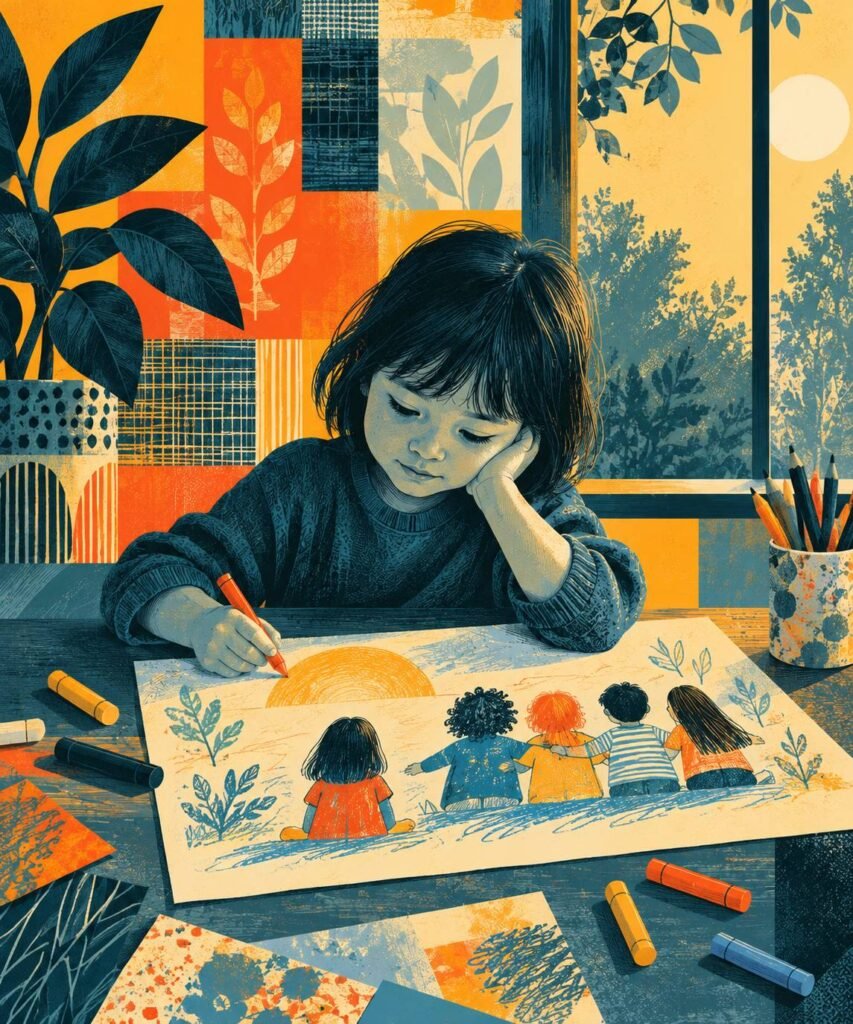
An Art Therapy Exercise for Social Skills: Conflict Compass
The Conflict Compass is one of the most practically useful exercises in the book for children who struggle specifically with conflict resolution — the large population of children who, when a social difficulty arises, have access to only one or two responses and cycle through them regardless of whether they fit the situation.
The exercise uses the compass metaphor to map the child’s conflict landscape. The four cardinal points represent four different responses to conflict — typically: move toward (engage directly, address it), move away (step back, give space), move with (find a compromise, go along for now), and stop (pause, take time before responding). The child draws or writes examples of when each direction might be the right choice — and then, crucially, reflects on which direction they most habitually go to, and whether that direction is always the most useful one.
What makes the Conflict Compass particularly effective as an art therapy exercise is the visual, spatial quality of the metaphor. The child who is habitual in their conflict response — who always moves toward or always moves away — can see, in the compass diagram, the directions they are not currently using. The four points are equally present on the page, equally accessible in principle, and the visual representation of that availability is itself a gentle reframe: there are more directions available than the one you usually take.
Once the compass is drawn and the reflection prompts are completed, explore it together with open questions:
- Which direction do you find yourself going to most often in a conflict?
- Can you think of a time when that direction made things better — and a time when it made things harder?
- Is there a direction on the compass you have never tried? What would it feel like to try it?
- If you could add a fifth direction to your compass, what would it be?
That last question is worth sitting with — because a child who invents a fifth direction has done something beyond the exercise’s original frame. They have begun to generate their own conflict resolution strategies, which is the developmental goal the compass is building toward.
For Deeper Work: 101 Art Therapy Exercises for Children
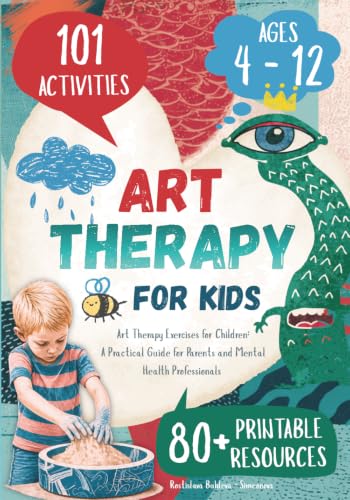
The Conflict Compass is one exercise from a chapter on social skills and peer relationships in 101 Art Therapy Exercises for Children: A Practical Guide for Parents and Mental Health Professionals — a book built around the understanding that social competence in children is built through creative, relational, experiential practice rather than instruction, within the safety of a warm, attuned, consistently present adult relationship.
The book contains 101 exercises structured across three age groups — 4 to 6, 7 to 9, and 10 to 12 — each activity informed by validated research demonstrating how creative engagement alters brain physiology, strengthens neural flexibility, and enhances emotional regulation. Every session comes with a clear therapeutic rationale, step-by-step guidance, reflection questions, and guidance on how to observe and respond to what emerges — without diagnosis, without pressure, and without losing sight of the child as the author of their own experience.
The social skills and peer relationships chapter addresses the full range of what social difficulty looks like in children: the child who is excluded and does not know why, the one whose social bids are consistently misread, the one whose conflict responses are limited and repetitive, the one who is lonely in a room full of people, and the one whose social anxiety keeps them at the edge of the belonging they most want.
Before You Begin: A Note on Professional Support
Before attempting any art therapy social skills exercises at home or in school with a child whose peer relationship difficulties are significantly impairing their daily functioning, I would sincerely recommend consulting a qualified mental health professional. The exercises described in this article are offered as a supportive resource — not as a replacement for clinical assessment and ongoing therapeutic care. Where social difficulties are accompanied by significant distress, bullying, withdrawal, or the specific social-cognitive profiles associated with neurodevelopmental differences, professional assessment is essential.
Three Things Worth Knowing
Social skills are built through practice, not through instruction.
The most important insight from the research on art therapy for social skills in children is that social competence is not a body of knowledge to be transmitted. It is a set of capacities to be developed — through repeated, supported, low-stakes practice of the specific interpersonal operations that peer relationships require. Group art therapy provides exactly this: a creative, structured, relationally embedded context in which social practice happens naturally, without the performance pressure that more direct social skill instruction tends to generate.
Art therapy for bullying specifically is a thinner evidence seam — but the mechanisms are sound.
The honest position on art therapy and bullying is this: the research directly confirming art therapy’s effectiveness for bullying outcomes is more limited than for the broader social skills domain. What the research does confirm — consistently and across multiple populations — is that art therapy builds the specific capacities that protect against bullying and support recovery from it: empathy, social confidence, conflict resolution, the sense of belonging, and the capacity to locate and articulate one’s own experience in a social context. These are not peripheral to bullying. They are precisely what bullying targets and what recovery requires.
You are the most important tool in the room.
Art therapy for social skills in children is not delivered by exercises. It is delivered through the quality of the relationship within which those exercises are offered. A warm, genuinely curious, non-evaluative adult presence — one that models the social attunement it is trying to build, that receives the child’s social world with interest rather than judgment, and that communicates through its own behaviour what good social engagement actually looks and feels like — is providing something that no curriculum can replicate. The exercises are the structure. You are the social model that makes the structure worth inhabiting.
Ready to Go Further?
If these art therapy exercises for social skills in children gave you a sense of what becomes possible when children are given a creative, relational context in which to practise the capacities that peer relationships require, 101 Art Therapy Exercises for Children: A Practical Guide for Parents and Mental Health Professionals gives you 101 more tools built on the same foundation — grounded in neuroscience, informed by developmental research, and written for every adult who has ever watched a child stand at the edge of belonging and wished they had something more to offer.
Disclaimer: This article is intended as an educational and supportive resource for parents, caregivers, educators, and mental health professionals. It is not intended to diagnose, treat, or replace professional therapeutic or medical care. If a child is experiencing significant emotional, behavioural, or developmental difficulties, please seek guidance from a qualified mental health professional.

Rostislava Buhleva-Simeonova is a psychologist and game design specialist. She has worked with children, adults, and the elderly within various therapeutic programmes over the past eight years, all the while providing the much-needed playful twist that art and gamified experiences can bring to this sometimes uneasy setting. But it wasn’t until the birth of her daughter, Aurora, that this work took on an even deeper personal meaning. With her academic and real-life experience, honed through numerous trainings and sessions, she is currently authoring books and articles in the field of child psychology and development, offering expertise in art and play therapy to guide parents and caregivers, as well as professionals in the fields of social work and mental health, throughout various pivotal moments in children’s lives. Last but not least, all of her books have been “peer-reviewed” by her daughter, who testifies to the efficiency of these methods.
References
Canadian Art Therapy Association Journal. (2024). Art therapy as a safe haven: Addressing the loneliness crisis and reimagining connection in a post-pandemic world. https://doi.org/10.1080/26907240.2024.2428522
Freilich, R., & Shechtman, Z. (2010). The contribution of art therapy to the social, emotional, and academic adjustment of children with learning disabilities. The Arts in Psychotherapy, 37(2), 97–105.
Healthcare. (2025). The effectiveness of art therapy on children and adolescents with ASD: A systematic review of RCTs. https://doi.org/10.3390/healthcare13222960
Journal of Child Psychology and Psychiatry. (2023). Practitioner review: Effectiveness and mechanisms of change in participatory arts-based programmes for promoting youth mental health and well-being — a systematic review.
Journal of Early Childhood Education (JECE). (2022). Art therapy on bullying-victims behavior aged 5–6. https://journal.uinjkt.ac.id/index.php/jece/article/view/20282
Khanna, A., & Rawat, O. (2024). The Art Circle: A group experience using arts-based therapy with children. Indian Journal of Psychiatry. https://doi.org/10.1177/09731342241239853
Moula, Z., et al. (2022). Qualitative and arts-based evidence from children participating in a pilot randomised controlled study of school-based arts therapies. Children (MDPI). https://pmc.ncbi.nlm.nih.gov/articles/PMC9221561/
Nature Index. (2024). Art therapy interventions for mental health in children and adolescents. https://www.nature.com/nature-index/topics/l4/art-therapy-interventions-for-mental-health-in-children-and-adolescents
Versitano, S., Tesson, S., Lee, C., Linnell, S., & Perkes, I. (2025). Art therapy with children and adolescents experiencing acute or severe mental health conditions: A systematic review. Australian & New Zealand Journal of Psychiatry. https://doi.org/10.1177/00048674251361731
Wu, J.-F., & Chung, C.-Y. (2023). Art therapy as an intervention for children: A bibliometric analysis of publications from 1990 to 2020. SAGE Open. https://doi.org/10.1177/21582440231219143