
Every parent has had the experience of watching their child be someone slightly different in public than they are at home. The child who is confident and loud in the living room and quiet at the school gate. The one who performs competence in front of peers but collapses into uncertainty the moment the door closes. The one who smiles at the party and cries in the car on the way home. This is not deception. It is the entirely normal, developmentally appropriate phenomenon of a child who has an outer self and an inner self — and who has not yet been given the language or the space to look at both at the same time.
Self-awareness — the capacity to know what one is actually feeling, thinking, and caring about on the inside, and to understand how that relates to what one presents on the outside — is one of the foundational capacities of emotional intelligence. It is also one of the most consistently underdeveloped, because the social world of childhood provides abundant feedback about the outer self — how one appears, how one behaves, what others think — and very little structured invitation to attend to the inner one.
A well-designed self-awareness worksheet for kids does not simply ask a child how they feel. It holds up a mirror that has two sides — and invites the child to look honestly at both.
What Self-Awareness Actually Is in Child Development
Self-awareness in children is not a single capacity. It is a cluster of related abilities that develop gradually across childhood: the ability to notice one’s own emotional states, to understand that one’s inner experience may differ from what others see, to reflect on one’s own thoughts and values, and to hold the outer and inner versions of oneself in mind simultaneously without needing to collapse one into the other.
Research on emotional intelligence consistently identifies self-awareness as its foundational component — the capacity on which empathy, self-regulation, social skills, and motivation all rest. A child who does not know what they are feeling cannot regulate that feeling. A child who does not know what they value cannot make choices that are genuinely aligned with those values. And a child who has learned to keep the inner self entirely hidden from the outer one — through the social pressures of fitting in, through the experience of having inner states dismissed or minimised, or through the learned belief that what they feel on the inside is not welcome in the world — is a child whose self-awareness has been specifically and consequentially impaired.
A 2025 study published in Education Sciences, examining gamification and emotional intelligence development in children, confirmed that children’s emotion management and identification skills develop most effectively when they are given structured opportunities to attend to their own inner experience — and that parents who are more emotionally aware have strategies that support and encourage children to express their feelings, which helps develop emotional intelligence. The dual self-portrait exercise provides exactly this: a structured, visual, developmentally accessible invitation to attend to both the outer and inner self simultaneously, in a medium that does not require verbal articulateness and does not carry the social risk of direct disclosure.
The Gap Between Outer and Inner Self — Why It Matters Clinically
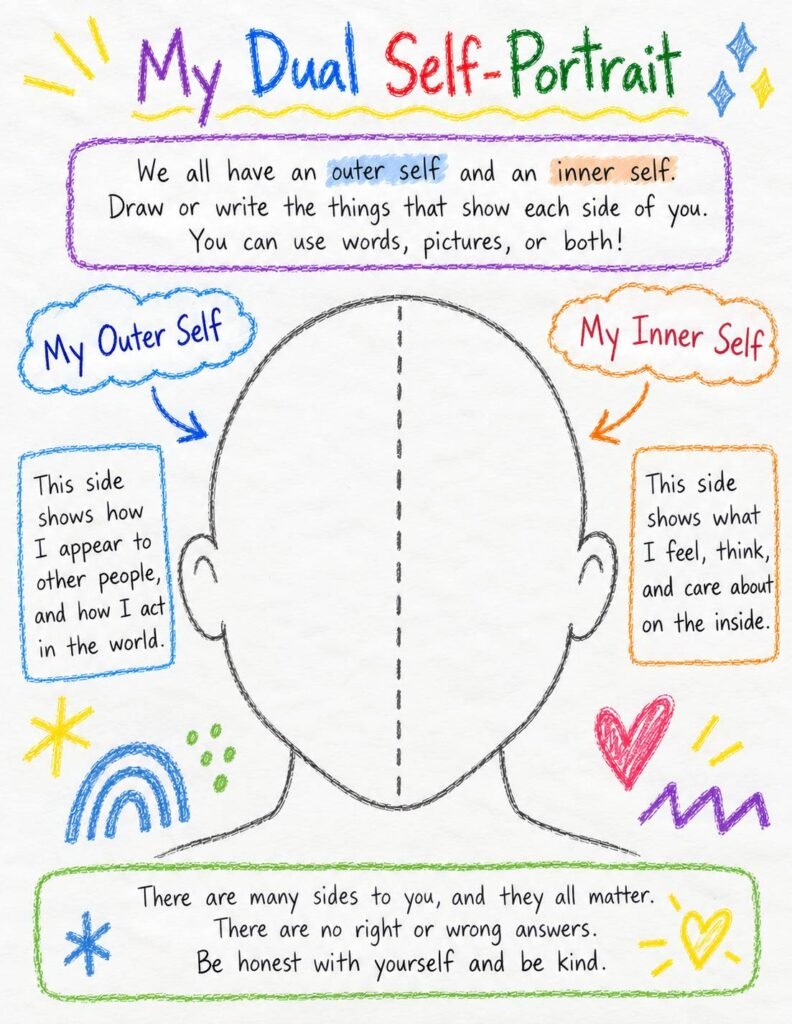
One of the most therapeutically significant features of the My Dual Self-Portrait worksheet is the explicit naming of the gap between outer and inner self — the acknowledgement, built into the worksheet’s very structure, that these two sides exist and that they may not be the same.
For many children, this acknowledgement is itself therapeutic. The child who has learned that their inner experience does not match what is expected of them — who is told they should feel grateful when they feel resentful, or brave when they feel terrified, or happy when they feel sad — develops a relationship to their own inner life that is characterised by disconnection, dismissal, and the gradual, cumulative sense that what they feel on the inside is not quite valid. The dual self-portrait does not need to do anything elaborate to begin addressing this. Simply providing a space for the inner self — a defined, legitimised space that is specifically designated for what I feel, think, and care about on the inside — communicates something that no amount of reassurance can fully replicate: that the inner self exists, that it matters, and that it is worth looking at.
The outer self side of the portrait — how I appear to other people, and how I act in the world — is equally important clinically, because it externalises the performed or presented self in a way that allows the child to see it from the outside. A child who has drawn what they look like to others, what they do in the world, how they act — has, in the act of drawing it, created a small but significant distance from it. The performance is on the page. And from that slight distance, the comparison with the inner self becomes possible in a way that it rarely is when both sides are experienced simultaneously from the inside.
Free Self-Awareness Worksheet for Kids: My Dual Self-Portrait
The worksheet below — My Dual Self-Portrait — is a free resource you can use with your child today. It is suitable for children aged approximately 6 to 12, and works equally well at home, in school, or in a therapeutic setting. It is clean, inviting, and built around one of the most therapeutically elegant frames available for self-awareness work with children: the human figure, divided down the centre.
How to Use It
Place the worksheet in front of your child with a warm, open introduction — genuinely curious rather than directive: “We all have an outer self and an inner self — the part people see and the part only you really know. This is your space to draw or write both. There are no right answers. Just what’s true for you.” Then step back. Give the child time and space to work without commentary or suggestion.
The inner self side typically takes longer than the outer self side — which is itself useful information. A child who fills the outer self quickly and sits with the inner self for a long time is showing you something about where their self-knowledge currently sits. A child who leaves the inner self sparse or vague while the outer self is detailed is showing you something different. Neither is wrong. Both are worth noting gently.
Once the portrait is complete, explore it together with open, unhurried questions:
- Is there anything on the inner self side that surprised you — something you didn’t expect to put there?
- Is there anything on the outer self side that doesn’t feel quite like you — something you do or show that isn’t really how you feel inside?
- Is there anything that appears on both sides — something that is the same inside and outside?
- Is there anyone in your life who gets to see both sides of you?
- If you could let one thing from the inner self be more visible on the outside, what would it be?
That last question is worth sitting with — because a child who can name something from their inner self that they would like to bring outward has already begun the most significant movement that self-awareness work makes possible: the gradual, chosen, self-directed integration of the inner and outer self.
The most important thing is not the answers. It is the quality of attention you bring to hearing them — and the consistent message that both sides of the portrait matter, and that the child who made it is more than either side alone.
For Deeper Work: 101 Art Therapy Exercises for Children
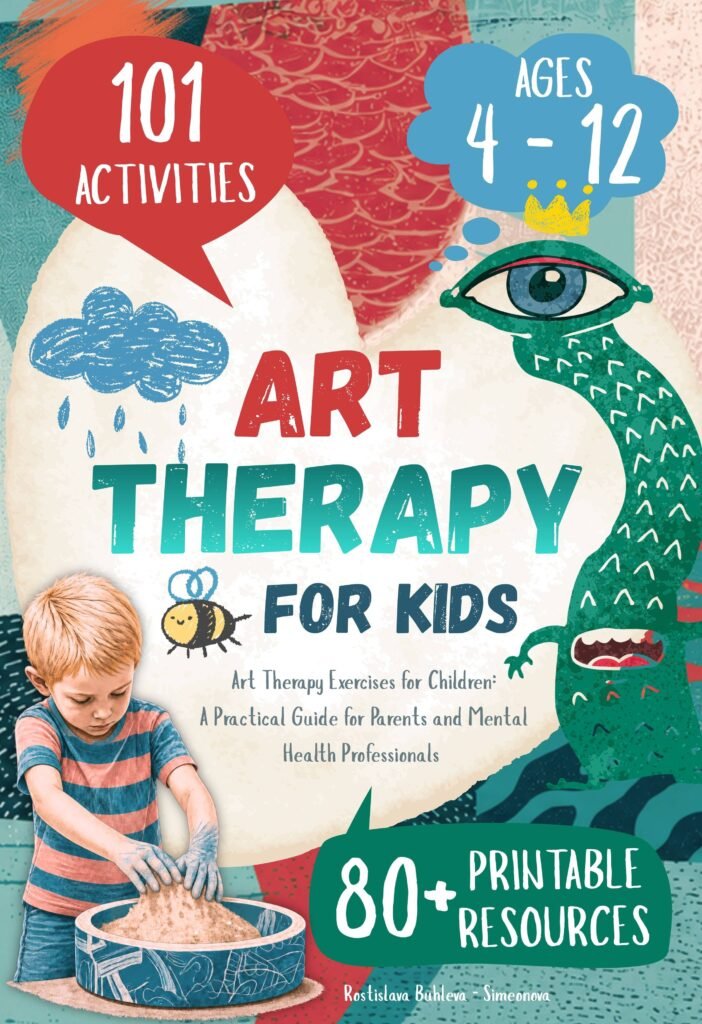
My Dual Self-Portrait is one example of the kind of identity-centred, self-awareness-building tool available in 101 Art Therapy Exercises for Children: A Practical Guide for Parents and Mental Health Professionals — a book built around the understanding that children develop genuine self-knowledge not through instruction but through the direct, creative, visually mediated experience of looking at themselves honestly.
The book contains 101 exercises structured across three age groups — 4 to 6, 7 to 9, and 10 to 12 — each activity informed by validated research demonstrating how creative engagement alters brain physiology, strengthens neural flexibility, and enhances emotional regulation. Every session comes with a clear therapeutic rationale, step-by-step guidance, reflection questions, and guidance on how to observe and respond to what emerges — without diagnosis, without pressure, and without losing sight of the child as the author of their own experience.
The self-awareness and identity chapter addresses the full range of what limited self-awareness looks like in children: the child who has learned to suppress the inner self entirely in the service of social acceptance, the one who performs confidence they do not feel, the one who has no language for their inner experience because no one has ever asked, and the one whose outer and inner selves have diverged so significantly that the gap itself has become a source of anxiety and shame.
Before You Begin: A Note on Professional Support
Before attempting any self-awareness or identity exercises at home with a child who is experiencing significant emotional, behavioural, or identity-related difficulties, I would sincerely recommend consulting a qualified mental health professional. The exercises described in this article are offered as a supportive resource — not as a replacement for clinical assessment and ongoing therapeutic care.
Three Things Worth Knowing
The inner self needs a designated space.
The most important thing a self-awareness worksheet for kids can do is not produce insight — it is create the conditions under which insight becomes possible. For most children, the inner self does not get a designated space. It gets managed, suppressed, performed around, or simply not attended to in the course of a day that is structured almost entirely around the outer self. The dual self-portrait creates that space — bounded, legitimised, and specifically designated for what is actually happening inside. That space alone, offered consistently and received with genuine interest, builds self-awareness in ways that no amount of direct questioning can replicate.
What the child leaves blank is as important as what they fill in.
The gaps in the dual self-portrait — the inner self side that is left sparse, the outer self side that is filled in quickly and without reflection, the particular quality that appears on neither side — carry as much information as the content that is present. Stay curious about what is not there. A child who has nothing to put on the inner self side has told you something important about their current relationship to their own inner experience. That is not a problem to be fixed in the session. It is a starting point.
You are the most important tool in the room.
The worksheet creates the space for self-awareness. You are the reason the child is willing to be honest in it. A child who has experienced, consistently and specifically, the genuine curiosity and warm regard of an adult who receives whatever they find on the inside without alarm, without evaluation, and without the urge to make it different — that child is a child who gradually becomes willing to look more honestly. The portrait is the invitation. Your unhurried, genuinely interested presence is what makes the looking feel safe enough to do.
Ready to Go Further?
If this free self-awareness worksheet for kids gave you a sense of what becomes possible when children are given a structured, honest, compassionate space to see both sides of who they are, 101 Art Therapy Exercises for Children: A Practical Guide for Parents and Mental Health Professionals gives you 101 more tools built on the same foundation — grounded in neuroscience, informed by developmental research, and written for every adult who has ever sat beside a child and wished they had something more to offer than a question.
Disclaimer: This article is intended as an educational and supportive resource for parents, caregivers, educators, and mental health professionals. It is not intended to diagnose, treat, or replace professional therapeutic or medical care. If a child is experiencing significant emotional, behavioural, or developmental difficulties, please seek guidance from a qualified mental health professional.

Rostislava Buhleva-Simeonova is a psychologist and game design specialist. She has worked with children, adults, and the elderly within various therapeutic programmes over the past eight years, all the while providing the much-needed playful twist that art and gamified experiences can bring to this sometimes uneasy setting. But it wasn’t until the birth of her daughter, Aurora, that this work took on an even deeper personal meaning. With her academic and real-life experience, honed through numerous trainings and sessions, she is currently authoring books and articles in the field of child psychology and development, offering expertise in art and play therapy to guide parents and caregivers, as well as professionals in the fields of social work and mental health, throughout various pivotal moments in children’s lives. Last but not least, all of her books have been “peer-reviewed” by her daughter, who testifies to the efficiency of these methods.