
Every parent has watched a child struggle to answer a question that seems, on the surface, simple. Not a difficult academic question or a complex social one — but the most fundamental question of all. Who are you? What do you love? What do you dream about? What do you want to see more of in the world? And who, in your life, actually sees you — not the version of you that performs and manages and tries to get things right, but the real one underneath?
Children are surrounded by feedback about what they do — their grades, their behaviour, their social performance, their achievements and failures. They receive considerably less structured invitation to attend to who they actually are: what matters to them specifically, what they care about that has nothing to do with performance, who they hope to become, and who in their world has genuinely seen them for it.
A well-designed who am I worksheet for kids does not simply list facts about the child. It asks four questions that together build a picture of the self that is both grounded in the present — who I am now, who sees me — and oriented toward the future — what I want to see in the world, and who I hope to become. That combination, specific and personal and forward-facing, is what makes the difference between a worksheet that produces information and one that produces genuine self-knowledge.
Why Children Need Structured Opportunities for Self-Reflection
The development of a coherent, stable, personally meaningful sense of self — what developmental psychologists call self-concept — does not happen automatically. It is built through the accumulated experience of being asked good questions, having the answers taken seriously, and gradually developing the internal language and the relational confidence to know and name what is genuinely one’s own.
Research on identity development consistently confirms that adolescents who have a clear sense of who they are demonstrate greater psychological wellbeing, lower anxiety, and stronger resilience under social pressure than those whose self-concept remains uncertain and dependent on external validation. And the foundations of that clear sense of self are laid not in adolescence but across the whole of childhood — through the repeated, small, specific experience of being known, being seen, and being invited to attend to one’s own inner world.
A 2024 longitudinal study published in Frontiers in Psychology confirmed that identity commitment is positively related to psychological wellbeing — and that the development of a stable sense of identity provides the emotional scaffolding that children and adolescents need to navigate comparison, challenge, and doubt. The who am I worksheet for kids that invites the child to name their strengths, their loves, their dreams, their values, and their future self is not simply a pleasant creative activity. It is building the internal evidence base on which a stable, resilient sense of identity depends.
Free Who Am I Worksheet for Kids: Now You See Me
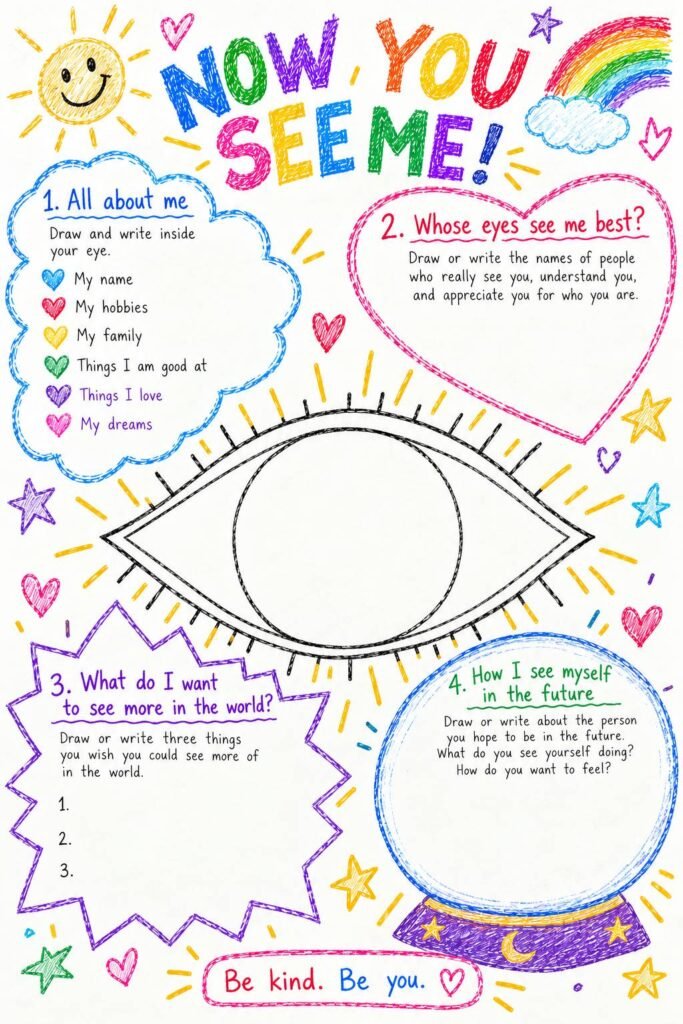
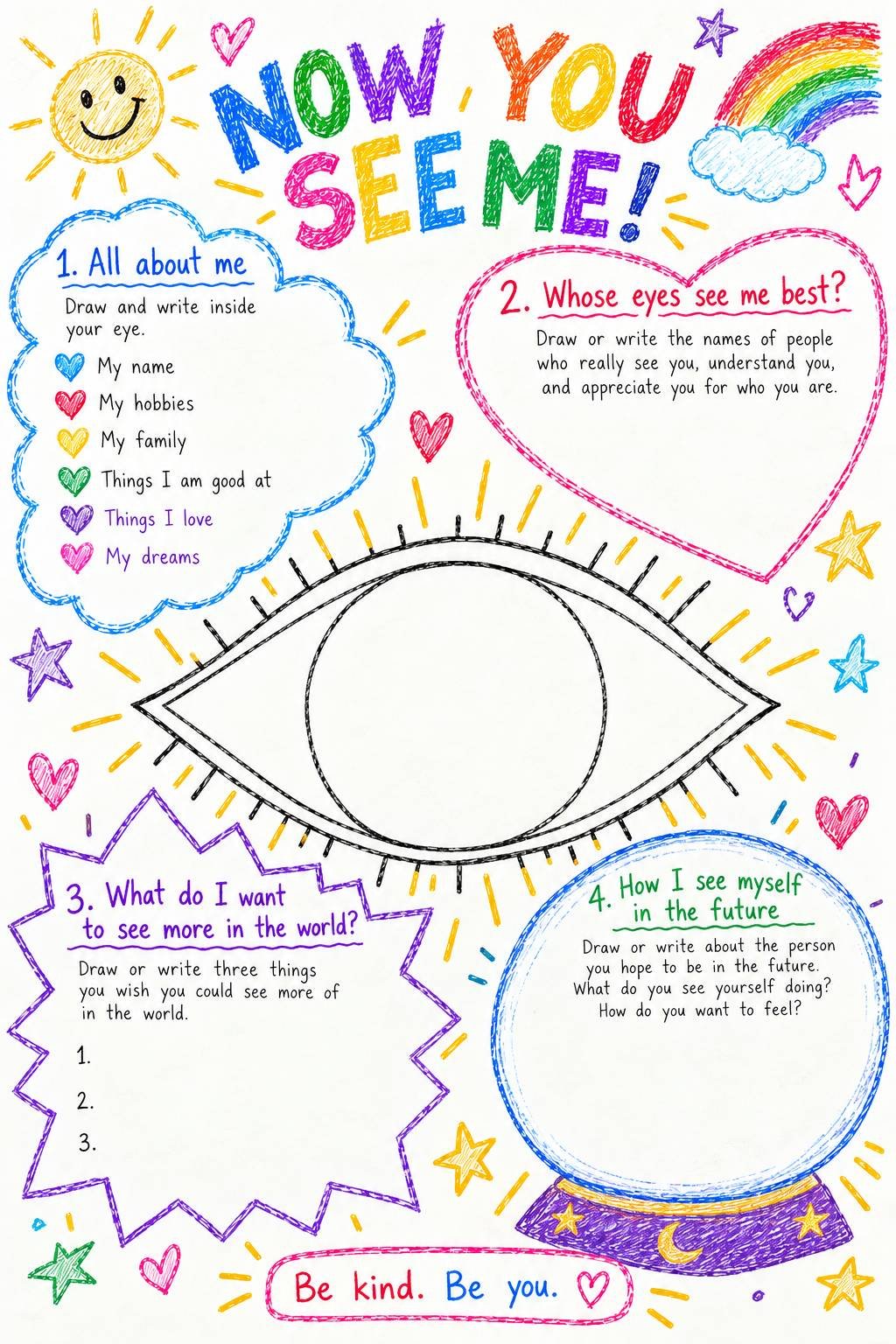
The worksheet below — Now You See Me — is a free resource you can use with your child today. It is suitable for children aged approximately 6 to 12, and works equally well at home, in school, or in a therapeutic setting. It is vivid, joyful, and structured around four questions that together constitute one of the most complete identity explorations available in a single worksheet.
How to Use It
Place the worksheet in front of your child with a warm, open introduction: “This is a worksheet all about you — who you are right now, who sees you, what you care about, and who you want to become. There are no right answers. Just what’s true for you.” Then step back. Give the child time and space to work through all four sections. You can ask gentle open-ended questions, but do not tell them what they should or should not write or draw.
Pay attention to the order in which the child approaches the sections — whether they go straight to the eye or avoid it, whether they spend longest on the people who see them or on the future self, whether any section is left sparse or blank. The pattern of engagement is as informative as the content.
Once the worksheet is complete, explore it together with open, unhurried questions:
- Of everything in your eye, which thing feels most like the real you?
- Is there something that belongs in your eye that you didn’t put in — something you weren’t sure about including?
- The people in your heart — do they know they’re there? Do they know they really see you?
- Of the three things you want to see more of in the world, is there one you could do something about yourself?
- When you look at the person in the crystal ball — does that feel possible, or does it feel far away?
That last question is worth sitting with. A child who says it feels possible has a different relationship to their own future than one who says it feels far away — and both answers deserve gentle, specific, genuinely curious follow-up. The most important thing is not the answers. It is the quality of attention you bring to hearing them.
For Deeper Work: The Play Therapy Toolbox
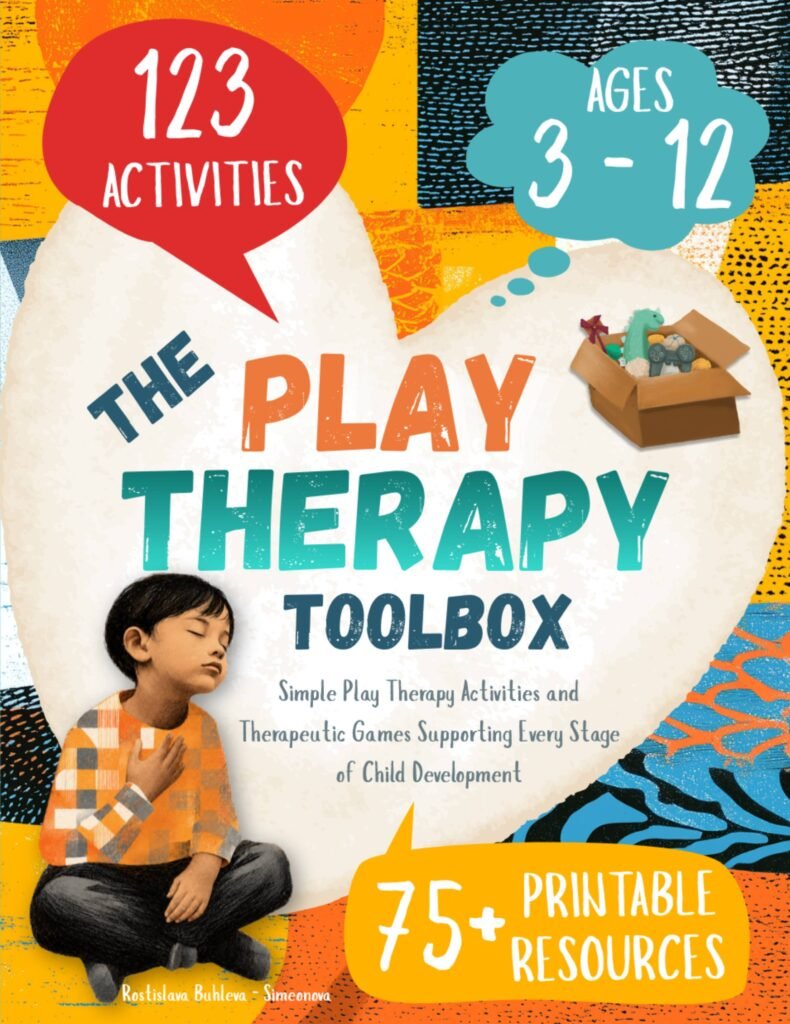
Now You See Me is one example of the kind of identity-building, self-concept-developing, relationally grounded tool that sits at the heart of The Play Therapy Toolbox: 123 Simple Play Therapy Activities and Therapeutic Games Supporting Every Stage of Child Development from Age 3 to 12 — a book built around the understanding that children speak in a language adults often forget they once spoke fluently themselves.
The book contains 123 activities spanning role-play, enactment, fantasy storytelling, somatic exercises, and gamified experiences, alongside 75+ printable, downloadable, full-colour worksheets designed to support and extend each activity. Every activity comes with a therapeutic rationale grounded in peer-reviewed research, step-by-step guidance on how to conduct the session and what to say, questions to use with the child, and a parent guidance note written in the same warm, accessible language as this article.
The identity, self-concept, and self-esteem chapters address the full range of what identity difficulties look like across the developmental stages: the child who has not yet accumulated sufficient evidence of their own particular worth, the one whose sense of self is entirely dependent on external validation, the one whose identity has been shaped by difficult experiences they did not choose, and the one who can describe what they do but not who they are. Every activity is cross-referenced in a comprehensive annex by presenting condition, age group, and page number — so you can navigate directly to the right tool for the right child at the right moment, without searching.
Before You Begin: A Note on Professional Support
Before attempting any identity or self-concept activities at home with a child who is experiencing significant emotional, behavioural, or identity-related difficulties, I would sincerely recommend consulting a qualified mental health professional. The exercises described in this article are offered as a supportive resource — not as a replacement for clinical assessment and ongoing therapeutic care.
Three Things Worth Knowing
Being seen is not the same as being praised.
The most important thing the whose eyes see me best section of this worksheet reveals is whether the child has experienced the specific relational quality that identity development most depends on: genuine recognition — the experience of being known for who one actually is rather than for what one does or achieves. A child who can name someone who really sees, understands, and appreciates them for who they are has a relational anchor for their identity that no amount of generic praise can replicate. If the heart is empty or uncertain, that is the most important thing the worksheet has told you.
Values are identity, not just opinion.
The what do I want to see more in the world section is not a survey of preferences. It is an identity question — one that asks the child to locate themselves as a person who cares about something, whose vision of the world reflects something genuinely their own. A child who has named what they want more of in the world has begun to understand themselves not only as a recipient of experience but as a potential contributor to it. That shift — from passive to agentic — is one of the most significant identity developments available to a child, and it begins with the simple act of being asked what they care about.
You are the most important tool in the room.
The worksheet asks who the child is. You are the reason they believe the answer is worth finding. A child who has experienced, consistently and specifically, the genuine curiosity and warm regard of an adult who takes their identity seriously — who asks real questions, receives real answers, and treats what the child knows about themselves as genuinely worth knowing — develops a self-concept that is grounded, specific, and resilient in the way that no worksheet alone can produce. Fill in your own eye. Show them your heart. Let them see that the question of who we are is one that grown-ups are still exploring — and that the exploring is always worth doing.
Available Now for $5.99 — For a Limited Time
If this free who am I worksheet for kids gave you a sense of what becomes possible when children are given a structured, warm, genuinely curious invitation to know and name who they are, The Play Therapy Toolbox gives you 123 more tools built on the same foundation. The ebook is available now on Amazon at $5.99 for a limited time — with immediate access to 123 activities and 75+ full-colour printable worksheets for children aged 3 to 12.
Play is not preparation for life. It is life — in its most honest, most essential, most healing form.

Disclaimer: This article is intended as an educational and supportive resource for parents, caregivers, educators, and mental health professionals. It is not intended to diagnose, treat, or replace professional therapeutic or medical care. If a child is experiencing significant emotional, behavioural, or developmental difficulties, please seek guidance from a qualified mental health professional.

Rostislava Buhleva-Simeonova is a psychologist and game design specialist. She has worked with children, adults, and the elderly within various therapeutic programmes over the past eight years, all the while providing the much-needed playful twist that art and gamified experiences can bring to this sometimes uneasy setting. But it wasn’t until the birth of her daughter, Aurora, that this work took on an even deeper personal meaning. With her academic and real-life experience, honed through numerous trainings and sessions, she is currently authoring books and articles in the field of child psychology and development, offering expertise in art and play therapy to guide parents and caregivers, as well as professionals in the fields of social work and mental health, throughout various pivotal moments in children’s lives. Last but not least, all of her books have been “peer-reviewed” by her daughter, who testifies to the efficiency of these methods.