
There is a particular kind of conversation that happens in the evening, usually when everyone is tired, when a child has had a difficult day and cannot find their way back from it. The frustration that has stuck. The disappointment that has not shifted. The feeling that things are wrong, or hard, or not what they should be — and the parent standing beside them, wanting to help, not quite sure what to offer.
Reassurance helps, sometimes. Distraction helps, sometimes. But what consistently helps most — what the research on children’s wellbeing identifies as one of the most reliable protective factors available across the childhood years — is something quieter and more specific than either. It is the practiced capacity to notice what is already good. Not to pretend the difficult things are not there. Not to force a positive spin on a genuinely hard day. But to hold both — the difficulty and the good — and to let the good have as much reality as the rest.
That capacity does not develop automatically. It is built — through practice, through structure, through the kind of gently repeated invitation to attend to what is good that the best gratitude activities for kids are specifically designed to provide.
What Gratitude Practice Actually Does
The research on gratitude in children is more substantial and more specific than its popular framing as a feel-good habit tends to suggest. Regular gratitude practice in children has been linked to improved subjective wellbeing, stronger peer relationships, greater academic engagement, reduced anxiety and depression symptoms, and — perhaps most significantly — greater resilience under stress. These are not marginal effects. They are the kinds of outcomes that appear consistently across diverse populations and across follow-up assessments that extend well beyond the intervention period.
The neuroscience behind these findings is now reasonably well understood. Gratitude activates the brain’s reward circuitry — producing dopamine release that reinforces the noticing-of-good as a habit. It engages the prefrontal cortex in a mode of positive appraisal that builds the neural pathways associated with optimism, perspective, and the capacity to hold complexity — to see the difficult and the good as simultaneously real. And it activates the social brain: gratitude that is directed toward other people — someone kind who made my day, a person I appreciate so much — generates the neurochemical responses associated with social connection and belonging.
What all of this means practically is that gratitude activities for kids that are specific, personal, regularly practiced, and directed at both the external world and the child’s own inner life, produce the full range of these effects. Generic gratitude — the rote listing of things I am thankful for — produces some of them. Specific, visual, personally meaningful gratitude — the kind that asks not simply what are you grateful for but who made your day, what made you laugh, what small win are you proud of — produces considerably more.
Why a Gallery Changes Everything
The framing of a gratitude exercise as a gallery is not simply aesthetic. It is therapeutically precise in ways that are worth naming.
A gallery is curated. The child who fills a gallery is not listing everything that exists — they are choosing, selecting, deciding what belongs. That act of curation is itself an exercise in values and attention: what do I choose to put here? What is worth displaying? The gallery frame shifts the child from passive recipient of experience to active curator of their own world — and that shift, from passive to active, from endured to chosen, is one of the most significant moves available in any therapeutic or developmental context.
A gallery is also visual and spatial — it has frames, compositions, a visible structure that gives the gratitude content a form it can be looked at and returned to. The gratitude that lives in a journal entry is read once and turned past. The gratitude that lives in a gallery — sixteen illustrated frames, each one holding something specific — can be looked at as a whole, can be added to, can be shared, and can be returned to on difficult days as visual evidence that the good things were real.
And a gallery is designed to be seen. Not necessarily by others — though sharing it is a natural and beautiful extension of the exercise — but by the child themselves. The completed gallery is a self-portrait of what is already good in this particular child’s life. And that portrait, looked at in full, communicates something that no amount of adult reassurance can quite replicate: your world contains more good than you can hold in your mind at once.
Free Gratitude Activities for Kids: My Petit Gallery of Gratitude
The worksheet below — My Petit Gallery of Gratitude — is a free resource you can use with your child today. It is suitable for children aged approximately 6 to 12, and works equally well at home, in school, or in a therapeutic setting. It is beautifully illustrated, visually inviting, and structured around sixteen distinct frames — each one a different shape, each one holding a different prompt, each one contributing to a complete gallery of what is already good.
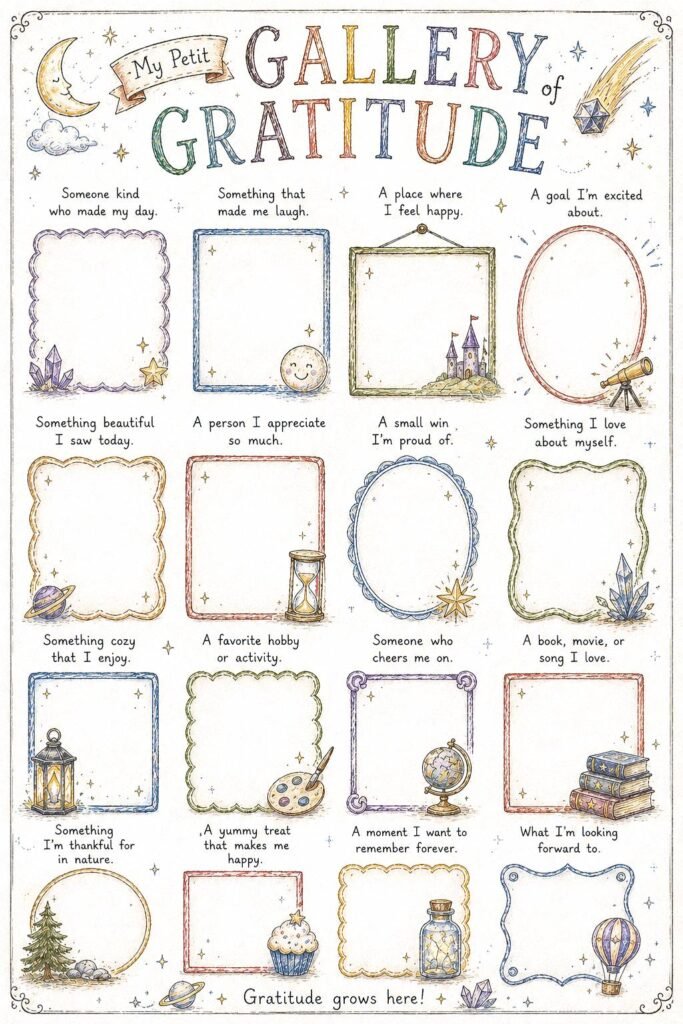
What makes this one of the most effective gratitude activities for kids is the range of what the sixteen prompts cover. They move through the relational — who made my day, who I appreciate, who cheers me on; the experiential — what made me laugh, something beautiful, a moment to remember; the self-regarding — a small win I’m proud of, something I love about myself; the sensory and comfort-based — something cosy, a favourite treat; and the forward-facing — a goal I’m excited about, what I’m looking forward to. Together, they produce a gratitude practice that is not only about what is good in the external world but about the child’s own worth, the relationships that hold them, and the future they are moving toward.
How to Use It
Sit with your child and place the worksheet between you. Introduce it simply and warmly: “This is your very own gallery — like a real art gallery, but made of things from your life. We’re going to fill each frame with something that matters to you.” Then follow the child’s pace. Some frames will fill immediately and confidently. Others — particularly a small win I’m proud of and something I love about myself — may need more time, more prompting, and more of the adult’s genuine, specific curiosity.
Those are the frames worth sitting with longest. A child who cannot immediately name something they love about themselves is not failing at the exercise. They are telling you something important about where their self-regard currently sits — and the act of staying with the question, gently and without pressure, until something genuine surfaces, is itself one of the most therapeutically significant moments the gallery can produce.
Once the gallery is complete, explore it together:
- Which frame was your favourite to fill in?
- Is there a frame you found harder than you expected?
- If you could only keep one frame — one thing you would always want to remember — which would it be?
- Which frame would you most like to look at on a really difficult day?
- Is there anything you wish there was a frame for — something good that doesn’t quite fit any of the prompts?
The most important thing is not the answers. It is the quality of attention you bring to hearing them — and the message that quality communicates: that what is good in your world is worth attending to, that your particular good things are worth knowing about, and that the gallery you just made is a portrait of something real.
For Deeper Work: The Play Therapy Toolbox
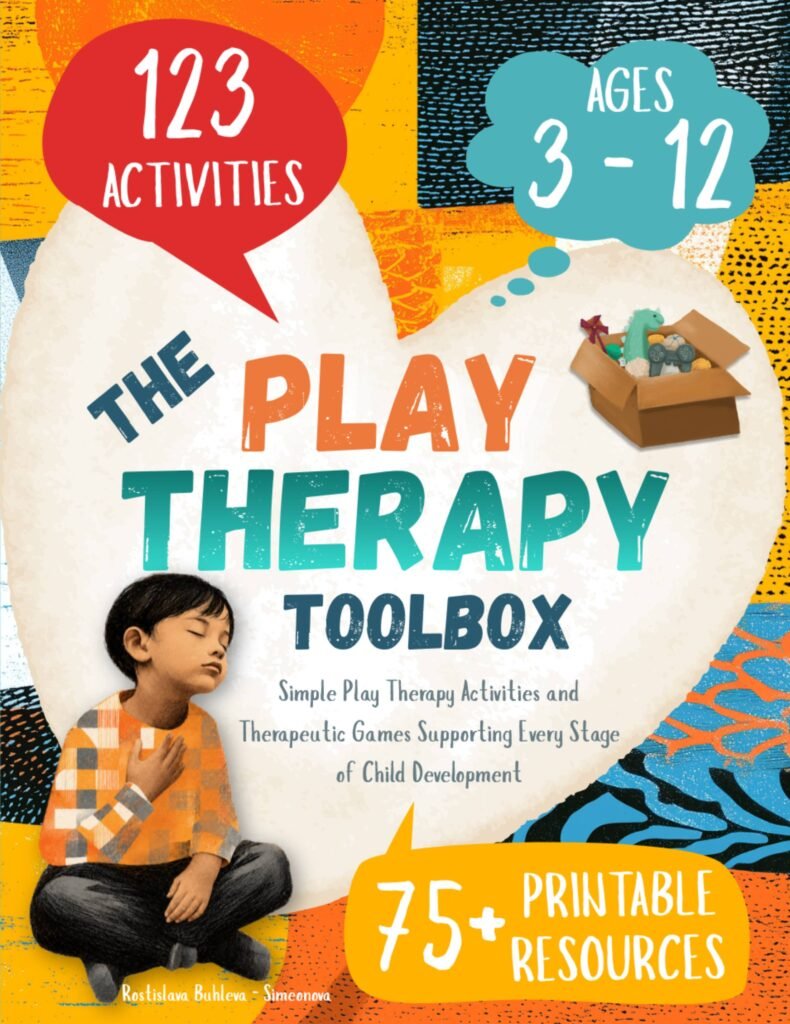
My Petit Gallery of Gratitude is one example of the kind of positive psychology-informed, visually rich, personally meaningful tool that sits at the heart of The Play Therapy Toolbox: 123 Simple Play Therapy Activities and Therapeutic Games Supporting Every Stage of Child Development from Age 3 to 12 — a book built around the understanding that children develop emotional resilience not through the absence of difficulty but through the practiced, supported capacity to hold difficulty alongside what is good.
The book contains 123 activities spanning role-play, enactment, fantasy storytelling, somatic exercises, and gamified experiences, alongside 75+ printable, downloadable, full-colour worksheets designed to support and extend each activity. Every activity comes with a therapeutic rationale grounded in peer-reviewed research, step-by-step guidance on how to conduct the session and what to say, questions to use with the child, and a parent guidance note written in the same warm, accessible language as this article.
The positive psychology, resilience, and wellbeing chapters address the full range of what gratitude practice is most effective for: the child who has developed a habitual negative attentional bias, the one whose anxiety makes the good things hard to see, the one who is navigating genuine difficulty and needs the practice of noticing what is good as a counterweight to what is hard, and the one who is simply developing — across ordinary childhood — the attentional habits that will shape their relationship to their own life for decades to come. Every activity is cross-referenced in a comprehensive annex by presenting condition, age group, and page number — so you can navigate directly to the right tool for the right child at the right moment, without searching.
Three Things Worth Knowing Before You Begin
Specific gratitude is more powerful than generic gratitude.
The research on gratitude practice consistently confirms that specificity is the variable that most determines how much benefit is produced. Someone was kind to me is less powerful than Mia let me sit with her when I didn’t know anyone. Something made me laugh is less powerful than the moment when the dog slipped on the kitchen floor and looked surprised. The gallery’s prompts are designed to produce specific responses — and when a child gives a vague answer, the most therapeutically productive response is gentle, genuine curiosity about the specific: tell me more about that, what exactly happened, what did it feel like?
Regular use builds more than crisis use.
Gratitude activities for kids work best when they are an ordinary, consistent, low-pressure part of daily or weekly life — not only reached for in moments of visible difficulty. A child who fills a frame or two regularly, who returns to their gallery and adds to it, who has the habit of noticing the good as a matter of course, builds a neural and attentional infrastructure that is available to them automatically in difficult moments. The gallery does not need to be completed in one sitting. It can be a living document that grows over time — which is, in many ways, both more beautiful and more therapeutically useful than a document that is finished.
You are the most important tool in the room.
The gallery holds what is good. You are the reason the child believes their good things are worth putting in a frame. A child who has experienced, consistently and specifically, the genuine curiosity and warm regard of an adult who takes what is good in their world seriously — who asks follow-up questions, who remembers what was in the frames, who treats the gallery as something worth returning to — develops a relationship to their own good things that no worksheet alone can produce. Sit down. Fill in your own frames. Let them see what you put in your gallery — and why.
Available Now for $5.99 — For a Limited Time
If these free gratitude activities for kids gave you a sense of what becomes possible when children are helped to see that their world contains more good than they can hold in their mind at once, The Play Therapy Toolbox gives you 123 more tools built on the same foundation. The ebook is available now on Amazon at $5.99 for a limited time — with immediate access to 123 activities and 75+ full-colour printable worksheets for children aged 3 to 12.
Play is not preparation for life. It is life — in its most honest, most essential, most healing form.

Disclaimer: This article is intended as an educational and supportive resource for parents, caregivers, educators, and mental health professionals. It is not intended to diagnose, treat, or replace professional therapeutic or medical care. If a child is experiencing significant emotional, behavioural, or developmental difficulties, please seek guidance from a qualified mental health professional.

Rostislava Buhleva-Simeonova is a psychologist and game design specialist. She has worked with children, adults, and the elderly within various therapeutic programmes over the past eight years, all the while providing the much-needed playful twist that art and gamified experiences can bring to this sometimes uneasy setting. But it wasn’t until the birth of her daughter, Aurora, that this work took on an even deeper personal meaning. With her academic and real-life experience, honed through numerous trainings and sessions, she is currently authoring books and articles in the field of child psychology and development, offering expertise in art and play therapy to guide parents and caregivers, as well as professionals in the fields of social work and mental health, throughout various pivotal moments in children’s lives. Last but not least, all of her books have been “peer-reviewed” by her daughter, who testifies to the efficiency of these methods.