
Most parents have encountered the names Piaget or Freud in a parenting book or a school newsletter. Fewer have been shown what those names actually mean — how the ideas behind them illuminate the child in front of you, and why they still matter.
These are not abstract theories. They were built by watching children: how they play, what they avoid, what they return to, how they grow. Each of the five child development theories in this article offers a different window into the same essential fact: that play is not a break from development. Play is how development happens.
This is the framework that runs through every activity in The Play Therapy Toolbox — the understanding that what a child does in play is always meaningful, even when it looks like nothing at all.
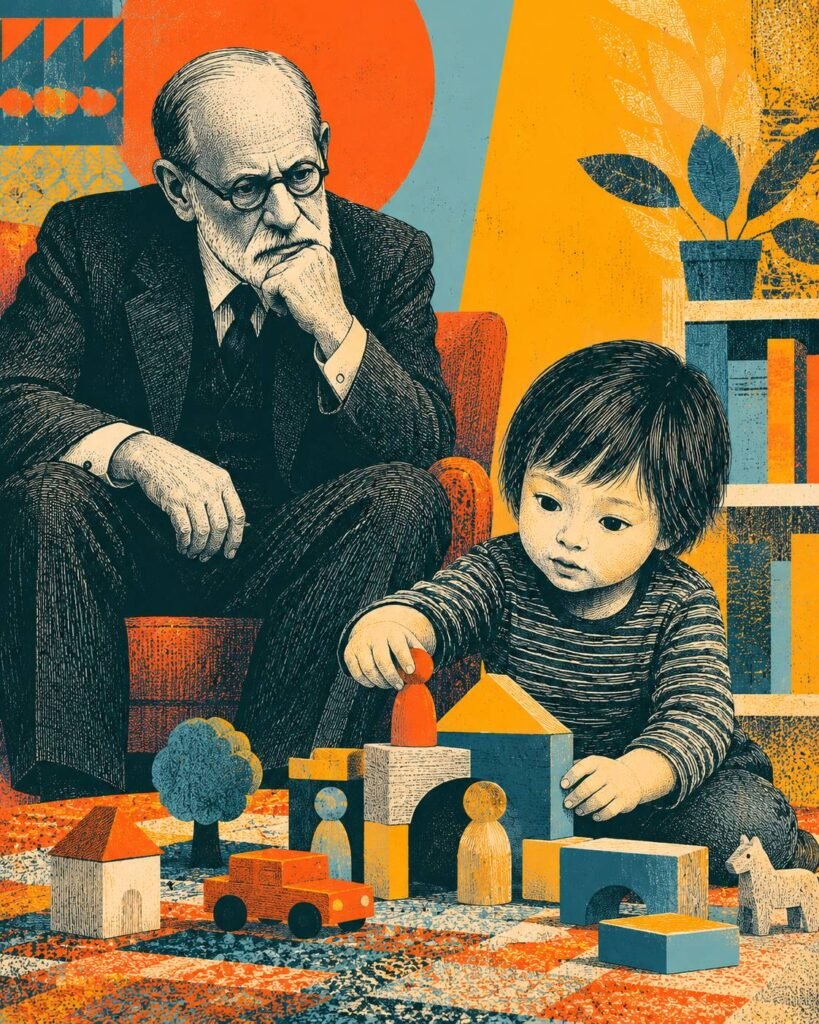
1. Sigmund Freud: Play as the Child’s Way of Processing What Hurts
Freud’s foundational insight — that much of what drives human behaviour originates below the level of conscious awareness — created the conceptual soil in which play therapy would later take root.
Children, he observed, cannot reliably access their inner world through language. But they can play. And in their play, they return again and again to the experiences that have disturbed them — re-enacting, reversing, working them over. He called this the repetition compulsion: not masochism, but the psyche’s deep need for completion. The child who sets up the same rescue scene every single session is not stuck. They are working.
Freud also gave us the structural model of the mind — the id (raw impulse), the ego (the mediating self), and the superego (the internalised voice of expectation). Play is the ego’s great workshop: the place where competing inner forces can be tried out and gradually integrated, without the consequences real life would bring.
What this means in practice: when a child plays something frightening, repetitive, or aggressive, they are usually not in danger — they are in process. The therapeutic response is not to stop the play but to stay present within it, curious and regulated.
Freud’s ideas are woven throughout The Play Therapy Toolbox, particularly in activities involving role reversal, dramatic enactment, and the therapeutic use of story — all of which give the child the chance to be the author of an experience, rather than its subject.
2. John Bowlby and Mary Ainsworth: Why Safety Comes Before Everything Else
Of all the child development theories covered here, Bowlby’s attachment theory may be the one with the most immediate consequence for parents.
Bowlby’s central claim was that the human infant’s bond to a primary caregiver is not a learned convenience but a biological imperative — as essential as food. When a caregiver responds with sensitivity and consistency, the infant’s nervous system is regulated, and a mental model of the world as fundamentally safe begins to form. Bowlby called this the internal working model. It shapes how a child approaches relationships, challenges, and uncertainty for the rest of their life.
Mary Ainsworth’s Strange Situation experiments made attachment visible. By observing how infants responded when briefly separated from their caregiver and reunited, she identified patterns: secure, anxious-ambivalent, and anxious-avoidant attachment — each with measurable consequences for emotional regulation and social development into adulthood.
The practical implication is stark: co-regulation must precede self-regulation. A child cannot manage their own emotional states until they have repeatedly experienced being regulated from the outside in, by a calm and attuned adult. The activities in this book are only as powerful as the relational safety within which they are offered. Building that safety, patiently and consistently, is always the first task.
The Play Therapy Toolbox incorporates attachment principles throughout — from how activities are introduced and paced, to the parent guidance notes that accompany every activity. The goal is never technique applied to a child. It is connection offered through a child.
3. Jean Piaget: Why Children Don’t Just Know Less Than Adults — They Think Differently
Piaget’s contribution to child development theories was to challenge the assumption that children are simply smaller, less-informed versions of adults. They are not. The child’s mind works according to different principles, and understanding those principles changes everything about how we communicate, teach, and support them.
His stage model describes four broad periods: the sensorimotor stage (birth to two years); the preoperational stage (two to seven years), when symbolic thinking emerges but logic is still egocentric; the concrete operational stage (seven to eleven years); and the formal operational stage (eleven onward), when abstract reasoning becomes fully possible.
The preoperational stage is the golden age of play therapy. It is the period in which a child can let one thing stand for another — a cardboard box becomes a spaceship, a puppet becomes the part of themselves they cannot yet speak as — without the logical constraints that would make such substitutions feel arbitrary. This is not magical thinking to be corrected. It is the developmentally appropriate way children process experience.
When you ask a four-year-old to “talk about their feelings,” you are asking them to use a cognitive tool — abstract verbal reflection — that is not yet fully available to them. When you offer them a puppet, a sandtray, or a drawing prompt, you are meeting them in the mode through which they actually think. That is not a simplification. It is precision.
The age-structured chapters in The Play Therapy Toolbox are built directly on Piaget’s framework — each section opens with a developmental overview of what children can actually do at that stage, cognitively and emotionally, and every activity is calibrated accordingly.
4. Lev Vygotsky: What a Child Can Do Alone, and What They Can Do With You
Where Piaget focused primarily on the individual child’s construction of understanding, Vygotsky emphasised that development is fundamentally social. Children do not grow in isolation — they grow in relationship, within culture, through interaction.
His most important concept for parents and practitioners is the Zone of Proximal Development (ZPD): the space between what a child can do independently and what they can do with the support of a more capable other. This is where learning lives. Not in what is already mastered, and not in what is completely beyond reach — but in the productive middle, where challenge and support meet.
The adult’s role in the ZPD is not to do the task for the child but to scaffold it — to offer just enough structure, encouragement, and modelling that the child can stretch into slightly more than they could manage alone. Over time, this scaffolding is withdrawn as the child internalises the capacity.
Applied to therapeutic play, this means that the way a caregiver or therapist participates in play matters enormously. Following the child’s lead, asking the question that opens the next door, staying in the story just long enough — these are not passive acts. They are the conditions under which growth happens.
Throughout The Play Therapy Toolbox, you will find this principle at work in the structured use of prompts, the therapeutic questions suggested after each activity, and the balance between child-led and guided play. The adult is always in the room — not directing, but not absent.
5. Erik Erikson: The Emotional Milestones Every Child Must Navigate
Erikson extended Freudian thinking into the full arc of the human lifespan, mapping a series of psychosocial crises — each representing a developmental task the person must work through to move forward with a stable sense of self.
The stages most relevant to the age range of this book are:
Autonomy versus shame and doubt (roughly ages 1–3): The toddler’s push for independence is not defiance — it is developmental necessity. A child who is shamed for exploring, failing, or asserting themselves develops doubt rather than confidence as their baseline orientation toward the world.
Initiative versus guilt (roughly ages 3–6): Children at this stage are naturally bold, curious, and experimental. When their initiatives are met with warmth and appropriate limits, they develop a sense of purpose. When they are repeatedly criticised or shut down, guilt becomes their dominant internal voice.
Industry versus inferiority (roughly ages 6–12): The school-age child needs to feel competent — to make things, solve things, contribute. Success builds industry; repeated failure, or comparison without support, builds a lasting sense of inferiority.
Play is where these crises are rehearsed and resolved. In dramatic play, a three-year-old tests initiative without real-world consequences. In games with rules, a nine-year-old practices industry — strategising, cooperating, recovering from mistakes. Erikson understood that emotional development is not primarily cognitive. It is lived, felt, and worked through in experience.
The chapter structure of The Play Therapy Toolbox maps directly onto Erikson’s stages. Every age group section includes a developmental overview of the specific emotional and relational challenges children face at that stage — not as a diagnostic framework, but as a map for understanding what your child is actually working on, right now.
Why These Child Development Theories Still Matter
These five frameworks were built across more than a century, in different countries, by people with different methods and different questions. What they share is this: each one, from a different angle, points to the same conclusion.
Children are not failing to communicate. They are communicating — through their play, their repetitions, their regressions, their apparently irrational fears and their seemingly random enthusiasms. The challenge is not to make them communicate differently. It is to learn to receive what they are already saying.
Understanding these child development theories does not require a psychology degree. It requires the willingness to pause, to notice, and — most of all — to play.
Explore the Activities
The Play Therapy Toolbox brings these five child development theories to life through 123 practical activities and 75+ printable worksheets, structured by age from 3 to 12. Each activity includes a therapeutic rationale, step-by-step guidance, and parent notes — grounded in the developmental frameworks above, and designed for use at home or in a clinical setting.
You can find it on Amazon in both Kindle and paperback.


Rostislava Buhleva-Simeonova is a psychologist and game design specialist. She has worked with children, adults, and the elderly within various therapeutic programmes over the past eight years, all the while providing the much-needed playful twist that art and gamified experiences can bring to this sometimes uneasy setting. But it wasn’t until the birth of her daughter, Aurora, that this work took on an even deeper personal meaning. With her academic and real-life experience, honed through numerous trainings and sessions, she is currently authoring books and articles in the field of child psychology and development, offering expertise in art and play therapy to guide parents and caregivers, as well as professionals in the fields of social work and mental health, throughout various pivotal moments in children’s lives. Last but not least, all of her books have been “peer-reviewed” by her daughter, who testifies to the efficiency of these methods.
References
Ainsworth, M. D. S., Blehar, M. C., Waters, E., & Wall, S. (1978). Patterns of attachment: A psychological study of the Strange Situation. Lawrence Erlbaum.
Bowlby, J. (1969). Attachment and loss: Vol. 1. Attachment. Basic Books.
Bowlby, J. (1988). A secure base: Parent–child attachment and healthy human development. Basic Books.
Erikson, E. H. (1963). Childhood and society (2nd ed.). Norton.
Freud, S. (1920). Beyond the pleasure principle. Standard Edition, Vol. 18. Hogarth Press.
Piaget, J. (1952). The origins of intelligence in children. International Universities Press.
Porges, S. W. (2011). The polyvagal theory: Neurophysiological foundations of emotions, attachment, communication, and self-regulation. Norton.
Schore, A. N. (2012). The science of the art of psychotherapy. Norton.
Siegel, D. J. (2012). The developing mind: How relationships and the brain interact to shape who we are (2nd ed.). Guilford Press.
Vygotsky, L. S. (1978). Mind in society: The development of higher psychological processes. Harvard University Press.