

Every child has a shadow. Not the one that follows them across the playground in the afternoon sun — but the other one. The part of the mind that shows up uninvited with mean, scary, or worried thoughts. The voice that says you are not good enough, that something bad is going to happen, that nobody really likes you, that you made a terrible mistake and cannot come back from it. The thought that arrives before the child has had a chance to choose it, that feels absolutely true in the moment of its arriving, and that the child does not yet know how to relate to as anything other than fact.
Every child has this shadow. And most children have never been told that it is not the same as them.
That distinction — between the child and the negative thought, between the self and the shadow — is one of the most clinically significant and most practically accessible insights available in all of cognitive psychology. It is also, for children, one of the most genuinely liberating. The child who discovers that the mean thought is not who they are but something they are having — something with its own feelings, its own triggers, its own needs, something that can be spoken to rather than simply believed — is a child who has gained a degree of freedom from their own inner experience that no amount of reassurance from the outside world can replicate.
A well-designed negative thoughts worksheet for kids asks the child to meet these thoughts differently — with curiosity, with understanding, and ultimately with the kind of compassion that turns an enemy into something far more manageable.
This is what the Me and My Shadow worksheet is built to do.
Why Negative Thoughts Are So Hard for Children to Manage
Negative thoughts in children are not simply unpleasant — they are, at a neurological level, genuinely difficult to interrupt. When the amygdala generates a threat signal — whether in response to a real external danger or an imagined internal one — the prefrontal cortex is temporarily overwhelmed. The thought that arrives in the wake of that signal feels not like a thought but like a fact. It carries the full weight of emotional conviction without the benefit of rational evaluation.
For children, whose prefrontal cortex is still actively under construction, this dynamic is amplified. The capacity for metacognition — the ability to think about one’s own thinking, to observe a thought from the outside rather than being entirely inside it — is a developmental achievement rather than a given. Young children have limited access to it. Older children are developing it. And all children benefit from tools that make the metacognitive move more accessible — that give the thought an external form it can be looked at rather than simply experienced.
This is the therapeutic logic of a negative thoughts worksheet for kids: not to eliminate the difficult thought but to change the child’s relationship to it. The child who is the thought cannot choose how to respond to it. The child who can observe the thought — who has externalised it, named it, understood something about where it comes from and what it needs — has a fundamentally different and more free relationship to their own inner experience.
The Psychological Foundations
The Me and My Shadow negative thoughts worksheet for kids draws on three of the most well-evidenced frameworks in contemporary child psychology — weaving them together into a single, accessible, developmentally appropriate exercise.
Cognitive Behavioural Therapy and Cognitive Defusion
CBT, in its classical form, teaches children to identify unhelpful thoughts and challenge their content — to examine the evidence for and against the negative thought and arrive at a more balanced conclusion. This approach is effective, particularly with older children whose prefrontal cortex is sufficiently developed for the metacognitive work of examining their own thinking.
But a related and in some ways more powerful technique — cognitive defusion, developed within Acceptance and Commitment Therapy — takes a different approach. Rather than challenging the content of the difficult thought, defusion changes the relationship the child has with it. The thought is not fought or disproved. It is externalised, observed, and related to from a position of slight but significant distance. The child is not the thought. The child is the one who is having the thought. And from that position of observer rather than experiencer, the negative thought loses much of its automatic authority.
Research consistently confirms that cognitive defusion produces significant reductions in the distress associated with difficult thoughts — including in children — without requiring the cognitive engagement of logical disputation that is not always available in the moment of activation. A 2025 meta-analysis of ACT-based interventions for children and adolescents, published in the Journal of Affective Disorders, confirmed that psychological flexibility — the capacity to hold negative thoughts without being controlled by them — is one of the primary mechanisms of change in child psychological interventions across multiple theoretical orientations.
Externalisation from Narrative Therapy
Michael White and David Epston’s narrative therapy approach introduced externalisation as a core therapeutic technique — the practice of giving the problem a name and a form outside the child’s identity. The problem is not the child. The problem is the problem. The shadow is not you. The shadow is the shadow.
Externalisation works because it interrupts the identification between the child and their negative thoughts that is one of the most consistent features of childhood psychological distress. The child who is anxious has, in most cases, absorbed the anxiety into their identity — they are the anxious one, the worried one, the one who cannot cope. Externalisation reverses this: it gives the difficulty a form that exists outside the child, which can be examined, understood, and related to differently. The child who has drawn their shadow, named what it is feeling, and written a kind reminder to it, has done something therapeutically significant: they have moved from being inside the negative thought to standing beside it.
Self-Compassion from Kristin Neff’s Research
The closing section of the worksheet — a kind reminder to my shadow — draws directly on the self-compassion framework developed by Kristin Neff, whose research has consistently confirmed that self-compassion rather than self-criticism is the most effective stance toward one’s own difficulties. A 2024 systematic review published in Clinical Psychology Review confirmed that self-compassion interventions for children and adolescents produce significant reductions in anxiety, depression, and self-criticism — and that the capacity to treat oneself with the same kindness one would offer a friend in difficulty is one of the most robustly protective psychological capacities available across the lifespan.
The negative thoughts worksheet does not ask the child to fix the shadow, silence it, or prove it wrong. It asks them to be kind to it. That instruction — rooted in decades of self-compassion research — is not simply touching. It is clinically precise.
Free Negative Thoughts Worksheet for Kids: Me and My Shadow
The worksheet below — Me and My Shadow for Boys and Me and My Shadow for Girls — is a free resource you can use with your child today. It is suitable for children aged approximately 7 to 12, and works equally well at home, in school, or in a therapeutic setting. It is visually engaging, immediately accessible, and structured around the core insight that the negative thought is not the child — and that understanding it, rather than fighting it, is the most effective available response.
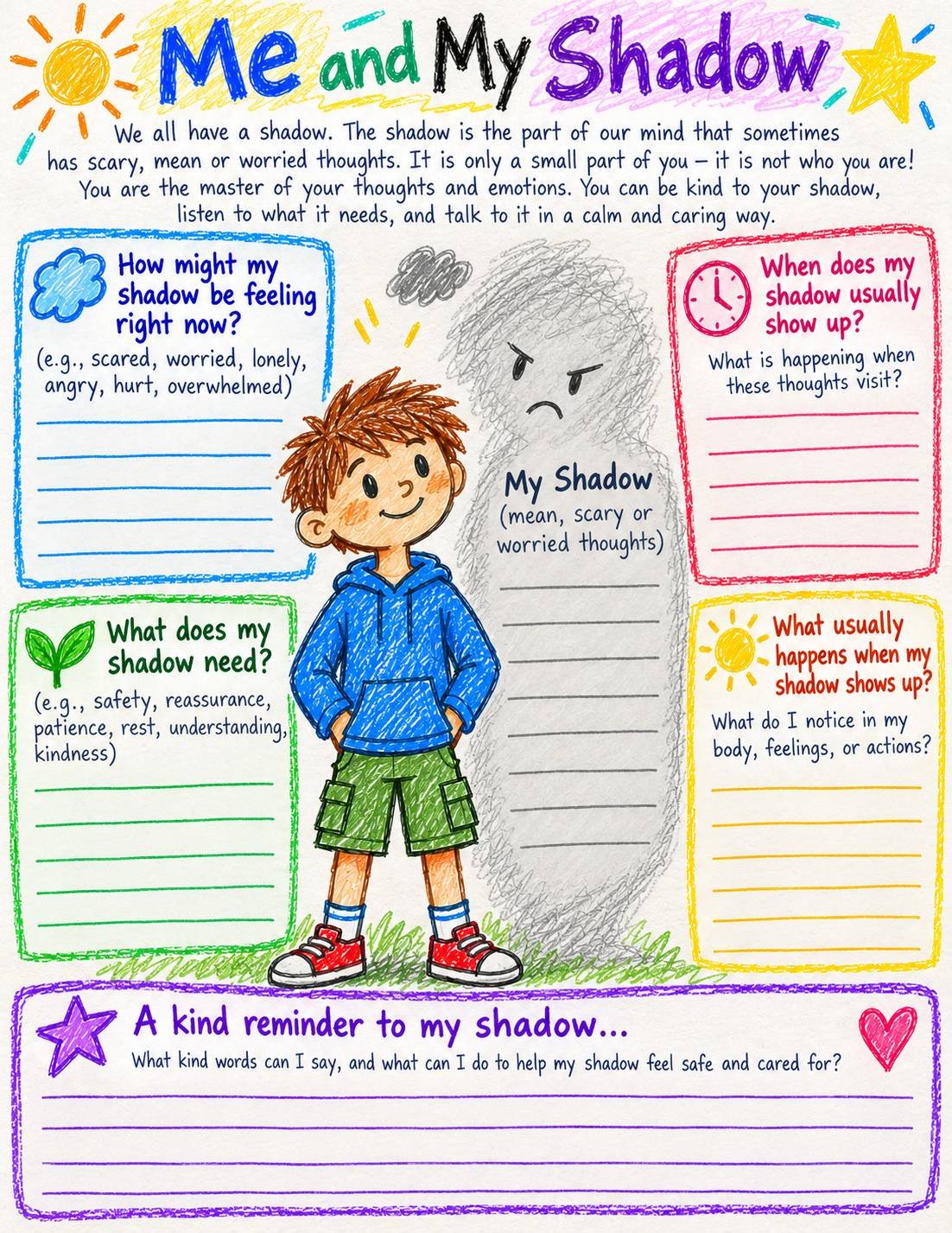
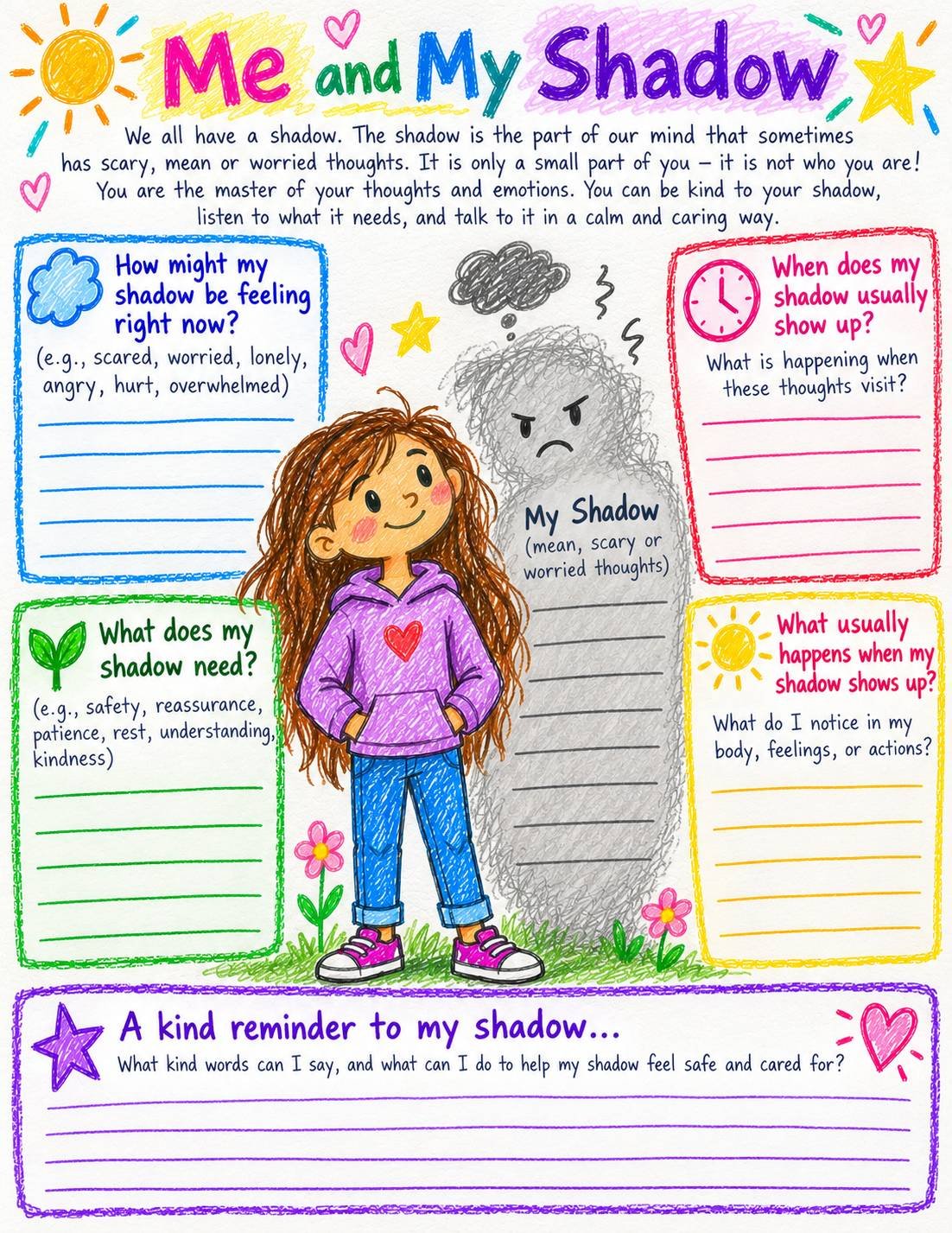
The introduction at the top of the worksheet delivers the therapeutic frame in language any child can receive: we all have a shadow. The shadow is the part of our mind that sometimes has scary, mean or worried thoughts. It is only a small part of you — it is not who you are. You are the master of your thoughts and emotions. You can be kind to your shadow, listen to what it needs, and talk to it in a calm and caring way.
That paragraph contains the entire therapeutic philosophy of the exercise — and offering it to a child before they begin is itself a significant intervention. Many children have never been told that the negative thought is not them. That it is only a small part. That they can relate to it differently. For some children, that information alone is enough to change something.
How to Use It
Introduce the negative thoughts worksheet during a calm, reflective moment — not in the middle of a difficult thought’s arrival, when the shadow is too present for the child to examine it with any distance. A warm, curious introduction: “This worksheet is about the part of all of us that sometimes has worried or mean thoughts. Everyone has one — even grown-ups. It is called a shadow. Let’s find out about yours.”
Give the child time and space to complete each section without direction or commentary. The what does my shadow need section often takes the longest — and the time the child spends with it is as therapeutically significant as what they write.
Once the worksheet is complete, explore it together with open, unhurried questions:
- What surprised you most about your shadow?
- If your shadow could hear you right now, what do you think it would say back?
- Is there a moment recently when you noticed your shadow arriving — and did knowing it was the shadow help at all?
- Of all the things your shadow needs, which one do you think it needs most right now?
- What would it look like to be a little bit kinder to your shadow this week?
That last question is worth sitting with — because the child who can name one small act of self-compassion toward their own negative thoughts has already begun the most important shift the worksheet is designed to produce: from the child who is controlled by their shadow, to the child who can stand beside it with some degree of warmth.
For Deeper Work: The Play Therapy Toolbox
Me and My Shadow is one example of the kind of cognitively grounded, narrative-rich, self-compassion-informed negative thoughts worksheet for kids available in The Play Therapy Toolbox: 123 Simple Play Therapy Activities and Therapeutic Games Supporting Every Stage of Child Development from Age 3 to 12 — a book built around the understanding that children change not through being told what to think but through being given a different relationship to their own inner experience.
The cognitive and CBT-informed chapters draw on the same theoretical foundations as this worksheet — cognitive defusion, externalisation, self-compassion, and the development of the observing self — while delivering them through the medium most naturally available to children: play, story, image, and creative engagement. Every activity comes with a therapeutic rationale grounded in peer-reviewed research, step-by-step guidance on how to conduct the session and exactly what to say, questions to use with the child, and a parent guidance note written in the same warm, accessible language as this article.
The anxiety, negative thinking, and self-criticism chapters address the full range of what the shadow looks like across the developmental stages: the catastrophic negative thought of the seven-year-old, the relentless self-criticism of the ten-year-old, the inner voice that has absorbed the worst things anyone has ever said and plays them back on a loop, and the particular difficulty of the child who has never been given the conceptual tool to separate themselves from what the shadow says. Every activity is cross-referenced in a comprehensive annex by presenting condition, age group, and page number — so you can navigate directly to the right tool for the right child at the right moment, without searching.
Before You Begin: A Note on Professional Support
Before attempting any cognitive defusion or negative thoughts activities at home with a child who is experiencing significant anxiety, depression, or distress, I would sincerely recommend consulting a qualified mental health professional. The exercises described in this article are offered as a supportive resource — not as a replacement for clinical assessment and ongoing therapeutic care. Where negative thoughts are persistent, intrusive, or accompanied by significant functional impairment, professional support is essential.
Three Things Worth Knowing
The shadow is not the enemy.
The most important clinical insight embedded in this negative thoughts worksheet for kids is also the most counter-intuitive: the difficult thought does not need to be defeated. It needs to be understood. The anxious negative thought is, in most cases, trying to protect the child from something — even if its method is unhelpful and its content is inaccurate. The critical thought is, in many cases, trying to prevent the child from making a mistake or being hurt. Approaching the shadow with curiosity rather than combat does not validate its content. It changes the child’s relationship to it — and that change in relationship is more effective at reducing the shadow’s power than any amount of evidence-based disputation.
Distance is the beginning of freedom.
The most significant therapeutic move in the Me and My Shadow worksheet is the first one: naming the negative thought as the shadow rather than as the self. That naming creates a small but significant space between the child and the thought — and in that space, something becomes possible that was not possible before. The child who is the thought cannot choose how to respond to it. The child who is having the thought — who can observe it, name it, notice it — can begin to make a choice. That choice is not always available. But the worksheet builds the capacity for it, and the capacity, practised regularly, grows.
You are the most important tool in the room.
The worksheet gives the shadow a form. You are the reason the child believes their shadow is safe to look at. A child who has experienced the consistent, warm, non-alarmed response of an adult to whatever the shadow contains — who has learned that the negative thought can be brought into the room without being met with panic, dismissal, or judgment — is a child who is already developing the relationship to their own inner experience that the worksheet is designed to build. The exercises are the structure. Your genuine, unhurried, compassionate presence is what makes the shadow safe enough to meet.
Available Now for $5.99 — For a Limited Time
If this free negative thoughts worksheet for kids gave you a sense of what becomes possible when children are helped to stand beside their shadow rather than be controlled by it, The Play Therapy Toolbox gives you 123 more tools built on the same foundation. The ebook is available now on Amazon at $5.99 for a limited time — with immediate access to 123 activities and 75+ full-colour printable worksheets for children aged 3 to 12.
Play is not preparation for life. It is life — in its most honest, most essential, most healing form.
Disclaimer: This article is intended as an educational and supportive resource for parents, caregivers, educators, and mental health professionals. It is not intended to diagnose, treat, or replace professional therapeutic or medical care. If a child is experiencing significant emotional, behavioural, or developmental difficulties, please seek guidance from a qualified mental health professional.

Rostislava Buhleva-Simeonova is a psychologist and game design specialist. She has worked with children, adults, and the elderly within various therapeutic programmes over the past eight years, all the while providing the much-needed playful twist that art and gamified experiences can bring to this sometimes uneasy setting. But it wasn’t until the birth of her daughter, Aurora, that this work took on an even deeper personal meaning. With her academic and real-life experience, honed through numerous trainings and sessions, she is currently authoring books and articles in the field of child psychology and development, offering expertise in art and play therapy to guide parents and caregivers, as well as professionals in the fields of social work and mental health, throughout various pivotal moments in children’s lives. Last but not least, all of her books have been “peer-reviewed” by her daughter, who testifies to the efficiency of these methods.