
Every parent has watched a child carry a hurt that has outlasted the event that caused it. The falling-out with a friend that happened weeks ago and is still present at the dinner table. The unkind thing a classmate said that the child returns to, quietly and repeatedly, long after everyone else has moved on. The sibling conflict that was technically resolved and yet has left something changed in the atmosphere between them. The particular quality of a hurt that has been held too long — the way it becomes less about what happened and more about the child’s relationship to what happened, the story they are telling about it, the weight of it in their body and their daily life.
Forgiveness is one of the most misunderstood concepts in all of child psychology — and one of the most consequential. It is misunderstood because it is so frequently presented to children as something they should do, quickly and completely, in response to adult pressure rather than genuine internal readiness. And it is consequential because the child who learns to move through hurt — not past it, not around it, but genuinely through it — is building one of the most protective psychological capacities available across the lifespan.
A well-designed forgiveness worksheet for kids does not tell a child to forgive. It creates the conditions under which forgiveness becomes genuinely possible — by giving the hurt a form, the feelings a space, the needs a voice, and the child the agency to decide what comes next.
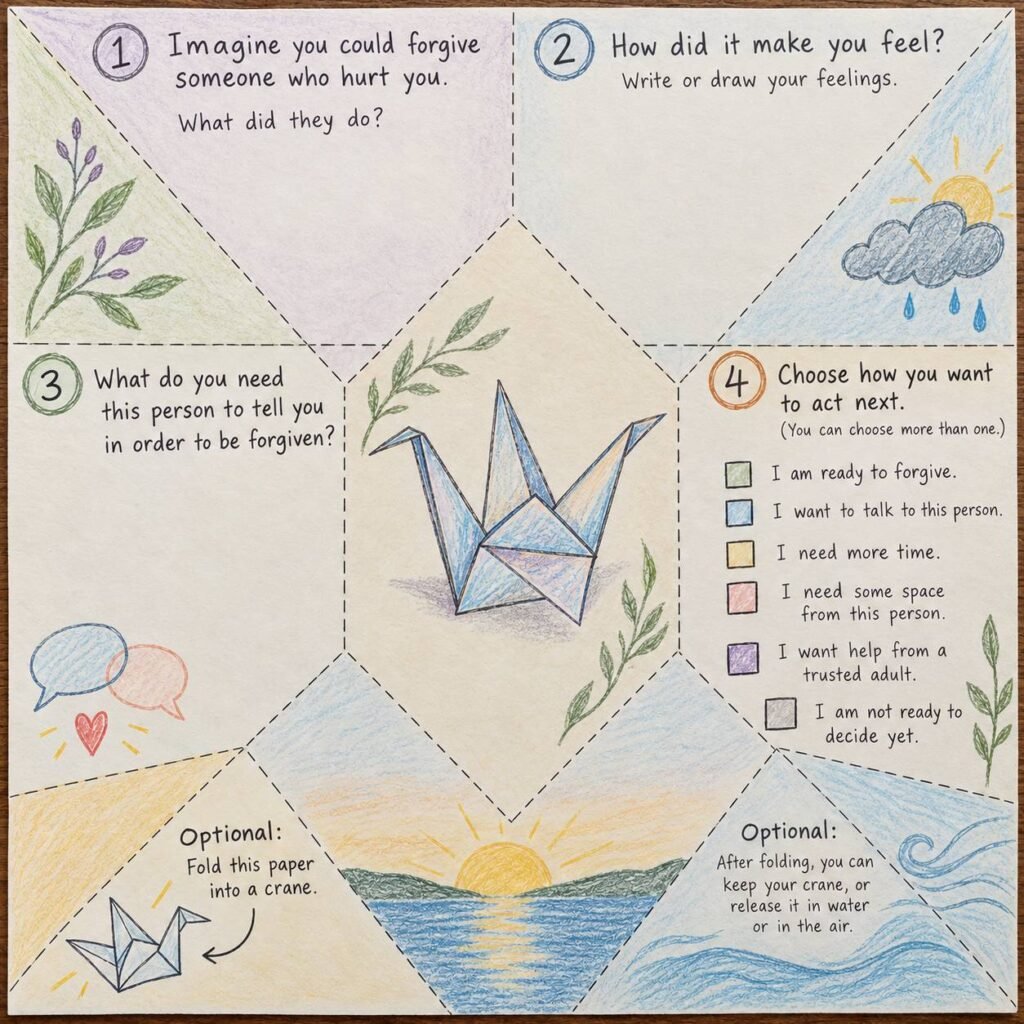
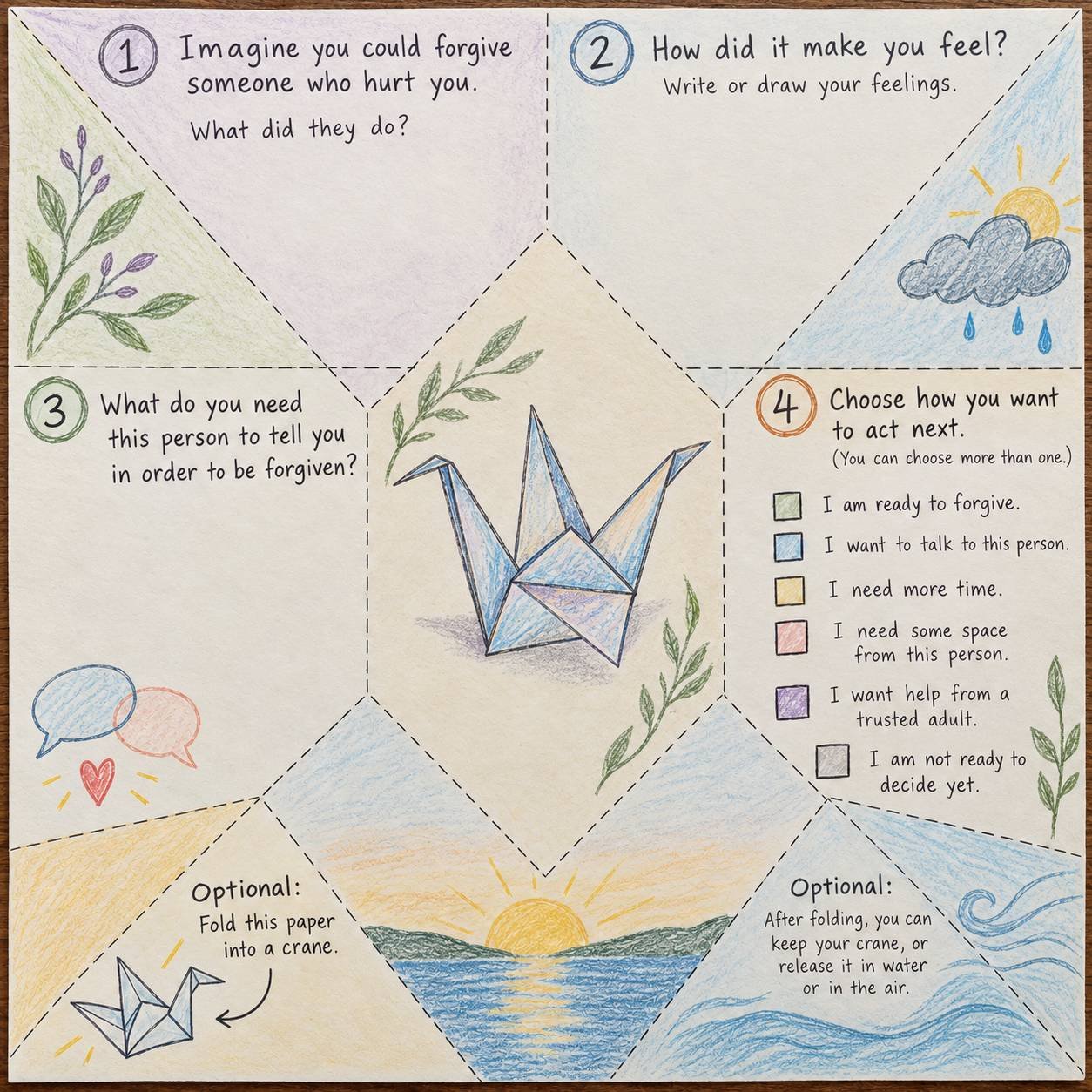
This is what the paper crane worksheet is designed to do.
What Forgiveness Actually Is — and What It Is Not
The research on forgiveness in children and adults is consistent on one point that is worth stating clearly before anything else: forgiveness is not the same as reconciliation, and it is not the same as condoning what happened.
Forgiveness, in the clinical and research literature, refers to an internal process — the gradual release of resentment, bitterness, and the ongoing harm that holding a grievance produces in the person holding it. It is something the child does for themselves, not for the person who hurt them. It does not require that the relationship be restored. It does not require that the other person apologise or change. And it does not require that what happened be minimised, excused, or forgotten.
Robert Enright, whose forgiveness theory and research programme has been foundational for the field, defines forgiveness as the willingness to abandon one’s right to resentment, condemnation, and subtle revenge toward a person who has unjustly hurt us, while fostering the undeserved qualities of compassion, generosity, and even love toward them. Crucially, Enright’s process model of forgiveness — which has been validated in clinical programmes with children, adolescents, and adults across diverse cultural contexts — identifies forgiveness not as a single decision but as a developmental process that moves through phases: uncovering the anger, deciding to forgive, working toward understanding, and discovering release.
A 2024 meta-analysis published in the Journal of Counseling and Development, examining forgiveness interventions across diverse populations including children, confirmed that structured forgiveness interventions produce significant improvements in wellbeing, reductions in anxiety and depression, and increases in hope — and that the effects are strongest when the intervention moves through the full process rather than simply encouraging the decision to forgive without the emotional work that precedes it.
The forgiveness worksheet for kids that asks a child to move through all four stages — what happened, how it felt, what they need, and what they choose next — is doing exactly this: supporting the full process rather than shortcutting to the outcome.
Why Children Struggle With Forgiveness
Children’s relationship to forgiveness is shaped by several developmental realities that are worth understanding before exploring how the worksheet addresses them.
Moral development and justice
Children in the concrete operational stage — roughly ages seven to eleven — have a highly developed sense of fairness and justice. They understand rules, they understand fairness, and they understand that some things are simply wrong. The child who has been hurt has a genuine developmental need to have that wrongness acknowledged — to have what happened named as unfair or unkind — before forgiveness becomes genuinely accessible. Asking a child to forgive before the hurt has been adequately validated is asking them to skip a developmental step that their moral understanding requires.
Theory of mind and perspective-taking
The capacity to understand why another person did something hurtful — to imagine their perspective, their motivations, their own difficulties — develops gradually across childhood and is not reliably present before approximately age eight or nine. The child who cannot yet imagine why the other person acted as they did is not withholding forgiveness out of stubbornness. They are at a developmental stage that has not yet provided the cognitive tools that forgiveness in its full sense requires. The forgiveness worksheet that asks what do you need this person to tell you in order to be forgiven is working within this developmental reality — it is not asking the child to generate understanding they may not yet have, but to identify what they need in order to move forward.
Agency and readiness
Research on forgiveness in children consistently confirms that the most important predictor of genuine forgiveness — as distinct from compliant expressions of forgiveness under adult pressure — is the child’s sense of agency in the process. The child who chooses to forgive, in their own time, for their own reasons, after their own feelings have been adequately processed, is more likely to experience the genuine psychological benefits of forgiveness than the child who is told to forgive and complies without genuine internal readiness.
This is why the fourth section of the worksheet — choose how you want to act next — includes options that do not involve immediate forgiveness. I need more time. I need some space from this person. I am not ready to decide yet. These options are not failures of the forgiveness process. They are honest, developmentally appropriate positions on a continuum — and the worksheet’s inclusion of them is one of its most clinically precise features.
The Origami Crane — Why the Ritual Matters
The optional instruction at the bottom of the worksheet — fold this paper into a crane; after folding, you can keep your crane, or release it in water or in the air — is not a decorative addition to a functional exercise. It is one of the most therapeutically significant elements of the entire worksheet.
Ritual has been used across cultures and throughout human history as a medium for emotional processing and transition. The anthropologist Arnold van Gennep described rites of passage as moving through three phases: separation from the old state, a liminal transition period, and incorporation into the new state. The origami crane ritual maps precisely onto this structure: the completion of the worksheet is the separation — the full engagement with what happened and how it felt; the folding is the liminal transition — the physical, embodied act of transforming the hurt into something new; and the keeping or releasing of the crane is the incorporation — the child’s choice about what to carry forward and what to let go.
The specific symbolism of the origami crane is particularly apt. In Japanese tradition, the crane is a symbol of healing, longevity, and the granting of wishes — and the practice of folding a thousand cranes is associated with healing and the fulfilment of a deep wish. The child who folds their completed worksheet into a crane is not simply doing an art activity. They are participating in a symbolic act of transformation: the hurt, written and felt and processed on the page, is being folded into something new.
Research on expressive writing and symbolic ritual in children confirms that the physical, embodied dimension of emotional processing — doing something with the material rather than only thinking or talking about it — produces measurably different outcomes from purely cognitive or verbal approaches. The child who writes about the hurt and then folds it into a crane and releases it has done something neurologically and psychologically distinct from the child who only wrote.
Free Forgiveness Worksheet for Kids: The Paper Crane
The worksheet below is a free resource you can use with your child today. It is suitable for children aged approximately 7 to 12, and works equally well at home, in school, or in a therapeutic setting. It is quietly beautiful, structured around a central origami crane, and built around four sections that move the child through the complete arc of the forgiveness process.
How to Use It
Introduce the worksheet during a calm, unhurried moment — not immediately following the hurtful event, when the feelings are too acute for reflection, but after sufficient time has passed for the initial intensity to settle while the hurt is still present enough to be worked with genuinely.
A warm, open introduction: “This worksheet is about something difficult — being hurt by someone. It is not about deciding to forgive straight away. It is about understanding what happened, how it felt, and what you need. You get to decide what comes next.”
Work through the four sections at the child’s pace, giving particular time to sections two and three. Once the worksheet is complete, explore it together:
- Of all the feelings you drew or wrote in section two, which one is still the strongest right now?
- The thing you need this person to tell you — have they told you that yet? If not, do you think they could?
- Looking at the options you chose in section four — does that feel right, or has something shifted since you started?
- Do you want to fold the crane — and if so, do you want to keep it or release it?
That last question is worth offering without pressure and without suggestion about the right answer. The child who folds the crane and releases it has made one choice. The child who folds it and keeps it has made another. Both are valid. Both are informative. And both are the child’s own.
For Deeper Work: The Play Therapy Toolbox
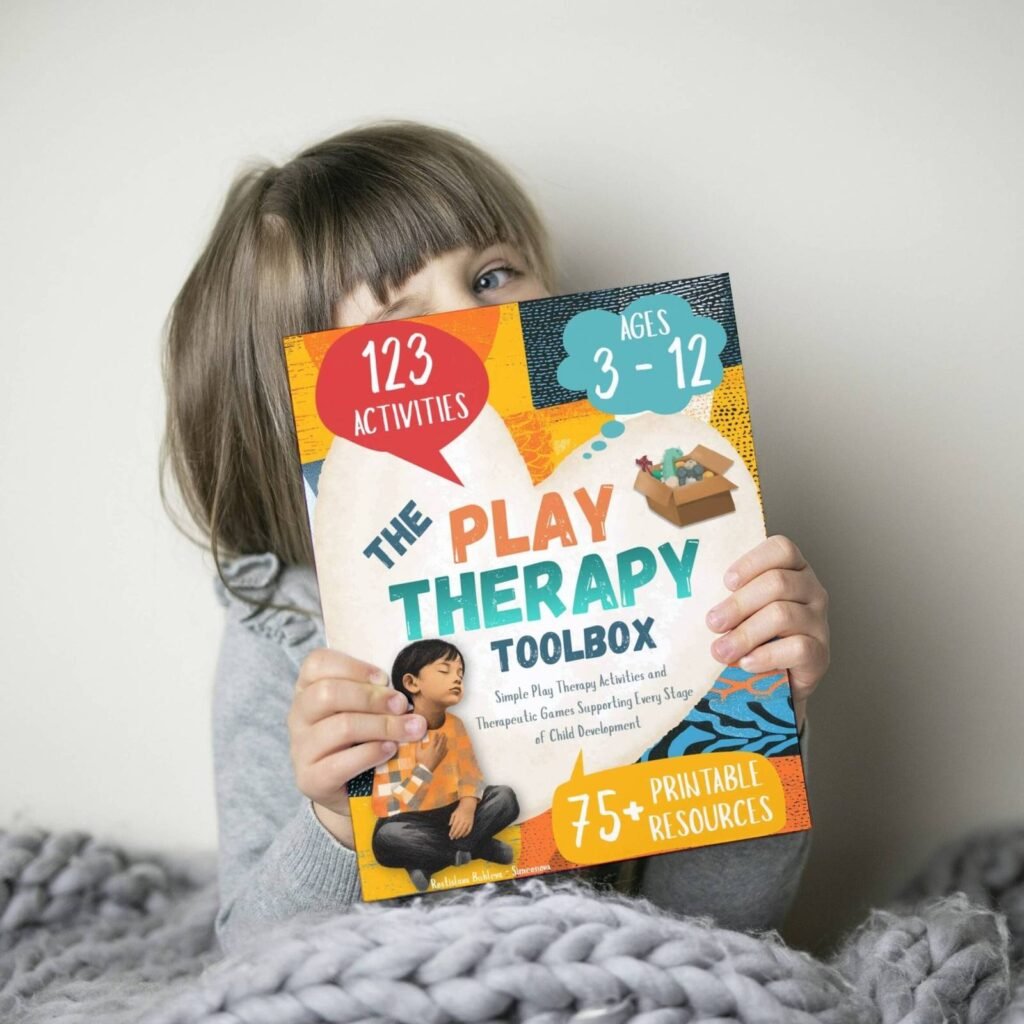
This forgiveness worksheet for kids is one example of the kind of emotionally precise, narratively rich, agency-centred tool that sits at the heart of The Play Therapy Toolbox: 123 Simple Play Therapy Activities and Therapeutic Games Supporting Every Stage of Child Development from Age 3 to 12 — a book built around the understanding that children process difficult experiences not through being told what to feel but through being given the right kind of space to find their own way through.
The conflict resolution, forgiveness, and peer relationship chapters address the full range of what hurt and conflict look like in children: the acute falling-out that needs immediate support, the chronic low-level resentment that has become part of the child’s relational landscape, the particular difficulty of the child who holds grievances without being able to name them, and the child who forgives too quickly — who bypasses the genuine processing of hurt in the service of social harmony — and who carries the unprocessed material in their body long after the verbal forgiveness has been expressed.
Every activity comes with a therapeutic rationale grounded in peer-reviewed research, step-by-step guidance on how to conduct the session and exactly what to say, questions to use with the child, and a parent guidance note. And a comprehensive annex cross-references all 123 activities by presenting condition, age group, and page number — so you can navigate directly to the right tool for the right child at the right moment, without searching.
Before You Begin: A Note on Professional Support
Before attempting any forgiveness activities at home with a child who has experienced significant harm, bullying, abuse, or betrayal by a trusted adult, I would sincerely recommend consulting a qualified mental health professional. The forgiveness process described in this article is appropriate for the ordinary hurts of childhood — the friendship conflicts, the unkind words, the minor betrayals of trust that are part of every child’s social experience. Where the hurt is significant, complex, or involves a significant power differential, professional support is essential and the forgiveness process should not be attempted without clinical guidance.
Three Things Worth Knowing
Forgiveness is for the child, not for the person who hurt them.
The most important reframe any adult can offer a child who is working with a forgiveness worksheet is this: forgiveness is not something you do for the other person. It is something you do for yourself. The resentment and bitterness of an unprocessed hurt do not harm the person who caused them. They harm the child who is carrying them. Forgiveness — genuine, chosen, properly processed forgiveness — is the child’s act of releasing themselves from that carrying. It does not require that the other person deserves it. It requires only that the child is ready.
Not ready is a valid answer.
The most clinically precise feature of this forgiveness worksheet for kids is the inclusion of I am not ready to decide yet as a legitimate option in section four. Forgiveness cannot be rushed without becoming something else — compliance, suppression, or the performance of forgiveness for an adult audience. The child who is genuinely not ready to forgive, and who is given permission to name that readiness honestly, is in a better position therapeutically than the child who forgives on demand and carries the unprocessed hurt quietly forward. Not ready is not a failure. It is an honest position on a genuine continuum — and the worksheet honours it.
You are the most important tool in the room.
The worksheet creates the space for forgiveness. You are the reason the child believes the hurt is worth bringing into that space. A child who has experienced the consistent, warm, non-pressuring response of an adult to their genuine emotional reality — who has learned that they will not be pushed toward forgiveness before they are ready, that their hurt will be received rather than managed, and that their choices about how to act next will be respected — is a child who is far more likely to arrive at genuine forgiveness, in their own time, than one who is told what they should feel and when. The crane is the structure. Your unhurried, genuinely present attention is what makes the folding meaningful.
Available Now for $5.99 — For a Limited Time
If this free forgiveness worksheet for kids gave you a sense of what becomes possible when children are given the right kind of space to move through hurt at their own pace, The Play Therapy Toolbox gives you 123 more tools built on the same foundation. The ebook is available now on Amazon at $5.99 for a limited time — with immediate access to 123 activities and 75+ full-colour printable worksheets for children aged 3 to 12.
Play is not preparation for life. It is life — in its most honest, most essential, most healing form.

Disclaimer: This article is intended as an educational and supportive resource for parents, caregivers, educators, and mental health professionals. It is not intended to diagnose, treat, or replace professional therapeutic or medical care. If a child is experiencing significant emotional, behavioural, or developmental difficulties, please seek guidance from a qualified mental health professional.

Rostislava Buhleva-Simeonova is a psychologist and game design specialist. She has worked with children, adults, and the elderly within various therapeutic programmes over the past eight years, all the while providing the much-needed playful twist that art and gamified experiences can bring to this sometimes uneasy setting. But it wasn’t until the birth of her daughter, Aurora, that this work took on an even deeper personal meaning. With her academic and real-life experience, honed through numerous trainings and sessions, she is currently authoring books and articles in the field of child psychology and development, offering expertise in art and play therapy to guide parents and caregivers, as well as professionals in the fields of social work and mental health, throughout various pivotal moments in children’s lives. Last but not least, all of her books have been “peer-reviewed” by her daughter, who testifies to the efficiency of these methods.