
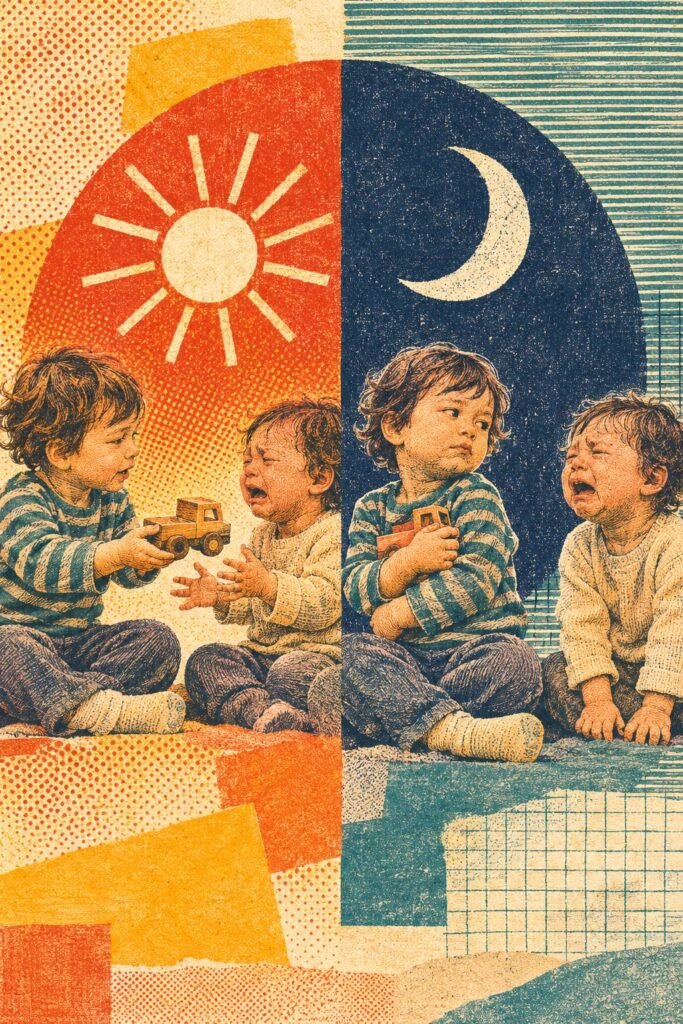
Many parents have seen both versions of the same child. In the morning, a toddler hands over a favourite toy to a crying friend without being asked. In the afternoon, the same child snatches a toy and watches a tearful face with no sign of connecting the two. Parents can find this baffling, and sometimes worrying.
Neither moment is a contradiction. Empathy is not something a child has or lacks. It develops in stages, each one built on the last, and it is shaped heavily by the relationships around the child. Knowing how children develop empathy changes what you expect at each age, and what you can do to help it grow.
What Empathy Actually Is
Empathy is three connected abilities that mature at different times.
The first is emotional resonance, the feeling of being affected by another person’s emotion. Newborns show an early form of it when they cry in response to another baby’s crying.
The second is perspective-taking, the understanding that another person has thoughts, beliefs and feelings that may differ from your own. Psychologists call this theory of mind.
The third is empathic concern, the wish to comfort or help. This is where empathy becomes action.
A child can be strong in one and still developing in another. A four-year-old may feel deeply for a sad classmate (resonance) and still have no idea what to do about it (concern), or misjudge why the classmate is sad (perspective-taking). This is ordinary development, not a character flaw.
How Children Develop Empathy: The Stages
From birth: emotional contagion. Infants are affected by the emotions around them, but they cannot yet separate their own distress from someone else’s. Developmental psychologist Martin Hoffman, whose work shaped the field, described this as global empathy. The baby feels something, but not yet that someone else is feeling it.
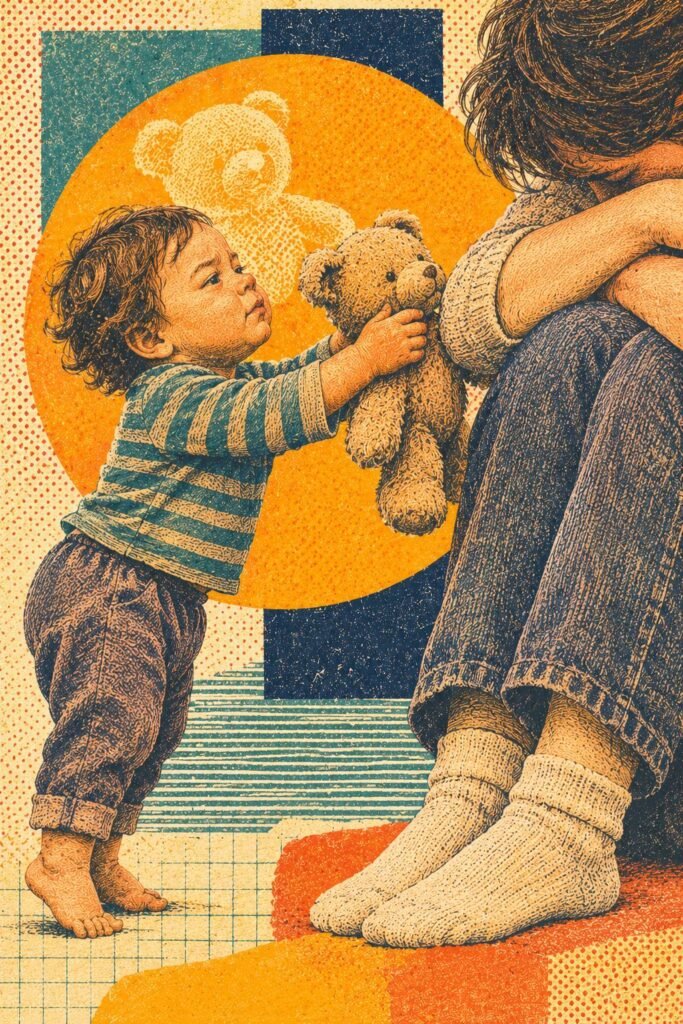
Around the second year: the first concern for others. Observational research by Carolyn Zahn-Waxler and colleagues showed that from roughly 18 months to two years, many children begin to respond to another person’s distress with concern: looking worried, offering a toy, patting, fetching a parent. Toddlers are starting to realise that other people have inner states of their own. Their attempts to help are often clumsy and guided by what would comfort them, so the toddler who brings you their own teddy when you are sad is showing empathy, not missing the point.
Around age four: understanding that others can be wrong about the world. This is the false-belief milestone. By about four, most children can understand that someone can hold a belief that is different from their own, and different from reality. This is the classic finding of Wimmer and Perner, later confirmed in a large meta-analysis by Wellman and colleagues. It matters because it allows children to start working out why someone feels what they feel, not only that they feel something. Lund University researchers have reported that supportive adult involvement in social situations can help children show this understanding earlier than four, which suggests the timeline is not fixed.
Around six to seven: understanding complicated feelings. In early primary school, children begin to grasp that one person can feel two things at once, such as nervous and excited, or happy about winning and sorry that a friend lost. This understanding of mixed and contradictory emotions continues to develop through middle childhood. It is the foundation of more sophisticated empathy, including the ability to feel with someone whose emotions are not simple.
Middle childhood and beyond: empathy for people outside the child’s own circle. As perspective-taking matures, empathy can extend to people the child has never met and to situations they have never experienced.
What the Research Shows About What Helps
The research points to two things that help empathy develop: what children understand about emotions, and what they experience from the adults around them.
On understanding: a 2016 study in Frontiers in Psychology by Ornaghi, Pepe and Grazzani followed 101 children aged four to six and found that comprehension of emotions was linked to prosocial orientation, and that false-belief understanding and language ability helped explain the link. In plain terms, children who can name emotions, understand perspectives, and put thoughts into words are better placed to act kindly. The same paper cites longitudinal work showing that emotion understanding at age three predicts prosocial behaviour at age four.
On the adult’s role: research on emotion socialisation, such as Gottman and colleagues’ work on parents’ meta-emotion philosophy, consistently finds that parents who notice, name and accept children’s feelings, an approach called emotion coaching, tend to raise children who regulate their emotions better and get along better with others. A review of empathy and prosocial development in early childhood compiled by Nature Index points to parental models and emotion socialisation among the main influences, and notes that early programmes combining emotion coaching with structured helping tasks show promise.
Empathy is also linked to kindness in action. A foundational review by Eisenberg and Miller found that empathy and sympathy are positively related to prosocial behaviour in children.
An honest note: the evidence is real but not simple. Reviews of attachment and prosocial behaviour describe the links as generally positive but inconsistent, and some studies of toddlers do not find that parental responsiveness directly predicts helping behaviour. Temperament, language and the child’s own regulation all play a part. Parenting matters a great deal, but no single parenting behaviour produces an empathic child.
How to Help Empathy Grow at Every Age
The research suggests three habits that matter most: naming emotions, validating feelings, and modelling empathic responses. Here is what they look like at different ages.
Toddlers (18 months to 3 years). Narrate feelings as they happen, in simple words. “You’re sad. You wanted the block.” When another child cries, point to what is happening: “Look, Mia is crying. She’s sad. Let’s see if she needs a cuddle.” Praise their attempts to help, even clumsy ones.
Preschoolers (3 to 5 years). Ask questions that stretch perspective-taking in a gentle way. “How do you think she felt when that happened?” “What do you think he was hoping for?” Pretend play is very useful at this age, because children try out other people’s roles and feelings. Picture books are good prompts: “How is the bear feeling on this page? How can you tell?”
School-age children (6 to 8 and up). Introduce the idea that feelings can be mixed. “It sounds like you were excited and nervous at the same time.” Talk about how the same event can feel different to different people. When your child does something hurtful, separate the behaviour from the child, then help them picture the other person’s experience: “What do you think it was like to be on the other side of that?”
At every age: take their feelings seriously. A child whose own emotions are met with interest, not dismissal, is learning what it feels like to be understood, and that experience is the template for understanding others. If your own response misses, repair it. Going back and saying “I think I brushed off how upset you were earlier” is itself a lesson in empathy.
Why Play Is Where Empathy Grows
Children build empathy through play. When a child pretends to be a doctor comforting a frightened patient, voices a toy that is afraid of the dark, or acts out a conflict from school, they are practising taking another point of view and feeling what it would be like. Play lets them try out perspectives with no real stakes.
That is why activities that give children a way to name emotions, play different characters, and talk about how someone else might be feeling are among the most natural ways to support empathy at home.
How Children Develop Empathy and The Play Therapy Toolbox
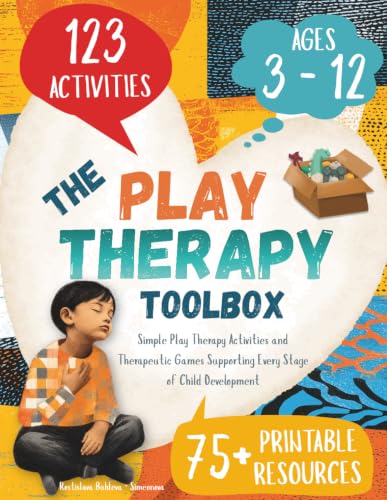
The Play Therapy Toolbox: 123 Simple Play Therapy Activities and Therapeutic Games Supporting Every Stage of Child Development from Age 3 to 12 is built around many of the habits described above. Its activities use role-play, storytelling, emotion naming and symbolic play to help children understand their own feelings and imagine other people’s. Each one includes a parent guidance note that explains what the activity is doing and how to respond to what the child shares, so parents can model the naming, validating and curiosity the research points to.
The activities are organised by age and presenting concern, with a cross-referenced annex, so you can find tools suited to a child’s developmental stage: from simple feelings activities for three-year-olds to perspective-taking and conflict activities for older children.
Before You Begin: A Note on Professional Support
Most children’s empathy develops at its own pace, and uneven progress is normal. If a child shows persistent difficulty understanding or responding to others’ feelings alongside other concerns, such as significant aggression, social withdrawal or developmental differences, I would sincerely recommend consulting a qualified mental health professional or developmental paediatrician. The activities in this article are supportive resources, not a substitute for assessment.
Three Things Worth Knowing
Empathy grows in stages, so meet your child where they are.
A toddler’s clumsy comfort, a four-year-old’s puzzled “but why is she sad?”, and a seven-year-old’s growing grasp of mixed feelings are all real empathy at the stage the child has reached. Expecting adult-style perspective-taking from a young child leads to frustration on both sides. Supporting the next step works better than demanding the final one.
Your response to their feelings is the lesson.
Children learn how to treat other people’s emotions largely from how their own emotions are treated. Naming a feeling, accepting it, and staying with it, even when you cannot fix what caused it, shows a child exactly what empathy looks like. Empathy is taught every time you take your child’s emotional experience seriously.
You are the most important tool in the room.
No book, worksheet or activity replaces the child’s experience of being understood by someone who matters to them. Activities give that experience a structure. Your warm, curious, unhurried attention is what makes it work.
Available Now for $7.99 — For a Limited Time
If this guide to how children develop empathy gave you a clearer picture of what to expect and how to help, The Play Therapy Toolbox gives you 123 activities built around the same approach. The ebook is available now on Amazon at $7.99 for a limited time, with 123 activities and 75+ full-colour printable worksheets for children aged 3 to 12.
Play is not preparation for life. It is life, in its most honest, most essential, most healing form.
Disclaimer: This article is intended as an educational and supportive resource for parents, caregivers, educators, and mental health professionals. It is not intended to diagnose, treat, or replace professional therapeutic or medical care. If a child is experiencing significant emotional, behavioural, or developmental difficulties, please seek guidance from a qualified mental health professional.

Rostislava Buhleva-Simeonova is a psychologist and game design specialist. She has worked with children, adults, and the elderly within various therapeutic programmes over the past eight years, all the while providing the much-needed playful twist that art and gamified experiences can bring to this sometimes uneasy setting. But it wasn’t until the birth of her daughter, Aurora, that this work took on an even deeper personal meaning. With her academic and real-life experience, honed through numerous trainings and sessions, she is currently authoring books and articles in the field of child psychology and development, offering expertise in art and play therapy to guide parents and caregivers, as well as professionals in the fields of social work and mental health, throughout various pivotal moments in children’s lives. Last but not least, all of her books have been “peer-reviewed” by her daughter, who testifies to the efficiency of these methods.
References
Child in the City. (n.d.). Attentive adults increase children’s ability to empathise (report on research by E. Psouni and colleagues, Lund University). https://www.childinthecity.org/?p=8121
Eisenberg, N., & Miller, P. A. (1987). The relation of empathy to prosocial and related behaviors. Psychological Bulletin, 101(1), 91-119.
Gottman, J. M., Katz, L. F., & Hooven, C. (1996). Parental meta-emotion philosophy and the emotional life of families: Theoretical models and preliminary data. Journal of Family Psychology, 10(3), 243-268.
Hoffman, M. L. (2000). Empathy and Moral Development: Implications for Caring and Justice. Cambridge University Press.
Nature Index. (n.d.). Empathy development and prosocial behavior in early childhood. https://www.nature.com/nature-index/topics/l4/empathy-development-and-prosocial-behavior-in-early-childhood
Ornaghi, V., Pepe, A., & Grazzani, I. (2016). False-belief understanding and language ability mediate the relationship between emotion comprehension and prosocial orientation in preschoolers. Frontiers in Psychology, 7, 1534. https://doi.org/10.3389/fpsyg.2016.01534
Richaud, M. C. (2013). Children’s perception of parental empathy in relation with children’s empathy. The Journal of Psychology, 147(6), 563-576.
Vaish, A., & Warneken, F. (2011). Social-cognitive contributors to young children’s empathic and prosocial behavior. In J. Decety (Ed.), Empathy: From Bench to Bedside (pp. 131-146). MIT Press. https://doi.org/10.7551/mitpress/9780262016612.003.0008
Wellman, H. M., Cross, D., & Watson, J. (2001). Meta-analysis of theory-of-mind development: The truth about false belief. Child Development, 72(3), 655-684.
Wimmer, H., & Perner, J. (1983). Beliefs about beliefs: Representation and constraining function of wrong beliefs in young children’s understanding of deception. Cognition, 13(1), 103-128.
Zahn-Waxler, C., Radke-Yarrow, M., Wagner, E., & Chapman, M. (1992). Development of concern for others. Developmental Psychology, 28(1), 126-136.