
Every parent knows the pull. Your child is struggling with a zip, a maths problem, a friendship that has gone wrong, and you can see exactly how to fix it. Your hands are already moving. Stepping in feels kind, and often it is kind.
But over time, some of those small rescues may cost something. The child never finds out they could have done it themselves. This article looks at what the research says about how to build resilience in children, including the parts that are well supported, the parts that are still uncertain, and what “letting your child struggle” can and can’t mean.

What Resilience Actually Is
Resilience is often pictured as toughness: the child who doesn’t cry, who shrugs things off. The research describes something different and more reassuring.
Psychologist Ann Masten, in a widely cited 2001 paper, reviewed decades of studies of children who did well despite serious difficulties. Her conclusion was that resilience is common, not rare. She called it “ordinary magic.” It usually arises from the normal systems children have for adapting, such as close relationships with caring adults, the ability to regulate attention and emotion, problem-solving skills, and a sense that their efforts matter. The greatest threats to development, she argued, are those that damage these protective systems.
That has two implications for parents. Resilience is not a fixed trait that a child either has or lacks, and it is built largely through everyday relationships and experience. And it is not the same as struggling alone. The research points to children who are supported, not left to cope.
Why Some Struggle Helps
Several lines of research suggest that manageable difficulty can strengthen learning and coping. Each has limits worth knowing.
Desirable difficulties. Cognitive psychologist Robert Bjork (1994) showed that some conditions that make learning feel harder, such as spacing practice out or testing yourself, slow progress in the moment but improve long-term retention. The word “desirable” matters: Bjork was clear that only some difficulties help. This research comes mainly from memory and learning tasks, so applying it to emotional resilience is an analogy.
Productive failure. Manu Kapur’s work found that students who attempted a problem before being taught the solution, and struggled, often understood the concept better afterwards. A 2021 meta-analysis by Sinha and Kapur (53 studies, 166 comparisons) found a moderate overall benefit. But it also found that results favoured teaching first for younger learners (second to fifth graders) and for general skills. Kapur’s framework also includes “unproductive failure,” where struggle isn’t followed by teaching and doesn’t help. Struggle on its own isn’t the active ingredient.
Steeling versus sensitising. Psychiatrist Michael Rutter (2006) noted that resistance to hazards may come from controlled exposure to risk, not from avoiding it, an idea he called “steeling.” But he also noted that stress can sensitise a person, making later stress harder, and that good research on when each happens is scarce. Some challenge builds strength. Too much, or too little support, may do the opposite.
So the honest picture is not “children need to fail.” It is that manageable difficulty, followed by support and understanding, tends to help, while overwhelming difficulty does not.
Frustration Tolerance Is a Skill
Frustration is what children feel when something doesn’t go as they want. Tolerating it, staying with a feeling without melting down or giving up, is a regulation skill that develops across childhood. Eisenberg, Fabes and Guthrie (1997) describe coping as regulation under stress, which develops with age and with experience.
Skills grow through practice. Mischel and colleagues’ (1989) review of children’s delay of gratification found that waiting is made easier by strategies children can use, such as directing their attention elsewhere. A word of caution here: the famous idea that preschoolers who wait longer go on to be more successful has weakened. In 2018, Watts, Duncan and Quan repeated the marshmallow test with 918 children and found an association about half the size of the original, which shrank by about two-thirds once family background, early thinking skills and the home environment were taken into account. What looks like willpower may partly reflect a child’s circumstances. The lesson is not “make your child wait for marshmallows” but that frustration tolerance is a skill that benefits from strategies and a supportive environment.
What Over-Helping Can Take Away
Researchers call excessive, controlling involvement in a child’s life “overparenting” or “helicopter parenting.” What does the evidence show?
A 2022 systematic review by Vigdal and Brønnick looked at 38 studies and found that most reported a link between helicopter parenting and anxiety and depression. The authors also found no longitudinal studies of sufficient quality to say which comes first, and concluded the evidence needs further investigation. An anxious child may prompt more parental control, and more control may feed anxiety, so the effect can run both ways. A 2024 meta-analysis of 53 studies found that young adults who perceived their parents as overly involved reported more internalising symptoms and lower self-efficacy and self-regulation. That’s a pattern, not proof of cause.
The most compelling evidence comes from the clinical side. Lebowitz and colleagues (2020) randomly assigned 124 children aged 7 to 14 with anxiety disorders to either CBT or a parent-only programme called SPACE. SPACE teaches parents to reduce “accommodation,” meaning the ways families adjust to avoid a child’s anxiety, while showing acceptance of the child’s distress and confidence in their ability to cope. It was as effective as CBT, and about 60 percent of children in both groups no longer met criteria for an anxiety disorder.
This was a clinical sample, so it doesn’t show that everyday helping causes harm. But the stance it models is useful for any parent: “I can see this is hard, and I believe you can handle it.”

How to Build Resilience in Children: Supported Struggle in Practice
The aim is not to withdraw help but to adjust it. Here is what that can look like.
Pause before you step in. A few seconds of waiting gives your child a chance to try again, and shows them you expect they might manage.
Ask before you fix. “What have you tried?” or “What do you think might work?” keeps the problem with the child while you stay close.
Name the feeling first. “That’s really frustrating” helps a child feel understood, and it supports the regulation skills the research points to. (See our article on co-regulation in children.)
Aim for “just manageable.” A task that is a little beyond what your child can do alone, with support available, is the sweet spot. If it is far too hard, struggle becomes distress.
Give the smallest help that works. A hint, a question or a demonstration of one step, not the whole solution.
Praise the process, not only the result. In a study of 53 children, Gunderson and colleagues (2013) found that parents who praised effort, strategies and actions when children were 1 to 3 years old had children who, five years later, were more likely to believe abilities can grow with effort. Dweck’s Mindset (2006) popularised this idea. (See our article on how to praise your child.)
Let small consequences happen, kindly. A forgotten lunchbox or a messy first attempt can teach more than a rescue, as long as you meet the feeling with warmth, not “I told you so.”
Repair afterwards. After a hard moment, talk about what happened without blame, and what your child might try next time. A child who knows a mistake won’t cost them your support learns that trying is safe.
Show your own struggle. Letting your child see you find something hard, and keep going, teaches more than telling them to persevere.
When Not to Let a Child Struggle
Supported struggle has limits.
- Safety comes first. Don’t allow struggle where there is real danger.
- Overwhelm is not growth. If a child is flooded, shut down or panicking, they need calming and connection before any problem-solving.
- Some children need more scaffolding. Children with developmental differences, learning difficulties or sensory needs may need more help for the same task, and that is not over-helping.
- Adversity changes the picture. Children who have experienced trauma or chronic stress need extra support, not more challenge. Masten’s point is that resilience depends on protective systems being intact.
- Independence is not abandonment. Stepping back works only when the child knows you are still there.
How to Build Resilience in Children Through Play
Play is a natural low-stakes setting for practising difficulty. In a game or a pretend scenario a child can try something hard, fail, and try again without real consequences, and an adult can stay close without taking over.
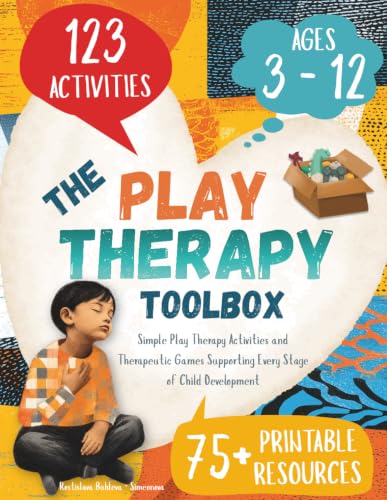
The Play Therapy Toolbox: 123 Simple Play Therapy Activities and Therapeutic Games Supporting Every Stage of Child Development from Age 3 to 12 is built around that kind of practice. Its activities have no wrong answers, so a child can approach a challenge without fear of failing. Each one comes with step-by-step guidance on how to run it and what to say, questions to ask the child, and a parent guidance note that encourages the stay-close, don’t-take-over stance this article describes. The book includes 123 activities and 75+ printable worksheets, with a cross-referenced annex to find activities by age and presenting concern.
Before You Begin: A Note on Professional Support
For most families, the habits above are low risk. If your child’s worries, avoidance or meltdowns are frequent, intense, or getting in the way of school, friendships or sleep, I would sincerely recommend consulting a qualified mental health professional. If you have been accommodating a child’s anxiety significantly, such as avoiding situations or providing constant reassurance, please don’t try to change that abruptly on your own. Programmes such as SPACE are delivered by trained clinicians for good reason.
Three Things Worth Knowing
Struggle helps when it is manageable and supported.
The research doesn’t say children need to fail. It suggests that challenge within reach, with an adult nearby and understanding afterwards, tends to build skills, while overwhelming difficulty can do the opposite.
Resilience is built in relationships.
It grows out of ordinary things: caring adults, regulation skills, problem-solving and a sense that effort matters. You don’t need to create hardship. You need to be a steady presence while your child meets the ordinary difficulties of growing up.
You are the most important tool in the room.
Your child learns they can cope from the way you respond when things are hard for them. A calm, warm “I’m here, and I think you can do this” is worth more than any amount of rescuing or any amount of standing back.
Available Now for $7.99 — For a Limited Time
If this guide to how to build resilience in children gave you a clearer sense of when to help and when to hold back, The Play Therapy Toolbox gives you 123 activities that put supported, playful practice into action. The ebook is available now on Amazon at $7.99 for a limited time, with 123 activities and 75+ full-colour printable worksheets for children aged 3 to 12.
Play is not preparation for life. It is life, in its most honest, most essential, most healing form.

Rostislava Buhleva-Simeonova is a psychologist and game design specialist. She has worked with children, adults, and the elderly within various therapeutic programmes over the past eight years, all the while providing the much-needed playful twist that art and gamified experiences can bring to this sometimes uneasy setting. But it wasn’t until the birth of her daughter, Aurora, that this work took on an even deeper personal meaning. With her academic and real-life experience, honed through numerous trainings and sessions, she is currently authoring books and articles in the field of child psychology and development, offering expertise in art and play therapy to guide parents and caregivers, as well as professionals in the fields of social work and mental health, throughout various pivotal moments in children’s lives. Last but not least, all of her books have been “peer-reviewed” by her daughter, who testifies to the efficiency of these methods.
References
Bjork, R. A. (1994). Memory and metamemory considerations in the training of human beings. In J. Metcalfe & A. Shimamura (Eds.), Metacognition: Knowing about knowing (pp. 185-205). MIT Press.
Dweck, C. S. (2006). Mindset: The new psychology of success. Random House.
Eisenberg, N., Fabes, R. A., & Guthrie, I. K. (1997). Coping with stress: The roles of regulation and development. In S. A. Wolchik & I. N. Sandler (Eds.), Handbook of children’s coping: Linking theory and intervention (pp. 41-70). Plenum.
Gunderson, E. A., Gripshover, S. J., Romero, C., Dweck, C. S., Goldin-Meadow, S., & Levine, S. C. (2013). Parent praise to 1- to 3-year-olds predicts children’s motivational frameworks 5 years later. Child Development, 84(5), 1526-1541. https://doi.org/10.1111/cdev.12064
Kapur, M. (2010). Productive failure in mathematical problem solving. Instructional Science, 38(6), 523-550.
Kapur, M. (2016). Examining productive failure, productive success, unproductive failure, and unproductive success in learning. Educational Psychologist, 51(2), 289-299.
Lebowitz, E. R., Marin, C., Martino, A., Shimshoni, Y., & Silverman, W. K. (2020). Parent-based treatment as efficacious as cognitive-behavioral therapy for childhood anxiety: A randomized noninferiority study of Supportive Parenting for Anxious Childhood Emotions. Journal of the American Academy of Child & Adolescent Psychiatry, 59(3), 362-372. https://doi.org/10.1016/j.jaac.2019.02.014
Lythcott-Haims, J. (2015). How to raise an adult: Break free of the overparenting trap and prepare your kid for success. Henry Holt. (Popular book, not primary research.)
Masten, A. S. (2001). Ordinary magic: Resilience processes in development. American Psychologist, 56(3), 227-238. https://doi.org/10.1037/0003-066X.56.3.227
Mischel, W., Shoda, Y., & Rodriguez, M. L. (1989). Delay of gratification in children. Science, 244(4907), 933-938.
Rutter, M. (2006). Implications of resilience concepts for scientific understanding. Annals of the New York Academy of Sciences, 1094, 1-12. https://doi.org/10.1196/annals.1376.002
Sinha, T., & Kapur, M. (2021). When problem solving followed by instruction works: Evidence for productive failure. Review of Educational Research, 91(5), 761-798. https://doi.org/10.3102/00346543211019105
Vigdal, J. S., & Brønnick, K. K. (2022). A systematic review of “helicopter parenting” and its relationship with anxiety and depression. Frontiers in Psychology, 13, 872981. https://doi.org/10.3389/fpsyg.2022.872981
Watts, T. W., Duncan, G. J., & Quan, H. (2018). Revisiting the marshmallow test: A conceptual replication investigating links between early delay of gratification and later outcomes. Psychological Science. https://doi.org/10.1177/0956797618761661
[Authors to confirm]. (2024). Meta-analysis of helicopter parenting and emerging adult adjustment (53 studies, 111 effect sizes). https://doi.org/10.1007/s10804-024-09496-5