
There is a persistent and quietly damaging myth in popular child development discourse — that abstract thinking is something children cannot do until early adolescence, that the young child’s mind is essentially concrete and literal, and that the appropriate response to this is to wait patiently until the abstract capacity arrives before introducing ideas that require it. This myth has its roots in a particular reading of Jean Piaget’s stage theory, and it has shaped educational practice, parenting advice, and therapeutic approaches in ways that consistently underestimate what children are actually doing with their minds from the very earliest months of life.
The truth is considerably more interesting. Abstract thinking in child development does not arrive at eleven or twelve like a developmental package delivered on a schedule. It grows — gradually, unevenly, domain by domain, context by context — from infancy onward. And what the adults around a child do with that growing capacity, at every stage, has a direct and measurable bearing on how richly and robustly it develops.
Understanding abstract thinking in child development — when it appears, what forms it takes at each stage, and how it can be actively nurtured rather than simply awaited — is one of the most practically valuable things any parent, educator, or therapist can know.
What Abstract Thinking Actually Is
Abstract thinking is the capacity to reason about things that are not concretely present — concepts, principles, hypothetical scenarios, symbols, metaphors, and ideas that exist independently of any specific physical instance. It is what allows a person to understand that justice is not the same as a specific verdict, that love is not the same as a specific action, that the number three exists independently of three apples or three chairs.
It is also what allows a person to think about their own thinking — metacognition — and to understand that the same situation can be interpreted in multiple ways, that other people’s inner experiences may differ radically from their own, and that language routinely says something other than what it literally means.
But abstract thinking is not a single, unified capacity that either exists or does not. It is a family of related cognitive abilities — analogical reasoning, metaphorical thinking, counterfactual reasoning, perspective-taking, symbolic representation, moral reasoning, and metacognition — each with its own developmental trajectory, each appearing earlier in familiar and emotionally meaningful contexts than in decontextualised or clinical ones, and each building on the sensory, emotional, and imaginative experience that precedes it.
Infancy: The Earliest Roots of Abstract Thought
The origins of abstract thinking in child development lie not in adolescence or middle childhood but in the first year of life — in capacities that are easy to overlook precisely because they appear before language, before symbolic play, and before any of the outward markers we typically associate with sophisticated cognition.
Research by Karen Wynn and others has demonstrated that infants as young as five months show sensitivity to numerical quantity — responding differently to displays of two objects versus three in ways that suggest an implicit grasp of abstract number that precedes any explicit counting or language. By nine to twelve months, infants demonstrate sensitivity to abstract relational concepts such as same and different — they notice when a pattern has been violated even when the specific objects involved are entirely novel. This is not concrete thinking. It is proto-abstraction: the extraction of a structural relationship from specific instances and the application of that relationship to new ones.
By twelve months, infants show clear evidence of understanding intentionality — the abstract concept that actions are directed toward goals, that agents have purposes, and that the same goal can be achieved by different means. When an adult reaches repeatedly for an object but is blocked, a twelve-month-old will hand them the object rather than imitating the blocked reaching movement — demonstrating that they have grasped the abstract goal behind the specific action rather than simply copying the surface behaviour.
What this tells us is that the infant mind is already in the business of abstraction — not in the systematic, linguistically mediated form it will eventually take, but in the embodied, perceptual, relational form that is its earliest expression.
Ages Two to Four: Symbolic Thinking, Counterfactuals, and the Understanding of Mind
The emergence of symbolic play around eighteen months is one of the most significant cognitive events of early childhood — and one of the most directly relevant to abstract thinking in child development. When a child picks up a banana and holds it to their ear like a telephone, they are demonstrating a genuinely abstract cognitive act: the separation of a symbol from its referent, the understanding that one thing can stand for another, and the capacity to operate within a representational space that is explicitly not the same as the concrete reality in front of them.
By age two to three, children demonstrate counterfactual reasoning — the capacity to think about what would have happened if things had been different — in familiar, emotionally meaningful contexts. “If we hadn’t stopped for milk, we would have been home earlier.” “If the bear had gone a different way, he wouldn’t have found the house.” This is hypothetical thinking about non-actual states of affairs. It is abstract reasoning, however concretely it is expressed.
Between three and four years, most children develop a theory of mind — the understanding that other people have mental states, beliefs, desires, and knowledge that may differ from their own. The classic false belief task, in which a child must reason about what another person believes when that belief is different from what the child knows to be true, has long been used as a marker of theory of mind. What is significant about theory of mind in the context of abstract thinking is that it requires reasoning about something fundamentally invisible and abstract: the interior of another person’s mind. A child who understands that their friend believes the chocolate is in the basket — even though the child knows it has been moved to the box — is reasoning abstractly about mental states.
Research by Alison Gopnik and others has demonstrated that children as young as three can engage in surprisingly sophisticated causal and counterfactual reasoning when the scenarios are presented in familiar, narrative, and emotionally grounded contexts. The implication is significant: young children’s abstract capacities are not absent. They are context-dependent — available in familiar, meaningful situations long before they become available in decontextualised, formal ones.
Ages Four to Seven: Metaphor, Moral Reasoning, and the Arbitrary Symbol
Between four and seven years, several specifically abstract capacities consolidate and deepen in ways that are often underappreciated.
Metaphorical thinking — the capacity to understand and generate non-literal language — develops significantly across this period. By age five, most children understand conventional metaphors and can generate novel ones, demonstrating an implicit grasp of structural similarity that is one of the cognitive foundations of abstract reasoning. Research by Dedre Gentner has shown that analogical reasoning — finding the structural similarity beneath surface differences — is present in rudimentary form from infancy and develops rapidly across the preschool years, provided the child has sufficient experience with the specific domains being compared.
By age five to six, most children demonstrate what is sometimes called metalinguistic awareness — the understanding that words are arbitrary symbols, that the word dog is not the animal itself, and that the same thing could in principle be called by a different name. This is a genuinely abstract insight about the nature of language and representation. It requires the child to step outside the immediate word-thing relationship and reason about it as a system — which is precisely the kind of second-order thinking that defines abstract cognition.
Moral reasoning across this period also demonstrates abstract thinking in a form that is easy to overlook. A five-year-old who argues that it is wrong to take someone’s toy even when no one is watching is reasoning from an abstract principle — the wrongness of the act is independent of its consequences and of whether it is observed. This is not concrete moral thinking. It is moral abstraction, expressed through the vivid, particular, emotionally grounded language of early childhood.
Ages Seven to Eleven: Concrete Operations and the Deepening of Abstract Capacity
Jean Piaget’s concrete operational stage — spanning approximately seven to eleven years — is often described as a period in which children can think logically but only about concrete, physically present situations. This characterisation, while capturing something real, significantly understates what is actually available to the concrete operational child.
Across this period, children develop conservation — the understanding that quantity remains the same even when appearance changes — classification and seriation — the ability to organise objects by multiple criteria simultaneously — and the capacity for reversible mental operations. Each of these is, in a meaningful sense, an abstract cognitive achievement: it requires reasoning about invariant properties that are not directly visible in the perceptual array.
More significantly, research since Piaget has consistently demonstrated that children in this age range show considerably more sophisticated abstract reasoning than Piaget’s tasks revealed — particularly in domains that are emotionally meaningful, narratively grounded, or connected to the child’s own direct experience. A nine-year-old may struggle with a formal logical syllogism presented in clinical language while simultaneously demonstrating sophisticated abstract reasoning about friendship, fairness, and identity in the context of their own social world.
The concrete operational child is not waiting for abstract thinking to arrive. They are thinking abstractly — within domains they know well, in contexts that provide sufficient scaffolding, and through the imaginative, narrative, and emotionally grounded modes that are their primary cognitive medium. What is still developing is the ability to generalise that abstract reasoning across domains, to apply it to genuinely novel and unfamiliar content, and to sustain it independently of concrete support.
Ages Eleven to Twelve and Beyond: Systematic Abstract Reasoning
The formal operational stage that Piaget described — characterised by systematic hypothetical-deductive reasoning, the ability to reason about purely abstract propositions with no concrete anchor, and fully consolidated metacognition — does indeed consolidate in early adolescence. The neurological changes underlying this consolidation are real and significant: the default mode network, which underlies self-referential thought, perspective-taking, and internally directed hypothetical reasoning, undergoes major reorganisation during early adolescence, with connectivity continuing to develop well into the twenties.
What this stage adds to what was already available is not abstract thinking itself but its systematic generalisation: the capacity to reason abstractly across all domains, including entirely unfamiliar ones, without requiring the scaffolding of familiar context, emotional grounding, or narrative frame. The formal operational thinker can follow a logical argument wherever it leads, even into territory that contradicts their existing beliefs or intuitions. They can reason about their own reasoning, notice when their logic has failed, and correct it from the inside.
This is a genuinely new cognitive capacity. But it is the culmination of a developmental process that has been underway since infancy — not a beginning.
What Recent Neuroscience Adds
Contemporary developmental neuroscience has added several insights that substantially enrich the picture.
The role of embodied cognition in abstract thinking is now well established. Research by George Lakoff, Mark Johnson, and others has demonstrated that abstract concepts are grounded in sensorimotor experience to a far greater degree than classical cognitive theory acknowledged. When we think abstractly about warmth — emotional warmth, interpersonal warmth — we are drawing on neural representations built by the literal physical experience of warmth. When we understand the concept of grasping an idea, we are drawing on the motor representations of physical grasping. Abstract thinking is not the abandonment of the body and the senses. It is their extension into the symbolic domain. The richer the sensory and physical experience of the concrete world, the richer the abstract thinking that eventually emerges from it.
The role of language in scaffolding abstract thinking — contra Piaget, and consistent with Vygotsky — is also well supported. Children who are regularly exposed to analogical reasoning, metaphorically rich language, and conceptually dense conversation demonstrate earlier and more flexible abstract thinking than those who are not. The linguistic environment is not simply a reflection of cognitive development. It is a driver of it.
And the emotional dimension of abstract thinking is more significant than classical cognitive theory acknowledged. The default mode network, which underlies abstract cognition, is also deeply involved in emotional processing, empathy, and the understanding of other minds. Abstract thinking and emotional intelligence are not separate capacities. They are intertwined — and activities that develop emotional awareness and perspective-taking are simultaneously developing the cognitive architecture for abstract thought.
How to Support Abstract Thinking at Every Stage
Supporting abstract thinking in child development is not primarily a matter of introducing abstract content earlier. It is a matter of providing the right kinds of experience — at every developmental stage — that build the cognitive, emotional, and imaginative foundations on which abstract thinking rests.
In infancy and toddlerhood, the most important contribution is rich, varied sensory and relational experience — the embodied foundation from which all later abstraction grows. Talking to infants about causes, intentions, and feelings. Narrating the world with conceptually rich language. Following the child’s attention and enriching what they notice with words that go beyond the immediately visible.
In the preschool years, imaginative play, storytelling, and exposure to metaphorically rich language are the primary developmental tools. Every act of pretend play is an act of symbolic abstraction. Every story that asks “what would have happened if…” is an exercise in counterfactual reasoning. Every conversation about a character’s feelings is a theory of mind exercise. These activities are not preparation for learning. They are learning, in its most developmentally appropriate form.
In middle childhood, analogical reasoning — asking the child to find structural similarities between different things, to understand how one situation is like another, to see the principle beneath the specific instance — is one of the most direct ways to develop abstract thinking. Not “what is a metaphor?” but “how is a friendship like a garden?” Not “define justice” but “how is what happened today like what happened in the story?” The analogy does not need to be correct. The exploration builds the capacity.
Across all stages, treating the child’s ideas with genuine intellectual respect — engaging with their thinking rather than correcting it, following their reasoning wherever it goes, asking questions that open rather than close — communicates something about the child’s mind that no curriculum can deliver: that their thinking is worth taking seriously. And the child who is treated as a capable thinker becomes one.
Illustrating the Abstract: Reference Sheets as a Bridge
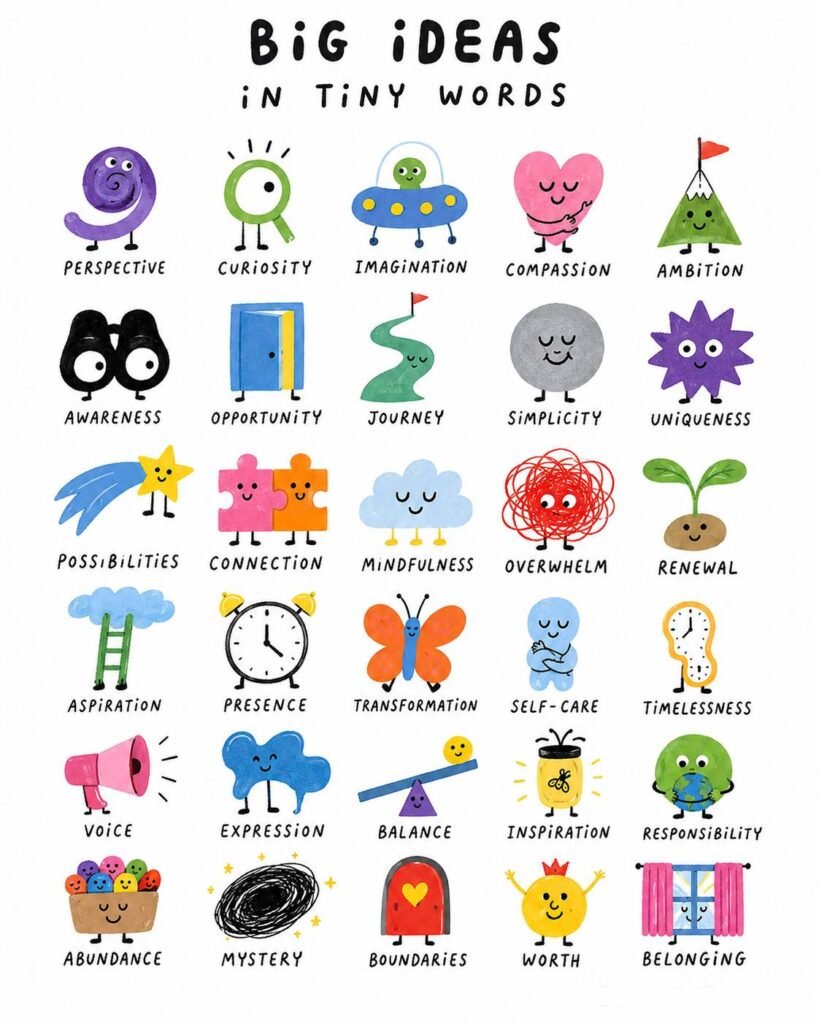
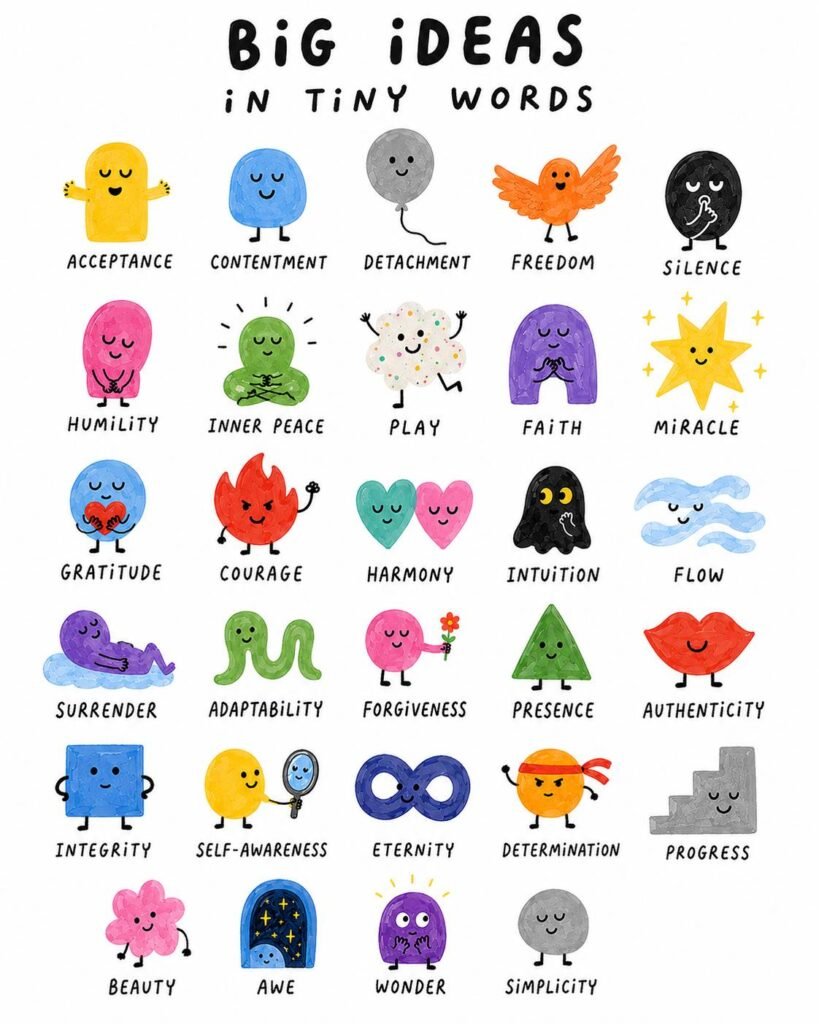
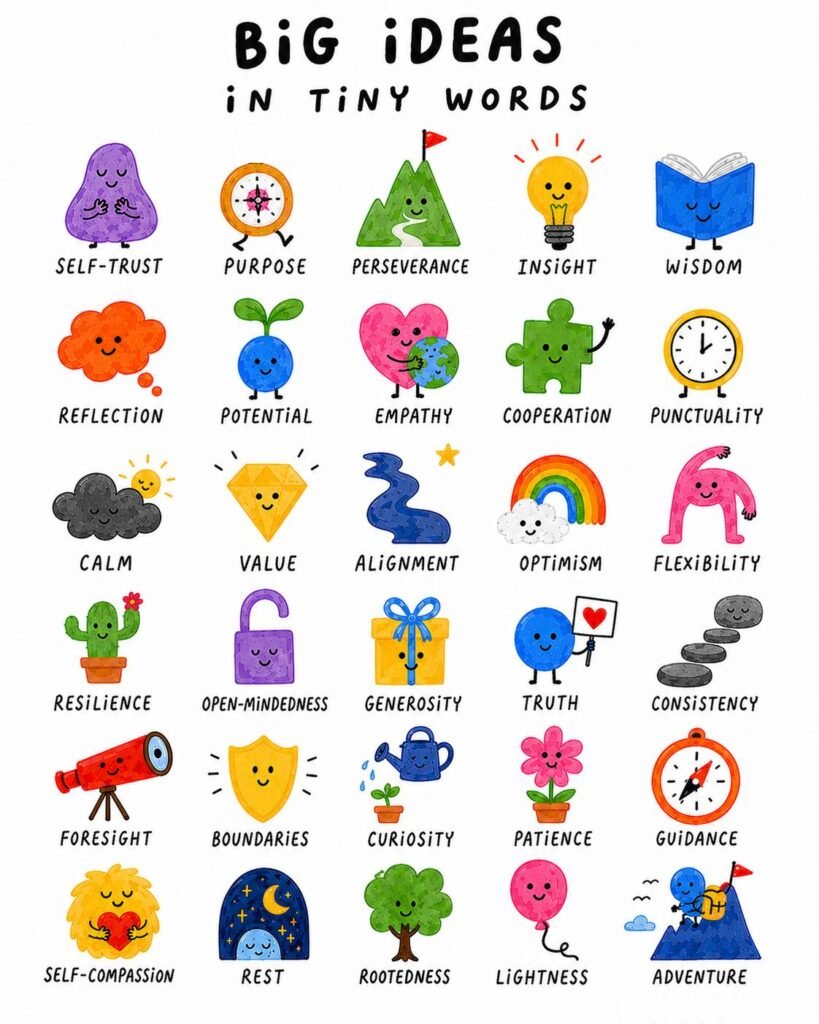
One of the most practically effective tools for supporting abstract thinking in child development — and one of the most underused — is the illustrated reference sheet: a visual representation of an abstract concept that gives it a concrete, memorable, and immediately accessible form.
Abstract concepts like courage, fairness, empathy, resilience, and creativity are regularly used with children long before the children can reason about them systematically across all contexts. An illustrated reference sheet gives the abstract concept a visual anchor — a character, a scene, a metaphor rendered in image — that the child can hold in mind and return to as the more abstract understanding gradually deepens. It does not replace abstract reasoning. It provides the concrete scaffolding from which abstract reasoning grows — which is precisely how abstract thinking in child development actually works.
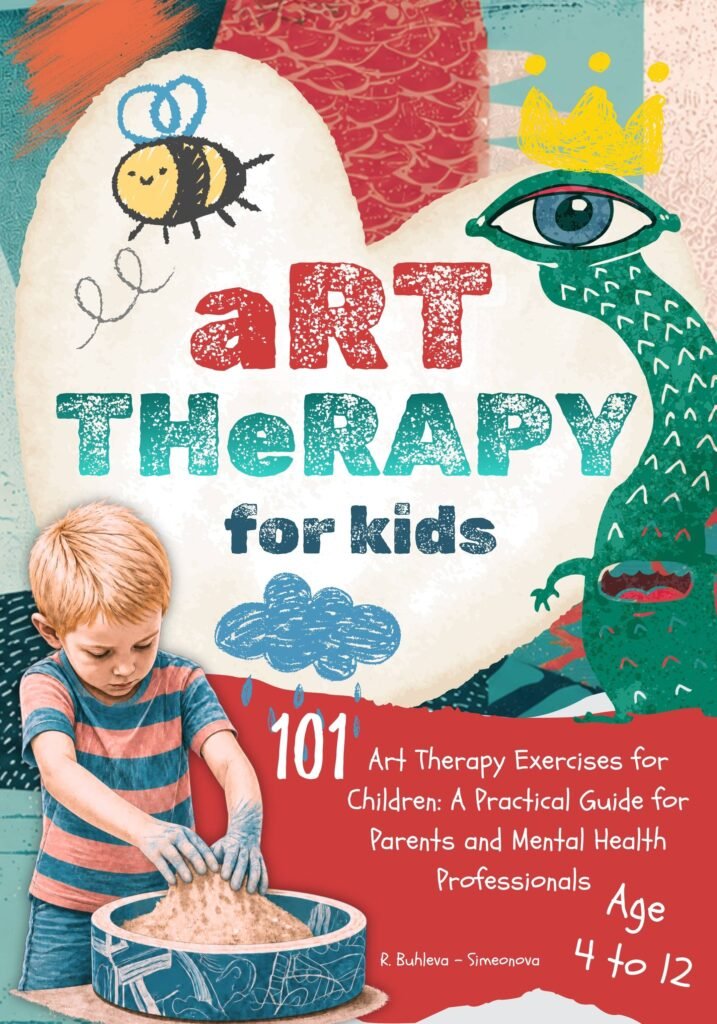
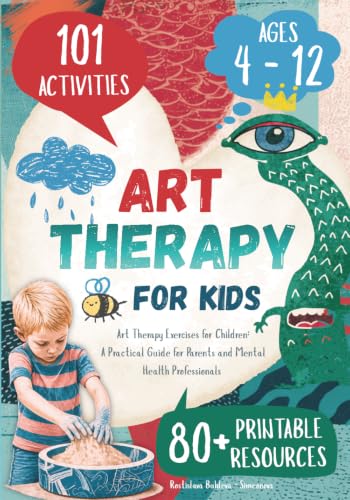
This approach is at the heart of 101 Art Therapy Exercises for Children: A Practical Guide for Parents and Mental Health Professionals — a book that consistently uses visual, creative, and expressive activities to give abstract emotional and psychological concepts the concrete form that makes them accessible to children at every developmental stage. Each exercise is designed not to deliver abstract understanding but to create the direct experience — sensory, emotional, imaginative — from which abstract understanding can emerge on the child’s own developmental timeline.
The book contains 101 art therapy exercises structured across three age groups — 4 to 6, 7 to 9, and 10 to 12 — each activity informed by validated research demonstrating how creative engagement alters brain physiology, strengthens neural flexibility, and enhances emotional regulation. Every session comes with a clear therapeutic rationale, step-by-step guidance, reflection questions, and guidance on how to observe and respond to what emerges — without diagnosis, without pressure, and without losing sight of the child as the author of their own understanding.
Three Things Worth Knowing
Abstract thinking does not arrive late — it develops gradually from birth.
The concrete-thinking child is not a child who cannot think abstractly. They are a child whose abstract thinking is context-dependent, domain-specific, and scaffolded by the familiar and emotionally meaningful. Meeting that thinking with respect, curiosity, and the right kinds of challenge is the condition under which it deepens — not an indulgence to be rationed until the child is old enough for the real thing.
The imagination is the laboratory.
Every act of symbolic play, every drawing that gives a feeling a colour, every story that gives an experience a narrative shape, every metaphor that lets the child hold two things alongside each other and notice their resemblance — all of these are acts of abstraction in progress. The child who is given rich, sustained, genuinely supported access to creative and imaginative experience is the child who will arrive at systematic abstract thinking with the deepest and most flexible foundation available.
You are the most important tool in the room.
The development of abstract thinking is a relational achievement — something that happens in the context of conversations, questions, stories, and the ongoing experience of being taken seriously as a thinker by the adults who matter most. Ask the child what they think. Follow the thought wherever it goes. Resist the urge to correct toward the right answer before the thinking has had time to arrive somewhere on its own terms. The child who is treated as a capable thinker becomes one.
Ready to Go Further?
If this exploration of abstract thinking in child development gave you a sense of the richness available when children’s cognitive and creative development are approached with the depth they deserve, 101 Art Therapy Exercises for Children: A Practical Guide for Parents and Mental Health Professionals gives you 101 practical tools for supporting that development — grounded in neuroscience, informed by developmental research, and written for every adult who has ever sat beside a child and wished they had something more to offer than a correct answer.
Disclaimer: This article is intended as an educational and supportive resource for parents, caregivers, educators, and mental health professionals. It is not intended to diagnose, treat, or replace professional therapeutic or medical care. If a child is experiencing significant emotional, behavioural, or developmental difficulties, please seek guidance from a qualified mental health professional.

Rostislava Buhleva-Simeonova is a psychologist, art therapist, and gamificator. She has worked with children, adults, and the elderly within various therapeutic programmes over the past eight years, all the while providing the much-needed playful twist that art and gamified experiences can bring to this sometimes uneasy setting. But it wasn’t until the birth of her daughter, Aurora, that this work took on an even deeper personal meaning. With her academic and real-life experience, honed through numerous trainings and sessions, she is currently authoring books and articles in the field of child psychology and development, offering expertise in art and play therapy to guide parents and caregivers, as well as professionals in the fields of social work and mental health, throughout various pivotal moments in children’s lives. Last but not least, all of her books have been “peer-reviewed” by her daughter, who testifies to the efficiency of these methods.