
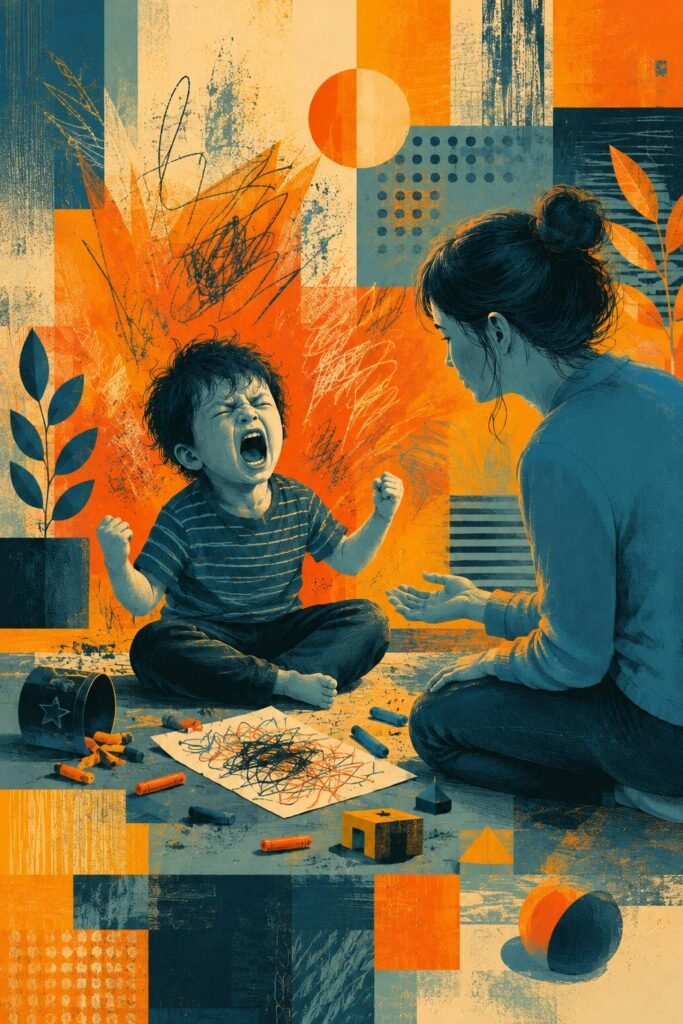
Every parent has stood in that moment — the child in front of them has crossed a line, and what is coming out of them is not simply naughtiness or defiance but something bigger and more urgent than either of those words adequately describes. The anger that arrives before the child has any access to the thought that preceded it. The meltdown that seems wildly disproportionate to the trigger. The child who hits, or screams, or throws something, or goes completely silent and unreachable — and who, afterwards, often cannot tell you what happened, because in the moment of its arriving, the anger was genuinely all there was.
Anger in children is not a behaviour problem. It is an emotional regulation problem — and that distinction matters enormously for how it is most effectively addressed. A child who cannot manage anger is not a child who is choosing to behave badly. They are a child whose nervous system has not yet developed the capacity to hold a big feeling and respond to it in a measured way — a capacity that is, in every child, still actively under construction throughout the whole of childhood and well into adolescence.
Art therapy for anger in children addresses this at the level where it actually lives — not in the rational mind, where instructions about using words and taking deep breaths operate, but in the body, the felt sense, and the urgent need to do something with a feeling that is simply too large to contain.
Why Anger Is So Hard for Children to Manage
Emotional regulation is not a character trait. It is a developmental achievement — one that requires both neurological maturation and repeated, supported practice within the right kind of relational environment. The prefrontal cortex — responsible for impulse control, emotional modulation, and the capacity to pause between stimulus and response — does not complete its development until the mid-twenties. Children are being asked to regulate anger with a tool that is still very much under construction.
When the amygdala fires — registering a threat, a frustration, an injustice, a loss of control — the prefrontal cortex is temporarily overwhelmed. The child cannot think their way through the anger in the moment because the thinking brain is the part that the anger has most effectively disabled. What remains is the feeling itself, in all its urgency, with nowhere adequate to go.
This is why telling an angry child to calm down, to use their words, or to think about the consequences of their behaviour so rarely produces the result the adult is hoping for. These instructions require the prefrontal cortex. And in the moment of genuine emotional activation, the prefrontal cortex is the part of the brain least available. What the angry child needs is not instruction. They need a route through the feeling that does not require the cognitive resources the feeling has temporarily disabled.
Art — particularly physical, tactile, kinetic art-making — offers exactly this. It engages the body and the sensory system directly, provides a channel for the physical urgency of the emotion, and activates the parasympathetic nervous system through the focused, rhythmic, absorbing quality of making something. A 2025 systematic review published in the Australian and New Zealand Journal of Psychiatry confirmed that art therapy produces statistically significant reductions in anger and improvements in emotional control — and identified the art-making process itself, rather than any specific technique, as the primary mechanism of change.
What the Research Shows
The research on art therapy for anger and emotional regulation in children has grown substantially in the past decade, and the evidence is now sufficiently consistent to be clinically significant.
A 2025 systematic review of art therapy with children and adolescents experiencing acute or severe mental health conditions found clear evidence of effectiveness for emotional regulation and reducing acute distress — with participants managing difficult emotions through the art-making process and reporting a greater sense of calm. Studies within juvenile justice settings found that children who undertook art therapy interventions had reduced anger, felt more in control, and were getting into less trouble — a finding that reflects not simply symptom reduction but genuine behavioural change.
A 2023 practice-based study published in the International Journal of Art Therapy examined a structured affect-regulation art therapy protocol — designed specifically for children with psychosocial difficulties — and confirmed that the protocol produced meaningful improvements in emotional regulation, supporting the therapeutic mechanism that the book’s anger exercises are built around: channelling the feeling into the artwork rather than into the environment or the people in it.
A 2026 case study published in The Arts in Psychotherapy traced how destructive and reconstructive art processes — splashing, tearing, building — help children externalise and regulate strong emotions, including anger and aggression. The research found that artistic media can reduce aggression and promote self-regulation among trauma-affected children — and that the physical, embodied nature of the art-making is precisely what makes it effective, because it offers the body a legitimate, contained outlet for what it is carrying.
A 2025 narrative review published in PMC examining the application of painting therapy in child psychological interventions found that empirical evidence confirms painting therapy significantly reduces symptoms of anger — and that randomised controlled trials indicate improvements in emotional disorders, ADHD, and social adaptability. And a 2024 study in the Indian Journal of Psychiatric Nursing on integrative art therapy for emotional and behavioural outcomes confirmed that structured art therapy programming produces meaningful improvements across the emotional regulation domain in children with a range of presenting difficulties.
Why Art Is the Right Medium for Anger
The case for art therapy as a response to anger in children is grounded in a straightforward neurological reality: anger is a body-based, sensory experience before it is ever a thought. It arrives as heat, as pressure, as urgency — as a felt need to do something with a feeling that is simply too large to hold. Verbal approaches to anger management ask the child to translate a somatic experience into language and then reason with it. Art approaches meet the somatic experience where it is.
Art therapy offers a non-verbal form of expression that is particularly useful for people who have difficulty articulating their emotions or experiences verbally — and it provides a safe and structured environment in which young people can explore overwhelming emotions and establish coping mechanisms. For angry children, the physical dimension of art-making is especially significant: the pressure of a pencil on paper, the resistance of clay under the hands, the sweeping gesture of a paintbrush across a large surface — these are all forms of physical expression that give the body’s urgency somewhere constructive to go without requiring the child to have words for what is happening.
The research on destructive and reconstructive art processes is particularly relevant here. A child who tears, splashes, pounds, or scrawls — within the safety of a contained therapeutic context — is not being encouraged to be aggressive. They are being given a sanctioned, physically satisfying channel for an emotional urgency that needs to move through the body before it can be reflected on. The destruction phase of the art process externalises and discharges the feeling. The reconstruction phase — building something new from what was torn down — introduces the experience of agency, repair, and transformation that follows genuine emotional processing.
Five Art Therapy Exercises for Anger and Emotional Regulation
The following five exercises are drawn from 101 Art Therapy Exercises for Children: A Practical Guide for Parents and Mental Health Professionals — a book built around the understanding that children who struggle with anger and emotional regulation need tools that meet them in the language their bodies are already speaking. Each exercise addresses the anger and emotional regulation challenge from a slightly different angle, making them complementary rather than interchangeable.
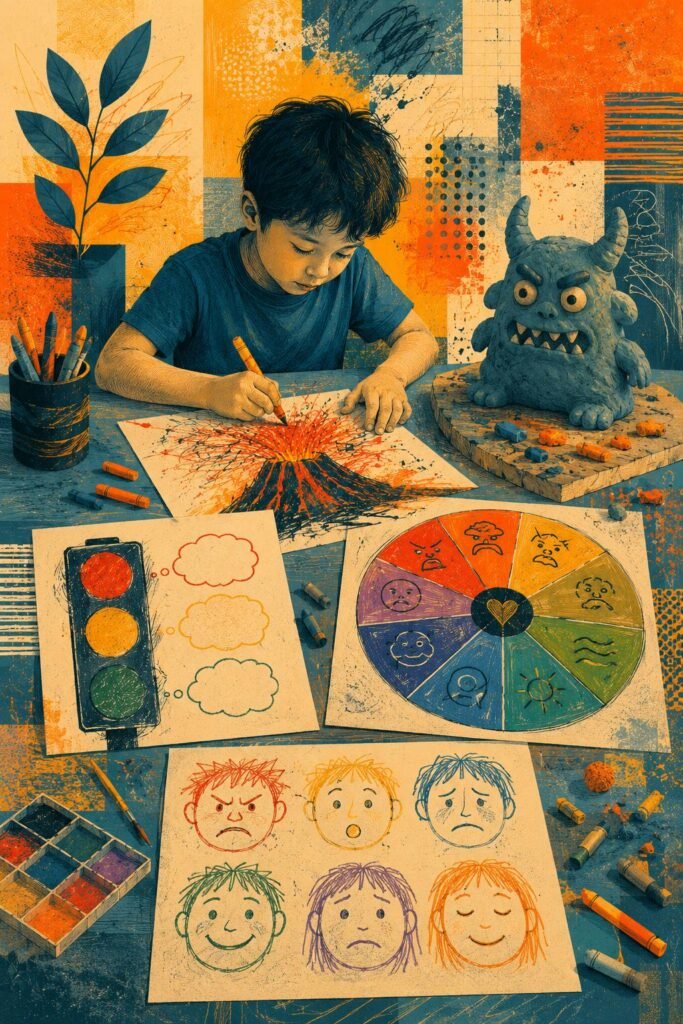
Anger Volcano gives the child’s anger a geological form — a volcano that can build pressure, erupt, and then settle. The child draws and colours their volcano in response to what their anger feels like in their body right now, externalising the feeling into an image that is both scientifically accurate and deeply resonant. The volcano metaphor does something that the instruction to calm down cannot: it validates the pressure that preceded the eruption, and it demonstrates that eruptions, however dramatic, are followed by stillness.
Clay Feelings Monsters takes the physical, tactile dimension of anger work directly. The child uses clay — pound it, shape it, reshape it — to create a creature that holds their difficult feeling. The making is therapeutic in itself: the physical engagement of working with clay activates the parasympathetic nervous system, and the monster that emerges is something the child has made and therefore, in some sense, commands. What felt overwhelming becomes something they have given a form — and what has a form can be examined, named, and related to from a position of slightly greater agency.
The Thought Traffic Light introduces a cognitive dimension to the emotional regulation work — asking the child to map their thoughts at three levels of emotional activation: red for stop, amber for slow, green for go. The visual, concrete, colour-coded format makes an abstract cognitive tool genuinely accessible to children across the developmental range, and the act of drawing and colouring the traffic light is itself a regulating activity — the child is doing something constructive with their hands at the same time as they are engaging with the content.
Emotion Colour Wheel expands the child’s emotional vocabulary by inviting them to assign colours to emotions — not the conventional red for anger and blue for sad, but their own, personal, idiosyncratic colour language for the full range of what they feel. A child who has built their own emotion colour wheel has created a private, visual lexicon for inner experience that is genuinely theirs — and that gives them a concrete, accessible way to name what is happening inside at moments when words are not available.
My Feelings Faces asks the child to draw a range of faces expressing different emotions — not copying prescribed expressions but creating their own visual representations of what each feeling looks like from the outside. The exercise builds emotional literacy and perspective-taking simultaneously, and the faces the child draws often reveal more about their relationship to specific emotions — particularly anger, shame, and fear — than any direct question could produce.
For Deeper Work: 101 Art Therapy Exercises for Children
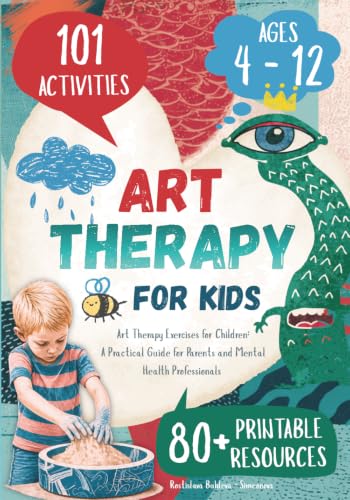
These five exercises represent a small selection of the art therapy tools for anger and emotional regulation available in 101 Art Therapy Exercises for Children: A Practical Guide for Parents and Mental Health Professionals — a book built around the understanding that children who struggle with anger need tools that meet them where the anger actually lives, within the safety of a warm, attuned, consistently present relationship.
The book contains 101 exercises structured across three age groups — 4 to 6, 7 to 9, and 10 to 12 — each activity informed by validated research demonstrating how creative engagement alters brain physiology, reduces cortisol, strengthens neural flexibility, and enhances emotional regulation. Every session comes with a clear therapeutic rationale, step-by-step guidance, reflection questions, and guidance on how to observe and respond to what emerges — without diagnosis, without pressure, and without losing sight of the child as the author of their own experience.
The anger and emotional regulation sessions address the full range of presentations children bring: the explosive anger that arrives without warning and subsides without resolution, the slow-burning frustration that accumulates across a day and finds its outlet at the wrong moment, the anger that is covering something else — sadness, fear, shame, or the helpless fury of a child who feels consistently unheard — and the particular emotional regulation challenges of children with ADHD, sensory processing differences, or histories of early trauma.
Before You Begin: A Note on Professional Support
Before attempting any art therapy exercises at home with a child who is struggling with anger or emotional regulation, I would sincerely recommend consulting a qualified mental health professional. The exercises described in this article are offered as a supportive resource — not as a replacement for clinical assessment and ongoing therapeutic care. Where anger is frequent, intense, or accompanied by significant distress, aggression, or self-harm, professional assessment is essential.
Three Things Worth Knowing
The anger needs somewhere to go before it can be reflected on.
The most important insight from the research on art therapy for anger in children is that emotional regulation does not begin with reflection. It begins with discharge — with giving the body’s urgency somewhere constructive to go. The child who pounds clay, who scrawls dark lines across a large piece of paper, who tears and rebuilds, is not being indulged. They are being given what their nervous system actually needs: a sanctioned, physically satisfying channel for a feeling that is genuinely too large to contain. The reflection comes after — and it comes more readily because the body has already been heard.
Externalisation is more effective than suppression.
Research on emotional regulation consistently confirms that suppression — pushing the feeling down, away, out of awareness — does not reduce the feeling’s intensity or its physiological impact. It increases it. Art therapy works in precisely the opposite direction: it externalises the feeling, gives it a form, and allows it to be looked at from the outside. A child who has drawn their anger volcano, shaped their feelings monster, or mapped their emotion colour wheel has done something neurologically distinct from a child who has been told to calm down. They have moved the feeling from inside, where it was formless and overwhelming, to outside, where it has edges and can be engaged with.
You are the most important tool in the room.
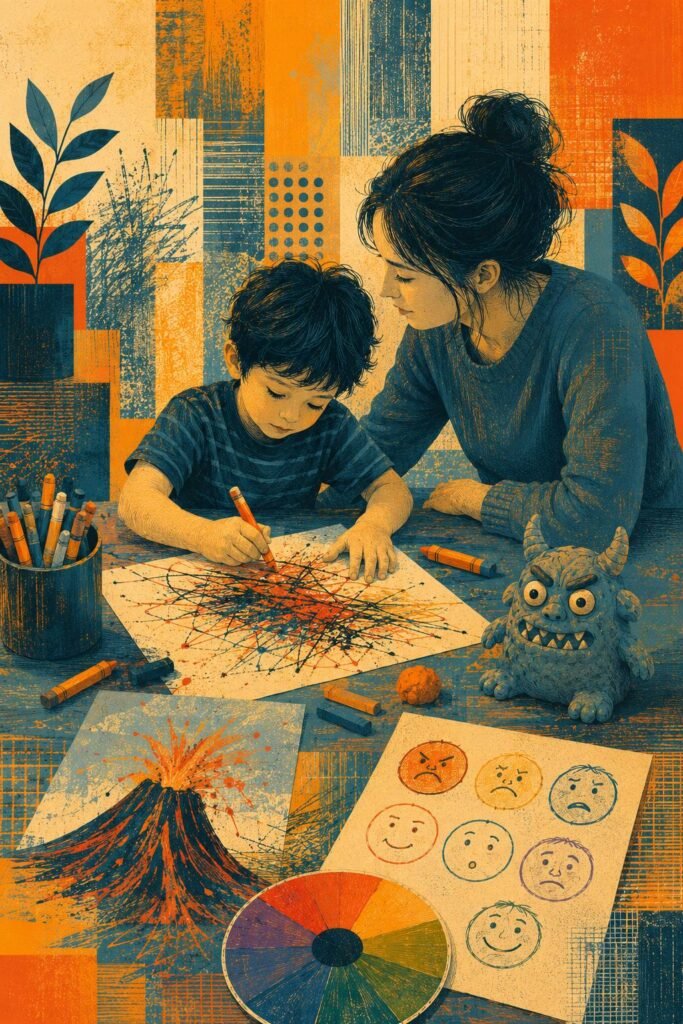
Art therapy for anger in children is not delivered by exercises. It is delivered through the quality of the relationship within which those exercises are offered. A regulated, warm, non-reactive adult presence — one that remains steady when the child is not, that communicates through its own nervous system that this feeling is survivable and that the child is not in trouble for having it — is the most powerful emotional regulation intervention available. The exercises are the invitation. You are the co-regulation that makes the invitation feel safe enough to accept.
Ready to Go Further?
If these five art therapy exercises for anger in children gave you a sense of what becomes possible when children are given a legitimate, creative, physically engaging channel for their most difficult feelings, 101 Art Therapy Exercises for Children: A Practical Guide for Parents and Mental Health Professionals gives you 101 more tools built on the same foundation — grounded in neuroscience, informed by developmental research, and written for every adult who has ever stood beside an angry child and wished they had something more to offer than a consequence.
Disclaimer: This article is intended as an educational and supportive resource for parents, caregivers, educators, and mental health professionals. It is not intended to diagnose, treat, or replace professional therapeutic or medical care. If a child is experiencing significant emotional, behavioural, or developmental difficulties, please seek guidance from a qualified mental health professional.
Rostislava Buhleva-Simeonova is a psychologist and game design specialist. She has worked with children, adults, and the elderly within various therapeutic programmes over the past eight years, all the while providing the much-needed playful twist that art and gamified experiences can bring to this sometimes uneasy setting. But it wasn’t until the birth of her daughter, Aurora, that this work took on an even deeper personal meaning. With her academic and real-life experience, honed through numerous trainings and sessions, she is currently authoring books and articles in the field of child psychology and development, offering expertise in art and play therapy to guide parents and caregivers, as well as professionals in the fields of social work and mental health, throughout various pivotal moments in children’s lives. Last but not least, all of her books have been “peer-reviewed” by her daughter, who testifies to the efficiency of these methods.
References
Bush, J. (1997). The development of an art therapy assessment and rating instrument. Art Therapy, 14(1), 5–12.
Huang, X., et al. (2025). The application of painting in the intervention of children’s psychological issues in China: A narrative review. PMC. https://pmc.ncbi.nlm.nih.gov/articles/PMC12325857/
International Journal of Art Therapy. (2023). Affect regulating art therapy for children and adolescents experiencing psychosocial problems. International Journal of Art Therapy, 29(2). https://doi.org/10.1080/17454832.2023.2208198
López Fernández-Cao, M., et al. (2026). Create, destroy, recreate: A case study of art therapy with children who have experienced early trauma. The Arts in Psychotherapy. https://doi.org/10.1016/S0197-4556(26)00002X
Sharma, R., et al. (2024). Integrative art therapy to improve emotional and behavioral outcomes. Indian Journal of Psychiatric Nursing, 21(2). https://journals.lww.com/iopn/fulltext/2024/21020/integrative_art_therapy_to_improve_emotional_and.12.aspx
Versitano, S., Tesson, S., Lee, C., Linnell, S., & Perkes, I. (2025). Art therapy with children and adolescents experiencing acute or severe mental health conditions: A systematic review. Australian & New Zealand Journal of Psychiatry. https://doi.org/10.1177/00048674251361731
Yin, H., et al. (2025). Healing through art: A systematic review and meta-analysis of art therapy in children and adolescents with chronic illnesses. Vulnerable Children and Youth Studies. https://doi.org/10.1080/17450128.2025.2587204