
Every parent has watched it happen — the child who cannot sleep the night before something new, who replays the same worry until it has circled back on itself so many times it no longer resembles the original thought, who stands at the threshold of a situation they want to enter and cannot quite bring themselves to cross. Some anxiety in children is developmentally appropriate — a signal system that has not yet been fully calibrated to the difference between genuine threat and anticipated difficulty. But for a growing number of children, anxiety has become something more persistent, more pervasive, and more interfering than the ordinary worries of a childhood that is, by definition, full of uncertain things.
The search for effective, accessible, developmentally appropriate tools for anxious children has generated a substantial body of research in recent years — and one of the most consistent findings in that literature is the effectiveness of art-based approaches. Not as decorative additions to real therapeutic work. As real therapeutic work, grounded in neuroscience, validated in randomised controlled trials, and uniquely suited to the way the anxious child’s nervous system actually processes experience.
Art therapy for anxiety in children works because it meets the child where the anxiety actually lives — not in the rational mind, where verbal reassurance and cognitive restructuring operate, but in the body, the imagination, and the felt sense of what is happening that language alone cannot adequately reach.
The Scale of Childhood Anxiety
The research on the prevalence of childhood anxiety is now consistent across methodologies and populations — and the picture it reveals has become more urgent with each successive wave of data.
According to the most recent CDC data from 2023 to 2024, eleven percent of children aged three to seventeen in the United States have a current, diagnosed anxiety disorder. A 2025 systematic review found pooled rates of anxiety varying from 13% to 25% across various countries and contexts in children and adolescents — a range that reflects genuine variation in prevalence across contexts while confirming that anxiety is among the most common mental health presentations in childhood globally.
A 2025 meta-analysis published in Behavioural Sciences examined seventeen studies involving 1,548 participants and found that mindfulness-based art interventions produced small-to-moderate anxiety reductions in children — and that full mindfulness-art programs significantly outperformed mandala-colouring-only activities, confirming that the structured, intentional, therapeutically directed use of art is what produces clinical benefit, rather than creative activity in the generic sense.
And a 2024 meta-analysis of six randomised controlled trials, published in Clinics and involving 422 participants, found a large effect of art therapy on anxiety in children and adolescents, with a standardised mean difference of -1.42 — one of the strongest effect sizes reported in the child anxiety intervention literature. The review found that twice-weekly sessions outperformed weekly ones, and that effects were stronger for state anxiety — the acute, situational anxiety of the moment — than for trait anxiety, suggesting that art therapy is particularly effective at reducing the immediate experience of anxiety while also contributing to longer-term change.
What Anxiety Does — and Why Art Reaches It
Understanding art therapy for anxiety in children requires understanding what anxiety actually is at the neurological level — because the treatment logic follows directly from the biological reality.
Anxiety is a state of physiological activation generated by the amygdala’s threat-detection system — a response that, in its original design, prepares the body for danger with a speed and completeness that bypasses the slower, more deliberate processes of the prefrontal cortex. In an anxious child, this response fires more readily, more intensely, and does not reliably return to baseline once the perceived threat has passed. The result is a nervous system that is, at a neurological level, living in a world that feels persistently more threatening than it objectively is.
Language and conscious cognitive reflection are prefrontal cortex functions. They require a level of cortical availability that anxiety specifically compromises. A child in the grip of anxious arousal does not have reliable access to the parts of the brain that verbal reassurance most depends on. Art bypasses this barrier. It operates through the right hemisphere — through image, symbol, sensation, and making — in the same register that the anxious nervous system is already using.
A 2025 systematic review of art therapy with children and adolescents experiencing acute or severe mental health conditions, published in the Australian and New Zealand Journal of Psychiatry, confirmed that art therapy produces statistically significant reductions in anxiety and acute distress — and identified emotional regulation and externalisation of inner experience as key mechanisms of change. When a child draws their worry, gives it a colour, places it in a jar, or maps the path to a safe place, they are not simply being creative. They are doing something neurologically significant: moving the anxiety from inside, where it is formless and overwhelming, to outside, where it has edges and can be looked at.
Five Art Therapy Exercises for Anxious Children
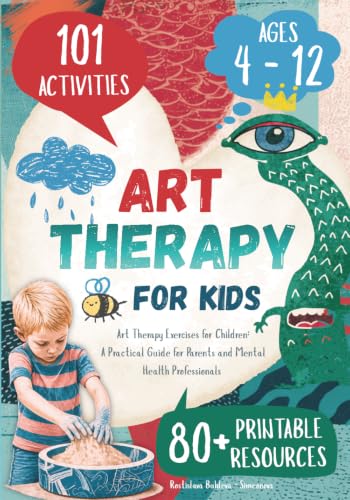
The following five exercises are drawn from 101 Art Therapy Exercises for Children: A Practical Guide for Parents and Mental Health Professionals — a book built around the understanding that the most effective tools for anxious children are those that meet them in their own language, within the safety of a warm, attuned, consistently present relationship. Each exercise addresses anxiety from a slightly different angle, making them complementary rather than interchangeable.
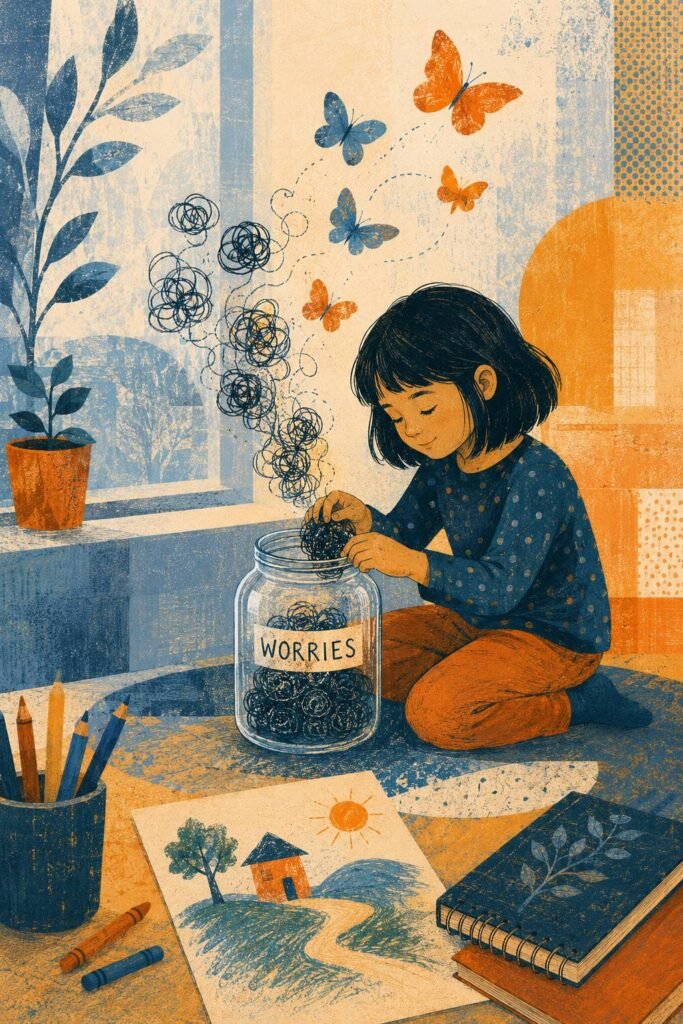
The Calm Down Jar gives the anxious mind a visible, external form — the child writes or draws their worries on small slips of paper and places them one by one into the jar, watching the jar fill with the things that have been weighing on them. Once the lid is closed, the worries are contained — held somewhere outside the child’s body, in a space that can be put on a shelf, revisited, or set aside for the night. It is one of the most accessible and versatile exercises in the book, suitable from age three upward, and particularly effective as a bedtime ritual for children whose anxiety tends to surface in the transition to sleep.
The Worry Doll draws on a therapeutic tradition rooted in Guatemalan culture, adapted here as a creative making exercise in which the child constructs a small figure to hold their worries. The making itself is therapeutic; the externalisation that follows gives the child a concrete, agentic way to set a worry down rather than simply endure it.
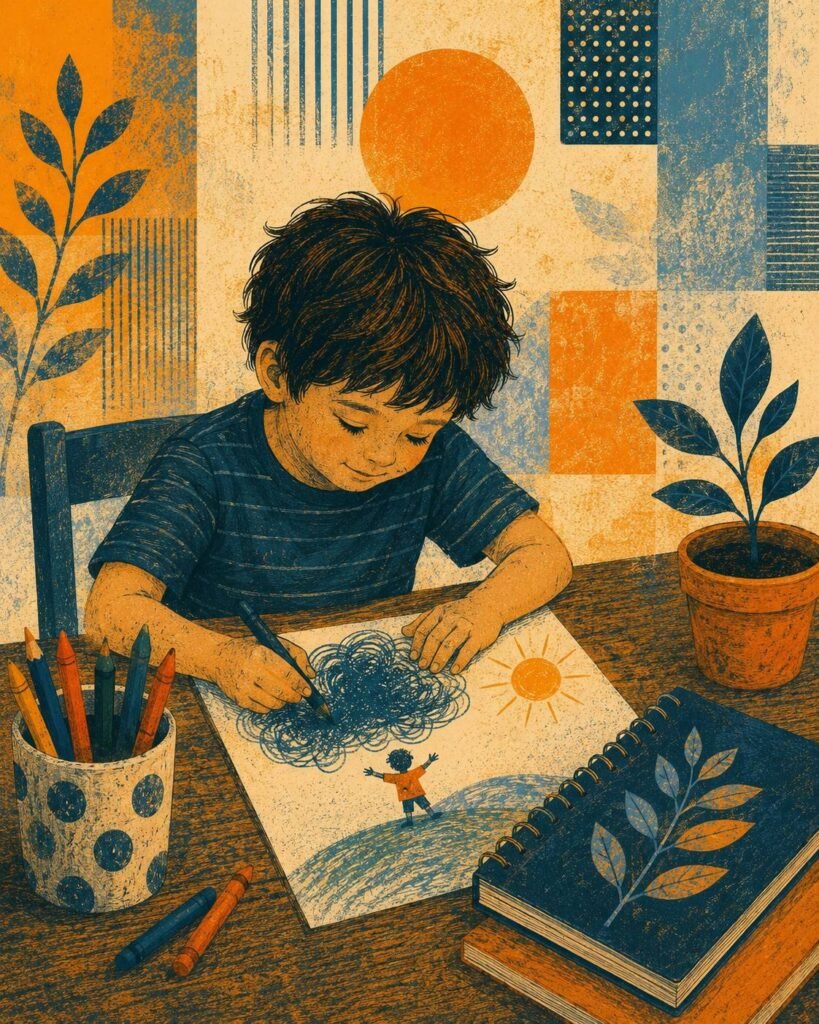
My Safe Place Drawing invites the child to draw a place — real or entirely imagined — where they feel completely safe. The exercise builds the child’s capacity for positive visualisation and creates a portable, visual record of their own regulatory resource that can be returned to in moments of acute anxiety.
Mindful Mountains integrates present-moment mindfulness with creative expression — asking the child to attend to what is happening in their body and then give it the form of a landscape. It is particularly effective for children whose anxiety manifests as racing thoughts and difficulty staying in the present.
The Bridge to Courage addresses avoidance directly — one of the most clinically significant features of childhood anxiety. The child draws what they are afraid of on one side of a bridge and what is waiting on the other. The bridge itself, which they design and populate with their own resources and evidence, becomes a visual map of what crossing feels like and what it makes possible.
For Deeper Work: 101 Art Therapy Exercises for Children
These five exercises represent a small selection of the art therapy tools for anxiety available in 101 Art Therapy Exercises for Children: A Practical Guide for Parents and Mental Health Professionals — a book built around the understanding that anxious children need to be met in the language their nervous systems are actually speaking, within the safety of a warm, attuned, consistently present relationship.
The book contains 101 exercises structured across three age groups — 4 to 6, 7 to 9, and 10 to 12 — each activity informed by validated research demonstrating how creative engagement alters brain physiology, reduces cortisol, strengthens neural flexibility, and enhances emotional regulation. Every session comes with a clear therapeutic rationale, step-by-step guidance, reflection questions, and guidance on how to observe and respond to what emerges — without diagnosis, without pressure, and without losing sight of the child as the author of their own experience.
The anxiety sessions address the full range of presentations children bring: the generalised worry that loops without resolution, the social anxiety that keeps the child at the edge of belonging, the separation anxiety that makes every goodbye feel permanent, the perfectionism that makes every attempt feel dangerous, the specific fears that have their own particular logic, and the existential anxiety of the older child who has understood enough about the world to be frightened by what they understand.
Before You Begin: A Note on Professional Support
Before attempting any art therapy exercises at home with an anxious child, I would sincerely recommend consulting a qualified mental health professional. The exercises described in this article are offered as a supportive resource — not as a replacement for clinical assessment and ongoing therapeutic care. Childhood anxiety exists on a spectrum, and what is appropriate support at one point on that spectrum may be insufficient at another.
Three Things Worth Knowing
The making is the medicine.
The most important insight from the research on art therapy for anxiety in children is that the therapeutic benefit is not located in the finished product. It is located in the process — in the focused, hand-based, sensory engagement of making something, which activates the parasympathetic nervous system, reduces cortisol, and moves the anxious child’s nervous system toward a regulated state before any reflection or processing has even begun. A child who says the drawing is not very good has still received the full neurological benefit of the making. The product is never the point.
Twice weekly outperforms weekly.
The 2024 meta-analysis finding that twice-weekly art therapy sessions produced significantly stronger anxiety reductions than weekly sessions has a direct practical implication: these exercises work best as a consistent, regular practice rather than a crisis intervention. The anxious child who engages with art-based regulation twice a week, building a habit rather than reaching for a tool only in moments of acute distress, is building a fundamentally different relationship to their anxiety over time.
You are the most important tool in the room.
Art therapy for anxiety in children is not delivered by exercises. It is delivered through the quality of the relationship within which those exercises are offered. A regulated, warm, genuinely curious adult presence — one that communicates, through small consistent acts of attuned attention, that the child’s inner world is worth attending to and that the anxiety does not have to be faced alone — is the most powerful anxiety intervention available. The exercises are the invitation. You are the reason the anxious child is willing to pick up the pencil.
Ready to Go Further?
If these five art therapy exercises for anxiety in children gave you a sense of what becomes possible when anxious children are met in their own language, 101 Art Therapy Exercises for Children: A Practical Guide for Parents and Mental Health Professionals gives you 101 more tools built on the same foundation — grounded in neuroscience, informed by developmental research, and written for every adult who has ever sat beside an anxious child and wished they had something more to offer than reassurance.
Disclaimer: This article is intended as an educational and supportive resource for parents, caregivers, educators, and mental health professionals. It is not intended to diagnose, treat, or replace professional therapeutic or medical care. If a child is experiencing significant emotional, behavioural, or developmental difficulties, please seek guidance from a qualified mental health professional.
Rostislava Buhleva-Simeonova is a psychologist and game design specialist. She has worked with children, adults, and the elderly within various therapeutic programmes over the past eight years, all the while providing the much-needed playful twist that art and gamified experiences can bring to this sometimes uneasy setting. But it wasn’t until the birth of her daughter, Aurora, that this work took on an even deeper personal meaning. With her academic and real-life experience, honed through numerous trainings and sessions, she is currently authoring books and articles in the field of child psychology and development, offering expertise in art and play therapy to guide parents and caregivers, as well as professionals in the fields of social work and mental health, throughout various pivotal moments in children’s lives. Last but not least, all of her books have been “peer-reviewed” by her daughter, who testifies to the efficiency of these methods.
References
Gocen, O., & Sari Ozturk, C. (2025). The effect of therapeutic artistic activities on anxiety and psychological well-being in adolescents with type 1 diabetes: A randomized controlled study. European Journal of Pediatrics. https://doi.org/10.1007/s00431-025-06237-y
Léger-Goodes, T., et al. (2023). Videoconference-led art-based interventions for children during COVID-19: Comparing mindful mandala and emotion-based drawings. Mental Health Science. https://doi.org/10.1002/mhs2.17
Liu, X., Sun, L., Du, X., Zhang, C., Zhang, Y., & Xu, X. (2023). Reducing anxiety and improving self-acceptance in children and adolescents with osteosarcoma through group drawing art therapy. Frontiers in Psychology. https://doi.org/10.3389/fpsyg.2023.1166419
Versitano, S., Tesson, S., Lee, C., Linnell, S., & Perkes, I. (2025). Art therapy with children and adolescents experiencing acute or severe mental health conditions: A systematic review. Australian & New Zealand Journal of Psychiatry. https://doi.org/10.1177/00048674251361731
Yin, H., et al. (2025). Healing through art: A systematic review and meta-analysis of art therapy in children and adolescents with chronic illnesses. Vulnerable Children and Youth Studies. https://doi.org/10.1080/17450128.2025.2587204
Zhang, B., Wang, J., & Abdullah, A. (2024). The effects of art therapy interventions on anxiety in children and adolescents: A meta-analysis. Clinics, 79, 100404. https://doi.org/10.1016/j.clinsp.2024.100404
Zhu, Z., Xiao, L., Ahmad, N. A., Roslan, S., Burhanuddin, N. A. N., Gao, J., & Huang, C. (2025). Mindfulness-based art interventions for students: A meta-analysis review of the effect on anxiety. Behavioral Sciences, 15(8), 1078. https://doi.org/10.3390/bs15081078