
Every parent has watched a child shrink from something they are genuinely capable of. The one who will not put their hand up because they are certain the answer is wrong even before they have fully formed it. The one who dismisses every compliment before it has had time to land. The one who compares themselves to a peer with a quiet, habitual thoroughness that leaves no room for the conclusion that they might also be enough. These moments do not always announce themselves as self-esteem difficulties. They arrive in small, unremarkable packages — a shrug here, a no I can’t there — and they accumulate, across months and years, into something that shapes the entire trajectory of how a child moves through their own life.
Self-esteem is not a personality trait that children either have or do not have. It is a developmental construction — built through experience, relationship, and the accumulated evidence a child gathers about their own worth and capability. And it is a construction that, when it goes wrong, has measurable consequences for every domain of the child’s life: their academic achievement, their peer relationships, their mental health, their resilience under challenge, and their capacity to become the person they are genuinely capable of becoming.
Art therapy for self-esteem in children addresses this not through reassurance or positive messaging but through the direct, embodied, creative experience of making something — of discovering, through the act of drawing, sculpting, decorating, and imagining, what is genuinely and specifically theirs.
What Self-Esteem in Children Is Actually Built From
The popular understanding of self-esteem — that it is built primarily through praise, through being told one is special, through the consistent affirmation of a loving adult — is only partially supported by the research. And the part it misses is clinically significant.
Self-esteem that is dependent on external validation is fragile. It rises when others approve and falls when they do not. It requires constant maintenance through the opinions of other people, making it particularly vulnerable to the social comparison pressures that intensify through middle childhood and become acute in adolescence. What the research identifies as genuinely protective is something different: an internally grounded, specifically detailed, personally meaningful sense of what one is capable of and what one brings to the world — one that does not require continuous external confirmation because it is built on evidence the child has gathered for themselves.
A 2025 study on the perceived effects of the Affect Regulation Art Therapy programme — published in Children and Youth Services Review — found that participants experienced improvements across domains including self-regulation, self-awareness, self-esteem, resilience, and flexibility. The success of the programme highlighted the importance of personalised approaches within art therapy: approaches that give the individual child a specific, concrete, personally meaningful experience of their own capacity rather than delivering generic positive messages about self-worth.
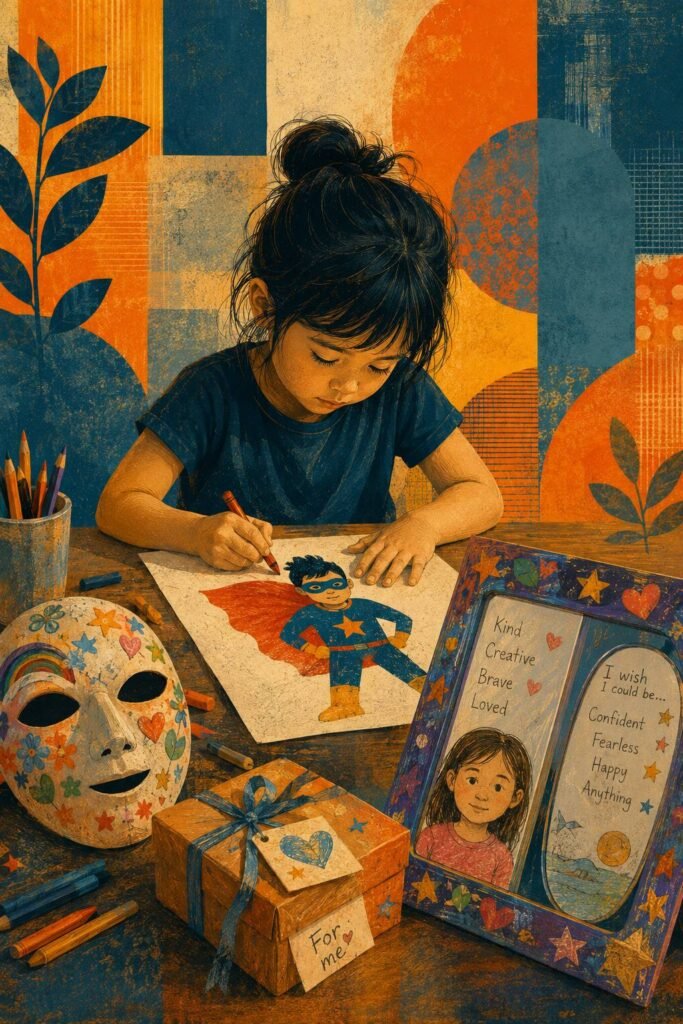
This is the therapeutic logic of art therapy for self-esteem in children. A child who creates a self-portrait, who designs a mask that represents who they uniquely are, who draws themselves as a superhero with powers they have identified for themselves, has not been told they are worthy. They have discovered it — through the making, through the specific choices they made, and through the concrete, visible evidence of what they produced. That discovery is qualitatively different from any reassurance an adult could deliver, because it belongs entirely to the child.
What the Research Shows
The research on art therapy for self-esteem in children has grown in both volume and methodological rigour in recent years — and the findings are consistent across populations, settings, and therapeutic approaches.
A 2023 pilot randomised controlled study published in The Arts in Psychotherapy examined a school-based art therapy intervention and confirmed that art therapy produces meaningful child-focused outcomes — including improved self-awareness, self-esteem, and confidence. As one of the few randomised designs in a school setting, this study represents an important methodological benchmark: it provides the kind of controlled evidence that places art therapy for self-esteem in the same evidence category as other established psychological interventions.
A 2025 feasibility study published in Arts and Health examined a structured ten-week art therapy intervention for children aged ten to sixteen living in residential childcare institutions in Kerala, India — a population characterised by early trauma, attachment difficulties, and chronically low self-esteem. Post-intervention outcomes revealed statistically significant improvements across emotional problems, conduct disorders, hyperactivity, and prosocial behaviour — with self-esteem gains maintained at follow-up. The finding that art therapy produces meaningful self-esteem improvements even in children with the most disrupted early relational histories is clinically significant: it confirms that the mechanism of change is not dependent on a stable home environment or secure attachment. It is located in the therapeutic relationship and the creative process itself.
A 2024 outcome study published in the Journal for ReAttach Therapy and Developmental Diversities, examining the effect of art therapy on self-esteem in children living in an orphanage, confirmed that art therapy is a successful intervention for enhancing self-esteem in children who have experienced parental loss and institutional care — corroborating the feasibility study’s findings in a distinct population and context.
A 2025 systematic review published in the Australian and New Zealand Journal of Psychiatry found that art therapy interventions consistently improve self-efficacy and empowerment in children and adolescents — evidenced by increased levels of self-confidence and assertiveness across multiple studies. And a 2023 randomised study found that group drawing art therapy significantly improved self-acceptance in children and adolescents — with the intervention group showing substantially higher self-acceptance scores than controls after eight sessions.
Why Art Is the Right Medium for Self-Esteem Work
The case for art therapy as a route to self-esteem in children is grounded in a straightforward developmental reality: self-esteem is not a cognitive conclusion. It is a felt experience — embodied, sensory, emotionally charged — that is built through the direct, repeated experience of being someone who makes things, who has preferences, who creates something that did not exist before and that is recognisably, specifically theirs.
Art therapy draws on psychodynamic, humanistic, and cognitive-behavioural frameworks to activate mechanisms of change including externalisation of inner experience, symbolic processing, and play. Each of these mechanisms is directly relevant to self-esteem work. Externalisation allows the child to see their own qualities and strengths represented in a visible, tangible form that can be looked at, returned to, and experienced as real. Symbolic processing allows the child to explore who they are and who they want to become through the protective medium of image and metaphor — which is less exposing than direct self-disclosure and more available to children who have learned to defend against the risk of self-evaluation. And play creates the conditions of genuine creative freedom in which the child can try things out, make unexpected discoveries, and build the experiential evidence base that genuine self-esteem requires.
Art therapy supports the regulation of emotions, alleviates symptoms of anxiety and depression, and enhances self-esteem and social skills by offering a secure environment in which children can explore and develop emotional regulation. The social dimension of this — the improved social skills and relational confidence that accompany self-esteem gains in art therapy — reflects the research finding that self-esteem and social competence are not separate outcomes. They develop together, through the same relational and creative processes, and reinforce each other in ways that extend the impact of the intervention well beyond the therapeutic context.
Four Art Therapy Exercises for Self-Esteem
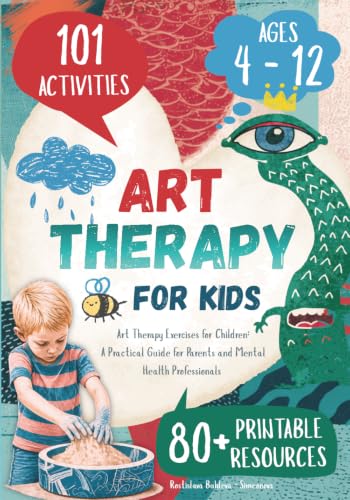
The following four exercises are drawn from 101 Art Therapy Exercises for Children: A Practical Guide for Parents and Mental Health Professionals — a book built around the understanding that the most effective tools for self-esteem work are those that give the child a specific, concrete, personally meaningful experience of their own worth, within the safety of a warm, attuned, consistently present relationship. Each exercise approaches self-esteem from a slightly different angle, making them complementary rather than interchangeable.
Draw Yourself as a Superhero invites the child to create an original superhero version of themselves — not a character from comics or film but one that is entirely their own invention. The superhero has powers, a mission, a costume, and qualities that the child identifies. The exercise is grounded in the same therapeutic logic as strength-based approaches in clinical practice: the child who has externalised an idealised, empowered version of themselves has created visible evidence of what they believe they are capable of — and that evidence, once on paper, becomes available to return to. It is particularly effective for children whose self-esteem is undermined by perfectionism or social comparison, because the superhero frame removes the comparative dimension entirely: there is no right answer, and no one else’s superhero to measure against.
My Unique Self Mask uses the mask — one of the oldest symbolic objects in human culture — as a vehicle for self-concept exploration. The child creates and decorates a mask that represents who they are: what they love, what makes them unique, what they want others to know about them and what they prefer to keep private. The two-sided nature of the mask — what is shown and what is held — is itself therapeutically rich, and the making process invites the child to make hundreds of small, specific, personally meaningful choices about what belongs on their face. Each choice is an act of self-definition.
Gift to Yourself asks the child a deceptively simple and therapeutically profound question: if you could give yourself any gift in the world, real or imaginary, what would it be and why? The child draws their gift and then reflects on what it would mean, why they chose it, and how it would help them or make them feel. A child who has named and drawn their own gift has done something clinically significant: they have treated their own needs as worth attending to, and they have discovered — through the specific, personal answer that the question produces — something about what they are currently reaching toward that generic self-esteem work cannot reveal.
Magic Mirror Frame invites the child to create a decorated frame — as elaborate or as simple as they choose — and then, inside the frame, draw or write what they see when they look at themselves in the mirror and everything they wish they could be outside the frame. The mirror metaphor is therapeutically precise: the frame the child creates is the frame through which they are being invited to look at themselves. And what they choose to put inside it — however simple or however detailed — is information about the self that they most want to be seen.
For Deeper Work: 101 Art Therapy Exercises for Children
These four exercises represent a small selection of the art therapy tools for self-esteem available in 101 Art Therapy Exercises for Children: A Practical Guide for Parents and Mental Health Professionals — a book built around the understanding that self-esteem in children is built not through messages delivered from the outside but through experiences generated from the inside, within the safety of a creative, relational, and therapeutically grounded process.
The book contains 101 exercises structured across three age groups — 4 to 6, 7 to 9, and 10 to 12 — each activity informed by validated research demonstrating how creative engagement alters brain physiology, strengthens neural flexibility, and enhances emotional regulation. Every session comes with a clear therapeutic rationale, step-by-step guidance, reflection questions, and guidance on how to observe and respond to what emerges — without diagnosis, without pressure, and without losing sight of the child as the author of their own experience.
The self-esteem and self-concept chapter addresses the full range of what low self-esteem looks like in practice: the perfectionism that keeps the child from trying; the social comparison that makes every room feel like a measurement; the critical inner voice that has learned to speak louder than anything else; the shame that keeps difficult feelings hidden; and the body-related anxiety that constricts a child’s willingness to engage, move, and simply inhabit their own life with confidence and pleasure.
Before You Begin: A Note on Professional Support
Before attempting any art therapy exercises at home with a child who is struggling with self-esteem, I would sincerely recommend consulting a qualified mental health professional. The exercises described in this article are offered as a supportive resource — not as a replacement for clinical assessment and ongoing therapeutic care. Where low self-esteem is accompanied by depression, anxiety, withdrawal, or significant distress, professional assessment is essential.
Three Things Worth Knowing
Self-esteem is built from specificity, not from praise.
The most important insight from the research on art therapy for self-esteem in children is that generic positive messages do not build the kind of self-esteem that withstands pressure. What builds something durable is the specific, embodied, personally meaningful experience of making something that is recognisably and entirely one’s own. A child who has drawn their superhero, decorated their mask, named their gift, and looked honestly into their magic mirror has gathered evidence about themselves that is far more resistant to social comparison and critical inner voices than anything an adult could say to them — because it came from inside, and it is theirs.
The making is the message.
In art therapy for self-esteem work, the therapeutic outcome is not located in what the child produces. It is located in the experience of producing it: the hundreds of small, specific, personally meaningful choices that go into making something, the discovery of unexpected preferences and capacities, and the felt sense of creative agency that the act of making generates. A child who finishes a session having made something — anything — has had the direct, embodied experience of being someone who creates. And that experience, repeated across sessions and across time, builds something that looks remarkably like self-esteem from the inside.
You are the most important tool in the room.
Art therapy for self-esteem in children is not delivered by exercises. It is delivered through the quality of the relationship within which those exercises are offered. The adult who sits beside a child and receives what they make with genuine, specific, unhurried interest — not generic praise but real curiosity about what the child chose and why — is offering the most powerful self-esteem intervention available. The exercises create the opportunity for the child to be seen. You are the reason they believe the seeing is worth something.
Ready to Go Further?
If these four art therapy exercises for self-esteem in children gave you a sense of what becomes possible when children are helped to discover their own worth from the inside out, 101 Art Therapy Exercises for Children: A Practical Guide for Parents and Mental Health Professionals gives you 101 more tools built on the same foundation — grounded in neuroscience, informed by developmental research, and written for every adult who has ever sat beside a child and wished they had something more to offer than reassurance.
Disclaimer: This article is intended as an educational and supportive resource for parents, caregivers, educators, and mental health professionals. It is not intended to diagnose, treat, or replace professional therapeutic or medical care. If a child is experiencing significant emotional, behavioural, or developmental difficulties, please seek guidance from a qualified mental health professional.

Rostislava Buhleva-Simeonova is a psychologist and game design specialist. She has worked with children, adults, and the elderly within various therapeutic programmes over the past eight years, all the while providing the much-needed playful twist that art and gamified experiences can bring to this sometimes uneasy setting. But it wasn’t until the birth of her daughter, Aurora, that this work took on an even deeper personal meaning. With her academic and real-life experience, honed through numerous trainings and sessions, she is currently authoring books and articles in the field of child psychology and development, offering expertise in art and play therapy to guide parents and caregivers, as well as professionals in the fields of social work and mental health, throughout various pivotal moments in children’s lives. Last but not least, all of her books have been “peer-reviewed” by her daughter, who testifies to the efficiency of these methods.
References
Children and Youth Services Review. (2025). Perceived effects of an art therapeutic treatment (ArAT) for children and adolescents with psychosocial problems. https://doi.org/10.1016/j.childyouth.2025.108038
Jrtdd.com. (2024). Effect of art therapy on self-esteem among children in a selected orphanage. Journal for ReAttach Therapy and Developmental Diversities, 7(1). https://jrtdd.com/index.php/journal/article/view/1923
Liu, X., Sun, L., Du, X., Zhang, C., Zhang, Y., & Xu, X. (2023). Reducing anxiety and improving self-acceptance in children and adolescents with osteosarcoma through group drawing art therapy. Frontiers in Psychology. https://doi.org/10.3389/fpsyg.2023.1166419
Moula, Z., et al. (2023). Child-focused outcome and process evaluation of a school-based art therapy intervention: A pilot randomised controlled study. The Arts in Psychotherapy. https://doi.org/10.1016/j.aip.2023.102077
Nature Index. (2025). Art therapy interventions for mental health in children and adolescents. https://www.nature.com/nature-index/topics/l4/art-therapy-interventions-for-mental-health-in-children-and-adolescents
Nithya, B., et al. (2025). The effectiveness of art therapy in addressing emotional and behavioral issues and enhancing self-esteem of children living in residential childcare institutions: A feasibility study in Kerala, India. Arts & Health. https://doi.org/10.1080/17533015.2025.2527185
PsychNexus. (2025). Effectiveness of trauma-informed art therapy on self-esteem among individuals with trauma histories. https://journals.kmanpub.com/index.php/psychnexus/article/download/3920/6706/19168
Versitano, S., Tesson, S., Lee, C., Linnell, S., & Perkes, I. (2025). Art therapy with children and adolescents experiencing acute or severe mental health conditions: A systematic review. Australian & New Zealand Journal of Psychiatry. https://doi.org/10.1177/00048674251361731