
Divorce is one of the most significant family transitions a child can experience. It is not a single event but a process — one that unfolds over months and years and touches every area of a child’s life: their sense of security, their understanding of relationships, their capacity to trust, and their developing sense of who they are.
What children need most during this process is not protection from the reality of what is happening, but support in navigating it. And what parents and professionals need is an honest, research-grounded picture of what children and divorce actually looks like — what the research shows, what factors make the difference, and what genuinely helps.
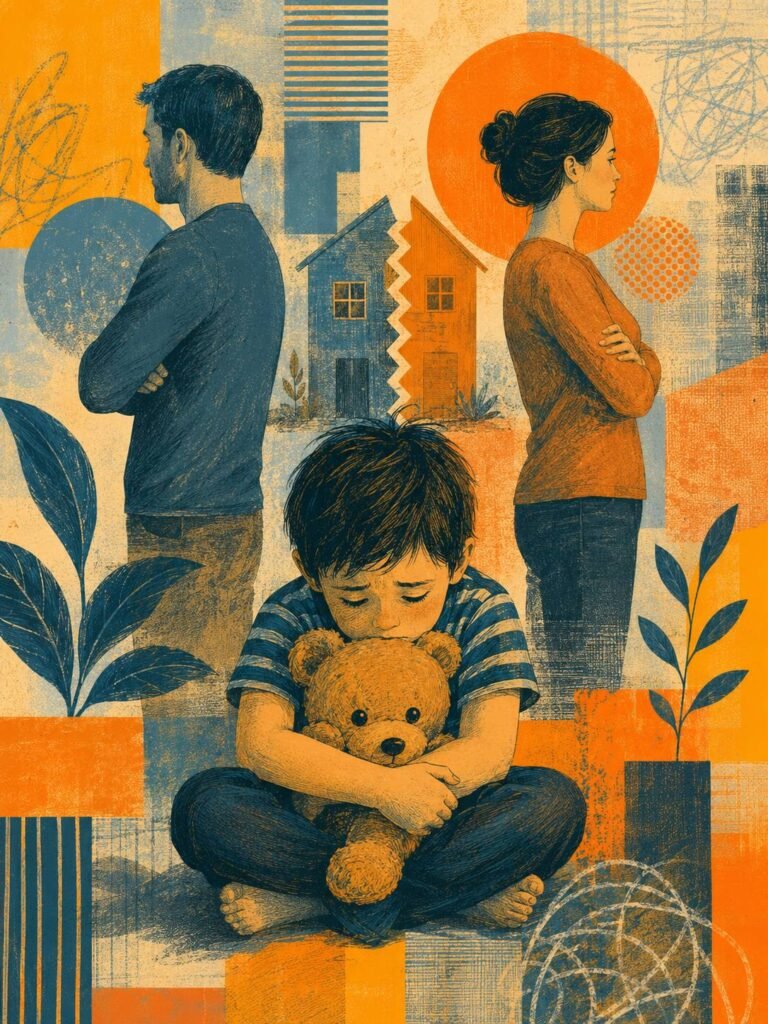
What the Research Says About Children and Divorce
The scale of childhood exposure to parental separation is significant. In the United States alone, parental divorce affects approximately 1.1 million children annually. Research from the JAG Institute estimates that in OECD countries, more than half of all divorces involve at least one dependent child. These are not abstract statistics — they represent an enormous number of children navigating a family transition that, without adequate support, can leave lasting marks.
The research on outcomes is consistent: children and divorce is a combination that carries genuine psychological risk. A 2025 systematic review confirmed that the most common impacts on children are anxiety, depression, and emotional instability, with the potential to increase the risk of mental disorders in adulthood. A 2024 study found that parental divorce and separation can have negative short and long-term effects on children — from decreased mental health and wellbeing to reductions in educational attainment.
However, the research also consistently shows that divorce itself is not the primary determinant of outcomes. The most significant variable is not whether the parents separate, but how.
The Real Risk Factor: Interparental Conflict
Research is unambiguous on this point. Children exposed to high interparental conflict following divorce are at the greatest risk for deleterious mental health consequences. Children who experience their parents’ ongoing conflict — who are caught in loyalty battles, used as messengers, or exposed to hostility between the two adults they depend on most — show significantly worse outcomes than children whose parents, despite separating, manage to maintain a functional co-parenting relationship.
This finding has a significant clinical implication: the separation itself is often less harmful than what surrounds it. The atmosphere of sustained conflict, the insecurity, the unpredictability — these are what children are most vulnerable to. A child who witnesses arguments, tension, and unhappiness before and after a separation often carries that witnessed pain as something they should have been able to prevent, something that was partly their fault, or something that reflects on them personally.
When children feel insecure, confused, and guilty — which research confirms is a common experience during parental divorce — these feelings do not always announce themselves directly. They show up in behaviour, in regression, in changes at school, in the quality of friendships, in sleep, in appetite. A child who is struggling to make sense of what has happened to their family will show you, in the only language available to them, that something inside them needs attention.
How Children Experience Divorce at Different Ages
Children and divorce do not look the same across developmental stages. What a three-year-old needs, understands, and is capable of processing is fundamentally different from what a ten-year-old needs — and both are different again from what a preadolescent navigating identity and belonging requires.
Ages 3–6
Younger children cannot yet understand the permanence or complexity of what has happened. Their primary experience is one of disruption to routine, loss of the predictable presence of a parent, and a heightened sense of separation anxiety. They may regress to earlier behaviours — bedwetting, baby talk, increased clinginess — not because they are being difficult but because regression is a reliable signal that the nervous system is overwhelmed.
At this age, children also commonly believe that they caused the divorce. Magical thinking — the developmental norm for this stage — means that a child who has been told the family is separating may conclude, in the logic available to them, that it happened because of something they did or felt or wished. This belief is rarely spoken aloud. It sits, quietly and heavily, and shapes how the child relates to both parents.
Ages 7–9
By middle childhood, children have a fuller understanding of what the separation means and what has been lost. They can feel it more completely and carry it more consciously. This is also the age at which loyalty conflicts become most acute: the child who loves both parents equally feels the impossibility of that love when the two parents are in conflict. They may begin to align with one parent against the other, not because they have chosen sides but because the weight of being caught in the middle has become unbearable.
Children at this age may also begin to show the effects of divorce in their school performance, their friendships, and their capacity to concentrate and regulate their emotions. The impact is not always visible at home — sometimes the school or the peer group is where the distress surfaces, precisely because the child is holding it together in the family space out of loyalty or fear of upsetting the remaining parent.
Ages 10–12
At ten to twelve, children are old enough to understand the full complexity of what has happened, to have opinions about it, and to feel the injustice of it with genuine force. This is also the age at which the peer group has reached the height of its influence — and a child navigating family disruption at the same time as navigating the social pressures of preadolescence is carrying a significant dual burden.
Research from 2024 found that children and divorce in this age group may carry a particular form of burden: they become, knowingly or not, emotional managers for their parents. They notice which parent is struggling. They moderate what they say and to whom. They protect. This parentification — the reversal of the child-parent dynamic, even partially and temporarily — has documented negative effects on children’s long-term wellbeing.
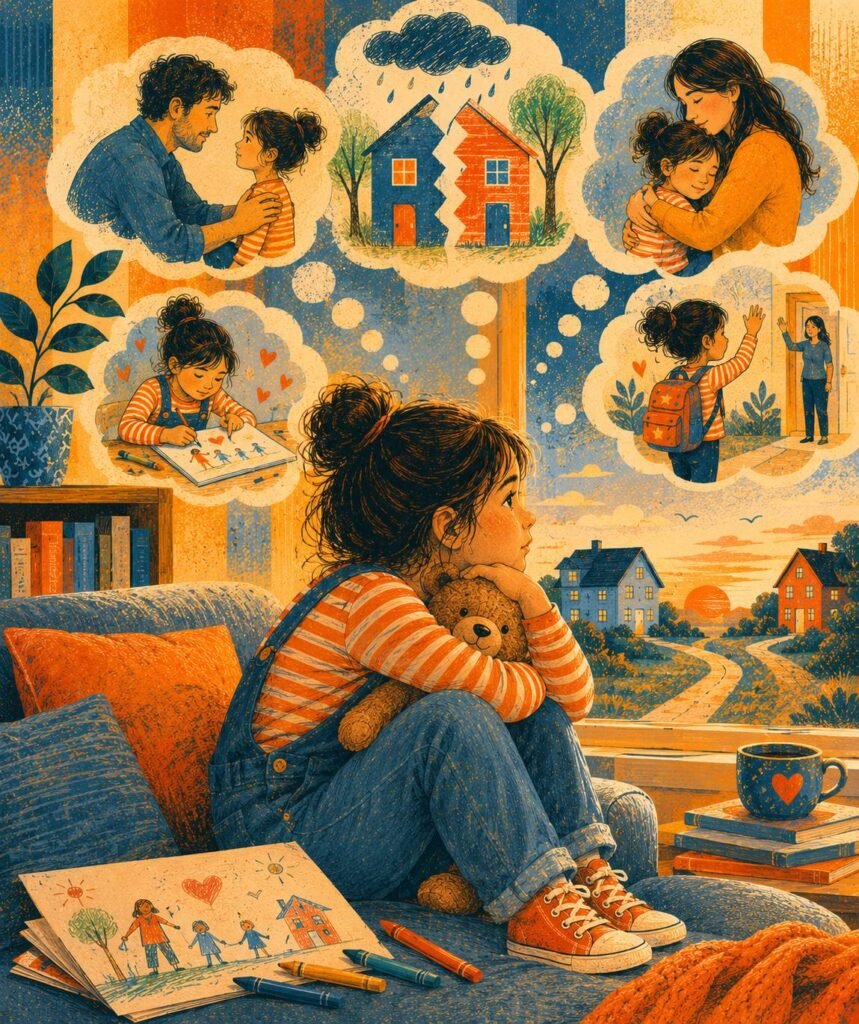
What Actually Helps: The Research on Protective Factors
The good news in the research is equally consistent: effective support makes a genuine difference. A 2025 study found that consulting children about arrangements following divorce — giving them a voice in what happens to them — is associated with positive mental health and stronger parent–child relationship outcomes. Children who are listened to rather than managed through the process show measurably better outcomes.
The research also confirms that effective parenting — characterised by high support and high responsiveness, even when a parent is themselves in significant distress — functions as the most powerful protective factor available. A parent who can remain emotionally present and reliably attuned to the child, despite everything else that is happening, provides something no intervention can replicate: a safe person.
Play-based tools and therapeutic activities are particularly valuable at this stage, for exactly the reason they are valuable at any stage: they give the child a language for what they cannot yet say directly. A child navigating the emotional complexity of children and divorce — the guilt, the grief, the loyalty, the confusion — may not be able to bring any of it into words. But they can show it, enact it, draw it, give it a character and send it somewhere safer than the inside of their chest.
The Play Therapy Toolbox: Activities for Children and Divorce
The Play Therapy Toolbox: 123 Simple Play Therapy Activities and Therapeutic Games Supporting Every Stage of Child Development from Age 3 to 12 includes dedicated activities for children navigating family transitions at every developmental stage. These include activities that address the specific emotional experience of separation at ages 3–4, activities that work with the loyalty conflict and self-blame of middle childhood, and activities designed for the preadolescent navigating two distinct family worlds simultaneously.
One of the most distinctive activities for older children is The Protector — a guided visualisation and embodiment activity in which the child imagines their parents’ love as a powerful Protector figure, steps physically into that character, and discovers that the difficult decision to separate was the Protector acting: shielding the child from something harmful rather than abandoning them to it. This reframe — divorce as protection rather than only as loss — does not minimise what the child has lost. It gives the loss a different shape.
Every activity in the book comes with a therapeutic rationale informed by peer-reviewed research, step-by-step guidance, and a parent guidance note written in plain, practical language for the adults at home. Because children and divorce is a subject that requires support for both the child and the adults around them.
Three Things Worth Knowing If Your Child Is Navigating Divorce
1. Their behaviour is communication
Regression, withdrawal, acting out, clinginess, changes in sleep or appetite — none of these are manipulation or defiance. They are the child’s nervous system telling you that something is too big to hold quietly. The behaviour is not the problem. It is the signal that points toward the problem.
2. They need permission to love both parents
One of the most damaging things a child can experience in the aftermath of separation is the feeling that loving one parent is a betrayal of the other. Explicitly and consistently giving your child permission to love the other parent — even when that is genuinely difficult — is one of the most protective things you can do.
3. You do not need to have all the answers
Children do not need parents who know exactly what to say. They need parents who stay present, who can tolerate the difficulty without collapsing under it, and who keep showing up. Presence, consistency, and warmth — these are the research-confirmed protective factors. They are not beyond any parent, even in the hardest circumstances.
If You Are Looking for More
If you are a parent, caregiver, or professional supporting children and divorce and looking for practical, evidence-based activities that meet children at every developmental stage — The Play Therapy Toolbox gives you 123 tools built for exactly this.

Disclaimer: This article is intended as an educational and supportive resource for parents, caregivers, educators, and mental health professionals. It is not intended to diagnose, treat, or replace professional therapeutic or medical care. If a child is experiencing significant emotional, behavioural, or developmental difficulties following family transition, please seek guidance from a qualified mental health professional.

Rostislava Buhleva-Simeonova is a psychologist and game design specialist. She has worked with children, adults, and the elderly within various therapeutic programmes over the past eight years, all the while providing the much-needed playful twist that art and gamified experiences can bring to this sometimes uneasy setting. But it wasn’t until the birth of her daughter, Aurora, that this work took on an even deeper personal meaning. With her academic and real-life experience, honed through numerous trainings and sessions, she is currently authoring books and articles in the field of child psychology and development, offering expertise in art and play therapy to guide parents and caregivers, as well as professionals in the fields of social work and mental health, throughout various pivotal moments in children’s lives. Last but not least, all of her books have been “peer-reviewed” by her daughter, who testifies to the efficiency of these methods.
References
Apata, O., et al. (2023). The effects of divorce on children’s psychological and physiological wellbeing. ResearchGate.
Boelen, P. A., & Spuij, M. (2024). Individual and systemic variables associated with prolonged grief and other emotional distress in bereaved children. PLOS One. https://doi.org/10.1371/journal.pone.0302725
Casseus, M., et al. (2025). Anxiety, depression, and behavioural problems among US children and adolescents, 2016–2022. Infant and Child Development. https://doi.org/10.1002/icd.70008
Frimmel, W., et al. (2024). Parental divorce, family arrangements, and children’s adult outcomes. US Census Bureau Working Papers.
Larsen, L., et al. (2025). Consulting children when parents divorce: Longitudinal associations with mental health and parent–child relationship outcomes. Family Transitions. https://doi.org/10.1080/28375300.2025.2527996
O’Hara, K. L., Wolchik, S. A., & Sandler, I. N. (2024). Preventing mental health problems in children after high conflict parental separation/divorce: An optimization randomized controlled trial protocol. Mental Health Prevention. https://doi.org/10.1016/j.mhp.2023.200301
Trenggono, A., Achdiani, Y., & Nastia, G. (2025). The effect of parental divorce on children’s mental health. THRIVE Health Science Journal, 2(1).
van der Wal, R. C., Levelt, L., Kluwer, E., & Finkenauer, C. (2024). Exploring associations between children’s forgiveness following parental divorce and psychological well-being. Family Transitions, 65(3), 248–270. https://doi.org/10.1080/28375300.2024.2310432