
Anger in children is not simply a behaviour problem. It is a communication — of need, of overwhelm, of a nervous system that has been pushed past the point where it can manage what it is holding. And like all communication, it is most useful when it can be heard clearly rather than simply reacted to. A child who can name what makes them angry, notice where anger lives in their body, and identify what helps them return to calm, has tools that will serve them across every difficult situation childhood has yet to produce.
A well-designed anger management worksheet for kids does not simply ask the child to calm down. It asks them to understand — specifically, personally, and in their own words — what the anger is, where it comes from, and what actually helps.
Why Anger Is So Hard for Children to Manage
Anger is one of the most neurologically powerful emotional states available to the human nervous system. When the amygdala registers a threat — a frustration, an injustice, a loss of control — the sympathetic nervous system activates immediately and completely. The body prepares for action. The heart rate rises. The muscles tense. And the prefrontal cortex — the part of the brain responsible for impulse control, perspective-taking, and the ability to pause before responding — is temporarily overwhelmed by the speed and intensity of the activation.
For children, this process is amplified by the simple neurological fact that the prefrontal cortex is still under construction. The regulatory infrastructure that adult anger management depends on — the capacity to notice the feeling, evaluate the situation, and choose a response — is a developmental achievement rather than a given. Children are not choosing to be overwhelmed by their anger. Their developing nervous system is genuinely less equipped than an adult’s to interrupt the escalation once it has begun.
This is why telling an angry child to calm down so consistently fails to produce calm. The instruction reaches the part of the brain that the anger has most effectively disabled. What works better — what the research on childhood anger consistently confirms works better — is building the child’s awareness of their own anger pattern before the activation arrives, so that the regulatory response has a better chance of being available when it is needed.
This is exactly what a well-designed anger management worksheet for kids builds.
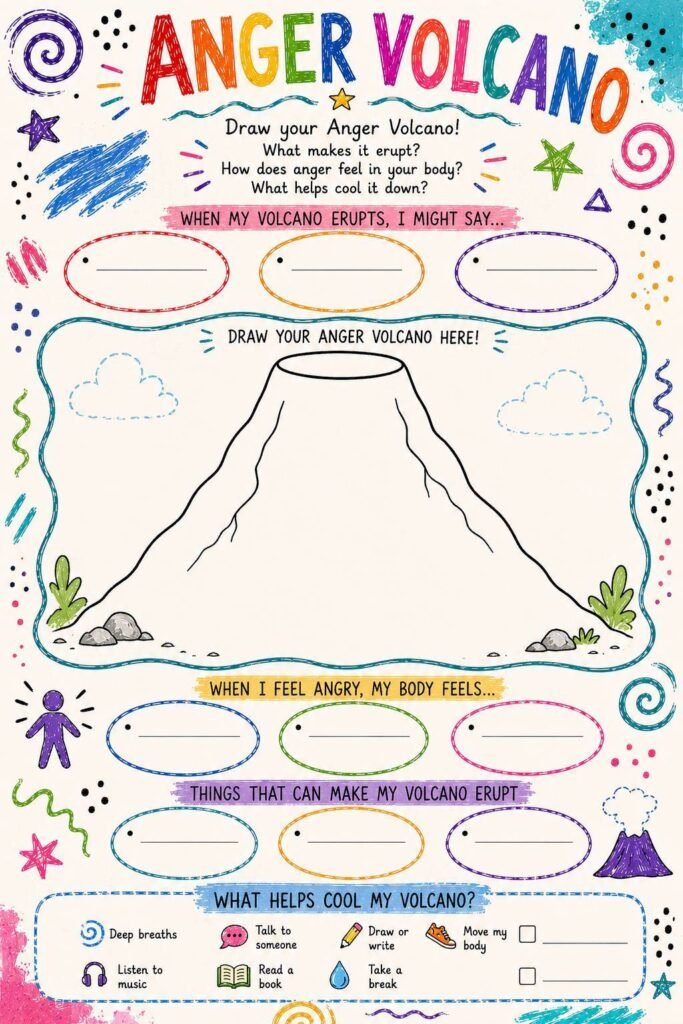
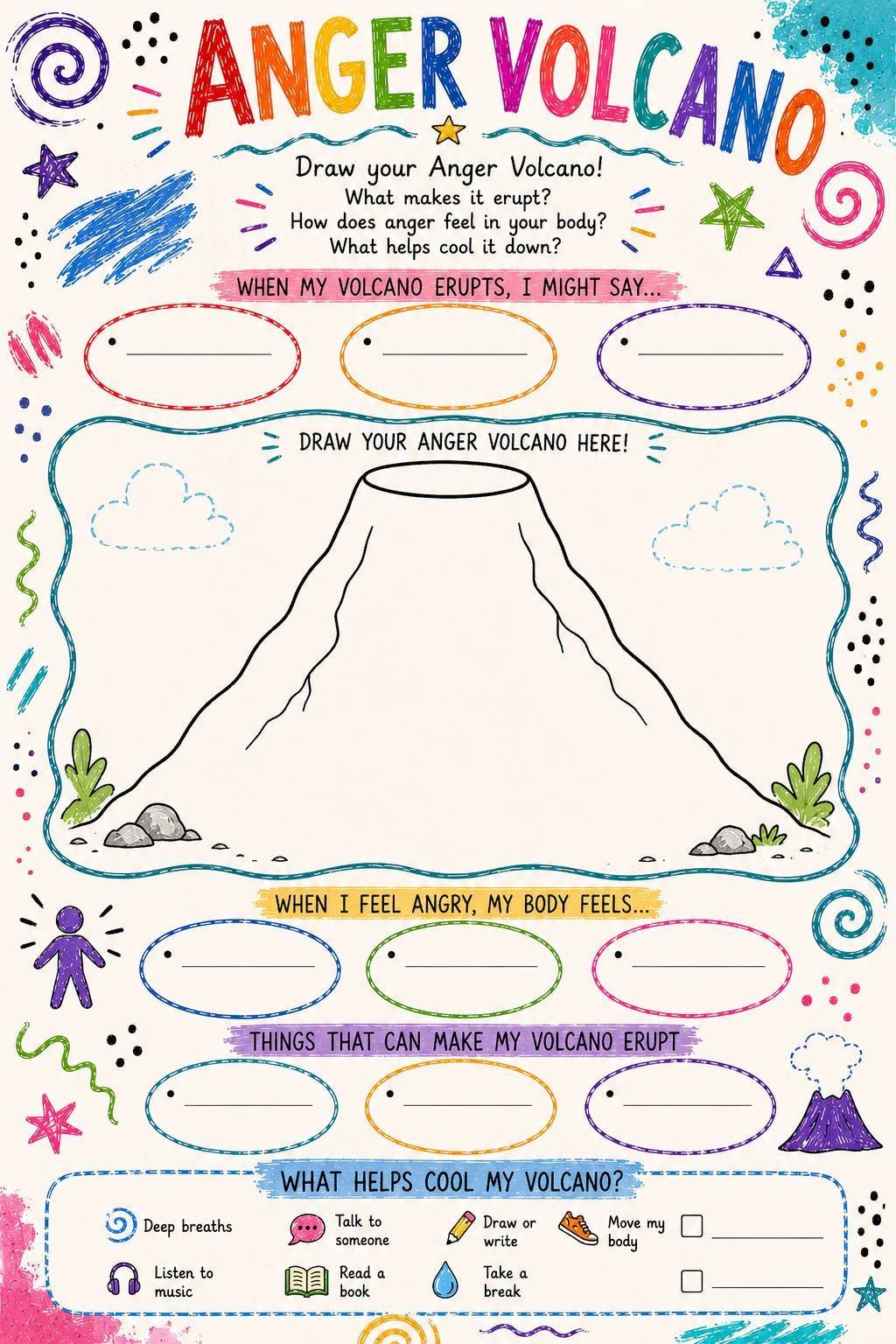
Free Anger Management Worksheet for Kids: Anger Volcano
The worksheet below — Anger Volcano — is a free resource you can use with your child today. It is suitable for children aged approximately 5 to 12, and works equally well at home, in school, or in a therapeutic setting. It is colourful, immediately engaging, and structured around a metaphor children grasp intuitively and immediately: the volcano.
The volcano metaphor is therapeutically precise in ways that go beyond its visual appeal. A volcano is not simply an explosion — it is a system. It has a structure, a pressure that builds over time, specific conditions that trigger the eruption, and a predictable aftermath once the eruption is complete. Framing anger as a volcano rather than as a problem or a failure gives the child something important: a model of their own anger as something with a structure that can be understood, rather than a force that simply arrives without warning and cannot be anticipated.
How to Use It
Introduce the worksheet during a calm, unhurried moment — not in the middle of or immediately after an angry episode, when shame is likely to be highest and the capacity for honest reflection lowest. A warm, non-punitive introduction works best: “This is called an Anger Volcano — and it’s for figuring out how your particular volcano works. Every volcano is different. Let’s figure out yours.”
Give the child time and space to complete each section without direction or evaluation. The drawing section in particular deserves uninterrupted time — what the child produces will tell you things that the written sections cannot.
Once the worksheet is complete, explore it together with open, unhurried questions:
- Of the things that make your volcano erupt, which one triggers it fastest?
- Where in your body do you notice the anger first — before it gets really big?
- When your volcano erupts, is there anyone nearby who makes it bigger, or anyone who helps it get smaller?
- Of all the things on the cooling list, which one have you actually tried — and did it help?
- Is there something that helps cool your volcano that isn’t on the list?
The most important thing is not the answers. It is the quality of attention you bring to hearing them — and the consistent message that anger is understandable, its triggers are real, and the cooling strategies are things the child already has access to.
For Deeper Work: 101 Art Therapy Exercises for Children
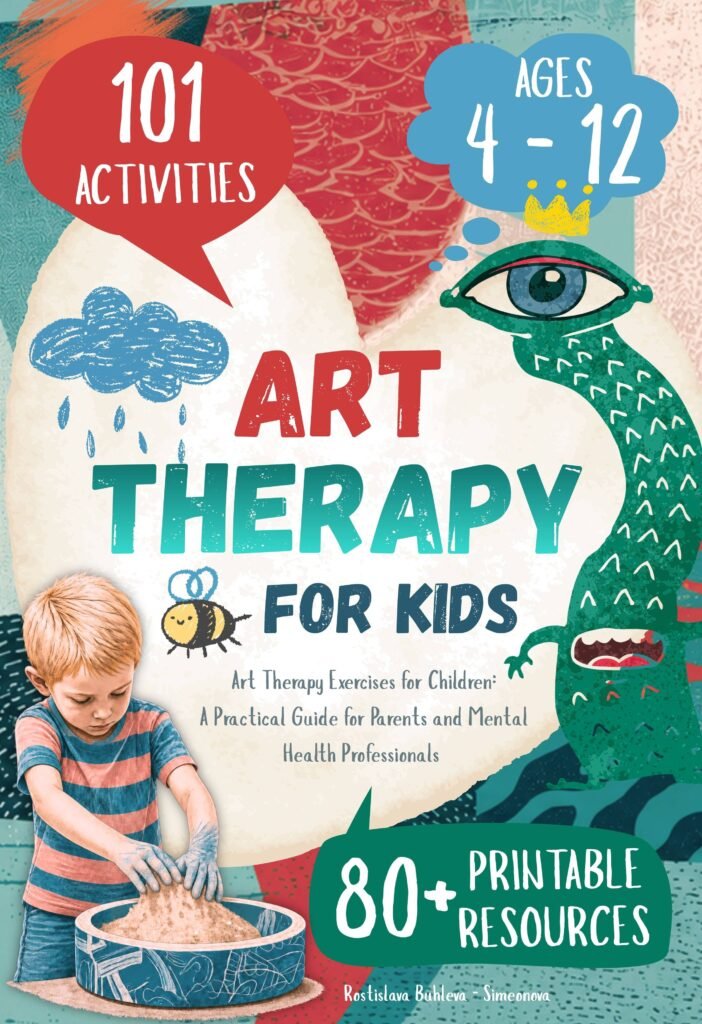
The Anger Volcano is one exercise from a chapter on anger and emotional regulation in 101 Art Therapy Exercises for Children: A Practical Guide for Parents and Mental Health Professionals — alongside Clay Feelings Monsters, which uses the physical, tactile engagement of clay to give the body’s urgency somewhere to go; The Thought Traffic Light, which introduces cognitive de-escalation in a visual format accessible to children across the developmental range; Emotion Colour Wheel, which builds emotional vocabulary through the child’s own personal colour language; and My Feelings Faces, which develops emotional literacy and perspective-taking simultaneously.
The book contains 101 exercises structured across three age groups — 4 to 6, 7 to 9, and 10 to 12 — each activity informed by validated research demonstrating how creative engagement alters brain physiology, reduces cortisol, strengthens neural flexibility, and enhances emotional regulation. Every session comes with a clear therapeutic rationale, step-by-step guidance, reflection questions, and guidance on how to observe and respond to what emerges — without diagnosis, without pressure, and without losing sight of the child as the author of their own experience.
The anger and emotional regulation chapter addresses the full range of what anger looks like in children: the explosive eruption that arrives without warning, the slow-building frustration that finds its outlet at the wrong moment, the anger that is covering sadness or fear or the helpless fury of a child who feels consistently unheard, and the particular regulatory challenges of children with ADHD, sensory differences, or histories of early adversity.
Before You Begin: A Note on Professional Support
Before attempting any emotional regulation activities at home with a child whose anger is significantly impairing their daily functioning or relationships, I would sincerely recommend consulting a qualified mental health professional. The exercises described in this article are offered as a supportive resource — not as a replacement for clinical assessment and ongoing therapeutic care. Where anger is frequent, intense, or accompanied by aggression, self-harm, or significant distress, professional assessment is essential.
Three Things Worth Knowing
Understanding the pattern is the intervention.
The most important thing any anger management worksheet for kids can do is not teach the child what to do when they are angry. It is build the child’s awareness of their own anger pattern — their specific triggers, their particular body signals, their characteristic verbal expressions — in a calm moment, before the activation arrives. That awareness is what gives the regulatory response a chance. A child who knows what their volcano looks and feels like before it erupts is a child with more options than one who only encounters the anger in the middle of it.
Body awareness comes first.
The body feelings section of the Anger Volcano is the most practically useful element of the entire worksheet — because the body’s signals arrive earlier than the thought, earlier than the verbal expression, and earlier than the behaviour. A child who can recognise the physical warning signs of their own escalation — the jaw tightening, the chest tightening, the hands balling — has access to a window of intervention that does not depend on the prefrontal cortex being fully operational. That window is small. But it is real. And the child who knows to look for it is much more likely to find it.
You are the most important tool in the room.
The Anger Volcano maps the pattern. You are the reason the child is willing to look at it honestly. A child who has experienced the consistent, warm, non-shaming response of an adult to their anger — an adult who receives the eruption without reacting in kind, who stays regulated when the child cannot, and who communicates through their own steady presence that the anger is survivable — is a child who is already building the regulatory capacity that the worksheet is designed to support. The exercises are the structure. Your regulated presence is what makes the structure safe enough to inhabit.
Ready to Go Further?
If this free anger management worksheet for kids gave you a sense of what becomes possible when children are helped to understand their own anger pattern before it arrives, 101 Art Therapy Exercises for Children: A Practical Guide for Parents and Mental Health Professionals gives you 101 more tools built on the same foundation — grounded in neuroscience, informed by developmental research, and written for every adult who has ever stood in the aftermath of a child’s anger and wished they had something more to offer than a consequence.
Disclaimer: This article is intended as an educational and supportive resource for parents, caregivers, educators, and mental health professionals. It is not intended to diagnose, treat, or replace professional therapeutic or medical care. If a child is experiencing significant emotional, behavioural, or developmental difficulties, please seek guidance from a qualified mental health professional.

Rostislava Buhleva-Simeonova is a psychologist and game design specialist. She has worked with children, adults, and the elderly within various therapeutic programmes over the past eight years, all the while providing the much-needed playful twist that art and gamified experiences can bring to this sometimes uneasy setting. But it wasn’t until the birth of her daughter, Aurora, that this work took on an even deeper personal meaning. With her academic and real-life experience, honed through numerous trainings and sessions, she is currently authoring books and articles in the field of child psychology and development, offering expertise in art and play therapy to guide parents and caregivers, as well as professionals in the fields of social work and mental health, throughout various pivotal moments in children’s lives. Last but not least, all of her books have been “peer-reviewed” by her daughter, who testifies to the efficiency of these methods.