
Every parent has had that moment. It is bedtime, or the morning before school, or a quiet Sunday afternoon, and your child is somewhere they cannot quite get back from — looping through the same worry, the same what-if, the same catastrophic conclusion they have reached before and will reach again, regardless of how many times you have gently, patiently, lovingly talked them back from the edge of it. You have said all the right things. You have been calm and warm and present. And the worry is still there, circling, because that is what worries do when they have nowhere else to go.
Childhood anxiety is not a character flaw, a parenting failure, or a sign that something has gone permanently wrong. It is, in many cases, an intelligent nervous system doing exactly what it was designed to do — scanning for threat, flagging uncertainty, preparing the child for difficulty that may or may not be coming. The problem is not the worry itself. The problem is that the worry has no container. It lives inside the child, formless and large, and because it has no form, it cannot be examined, challenged, or released. It simply circulates.
A well-designed anxiety worksheet for kids does not make the worry disappear. It gives it somewhere to go.
What Anxiety Actually Is in Children
Anxiety in children is a normal, developmentally appropriate response to a world that is frequently uncertain, occasionally frightening, and always larger than they are. The amygdala — the brain’s threat-detection system — is highly active in childhood, scanning the environment for danger with a sensitivity that has not yet been calibrated by years of accumulated experience. For most children, this produces manageable levels of worry: the nerves before a performance, the apprehension about a new situation, the bedtime fear that visits and then leaves.
For some children, however, the threat-detection system is more persistently activated — by temperament, by experience, by the particular pressures of the modern childhood environment, or by some combination of all three. Perfectionism operates as a self-reinforcing anxiety system: the child avoids challenge to avoid failure, missing the mastery experiences that would build genuine confidence; the absence of confidence reinforces the belief that they cannot cope, which deepens the anxiety. Separation anxiety, social anxiety, generalised worry, specific fears — these are all variations on the same underlying dynamic: a nervous system that has not yet found reliable evidence that the world is safe enough to relax into.
What the best anxiety worksheet for kids understands is that the pathway out of anxiety is rarely through it. It is around it — through externalisation, metaphor, and the particular relief of giving a formless internal experience a visible, manageable, even slightly ridiculous form.
Why Externalisation Works
The concept of externalisation comes from narrative therapy, developed by Michael White and David Epston, and it is one of the most practically powerful ideas in child therapeutic work. The core principle is simple: the problem is not the child. The problem is the problem. When a child becomes identified with their anxiety — when they become “a worrier,” when the worry becomes part of their identity — it is very difficult to shift. But when the worry is externalised — given a name, a form, a character that exists outside the child — it becomes something the child can have a relationship with rather than something the child simply is.
This is why the monster is such an effective therapeutic vehicle for anxiety work. A monster is inherently separate from the child. It has its own personality, its own agenda, its own particular way of operating. The child is not the monster — the child is the person who has to deal with the monster. And that distinction, simple as it sounds, fundamentally changes the therapeutic conversation. Instead of “I am anxious,” the child can say “the worry monster is being loud today.” And from that position — outside the anxiety rather than inside it — something becomes possible that was not possible before.
A well-designed anxiety worksheet for kids built around the monster frame gives the child a concrete, visual, playful way to practise this externalisation — not as a clinical technique, but as something that feels, from the inside, entirely like play.
Free Anxiety Worksheet for Kids: The Worry Monster
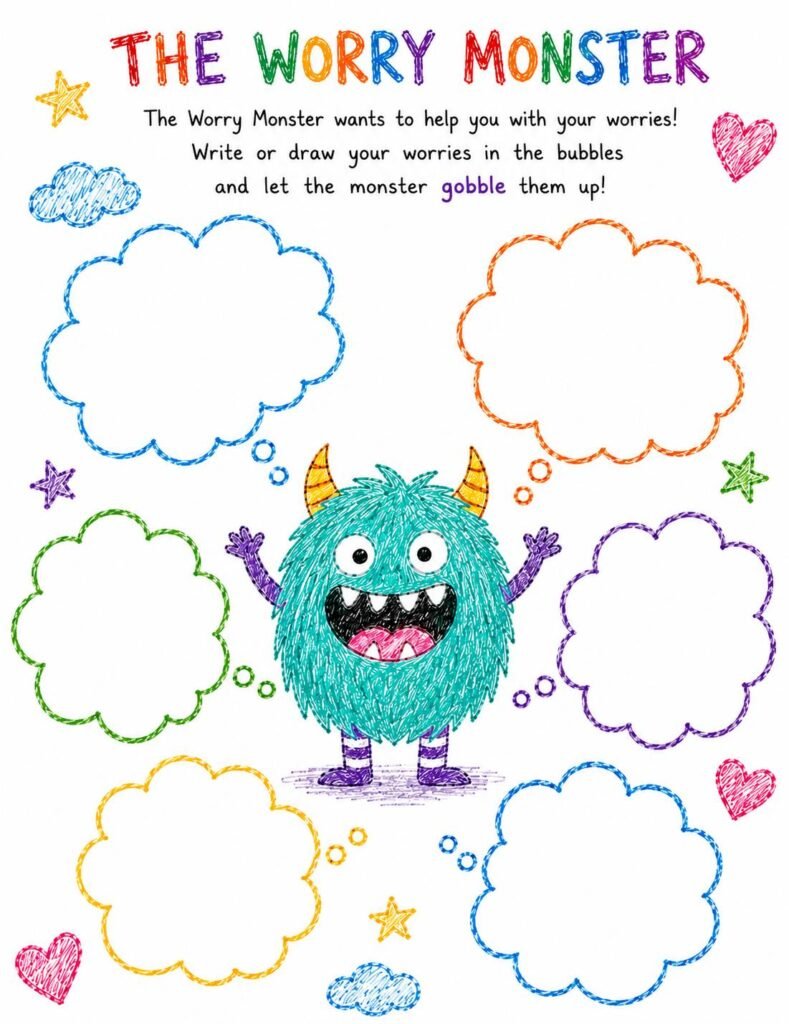
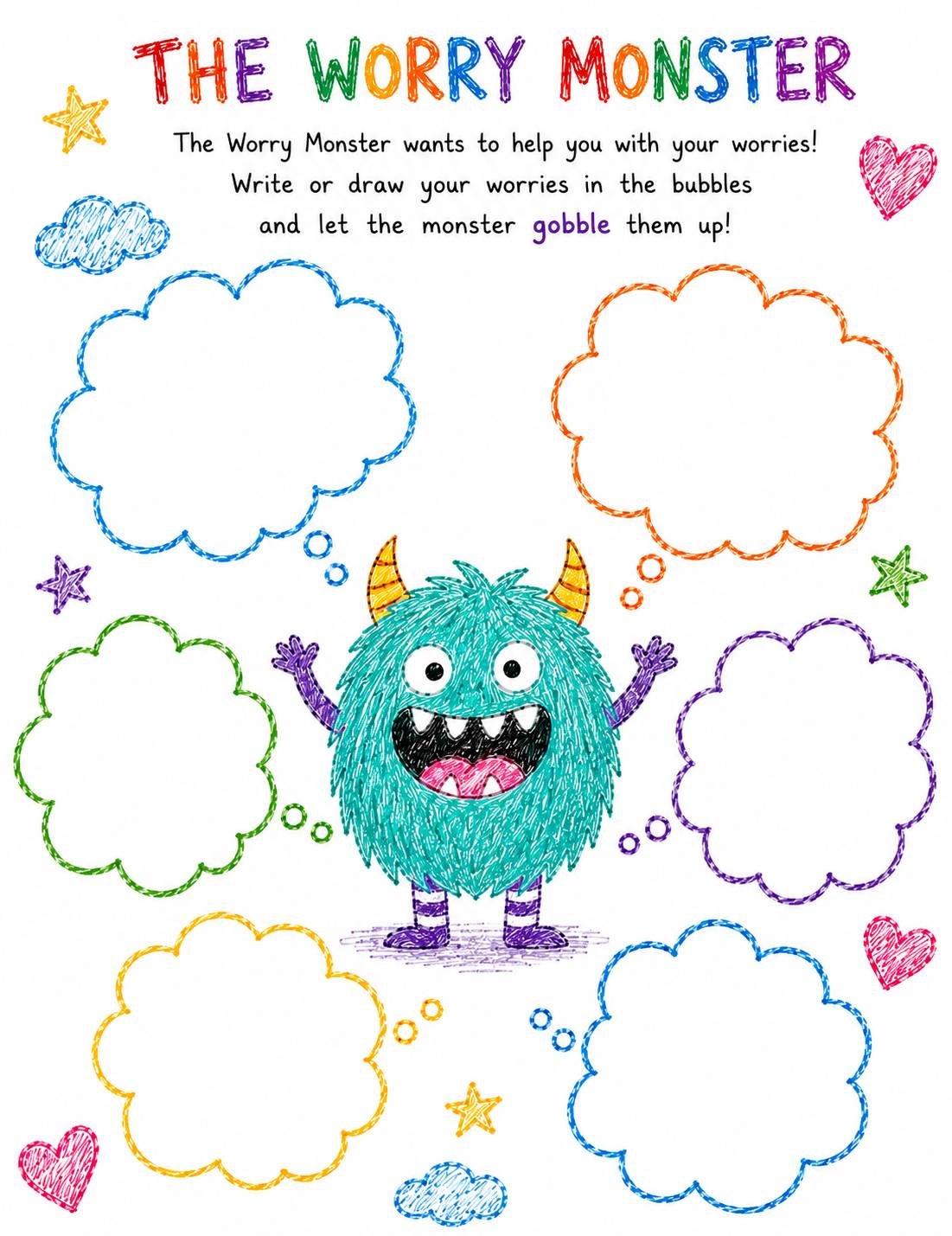
The worksheet below — The Worry Monster — is a free resource you can use with your child today. It is suitable for children aged approximately 5 to 11, and works equally well at home, in school, or in a therapeutic setting. It is colourful, immediately engaging, and built around a mechanic that is both clinically sound and genuinely delightful: feeding your worries to a monster who gobbles them up.
The premise is straightforward. A cheerful, enthusiastic, wide-mouthed teal monster stands at the centre of the page, arms raised and ready, surrounded by six large thought bubbles in different colours. The child is invited to write or draw their worries in the bubbles — and then let the monster gobble them up.
What appears simple on the surface is doing several things simultaneously at the level of therapeutic process. First, the act of writing or drawing a worry externalises it — moves it from inside the child onto the page, where it can be seen, named, and related to from the outside. Second, the thought bubble format normalises the experience of having many worries at once, without hierarchy or shame — each bubble is equal, each colour equally valid. Third, and perhaps most importantly, the monster’s enthusiastic, open-mouthed posture reframes the worry’s destination entirely. The worry is not being suppressed or dismissed. It is being consumed by a creature who specifically wants it — who is, in fact, delighted to receive it. The child is not being told their worry is wrong. They are being offered a way to put it somewhere that can hold it.
This is what makes this anxiety worksheet for kids genuinely effective rather than merely distracting.
How to Use It
Place the worksheet in front of your child with a simple, warm introduction — open enough to invite without directing: “This is the Worry Monster — and his favourite thing to eat is worries. I wonder if you have any he could gobble up today.” Then step back. Give the child time and space to write or draw. What appears in the bubbles, how much space each worry takes up, which bubbles are filled and which are left empty — all of it is information worth holding gently. You can prompt with gentle open-ended questions but do not name the worry for them.
Once the bubbles are filled, explore them together with open, unhurried questions:
- Which worry do you think the monster is most excited about eating?
- Is there a worry in there that has been visiting you for a long time?
- What does the worry feel like in your body before the monster gobbles it up?
- After the monster eats it — what happens to that space where the worry was?
- Is there a worry that felt smaller once you drew it down?
That last question is worth sitting with. One of the most consistent findings in anxiety research is that the act of externalising a worry — writing it, drawing it, giving it a form — reduces its subjective intensity, even before any further therapeutic work is done. The child who fills the bubbles is not simply completing a worksheet. They are already doing the therapeutic work.
For Deeper Work: The Play Therapy Toolbox
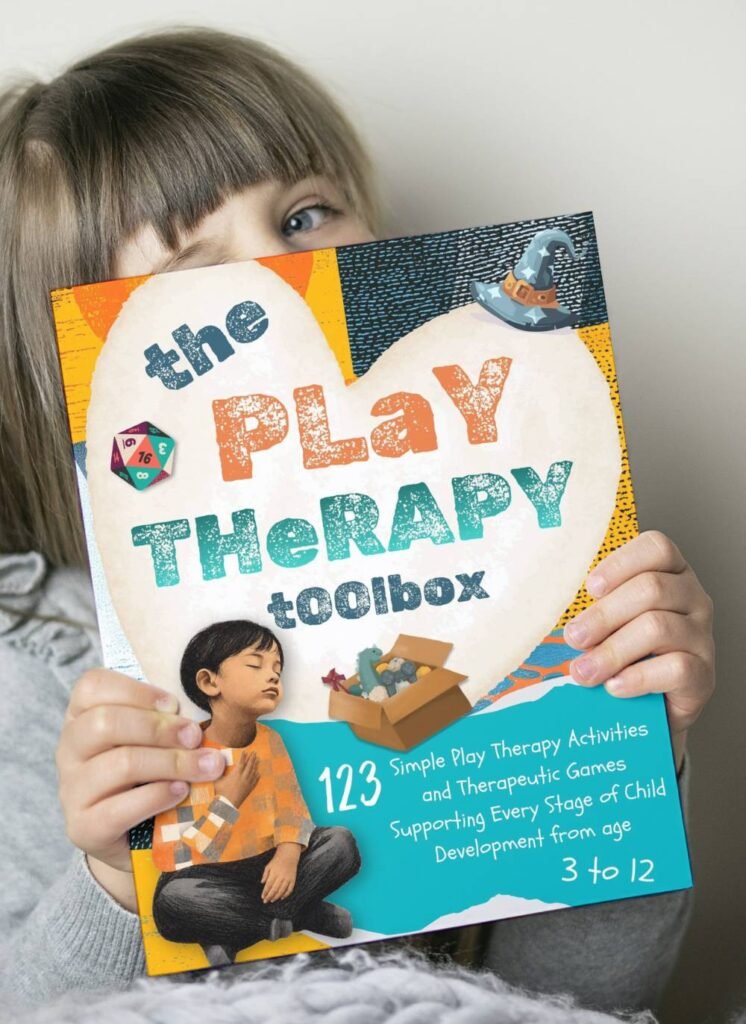
The Worry Monster is one example of the kind of externalisation-based, anxiety-focused tool that sits at the heart of The Play Therapy Toolbox: 123 Simple Play Therapy Activities and Therapeutic Games Supporting Every Stage of Child Development from Age 3 to 12 — a book built around the understanding that children speak in a language adults often forget they once spoke fluently themselves.
The book contains 123 activities spanning role-play, enactment, fantasy storytelling, somatic exercises, and gamified experiences, alongside 75+ printable, downloadable, full-colour worksheets designed to support and extend each activity. Every activity comes with a therapeutic rationale grounded in peer-reviewed research, step-by-step guidance on how to conduct the session and what to say, questions to use with the child, and a parent guidance note written in the same warm, accessible language as this article.
The activities address the full range of anxiety presentations children bring — separation anxiety, social anxiety, perfectionism, generalised worry, specific fears, school refusal, performance anxiety, and the particular anxieties generated by family transitions, bereavement, and the pressures of contemporary childhood. They are built around four dedicated chapters — one for Age 3, one for Ages 4–6, one for Ages 7–9, and one for Ages 10–12 — each opening with a developmental overview that traces the key milestones, common emotional challenges, and neurological realities most relevant to that stage. And a comprehensive annex cross-references all 123 activities by presenting condition, age group, and page number — so you can navigate directly to the right tool for the right child at the right moment, without searching.
Three Things Worth Knowing Before You Begin
The worry is not the enemy.
Any anxiety worksheet for kids used well begins from this position: the worry is not wrong, and the child is not broken. The nervous system doing its job — flagging uncertainty, preparing for difficulty — is the same nervous system that will one day help this child navigate genuine challenge with foresight and care. The therapeutic goal is not to eliminate worry but to help the child develop a different relationship with it. One where they are the person dealing with the monster, rather than the person who is the monster.
Regular use builds more than crisis use.
Anxiety tools work best when used consistently — not only reached for in moments of acute distress, but practised as an ordinary, low-stakes part of daily emotional life. A child who regularly feeds their worries to the monster, even on days when the worries are small, builds the habit of externalisation and the confidence that comes from repeatedly discovering that the worry can be named, moved, and survived.
You are the most important tool in the room.
Children disclose anxiety most readily within the safety of a warm, regulated, genuinely curious relationship with a trusted adult — one who has demonstrated, through small repeated moments of attentive presence, that whatever the child brings will be received without alarm. Sit down. Fill in a bubble of your own. Let them see that even grown-ups have worries.
Available Now for $5.99 — For a Limited Time
If this free anxiety worksheet for kids gave you a sense of what becomes possible when children are met in their own language, The Play Therapy Toolbox gives you 123 more tools built on the same foundation. The ebook is available now on Amazon at $5.99 for a limited time — with immediate access to 123 activities and 75+ full-colour printable worksheets for children aged 3 to 12.
Play is not preparation for life. It is life — in its most honest, most essential, most healing form.
Disclaimer: This article is intended as an educational and supportive resource for parents, caregivers, educators, and mental health professionals. It is not intended to diagnose, treat, or replace professional therapeutic or medical care. If a child is experiencing significant emotional, behavioural, or developmental difficulties, please seek guidance from a qualified mental health professional.


Rostislava Buhleva-Simeonova is a psychologist, art and play therapist, and gamificator. She has worked with children, adults, and the elderly within various therapeutic programmes over the past eight years, all the while providing the much-needed playful twist that art and gamified experiences can bring to this sometimes uneasy setting. But it wasn’t until the birth of her daughter, Aurora, that this work took on an even deeper personal meaning. With her academic and real-life experience, honed through numerous trainings and sessions, she is currently authoring books and articles in the field of child psychology and development, offering expertise in art and play therapy to guide parents and caregivers, as well as professionals in the fields of social work and mental health, throughout various pivotal moments in children’s lives. Last but not least, all of her books have been “peer-reviewed” by her daughter, who testifies to the efficiency of these methods.