
Every parent has been there. Your child has done something they know was wrong — yelled, lied, been unkind — and the aftermath is almost more difficult than the behaviour itself. Not because of the consequence or the conversation that follows, but because of what you can see happening inside them: the way the behaviour and the identity are collapsing into one another. This collapse — between what a child does and who a child is — is one of the most quietly damaging things that can happen to a developing sense of self. And it is extraordinarily common. Children, particularly younger ones, do not yet have the cognitive sophistication to hold the distinction between behaviour and identity with any reliability. When they do something they regret, the regret very often attaches not to the action but to the self that performed it. And a child who believes they are the problem — rather than a child who sometimes does things that are problematic — is a child whose capacity for genuine change is already undermined before it has begun. A well-designed behaviour worksheet for kids does not simply address the behaviour. It addresses the story the child is telling about themselves.
The Difference Between Guilt and Shame
The distinction between guilt and shame is one of the most clinically important in all of child psychology — and one of the least understood outside professional circles. Guilt is the feeling that I did something bad. Shame is the feeling that I am bad. They can look identical from the outside. They have completely different effects on a child’s capacity to change, grow, and repair.
Guilt, counterintuitively, is the more productive emotion. A child who feels guilty about a behaviour is a child who has registered that the behaviour caused harm, who cares about that harm, and who has some motivation to do things differently. Guilt keeps the self intact while acknowledging that the action was wrong. It leaves room for repair, for apology, for the genuine resolution that allows the child to move forward without carrying the weight of the incident indefinitely.
Shame does the opposite. A child in shame is not thinking about the behaviour and how to change it. They are thinking about themselves — about the fundamental wrongness of who they are — in a way that is both paralysing and, paradoxically, self-perpetuating. A child who believes they are an angry person has no particular motivation to manage their anger differently, because angry is just what they are. The behaviour and the identity have merged, and changing the behaviour would require changing the self — which feels, to a child in shame, not like growth but like an existential threat.
The best behaviour worksheets for kids work at this level. They do not simply address what the child did. They carefully, warmly, and specifically separate what the child did from who the child is — and in doing so, they return to the child the agency and the motivation that shame systematically removes.
Why Externalisation Is the Key
The therapeutic concept of externalisation, developed within narrative therapy by Michael White and David Epston, offers the most elegant solution available to the guilt-shame problem in children: separate the problem from the person. The problem is not the child. When a child becomes identified with their difficult behaviours — when they become “the angry one,” “the liar,” “the one who gives up” — it is extremely difficult to shift those patterns, because shifting them requires the child to argue against their own identity. But when the difficult behaviour is externalised — given a form, a name, a character that exists outside the child — it becomes something the child can have a relationship with, can examine, can choose to give less power to.
This is exactly what the “Not Me” Monster does. And it is why this particular approach to behaviour worksheets for kids is so much more therapeutically sophisticated than approaches that simply ask the child to reflect on what they did wrong and promise to do better. Promising to do better, without separating the behaviour from the self, asks the child to change at the identity level — which is the hardest possible level at which to change anything. Externalising the behaviour into a monster that is explicitly, emphatically not me asks the child to change at the behavioural level — which is where genuine, durable change is actually possible.
Free Behaviour Worksheets for Kids: The “Not Me” Monster
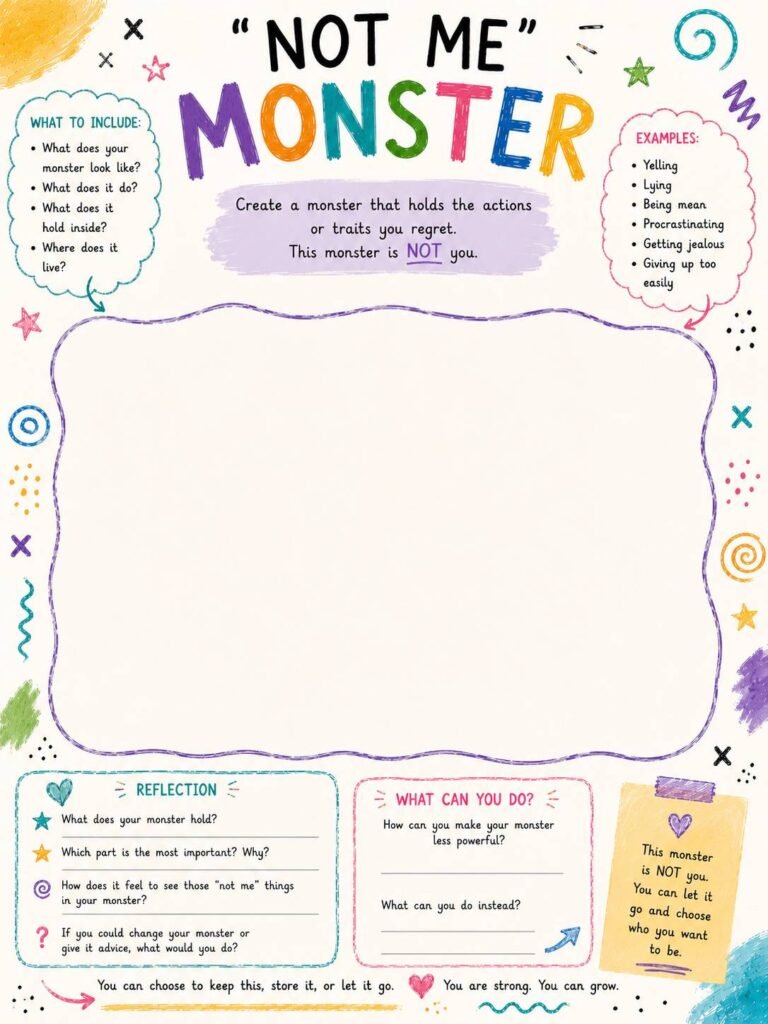
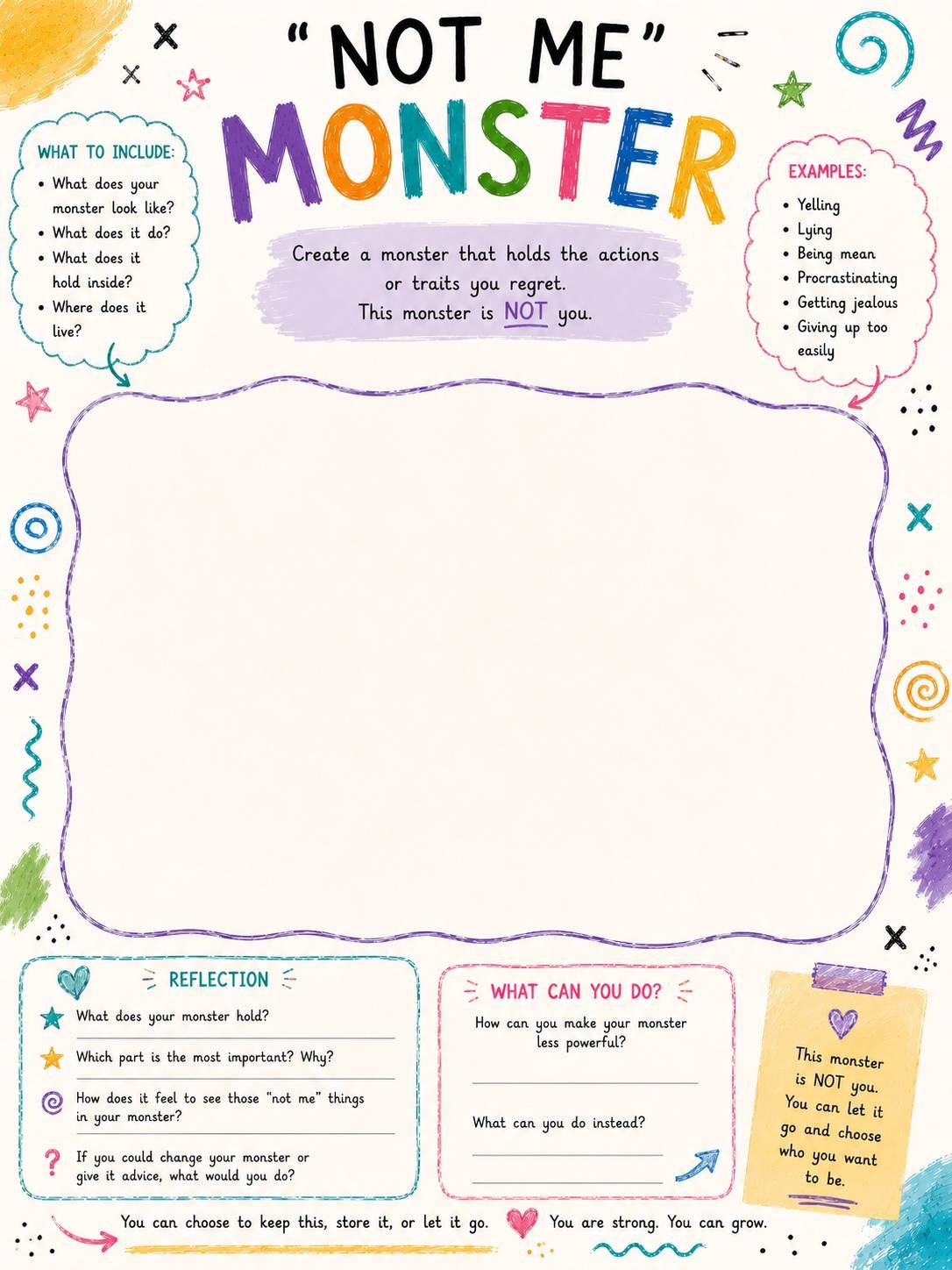
The worksheet below — the “Not Me” Monster — is a free resource you can use with your child today. It is suitable for children aged approximately 6 to 12, and works equally well at home, in school, or in a therapeutic setting. It is bold, colourful, and built around one of the most powerful therapeutic reframes available to children working with difficult behaviours: this monster holds the actions and traits you regret. This monster is not you.
The child is invited to create a monster — drawing it in a large, open space — that holds the behaviours and traits they regret. The worksheet offers examples to spark thinking without directing: yelling, lying, being mean, procrastinating, getting jealous, giving up too easily. And it asks four guiding questions about what to include: what does your monster look like? What does it do? What does it hold inside? Where does it live?
The closing message — printed at the bottom of the page in warm, direct language — is the therapeutic heart of the entire exercise: this monster is not you. You can let it go and choose who you want to be. You are strong. You can grow.
What makes this one of the most effective behaviour worksheets for kids is the complete arc it traces — from externalisation, through examination and emotional honesty, to agency and choice. The child does not simply name what they did wrong. They create it, look at it from the outside, feel what it feels like to see it separated from themselves, and then — from that position of separation — begin to consider what they want to do differently.
How to Use It
Place the worksheet in front of your child during a calm moment — not immediately after a difficult incident, when shame is likely to be highest and the capacity for reflection lowest. A gentle, warm introduction works best: “This is a monster for all the things we do that aren’t really us — the yelling, the lying, the stuff we regret afterwards. We’re going to put all of that into the monster, so we can look at it from the outside.”
Give the child time and space to draw without commentary or suggestion. The monster-creation phase is not a warm-up to the reflection. It is doing its own therapeutic work — the act of drawing the difficult behaviours into a creature, giving them a body and a home outside the self, is itself a significant act of externalisation. You can prompt the child with gentle open-ended questions but do not give them directions or tell them what they should or should not draw.
Once the monster is drawn and the reflection and action sections are complete, explore it together with open, unhurried curiosity:
- What does it feel like to see all of that in the monster rather than in yourself?
- Which of the things your monster holds do you find hardest to let go of — and why?
- When the monster gets loud, what is usually happening for you?
- What does the version of you without the monster look like?
- What is one small thing you could do differently next time the monster shows up?
The most important thing is not the answers. It is the quality of attention you bring to hearing them — and the consistent message that the child who drew the monster and the monster are two different things entirely.
A Note on When to Use This Worksheet
The “Not Me” Monster is most effective when used in a calm, reflective moment rather than in the immediate aftermath of a difficult behaviour. A child in the grip of shame is not yet available for the kind of curious, honest self-reflection this exercise requires. The shame needs to have settled enough for the child to approach the monster from the outside — which is rarely possible in the same hour as the incident.
Used proactively — as an ordinary, reflective exercise rather than a consequence — the worksheet is even more powerful. A child who creates their monster before a pattern of behaviour has become entrenched, who visits it regularly and asks themselves what the monster has been doing lately, builds a habit of self-observation and self-separation that becomes a genuine resource when difficult moments arrive.
For Deeper Work: 101 Art Therapy Exercises for Children
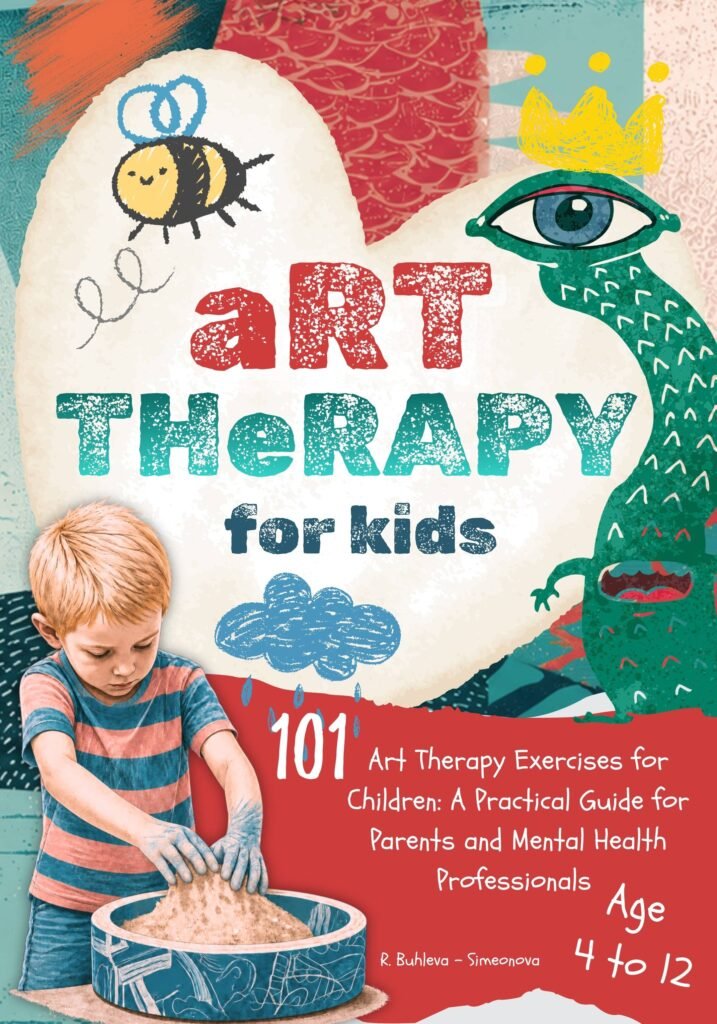
The “Not Me” Monster is one example of the kind of externalisation-based, identity-protective, behaviourally focused tool that sits at the heart of 101 Art Therapy Exercises for Children: A Practical Guide for Parents and Mental Health Professionals — a book built around the understanding that healing, growth, and genuine self-understanding often begin not with words, but with a simple mark on paper.
The book contains 101 art therapy exercises structured across three age groups — 4 to 6, 7 to 9, and 10 to 12 — each activity informed by validated research demonstrating how creative engagement alters brain physiology, strengthens neural flexibility, and enhances emotional regulation. Every session comes with a clear therapeutic rationale, step-by-step guidance, reflection questions, and guidance on how to observe and respond to what emerges — without diagnosis, without pressure, and without losing sight of the child as the author of their own experience.
The behaviour and emotional regulation chapters address the full range of presentations children bring — anger and aggression, lying and avoidance, perfectionism and giving up, jealousy, procrastination, and the particular challenge of helping a child change a pattern of behaviour without inadvertently reinforcing the shame that makes change feel impossible. Many exercises invite the caregiver to participate alongside the child — because a parent who creates their own “not me” monster is doing something more powerful than any instruction: they are showing the child that everyone has one, that having one does not make you bad, and that choosing to grow is something every person, at every age, gets to do.
Three Things Worth Knowing Before You Begin
The monster is not a consequence.
The most important thing about using behaviour worksheets for kids effectively is this: the “Not Me” Monster must never be introduced as a punishment or a consequence for a specific behaviour. The moment it becomes a consequence, it loses its therapeutic power — because the child is no longer choosing to engage with their difficult behaviours from a position of safety and curiosity. They are being directed toward their shame under conditions that intensify it. Introduce it in calm moments, revisit it regularly, and let it be something the child genuinely owns.
Separation is the work — not confession.
The goal of this exercise is not for the child to confess or enumerate everything they have done wrong. It is for the child to experience — specifically, visually, and in their own creative terms — the felt difference between the behaviour and the self. That experience, repeated across sessions and across time, gradually builds the internal distinction that makes genuine change possible: I am not my worst moments. I am the person who gets to decide what comes next.
You are the most important tool in the room.
The monster holds the difficult behaviours. You are the reason the child believes they are separable from them. A child who has repeatedly experienced the message — through small, consistent, specific acts of adult attention — that they are more than what they do on their worst days, develops the identity robustness to hold that belief themselves, even when the monster is loud. Create your own monster. Show them yours. Let them see that even grown-ups have things they are working on — and that working on something is entirely different from being it.
Ready to Go Further?
If this free behaviour worksheet for kids gave you a sense of what becomes possible when children are helped to separate who they are from what they do, 101 Art Therapy Exercises for Children: A Practical Guide for Parents and Mental Health Professionals gives you 101 more tools built on the same foundation — grounded in neuroscience, informed by developmental research, and written for every adult who has ever sat beside a child and wished they had something more to offer than words.
Disclaimer: This article is intended as an educational and supportive resource for parents, caregivers, educators, and mental health professionals. It is not intended to diagnose, treat, or replace professional therapeutic or medical care. If a child is experiencing significant emotional, behavioural, or developmental difficulties, please seek guidance from a qualified mental health professional.

Rostislava Buhleva-Simeonova is a psychologist, art therapist, and gamificator. She has worked with children, adults, and the elderly within various therapeutic programmes over the past eight years, all the while providing the much-needed playful twist that art and gamified experiences can bring to this sometimes uneasy setting. But it wasn’t until the birth of her daughter, Aurora, that this work took on an even deeper personal meaning. With her academic and real-life experience, honed through numerous trainings and sessions, she is currently authoring books and articles in the field of child psychology and development, offering expertise in art and play therapy to guide parents and caregivers, as well as professionals in the fields of social work and mental health, throughout various pivotal moments in children’s lives. Last but not least, all of her books have been “peer-reviewed” by her daughter, who testifies to the efficiency of these methods.