
Every parent has stood in that aftermath. The incident has happened — something was said, something was done, someone was hurt — and the child who caused the harm is now standing somewhere between defensiveness and shame, unable to find their way to the repair that everyone, including them, knows needs to happen. The apology that comes out flat and unconvincing because it was demanded rather than felt. The silence that stretches because the child genuinely does not know how to begin. The repair attempt that misses the point because the child has not yet been helped to understand what the point actually is.
Conflict resolution is not a natural skill. It is a learned one — and it is considerably more complex than the adult instinct to demand an apology and move on tends to acknowledge. Genuine repair after a harmful action requires empathy: the capacity to step into another person’s experience and feel something of what they felt. It requires accountability: the willingness to name what was done without minimising or deflecting. It requires perspective-taking: the cognitive ability to hold another person’s emotional reality alongside one’s own. And it requires agency: the belief that the harm can be addressed, that the relationship can be repaired, and that the child who caused the harm is capable of being the person who fixes it.
A well-designed conflict resolution worksheet for kids does not shortcut this process. It scaffolds it — moving the child through each of its necessary stages in a sequence that is both therapeutically sound and developmentally appropriate.
What Conflict Resolution Actually Requires
In developmental psychology, the capacity for genuine conflict resolution is understood as a complex social-emotional achievement that draws on several distinct but interrelated capacities — each one still developing across childhood, each one requiring explicit support and modelling rather than simply arriving with age.
Empathy — the capacity to feel something of what another person is feeling — is the foundational requirement. Without it, the apology is a performance rather than a genuine act of repair, and the child who delivers it is no closer to understanding why what they did was harmful than they were before. Research by Martin Hoffman distinguishes between affective empathy — the automatic, partly neurological sharing of another person’s emotional state — and cognitive empathy — the deliberate, perspective-taking act of reasoning about what another person is experiencing. Both are relevant to conflict resolution, but cognitive empathy — which develops more gradually and requires explicit cultivation — is what makes genuine repair possible.
Accountability without shame is the second requirement. The developmental literature on guilt and shame — and the distinction between them established by June Price Tangney and others — is clear on this point: guilt, the feeling that I did something wrong, motivates repair. Shame, the feeling that I am wrong, paralyses it. A child in the grip of shame cannot repair the harm they caused because they are too absorbed in defending themselves against the implication of their own badness. A child who can acknowledge what they did from a position of guilt — I made a mistake, and I can make it right — has access to the motivation and the agency that repair requires.
And forward orientation — the capacity to imagine and commit to a different way of treating the person going forward — is what transforms a repair from a transaction into a genuine relational reset. It is the difference between apologising for what happened and changing what happens next. A conflict resolution worksheet for kids that includes this dimension is doing something that most apology scripts do not: it is asking the child not only to account for the past but to author the future.
Why the Repair Process Needs to Be Walked Through
One of the most consistent findings in the research on children’s conflict resolution is that children who are given explicit, structured support for navigating the repair process develop significantly more sophisticated conflict resolution capacities than those who are simply told to apologise and move on. This is not surprising from a developmental perspective. The neural pathways that underlie empathy, perspective-taking, and forward-oriented thinking are still actively developing across childhood — and they develop most reliably through repeated, supported practice rather than through instruction or expectation alone.
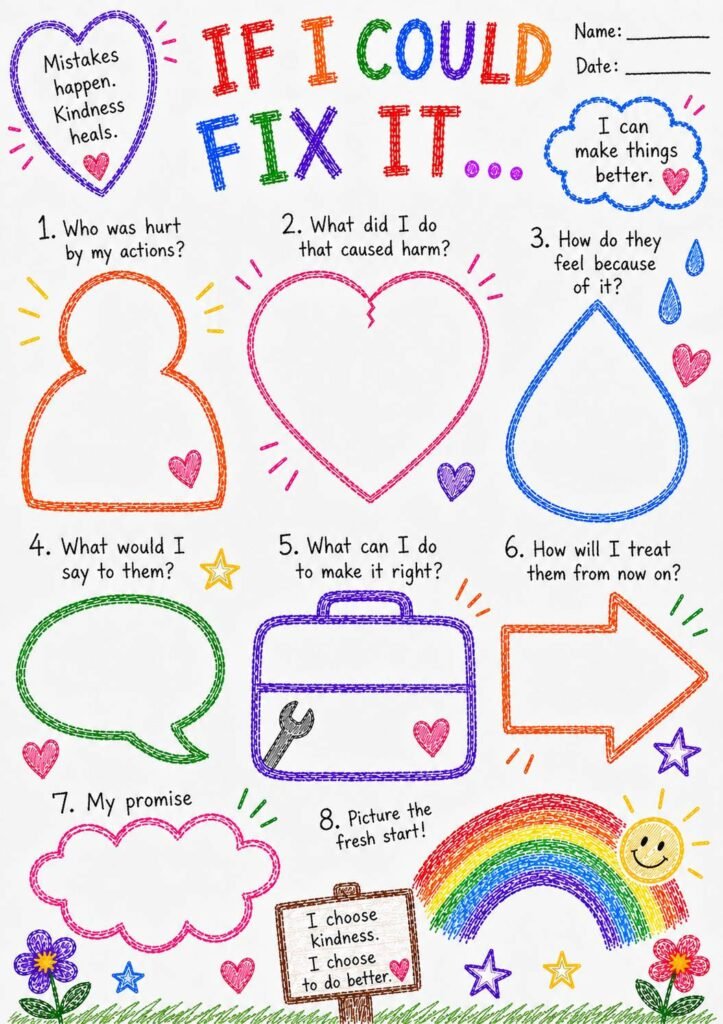
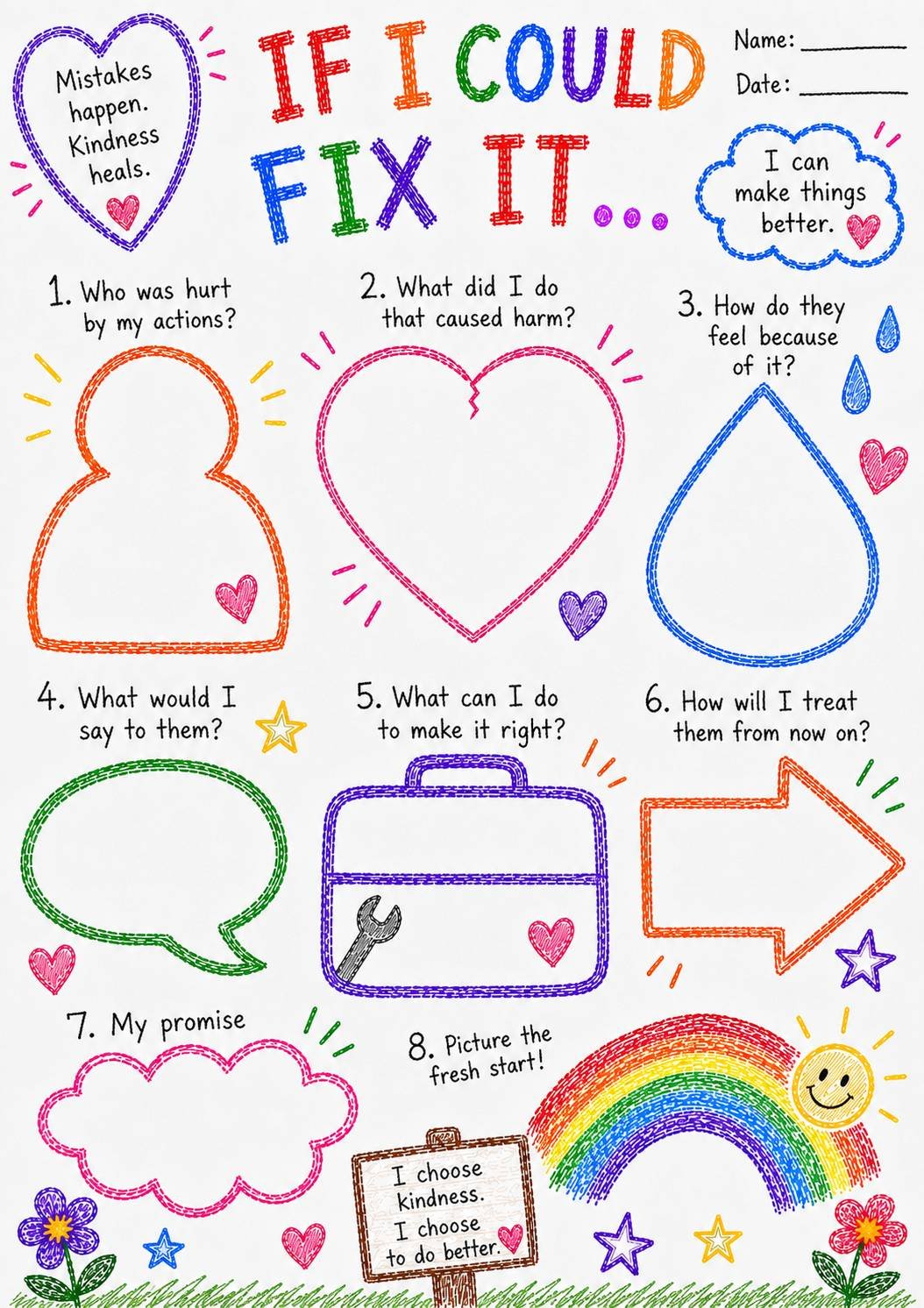
What this means practically is that the child who is walked through the eight steps of the If I Could Fix It worksheet — who is supported in naming who was hurt, what was done, how the other person feels, what to say, how to make it right, how to treat them going forward, what they promise, and what the fresh start looks like — is not simply completing an exercise. They are building the neural infrastructure for genuine conflict resolution: laying down the pathways that will, over time and with repeated use, make empathic, accountable, forward-oriented repair more and more available to them in the moment, without the scaffold.
This is the developmental logic of conflict resolution worksheets for kids — not compliance training but capacity building.
Free Conflict Resolution Worksheets for Kids: If I Could Fix It
The worksheet below — If I Could Fix It — is a free resource you can use with your child today. It is suitable for children aged approximately 6 to 12, and works equally well at home, in school, or in a therapeutic setting. It is warm, colourful, and structured around eight distinct steps that move the child through the complete arc of genuine repair — from honest acknowledgement of harm, through empathic perspective-taking, through concrete action and commitment, to the fresh start that genuine repair makes possible.
What makes this one of the most effective conflict resolution worksheets for kids is the sequence. It does not begin with what to say — which is where most apology scripts begin and end. It begins with who was hurt and what was done: the honest, accountable naming of the harm before any movement toward repair is attempted. It moves through the other person’s feelings before it arrives at the child’s words — which means the words, when they come, are grounded in genuine perspective-taking rather than performed remorse. And it closes not with the apology but with the fresh start: the forward-facing image of a relationship that has been repaired and a child who has chosen to do better.
How to Use It
Introduce the worksheet during a calm moment — not in the immediate heat of the incident, when shame is likely to be highest and the capacity for genuine perspective-taking lowest. A warm, non-punitive introduction works best: “Something happened that hurt someone, and I know you want to make it right. This is how we figure out how. Let’s go through it together.”
Work through the eight steps in sequence and without rushing. Steps one through three — naming who was hurt, what was done, and how they feel — deserve the most time and the most careful attention, because they are the foundation on which everything else rests. A child who has genuinely inhabited another person’s experience of being hurt — who has felt something of what that felt like — will compose a different speech bubble than a child who has been told what to say.
Do not correct or redirect what the child puts in each section. What appears in the cracked heart and the teardrop is information — about the child’s current level of empathic understanding, about where the perspective-taking work still needs to happen, about what the child genuinely understands and what they are still working toward. All of it is worth knowing.
Once the worksheet is complete, explore it together with open, unhurried questions:
- When you think about how they feel — what is that like for you to sit with?
- Is what you wrote in the speech bubble what you actually want to say, or what you think you should say?
- The thing in the toolbox — is that something you could actually do, or something that felt right to write but might be harder in practice?
- What would it take for you to keep the promise you made in the cloud?
- What does the fresh start feel like — is it something you believe in, or something you hope for?
That last question is worth sitting with. A child who can distinguish between believing in the fresh start and hoping for it is a child who is thinking honestly about the repair — and honesty is the only basis on which genuine repair is possible. The most important thing is not the answers. It is the quality of attention you bring to hearing them.
What the Research Says About Children and Repair
The developmental research on children’s repair behaviour — the actions children take after causing harm — is both extensive and practically illuminating.
Research by Margarita Svetlova and colleagues has shown that genuine prosocial repair behaviour — as distinct from compliance-driven apology — is associated with higher levels of empathic concern, stronger theory of mind, and more secure attachment relationships. Children who have experienced consistent, warm, non-shaming responses to their mistakes from their primary caregivers develop significantly more sophisticated repair capacities than those whose mistakes have been met with punishment, shame, or dismissal.
Research on restorative practices in educational settings — approaches that prioritise repair and relationship restoration over punishment — consistently shows that children who are supported through structured repair processes demonstrate improved empathy, stronger peer relationships, reduced recidivism in harmful behaviour, and greater overall social-emotional competence than those who receive punitive responses to conflict. The repair process itself is the developmental intervention.
And research on self-compassion — the capacity to treat oneself with the same kindness one would extend to a friend in difficulty — shows that children who can acknowledge their mistakes from a position of self-compassion rather than shame are significantly more likely to make genuine repair attempts, more likely to follow through on forward commitments, and more likely to learn from the experience in ways that actually change their future behaviour. The closing messages of the worksheet — mistakes happen, kindness heals, I choose to do better — are not simply reassuring. They are neurologically and developmentally strategic: they position the child in the self-compassion stance from which genuine repair is most possible.
For Deeper Work: The Play Therapy Toolbox
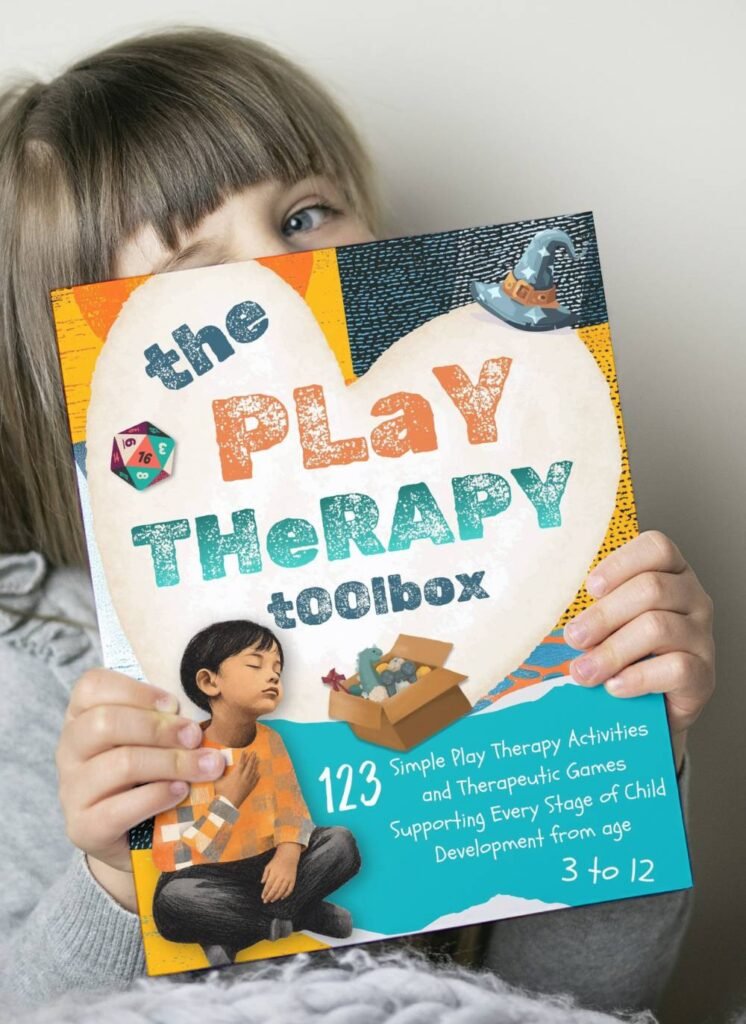
If I Could Fix It is one example of the kind of empathy-building, accountability-supporting, relationally restorative tool that sits at the heart of The Play Therapy Toolbox: 123 Simple Play Therapy Activities and Therapeutic Games Supporting Every Stage of Child Development from Age 3 to 12 — a book built around the understanding that children speak in a language adults often forget they once spoke fluently themselves.
The book contains 123 activities spanning role-play, enactment, fantasy storytelling, somatic exercises, and gamified experiences, alongside 75+ printable, downloadable, full-colour worksheets designed to support and extend each activity. Every activity comes with a therapeutic rationale grounded in peer-reviewed research, step-by-step guidance on how to conduct the session and what to say, questions to use with the child, and a parent guidance note written in the same warm, accessible language as this article.
The social skills, empathy, and conflict resolution chapters address the full range of presentations children bring — aggression and reactive behaviour, difficulty with perspective-taking, social exclusion and bullying, the particular challenges of neurodivergent social processing, and the experience of wanting to repair a relationship without knowing how to begin. Every activity is cross-referenced in a comprehensive annex by presenting condition, age group, and page number — so you can navigate directly to the right tool for the right child at the right moment, without searching.
Three Things Worth Knowing Before You Begin
The apology is the last step, not the first.
The most common error in responding to a child who has caused harm is moving immediately to the apology — demanding it, scripting it, waiting for it — before the child has been helped to understand who was hurt, what was done, and how the other person feels. An apology delivered before the empathic understanding is in place is a performance, not a repair. The conflict resolution worksheets for kids that produce genuine change are those that begin with honest acknowledgement and move through perspective-taking before they arrive at words.
Shame blocks repair — self-compassion enables it.
A child who is shamed for causing harm is a child who is too absorbed in defending their own sense of self to attend to the person they hurt. The non-punitive, warm, forward-facing framing of this worksheet — mistakes happen, kindness heals, I choose to do better — is not permissiveness. It is the neurologically and developmentally informed condition under which genuine repair is most possible. A child who feels safe enough to look honestly at what they did is a child who can actually change it.
You are the most important tool in the room.
The worksheet scaffolds the repair. You are the reason the child believes it is possible. Children develop the capacity for genuine conflict resolution primarily through the experience of being alongside adults who model it — who acknowledge their own mistakes with honesty and without drama, who repair their own relationships with the same warmth and accountability they are asking the child to find, and who communicate, through small consistent acts of non-shaming response to error, that mistakes are not the end of the story. They are, handled well, the beginning of a better one.
Available Now for $5.99 — For a Limited Time
If this free conflict resolution worksheet for kids gave you a sense of what becomes possible when children are helped to move through repair rather than past it, The Play Therapy Toolbox gives you 123 more tools built on the same foundation. The ebook is available now on Amazon at $5.99 for a limited time — with immediate access to 123 activities and 75+ full-colour printable worksheets for children aged 3 to 12.
Play is not preparation for life. It is life — in its most honest, most essential, most healing form.

Disclaimer: This article is intended as an educational and supportive resource for parents, caregivers, educators, and mental health professionals. It is not intended to diagnose, treat, or replace professional therapeutic or medical care. If a child is experiencing significant emotional, behavioural, or developmental difficulties, please seek guidance from a qualified mental health professional.

Rostislava Buhleva-Simeonova is a psychologist, art therapist, and gamificator. She has worked with children, adults, and the elderly within various therapeutic programmes over the past eight years, all the while providing the much-needed playful twist that art and gamified experiences can bring to this sometimes uneasy setting. But it wasn’t until the birth of her daughter, Aurora, that this work took on an even deeper personal meaning. With her academic and real-life experience, honed through numerous trainings and sessions, she is currently authoring books and articles in the field of child psychology and development, offering expertise in art and play therapy to guide parents and caregivers, as well as professionals in the fields of social work and mental health, throughout various pivotal moments in children’s lives. Last but not least, all of her books have been “peer-reviewed” by her daughter, who testifies to the efficiency of these methods.