
Every parent has sat at the edge of a child’s bed in the dark, trying to find the right words for something that does not quite have words yet. Not because the fear is irrational — though it may be — but because the fear is real, and it is large, and it belongs to a child who does not yet have the language or the cognitive distance to examine it from the outside. The monster under the bed. The thing behind the door. The something in the dark that has not been named yet and is, perhaps for that reason, more frightening than anything with a name could be.
Children’s fears are not simply failures of rational thinking that can be corrected with the right explanation. They are expressions of a nervous system that is still calibrating its threat-detection system — still learning, through the accumulated evidence of experience, what is genuinely dangerous and what is not. And they are, very often, expressions of something else alongside the surface fear: an anxiety about something in the child’s life that has found its form in the particular imagery of monsters and darkness and hidden watching things.
A well-designed fears worksheet for kids does not ask the child to explain their fear. It invites them to tell its story — to give the thing in the dark a who, a what, and a what-next, and in doing so, to discover that what can be named and storied can also, gradually, be approached.
Why Children’s Fears Live in Images, Not in Explanations
The instinct when a child is frightened is to explain. To turn the light on and show them there is nothing there. To walk them through the logic of why the fear is not warranted. And the explanation is always technically correct — and almost never sufficient. Because the child’s fear is not located in the part of the brain that receives explanations.
Fear, like all threat-based emotional experience, is generated and maintained by the amygdala — the brain’s threat-detection system — which processes threat with a speed and completeness that bypasses the prefrontal cortex’s logical evaluation. The child who knows, with the thinking part of their brain, that there is nothing under the bed, can simultaneously experience, with the feeling part, the absolute conviction that there is. Both are true simultaneously, and the explanation only reaches one of them.
What reaches the other is image, story, and the particular kind of creative engagement that allows the child to approach the feared thing from the outside — to give it a form, to attribute it an intention, to predict its behaviour — without the full neurological activation that direct confrontation produces. Projective storytelling exercises, like a well-designed fears worksheet for kids, work precisely because they operate in the same register as the fear itself: the register of image, symbol, and narrative rather than logic and language.
A child who tells the story of the creature in the dark is not avoiding their fear. They are approaching it — carefully, from the protective distance of fiction, in the only medium through which the fear actually lives.
Free Fears Worksheet for Kids: Look Closely
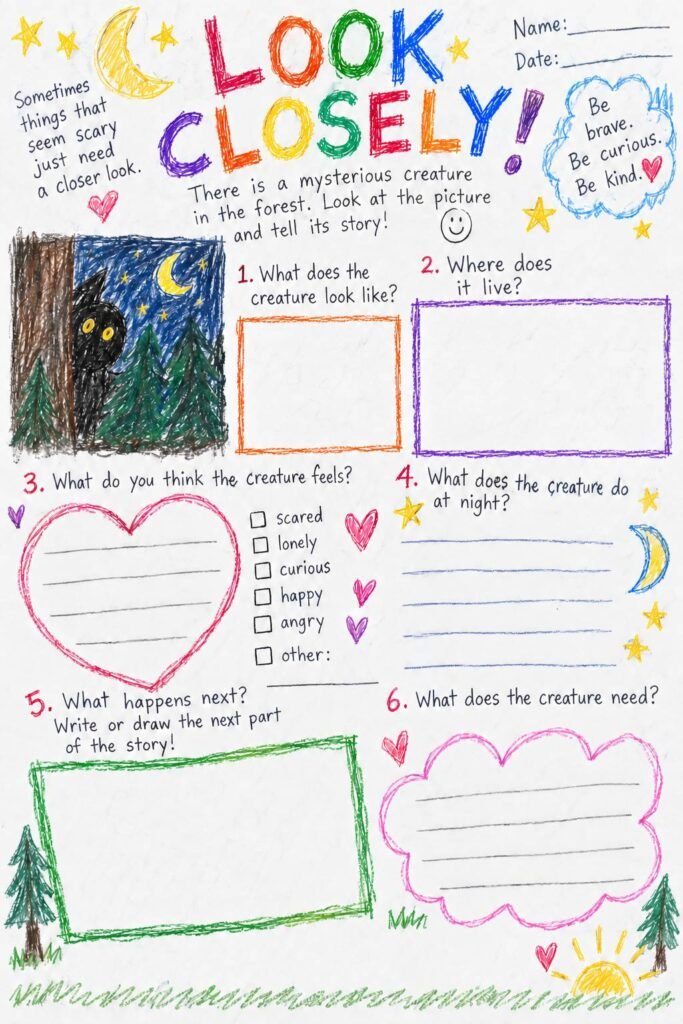
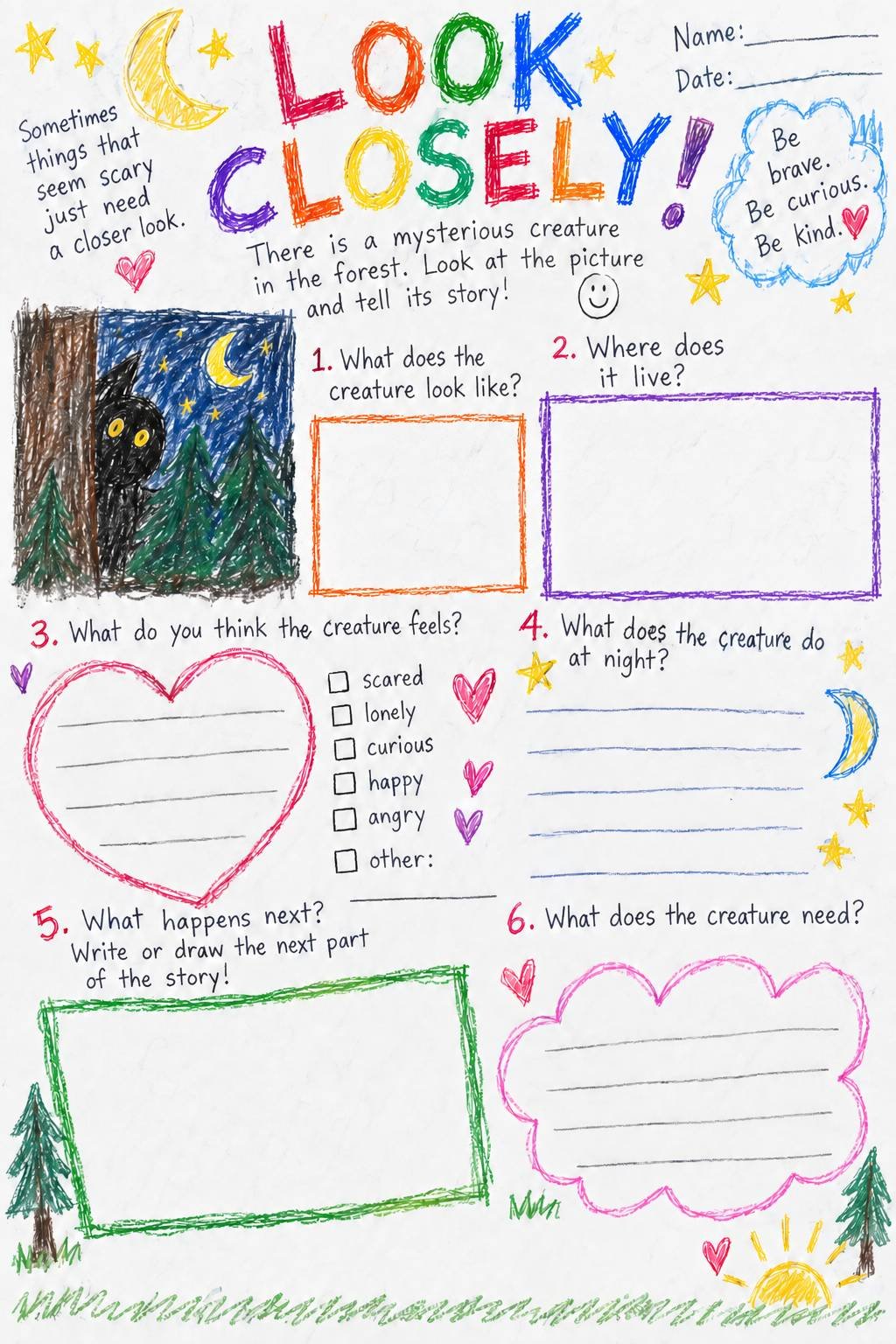
The worksheet below — Look Closely — is a free resource you can use with your child today. It is suitable for children aged approximately 5 to 12, and works equally well at home, in school, or in a therapeutic setting. It is visually rich, immediately arresting, and built around one of the most therapeutically versatile projective prompts available: a mysterious creature, half-hidden in a night-time forest scene, watching from the dark.
What makes this an effective fears worksheets for kids is the deliberate ambiguity of the central image. The creature is not clearly threatening. It is not clearly benign. It is simply watching, hidden, present — which is exactly the quality that makes it such a precise projective vehicle for the fears that children carry. The night-time setting, the hidden creature, the watching eyes: these are the images that children’s fears most naturally inhabit. And the three questions give the child a structured, gentle, completely open invitation to tell whatever story belongs to those images in their own inner world.
How to Use It
Place the worksheet in front of your child during a calm, unhurried moment — not immediately before bed, when the night-time imagery may be too activating, but during a relaxed afternoon or evening when the child has sufficient regulatory capacity to approach the material with curiosity rather than alarm. A simple, warm introduction works best: “Look at this picture. Something is hiding there. Look closely — what do you notice?”
Then step back. Give the child time and space to look without commentary or direction. Once the child begins answering the three questions, follow their story with open, genuinely curious questions:
- Tell me more about this creature — what else do you know about it?
- Has it been hiding there for a long time, or did it just arrive?
- Does it feel safe where it is, or is it hoping something will change?
- What would need to happen for it to come out from hiding?
- If the creature could say one thing right now, what would it say?
That last question is worth sitting with. A child who gives the creature a voice — who speaks from inside the hidden, watching perspective — is doing the most intimate form of projective storytelling available: they are not just describing the creature. They are inhabiting it.
The most important thing is not the answers. It is the quality of attention you bring to hearing them.
For Deeper Work: The Play Therapy Toolbox
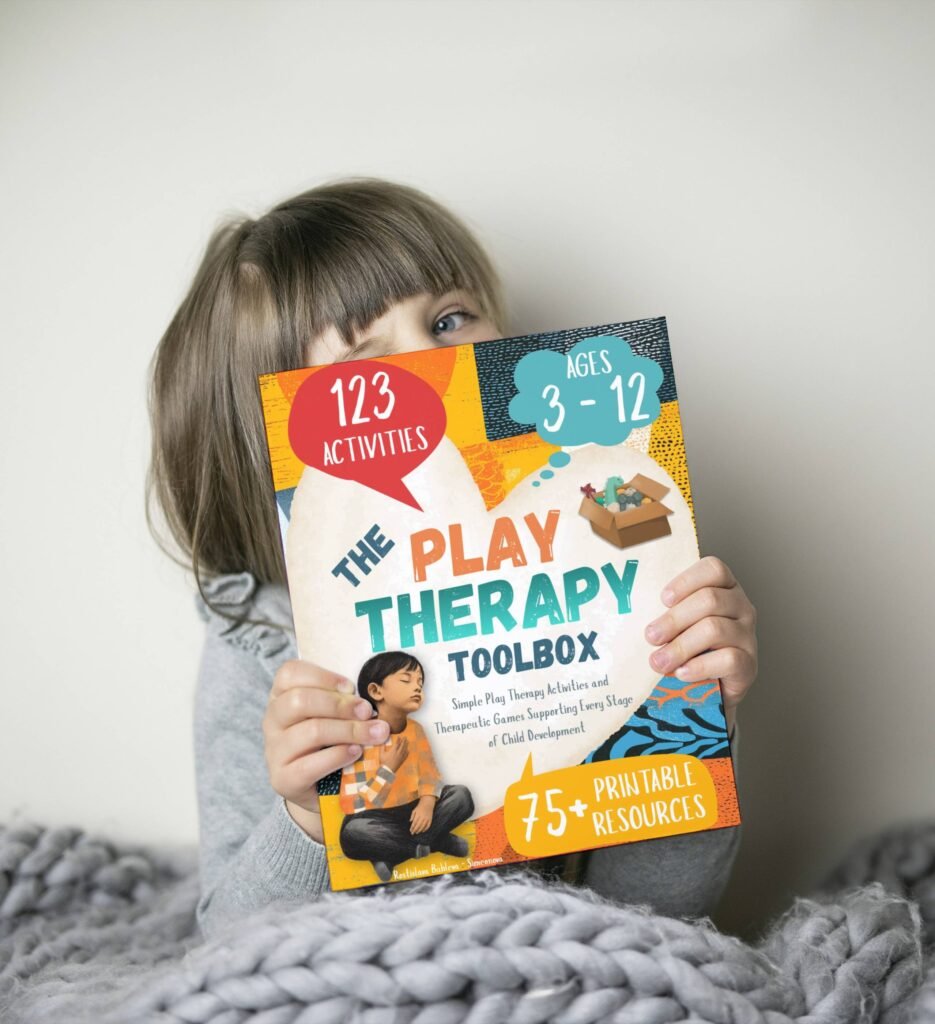
Look Closely is one example of the kind of projective, narrative-based, imagination-centred tool that sits at the heart of The Play Therapy Toolbox: 123 Simple Play Therapy Activities and Therapeutic Games Supporting Every Stage of Child Development from Age 3 to 12 — a book built around the understanding that children speak in a language adults often forget they once spoke fluently themselves.
The book contains 123 activities spanning role-play, enactment, fantasy storytelling, somatic exercises, and gamified experiences, alongside 75+ printable, downloadable, full-colour worksheets designed to support and extend each activity. Every activity comes with a therapeutic rationale grounded in peer-reviewed research, step-by-step guidance on how to conduct the session and what to say, questions to use with the child, and a parent guidance note written in the same warm, accessible language as this article.
The fears, anxiety, and projective storytelling chapters address the full range of what children are afraid of and how those fears express themselves — the surface fears that name themselves clearly and the deeper fears that find their form in the imagery of darkness, hidden things, and watching eyes. Every activity is cross-referenced in a comprehensive annex by presenting condition, age group, and page number — so you can navigate directly to the right tool for the right child at the right moment, without searching.
Three Things Worth Knowing Before You Begin
The story is protective, not evasive.
The child who tells the story of the creature rather than talking directly about their own fear is not avoiding the therapeutic work. They are doing it — at a distance and in a form that makes it genuinely possible. The protective fiction of the projective exercise is not a barrier to be dismantled. It is the therapeutic condition that makes honest engagement possible. Stay inside the story for as long as the child wants to be there. The real conversation will find its own time.
What the child does not say is as important as what they do.
A child who answers the three questions quickly and moves on is giving you different information from a child who sits with the image for a long time before speaking. A child who gives the creature a very specific, detailed inner life is telling you something different from one who keeps the answers brief and surface. A child who returns to the worksheet independently, who asks to look at it again, who mentions the creature in an unrelated conversation — that child is telling you that something in the image has found something in them. Stay curious.
You are the most important tool in the room.
A child who has experienced, consistently and specifically, the genuine curiosity and warm regard of an attuned adult — one who receives whatever the child brings to the story without alarm, without redirection, and without the urge to resolve the fear before it has been fully told — will bring something more honest and more revealing to the exercise than a child who has learned that their fears are too big or too strange to be received. Sit down. Look at the creature alongside them. Let them see that even grown-ups find something different in the image every time they look.
Available Now for $5.99 — For a Limited Time
If this free fears worksheet for kids gave you a sense of what becomes possible when children are given the right kind of space to tell the story of what frightens them, The Play Therapy Toolbox gives you 123 more tools built on the same foundation. The ebook is available now on Amazon at $5.99 for a limited time — with immediate access to 123 activities and 75+ full-colour printable worksheets for children aged 3 to 12.
Play is not preparation for life. It is life — in its most honest, most essential, most healing form.

Disclaimer: This article is intended as an educational and supportive resource for parents, caregivers, educators, and mental health professionals. It is not intended to diagnose, treat, or replace professional therapeutic or medical care. If a child is experiencing significant emotional, behavioural, or developmental difficulties, please seek guidance from a qualified mental health professional.

Rostislava Buhleva-Simeonova is a psychologist and game design specialist. She has worked with children, adults, and the elderly within various therapeutic programmes over the past eight years, all the while providing the much-needed playful twist that art and gamified experiences can bring to this sometimes uneasy setting. But it wasn’t until the birth of her daughter, Aurora, that this work took on an even deeper personal meaning. With her academic and real-life experience, honed through numerous trainings and sessions, she is currently authoring books and articles in the field of child psychology and development, offering expertise in art and play therapy to guide parents and caregivers, as well as professionals in the fields of social work and mental health, throughout various pivotal moments in children’s lives. Last but not least, all of her books have been “peer-reviewed” by her daughter, who testifies to the efficiency of these methods.