
Every parent has watched their child give up on something they genuinely wanted. Not because they stopped wanting it — but because the distance between where they were and where they wanted to be felt, in a single unguarded moment, too large to cross. The child who wanted to learn an instrument and quit after three weeks. The one who said they would run a race and never signed up. The one who set a goal with real excitement and then, when the first difficulty arrived, quietly concluded that the goal was not suitable for them.
This is not weakness. It is the entirely predictable result of a child who has a clear picture of the destination but no map of the terrain between here and there. Goals without structure are not goals — they are wishes. And a wish that meets its first obstacle without a plan for what to do when obstacles arrive will almost always give way to the conclusion that the obstacle was a sign: this is not meant for me.
Helping a child build a real relationship with their own goals — one that includes the hidden work beneath the surface, the steps that nobody sees, the obstacles that can be anticipated and prepared for — is one of the most durable gifts available to any adult who cares about a child’s capacity to pursue what matters to them. And a well-designed goal setting worksheet for kids is one of the most accessible ways to begin.
What Goal Setting Actually Requires
Goal setting is not wishful thinking with a deadline attached. At its developmental root, it is a complex cognitive and emotional skill — one that requires the child to hold a future state clearly in mind, identify the gap between that state and the present, generate a sequence of steps that bridges the gap, anticipate the obstacles that might disrupt those steps, and maintain motivation across the entire process even when progress is slow and the destination still feels distant.
Each of these capacities is still developing across middle childhood. The prefrontal cortex — responsible for planning, sequencing, impulse control, and the ability to delay gratification in service of a future reward — does not complete its development until the mid-twenties. Asking a child to set and pursue a meaningful goal without explicit structural support is asking them to rely on a tool that is still very much under construction.
This is not an argument against goal setting with children. It is an argument for doing it properly — with the right framework, the right questions, and the right kind of adult presence alongside. A goal setting worksheet for kids that breaks the goal into visible, manageable, sequenced components does not limit the child’s ambition. It gives that ambition the structure it needs to become something real.
Why the Iceberg Is the Right Frame
There is something therapeutically and developmentally precise about the iceberg as a metaphor for goal setting. The goal — the visible peak above the waterline, bright and clear against the sky — is what the child can already see. It is what they want, what they are excited about, what they have told you and themselves they are going to do. It is real, and it is important, and it deserves to be named and held and taken seriously.
But the iceberg extends far below the surface. The vast, invisible mass beneath the waterline — the steps, the preparation, the practice, the obstacles, the recoveries from setbacks — is where the actual work of achieving the goal lives. It is unglamorous. It is largely unseen by anyone else. And it is exactly what children most often fail to account for when they set a goal with excitement and then find themselves blindsided by the first difficulty.
A goal setting worksheet for kids built around the iceberg frame makes the hidden work visible. It does not ask the child only what they want to achieve — it asks them what needs to happen beneath the surface to get there. And in making the beneath-the-surface work visible and named and planned for, it transforms the goal from a wish into something that has the structure of a real possibility.
Free Goal Setting Worksheet for Kids: My Goal
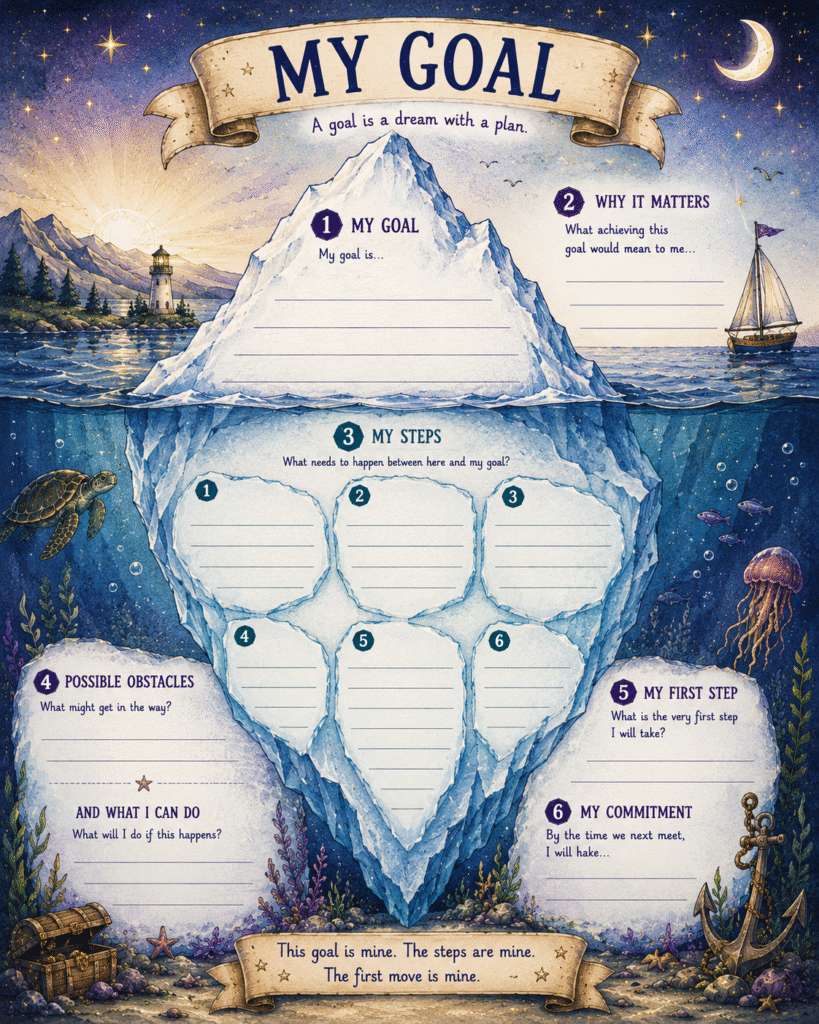
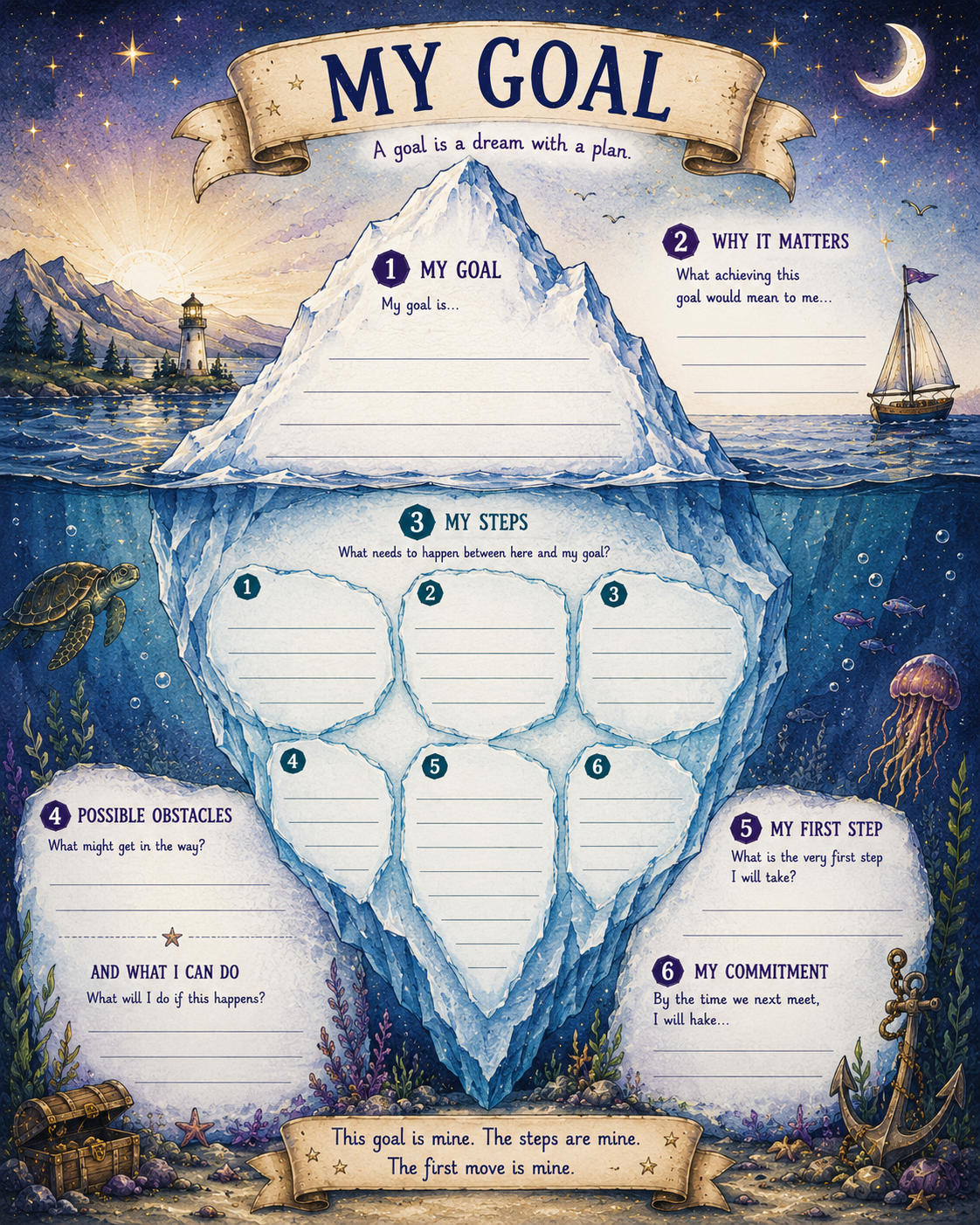
The worksheet below — My Goal — is a free resource you can use with your child today. It is suitable for children aged approximately 7 to 12, and works equally well at home, in school, or in a therapeutic setting. It is structured around six elements that move the child through the complete arc of genuine goal setting, from the dream to the first committed step.
What makes this one of the most effective goal setting worksheets for kids is the complete arc it traces — from articulating the goal and its meaning, through breaking it into concrete steps, to anticipating obstacles and committing to a specific first action before the session ends. A child who has worked through all six elements has not simply stated a goal. They have built a plan — and in building it, they have already begun.
How to Use It
Introduce the worksheet during a calm, unhurried moment — not in the immediate aftermath of a setback or failure, when the child’s relationship to their own goals may be at its most fragile. A simple, warm introduction works best: “A goal is a dream with a plan. This is the plan part. Let’s figure out what is above the waterline — and what is underneath it.”
Work through the six elements at the child’s pace. The goal and why it matters should be established before anything else — because the why is what the child will return to when the steps become difficult and the motivation falters. Give it proper time and proper weight. Once the goal and its meaning are clear, move beneath the surface together:
- If you were going to break this goal into six steps, what would the first one be?
- What is the hardest step — the one that feels most uncertain?
- What usually gets in the way when you are trying to do something difficult?
- If that obstacle arrived, what is one thing you could do instead of stopping?
- What is the smallest, most specific first action you could take this week?
That last question — the first step — is the most important practical element of the entire worksheet. Research on goal achievement consistently shows that the gap between intention and action is most reliably bridged not by stronger motivation but by a specific, concrete, immediately actionable first step. A child who leaves the session knowing exactly what they will do first — not eventually, not when they feel ready, but this week, this day, this afternoon — is a child whose goal has already begun to move from the imagined to the real.
Once the worksheet is complete, explore the commitment together:
- What would it feel like to have taken that first step by the time we next speak?
- Is there someone you could tell about your goal — someone who would ask you how it is going?
- What will you say to yourself if the first step is harder than you expected?
- When the goal feels far away, what will remind you why it matters?
The most important thing is not the answers. It is the quality of attention you bring to hearing them — and the consistent message that this goal is worth pursuing, that the steps are manageable, and that the first move is entirely within the child’s reach.
For Deeper Work: The Play Therapy Toolbox
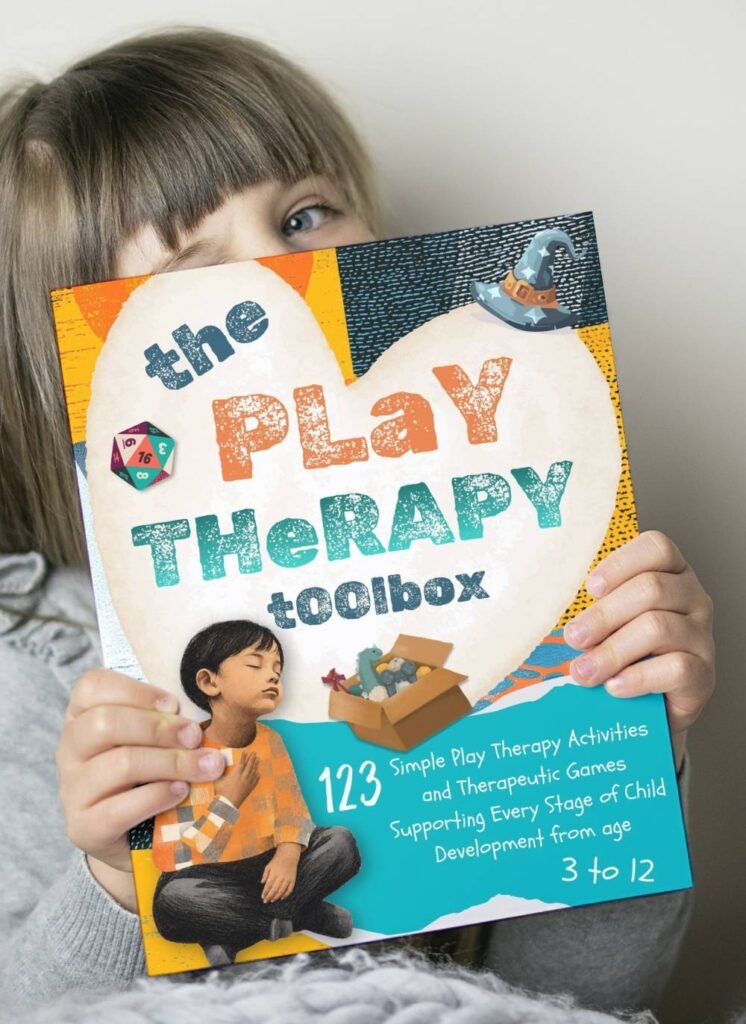
My Goal is one example of the kind of agency-building, resilience-focused, cognitively structured tool that sits at the heart of The Play Therapy Toolbox: 123 Simple Play Therapy Activities and Therapeutic Games Supporting Every Stage of Child Development from Age 3 to 12 — a book built around the understanding that children speak in a language adults often forget they once spoke fluently themselves.
The book contains 123 activities spanning role-play, enactment, fantasy storytelling, somatic exercises, and gamified experiences, alongside 75+ printable, downloadable, full-colour worksheets designed to support and extend each activity. Every activity comes with a therapeutic rationale grounded in peer-reviewed research, step-by-step guidance on how to conduct the session and what to say, questions to use with the child, and a parent guidance note written in the same warm, accessible language as this article.
The resilience, motivation, and identity chapters address the full range of goal-related presentations children bring — perfectionism and fear of failure, giving up under pressure, difficulty sustaining motivation, the particular challenge of pursuing long-term goals in a world calibrated for immediate reward, and the experience of working toward something meaningful in the face of genuine obstacles. Every activity is cross-referenced in a comprehensive annex by presenting condition, age group, and page number — so you can navigate directly to the right tool for the right child at the right moment, without searching.
Three Things Worth Knowing Before You Begin
The why is the engine.
The most important element of any goal setting worksheet for kids is not the goal itself — it is the meaning behind it. A child who knows why their goal matters to them has something to return to when the steps become difficult and the motivation falters. A child who set the goal because it seemed like a good idea has nothing to anchor to when the first obstacle arrives. Spend more time on why it matters than on any other single element. The steps will follow from the meaning, but the meaning cannot be retrofitted from the steps.
Obstacles are part of the plan — not evidence that the plan has failed.
The possible obstacles section is not pessimism. It is preparation. A child who has anticipated that the third step might be difficult, and who has already decided what they will do if it is, experiences the arrival of that difficulty not as a sign that the goal is not for them but as something they saw coming and planned for. The obstacle was always part of the iceberg. Naming it in advance transforms it from a threat into a known variable — and known variables are manageable in a way that surprises are not.
You are the most important tool in the room.
Children pursue goals most persistently when they have an attuned adult alongside them — not doing the goal for them, not rescuing them from the difficult steps, but staying genuinely interested in the progress, asking the right questions, and communicating, through small consistent acts of attention, that the goal matters because the child matters. Fill in your own worksheet. Show them your iceberg. Let them see that even grown-ups are working toward something — and that the steps beneath the surface are what makes the peak possible.
Available Now for $5.99 — For a Limited Time
If this free goal setting worksheet for kids gave you a sense of what becomes possible when children are helped to see not just where they want to go but what lies beneath the surface of getting there, The Play Therapy Toolbox gives you 123 more tools built on the same foundation. The ebook is available now on Amazon at $5.99 for a limited time — with immediate access to 123 activities and 75+ full-colour printable worksheets for children aged 3 to 12.
Play is not preparation for life. It is life — in its most honest, most essential, most healing form.

Disclaimer: This article is intended as an educational and supportive resource for parents, caregivers, educators, and mental health professionals. It is not intended to diagnose, treat, or replace professional therapeutic or medical care. If a child is experiencing significant emotional, behavioural, or developmental difficulties, please seek guidance from a qualified mental health professional.

Rostislava Buhleva-Simeonova is a psychologist, art therapist, and gamificator. She has worked with children, adults, and the elderly within various therapeutic programmes over the past eight years, all the while providing the much-needed playful twist that art and gamified experiences can bring to this sometimes uneasy setting. But it wasn’t until the birth of her daughter, Aurora, that this work took on an even deeper personal meaning. With her academic and real-life experience, honed through numerous trainings and sessions, she is currently authoring books and articles in the field of child psychology and development, offering expertise in art and play therapy to guide parents and caregivers, as well as professionals in the fields of social work and mental health, throughout various pivotal moments in children’s lives. Last but not least, all of her books have been “peer-reviewed” by her daughter, who testifies to the efficiency of these methods.