
Every parent has had that moment — your child is struggling, shutting down, acting out, or simply unable to tell you what they need, and you are doing your best but wishing you had a little more to go on. The meltdown that came from nowhere. The long silence after something happened. The quieter worry at the end of the day, wondering whether you responded the right way. The reassurance matters. But sometimes what a child needs is not a reminder that things will be fine. What they need is a way back to what is already good.
Gratitude is not toxic positivity. It is not pretending the hard things are not there. It is, rather, a practiced capacity to hold both — the difficulty and the good — and to let neither erase the other. And like any capacity worth having, it needs to be built. Carefully. Consistently. With the right tools.
That is exactly what a well-designed gratitude worksheet for kids can help you do.
What Gratitude Actually Does in a Child’s Brain
The research on gratitude is more substantial than it might appear. Regular gratitude practice in children has been linked to improved wellbeing, stronger relationships, greater resilience under stress, and — importantly — a measurable reduction in anxiety and low mood. These are not small effects, and they are not simply the result of thinking happy thoughts.
When a child pauses to identify something genuinely good in their day, the brain’s reward circuitry activates. The prefrontal cortex — the part responsible for perspective, reflection, and emotional regulation — becomes more engaged. Over time, with consistent practice, this becomes less of an effort and more of a habit: a quiet, internal reflex that reaches for something solid when things feel uncertain.
A gratitude worksheet for kids works because it makes this practice concrete. It gives the habit a shape, a ritual, and a visual record. Children do not build internal habits in the abstract. They build them through doing.
The Language Children Were Born Speaking
Children do not process the world the way adults do. They do not sit with a feeling, examine it, and arrive at a conclusion. They play it out. They draw it, build it, enact it, give it colour and form — and let it resolve in the way that stories resolve, through movement and metaphor and the particular safety of something that is both real and not real at the same time.
This is not avoidance. It is, in fact, the most sophisticated emotional processing available to a developing mind.
Play and visual creative activity are the first languages every child speaks fluently. Long before they have words for gratitude — or for its absence — they have ways of showing what matters to them, what gives them warmth, what they return to when the day has been hard. Meeting children in that language, rather than asking them to translate everything into ours, is what makes visual, play-based tools so genuinely effective.
A gratitude worksheet for kids designed around drawing and personal reflection honours this. It does not ask the child to produce the right answer. It asks them to look at their own life and notice what is there.
Free Gratitude Worksheet for Kids: My Gallery of Gratitude
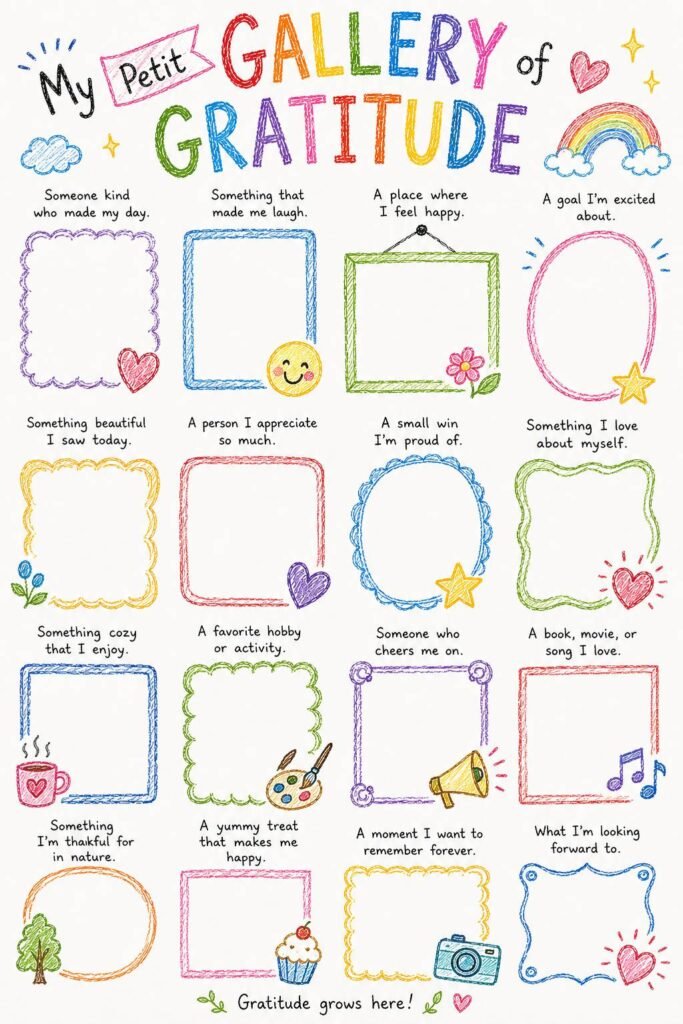
The worksheet below — My Petit Gallery of Gratitude — is a free resource you can use with your child today. It is suitable for children aged approximately 6 to 12, and works equally well at home, in school, or in a therapeutic setting. It is visual, personal, and designed to open a conversation rather than close one.
The premise is simple and beautiful. Your child is presented with sixteen illustrated frames — each one a different shape, each one holding a different prompt. Together, the frames form a gallery. Your child fills each one with a drawing, a doodle, or a few words. By the time the gallery is complete, they have created something that is entirely their own: a visual map of what is already good in their world. A child who has filled their gallery has already done the emotional work — quietly, without pressure, on their own terms. The adult’s job afterwards is simply to be curious about what they find.
How to Use It
Sit with your child and place the worksheet between you. Introduce it simply, without clinical language: “This is your very own gallery — like a real art gallery, but made of things from your life. We are going to fill each frame with something that matters to you.”
Work through the prompts together, or give your child space to fill the gallery independently and then share it with you. There are no wrong answers. The frame that takes the longest to fill is often the most interesting one.
Once the gallery is complete, explore it together with open, unhurried questions:
- Which frame was your favourite to fill in?
- Was there one that surprised you — something you hadn’t thought about in a while?
- Is there a frame you’d like to add to — something else that belongs there?
- Which one would you most like to look at on a hard day?
The most important thing is not the answers. It is the quality of attention you bring to hearing them.
For Deeper Work: The Play Therapy Toolbox
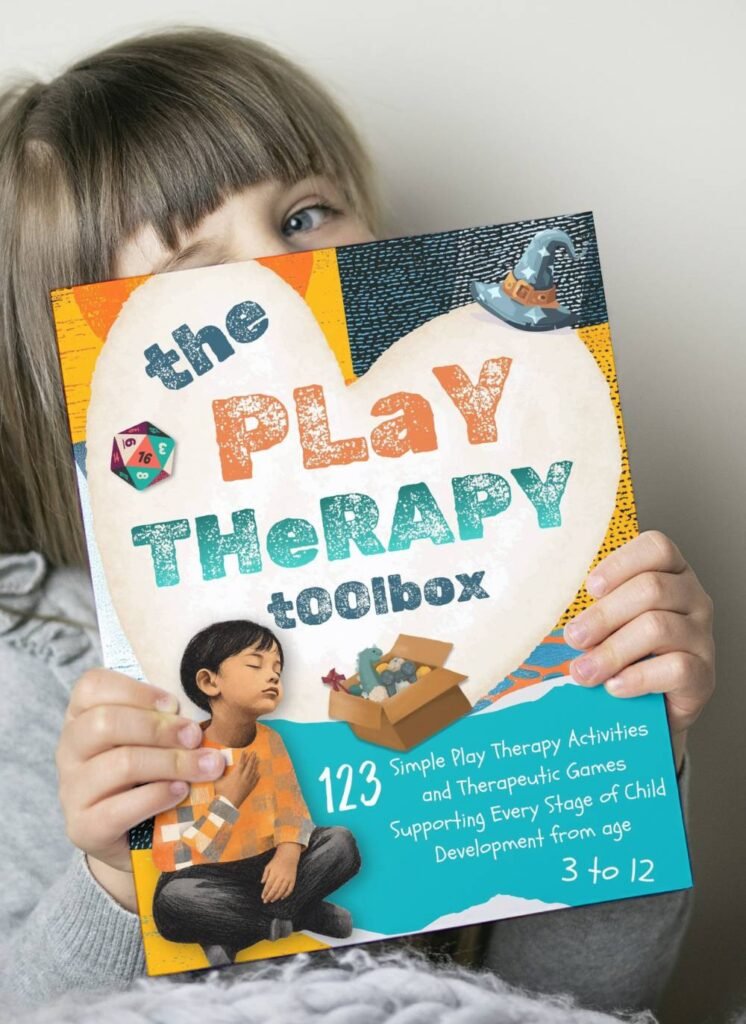
My Gallery of Gratitude is a strong standalone tool. But if you are looking for something more comprehensive — a clinically grounded resource that covers every major emotional and developmental need from ages 3 to 12 — that is what The Play Therapy Toolbox: 123 Simple Play Therapy Activities and Therapeutic Games Supporting Every Stage of Child Development from Age 3 to 12 was built to provide.
The book contains 123 activities spanning role-play, enactment, fantasy storytelling, somatic exercises, gamified experiences, and carefully designed worksheets. Each activity comes with a therapeutic rationale drawn from peer-reviewed research, step-by-step guidance, questions to use with the child, and a parent guidance note written in the same warm, practical language as this article. The activities grow with the child — because a three-year-old and an eleven-year-old are both navigating big feelings, but the way in needs to be completely different.
Three Things Worth Knowing Before You Begin
The worksheet is the door, not the destination.
Any gratitude worksheet for kids — including this one — is most powerful when it opens a conversation rather than substituting for one. Stay curious, stay unhurried, and let the child lead. What they put in the frames will tell you things they might not yet have words for.
Regular use builds more than crisis use.
Gratitude tools work best when used consistently rather than only in difficult moments. A child who fills their gallery regularly — not because something is wrong, but as an ordinary, enjoyable ritual — builds a quiet, durable habit of noticing the good. By the time something genuinely hard arrives, that habit is already there.
You are the most important tool in the room.
Children learn emotional habits primarily through the adults beside them. When you sit with your child and pick up a pencil yourself, you are not just modelling. You are offering your presence — calm, warm, genuinely interested — as a resource. That, more than any worksheet, is what makes the practice stick.
Ready to Go Further?
If this free gratitude worksheet for kids gave you a sense of what becomes possible when children are met in their own language, The Play Therapy Toolbox gives you 123 more tools built on the same foundation. The ebook is available now on Amazon at $5.99 for a limited time, with access to 123 activities and 75+ printable downloadable worksheets and resources in full colour.
Disclaimer: This article is intended as an educational and supportive resource for parents, caregivers, educators, and mental health professionals. It is not intended to diagnose, treat, or replace professional therapeutic or medical care. If a child is experiencing significant emotional, behavioural, or developmental difficulties, please seek guidance from a qualified mental health professional.


Rostislava Buhleva-Simeonova is a psychologist, art and play therapist, and gamificator. She has worked with children, adults, and the elderly within various therapeutic programmes over the past eight years, all the while providing the much-needed playful twist that art and gamified experiences can bring to this sometimes uneasy setting. But it wasn’t until the birth of her daughter, Aurora, that this work took on an even deeper personal meaning. With her academic and real-life experience, honed through numerous trainings and sessions, she is currently authoring books and articles in the field of child psychology and development, offering expertise in art and play therapy to guide parents and caregivers, as well as professionals in the fields of social work and mental health, throughout various pivotal moments in children’s lives. Last but not least, all of her books have been “peer-reviewed” by her daughter, who testifies to the efficiency of these methods.