
Identity in childhood is not a fixed concept. It is not something a child either has or does not have, something that arrives complete at a particular developmental milestone and remains stable from that point forward. It is something that is built — slowly, relationally, through the accumulated experience of being seen clearly, being asked good questions, and being given repeated opportunities to look at themselves from the outside and say: yes, that. That is something true about me.
The best identity activities for kids do not tell a child who they are. They create the conditions in which the child can begin to discover it for themselves.
What Identity Development Actually Requires
Erik Erikson described the central developmental work of middle childhood as the gradual construction of a stable, coherent sense of self — a process that unfolds not in a single moment of insight but across thousands of small encounters with the question of who I am in relation to others, to challenge, to failure, to success, and to the particular qualities that make me different from everyone else in the room.
This process is rarely linear. A child who feels confident and clear about who they are in one context may feel entirely uncertain in another. A child who has a strong sense of their own strengths in the familiar environment of home may lose access to that knowledge entirely in the social complexity of the playground. What builds identity robustly — what makes the child’s sense of self resilient enough to survive the inevitable challenges of growing up — is not a fixed belief about who they are, but a flexible, evidence-based, personally meaningful account of what they bring.
The best identity activities for kids build this account. Not through praise or reassurance — both of which are offered from the outside and can be dismissed from the inside — but through the direct experience of looking at oneself with curiosity and finding, repeatedly and specifically, something worth knowing.
Why the Animal Frame Works
There is something therapeutically specific about asking a child to choose an animal that represents them — something that goes beyond the general effectiveness of projective exercises. The animal choice is both immediate and deeply revealing. It bypasses the self-consciousness that direct questions about identity tend to produce — the child is not being asked to evaluate themselves, which is exposing and potentially threatening. They are being asked to identify with something they find compelling, which is natural, pleasurable, and genuinely absorbing.
And yet the animal they choose is almost always a remarkably precise self-portrait. The child who chooses a wolf is telling you something about their relationship to independence, loyalty, and strength. The one who chooses a butterfly is telling you something about transformation, delicacy, or the experience of being seen as beautiful. The one who chooses a bear is telling you something about protection, about warmth, about knowing how to be fierce when fierceness is needed. Each choice is a window — and the best identity activities for kids know how to stand at that window with genuine curiosity rather than reaching immediately for an interpretation.
The animal frame also does something that direct identity questions rarely achieve: it gives the child permission to claim positive qualities about themselves without the social awkwardness of seeming boastful. A child who would never say “I am strong and brave and loyal” can very comfortably say “I chose a wolf because wolves are strong and brave and loyal — and those are things I am too.”
Free Identity Activities for Kids: Draw Yourself as an Animal
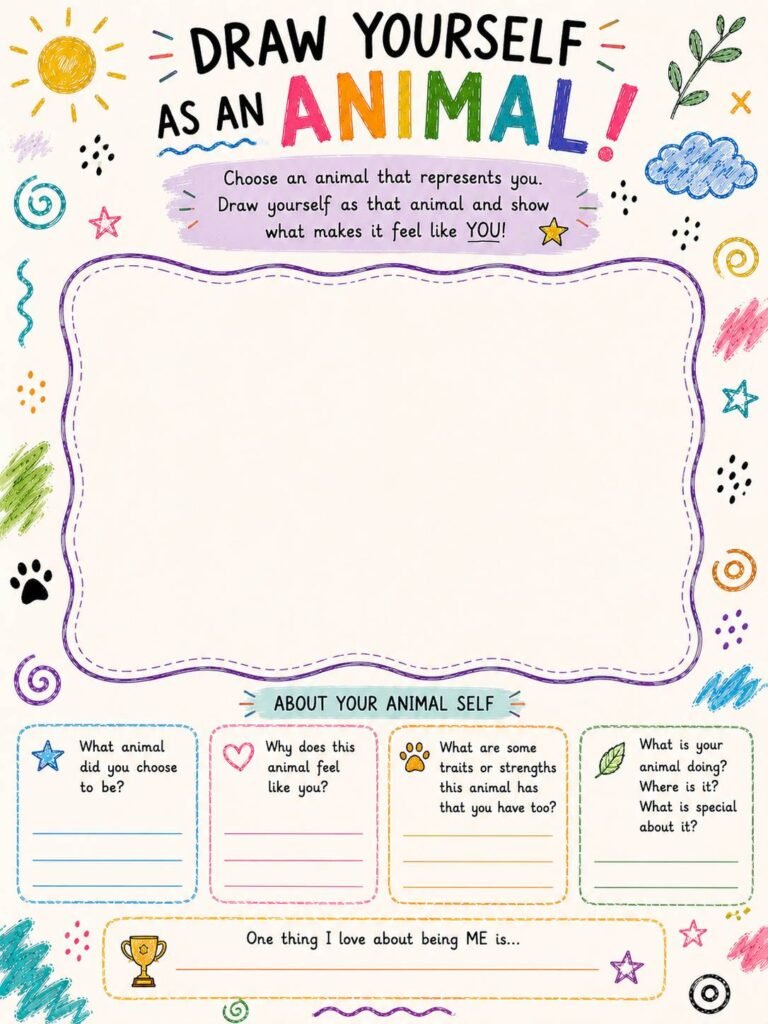
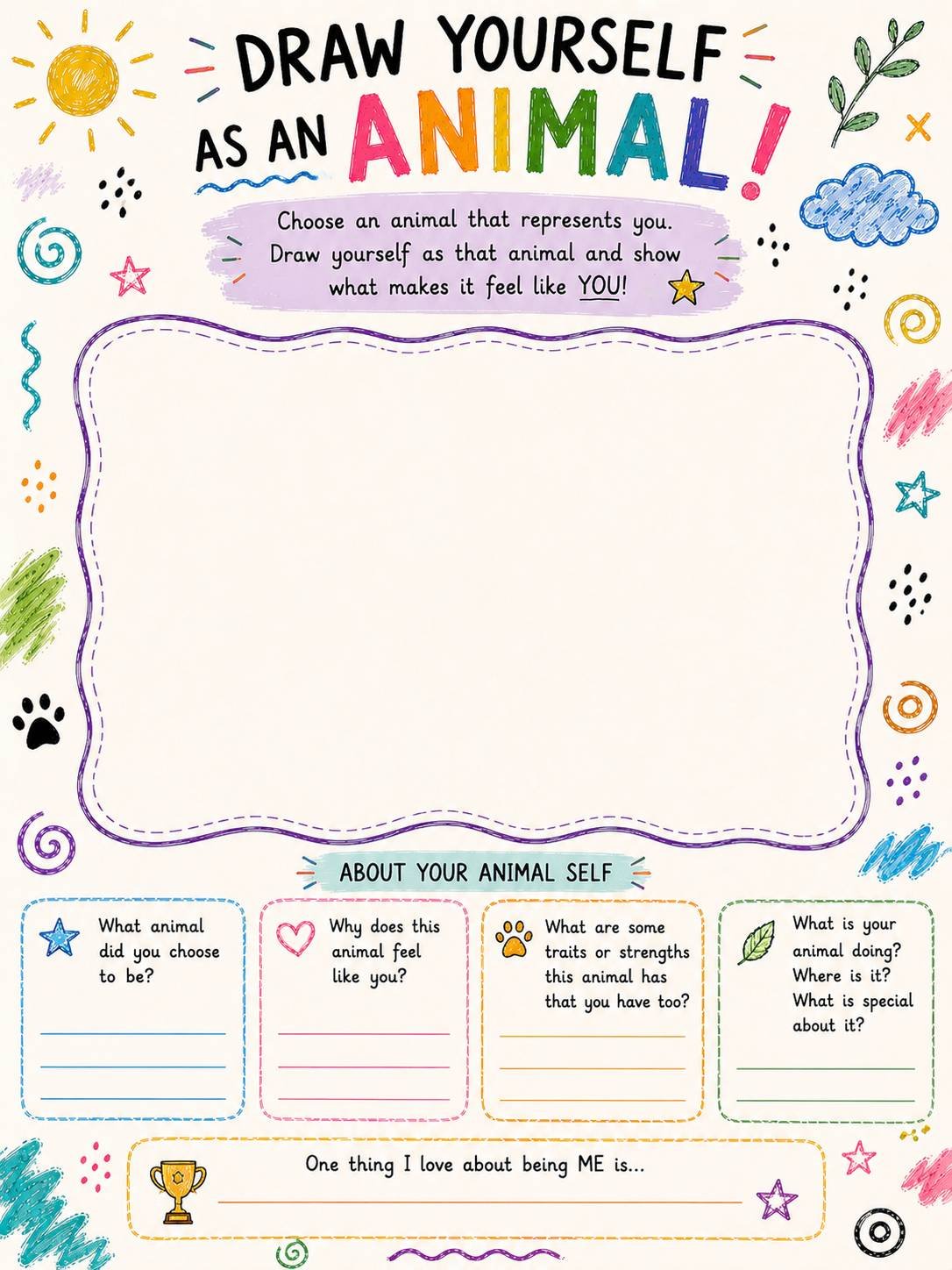
The worksheet below — Draw Yourself as an Animal — is a free resource you can use with your child today. It is suitable for children aged approximately 5 to 12, and works equally well at home, in school, or in a therapeutic setting. It is joyful, open, and built around a projective prompt that is both immediately engaging and therapeutically rich: choose an animal that represents you. Draw yourself as that animal and show what makes it feel like you.
A large, generously proportioned drawing space invites the child to draw their animal self in whatever detail they choose. Four reflection prompts sit below the drawing, each one approaching the identity question from a slightly different angle. And at the bottom, a closing prompt invites the child to step out of the animal frame entirely and speak directly as themselves: one thing I love about being me is…
That closing line is the quiet heart of the whole exercise. Everything that came before it — the animal choice, the drawing, the trait identification, the scene — has been building toward this moment of direct, unmediated self-regard. And because the child has spent the preceding minutes immersed in a detailed, specific, personally meaningful account of their own qualities through the animal, the closing prompt arrives at a moment when the answer is more available than it would have been at the start.
What makes this one of the most effective identity activities for kids is precisely that movement — from the protected distance of the animal to the direct warmth of being me. The journey between the two is the therapeutic work.
How to Read the Animal Choice
Before the how-to-use section, it is worth pausing here — because the animal a child chooses to represent themselves is rarely random, and learning to receive it with genuine curiosity is one of the most practically useful skills an attuned adult can develop.
A child who chooses a large, powerful animal — a lion, a bear, an elephant — may be telling you something about how they experience or aspire to experience their own strength and presence in the world. A child who chooses a small, quick, agile animal — a fox, a hummingbird, a cat — may be telling you something about intelligence, adaptability, and the particular kind of capability that does not announce itself loudly. A child who chooses a solitary animal may be telling you something about their relationship to independence and solitude. A child who chooses a social, pack-based animal may be telling you something about belonging and the importance of their connections.
And a child who struggles to choose — who moves through several animals and cannot settle, or who chooses and then second-guesses — may be telling you something about the difficulty of committing to a self-description, which is itself important information about where the identity work currently sits.
None of these observations should be offered directly to the child. Stay curious. Stay interested. Let the animal speak for itself before you ask any questions at all.
How to Use It
Place the worksheet in front of your child with a warm, open introduction — genuinely curious rather than instructional: “This is about choosing an animal that feels like you — not your favourite animal, not the coolest one, but the one that actually reminds you of yourself. I wonder which one that will be.” Then step back. Give the child time and space to think and draw without commentary or suggestion. The thinking phase — the pause before the animal is chosen — is often the most important part of the exercise. Do not rush it. You cam prompt with gentle open-ended questions but do not direct the process too much or tell them what they should or should not draw.
Once the drawing is complete and the prompts are answered, explore the animal self together with open, unhurried questions:
- What made you choose this particular animal over all the others?
- Which trait on your list are you most proud of?
- When in your own life do you feel most like this animal?
- Is there a trait your animal has that you would like more of in yourself?
- What does the one thing you love about being you have to do with your animal?
That last question invites the child to draw a thread between the animal identity and the direct self-statement — to notice that the qualities they attributed to the animal are qualities they were already claiming for themselves. Receiving that connection with genuine warmth, without over-explaining it, is the closing therapeutic act of the exercise.
The most important thing is not the answers. It is the quality of attention you bring to hearing them.
For Deeper Work: 101 Art Therapy Exercises for Children
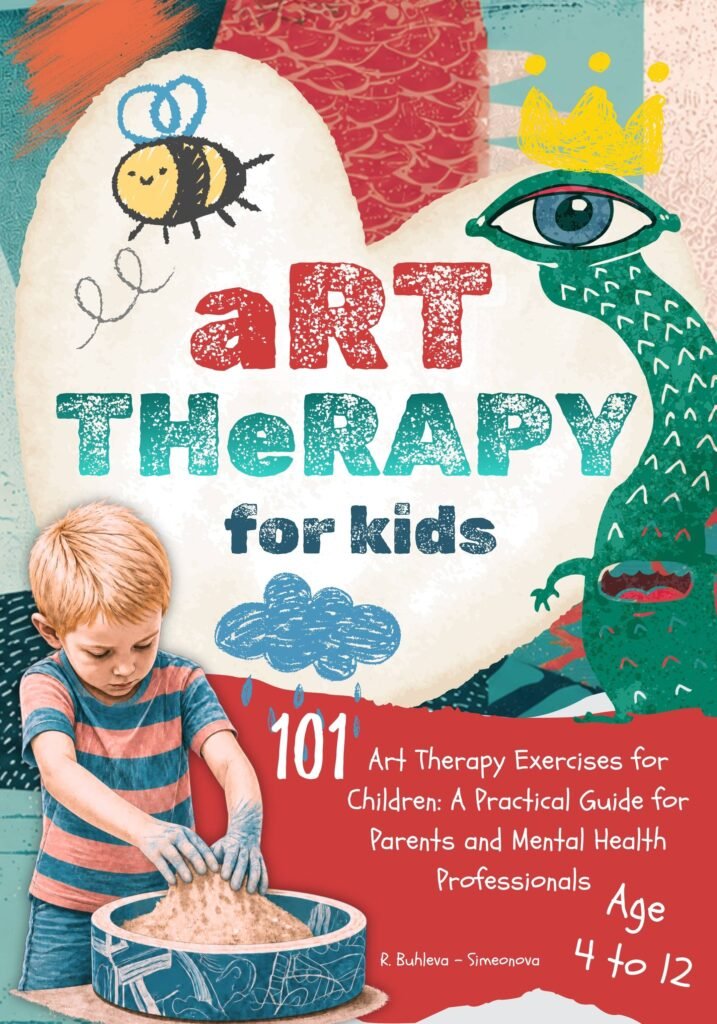
Draw Yourself as an Animal is one example of the kind of projective, identity-centred, strengths-based tool that sits at the heart of 101 Art Therapy Exercises for Children: A Practical Guide for Parents and Mental Health Professionals — a book built around the understanding that healing, growth, and genuine self-understanding often begin not with words, but with a simple mark on paper.
The book contains 101 art therapy exercises structured across three age groups — 4 to 6, 7 to 9, and 10 to 12 — each activity informed by validated research demonstrating how creative engagement alters brain physiology, strengthens neural flexibility, and enhances emotional regulation. Every session comes with a clear therapeutic rationale, step-by-step guidance, reflection questions, and guidance on how to observe and respond to what emerges — without diagnosis, without pressure, and without losing sight of the child as the author of their own experience.
The identity and self-esteem chapters cover the full range of presentations — self-concept, strengths recognition, shame, social comparison, belonging, body image, and the particular challenge of building a stable, flexible, personally meaningful sense of self in a world that constantly invites children to measure themselves against everyone else. Many exercises invite the caregiver to participate alongside the child — because shared creative experience is itself one of the most reliable contexts in which genuine identity conversations become possible.
Three Things Worth Knowing Before You Begin
The animal is a door, not a diagnosis.
The best identity activities for kids work from this position: the animal a child chooses is an invitation to a conversation, not a clinical assessment. Stay at the threshold. Ask what is on the other side. Let the child be the guide.
Regular use builds more than crisis use.
Identity is not built in a single session. It is built through the patient, consistent accumulation of experiences in which the child is invited to look at themselves with curiosity and find something worth knowing. A child who regularly engages with identity activities — who draws their animal self, fills their shield, maps their future, names their superpower — builds an increasingly detailed, specific, and resilient account of who they are. By the time something genuinely difficult arrives, that account is already there to return to.
You are the most important tool in the room.
Children build identity primarily through the eyes of the adults who matter most to them — through the experience of being seen specifically, described accurately, and valued consistently for what they actually bring rather than what they produce. Choose your own animal. Draw it. Tell them why you chose it. Let them see that identity is not something you arrive at once and carry forever — it is something you keep discovering, at every age, in every new encounter with the question of who you are.
Ready to Go Further?
If this free collection of identity activities for kids gave you a sense of what becomes possible when children are helped to see themselves clearly and specifically, 101 Art Therapy Exercises for Children: A Practical Guide for Parents and Mental Health Professionals gives you 101 more tools built on the same foundation — grounded in neuroscience, informed by developmental research, and written for every adult who has ever sat beside a child and wished they had something more to offer than words.
Disclaimer: This article is intended as an educational and supportive resource for parents, caregivers, educators, and mental health professionals. It is not intended to diagnose, treat, or replace professional therapeutic or medical care. If a child is experiencing significant emotional, behavioural, or developmental difficulties, please seek guidance from a qualified mental health professional.

Rostislava Buhleva-Simeonova is a psychologist, art therapist, and gamificator. She has worked with children, adults, and the elderly within various therapeutic programmes over the past eight years, all the while providing the much-needed playful twist that art and gamified experiences can bring to this sometimes uneasy setting. But it wasn’t until the birth of her daughter, Aurora, that this work took on an even deeper personal meaning. With her academic and real-life experience, honed through numerous trainings and sessions, she is currently authoring books and articles in the field of child psychology and development, offering expertise in art and play therapy to guide parents and caregivers, as well as professionals in the fields of social work and mental health, throughout various pivotal moments in children’s lives. Last but not least, all of her books have been “peer-reviewed” by her daughter, who testifies to the efficiency of these methods.