
Every parent has watched it happen — the gradual, quiet erosion of a child’s confidence in their own particular way of being. It rarely arrives as a single event. It arrives in accumulation: the comparison that lands a little harder than expected, the moment in a group when the child realises they are different from the others and reads that difference as a deficit, the slow, almost imperceptible shift from I am this way toward I should be more like that. By the time a parent notices it, the child has often been carrying it for a while — the growing suspicion that who they naturally are is not quite enough, not quite right, not quite what the world is looking for.
This suspicion is one of the most quietly damaging things that can take root in a developing child’s sense of self. And it is also one of the most common. Because children are social creatures, exquisitely sensitive to the norms and expectations of the groups they belong to, and developmentally oriented toward comparison and belonging in ways that make the discovery of their own difference feel, at certain moments, less like a gift and more like a problem.
A well-designed individuality worksheet for kids does not simply tell a child they are special. It helps them discover, through reflection and drawing and the specific naming of what is theirs alone, that their particular combination of qualities is not accidental — and that it is precisely this combination, unrepeatable and entirely their own, that makes them worth knowing.
What Individuality Actually Means in Child Development
Individuality is not the same as uniqueness in the trivial sense — the observation that every person has a different face or a different fingerprint. In developmental psychology, individuality refers to the child’s capacity to develop and maintain a stable, coherent, personally meaningful sense of self that is distinct from the social roles, group identities, and external expectations through which they are also defined.
Erik Erikson’s framework of identity development places the consolidation of individual identity at adolescence — but the foundations are laid across the whole of childhood. From the earliest months, the infant is engaged in the project of differentiating self from other, of discovering where they end and the world begins. By middle childhood, this project has become explicitly psychological: the child is actively constructing a narrative of who they are — what they like, what they are good at, what they value, who they love, what they dream of — and testing that narrative against the responses of the social world around them.
What the social world reflects back matters enormously. A child whose particular qualities — their specific interests, their way of thinking, their individual strengths — are received with genuine interest and warmth develops an individuality that is secure and self-sustaining. A child whose particular qualities are consistently overlooked, minimised, or implicitly compared unfavourably to others develops an individuality that is uncertain, defended, or gradually abandoned in favour of whatever the social world seems to prefer.
An individuality worksheet for kids that asks the child to name, draw, and reflect on the specific, personal, unrepeatable contents of their own identity is doing something therapeutically significant: it is creating the conditions under which the child’s particular way of being is placed at the centre, attended to with genuine interest, and held as something worth knowing about.
Why the Fingerprint Is the Right Frame
There is something both scientifically accurate and deeply resonant about the fingerprint as a metaphor for individuality — and its therapeutic effectiveness goes beyond its visual appeal.
A fingerprint is not chosen. It is not constructed or earned or performed. It is simply, irreducibly, what a person is — formed before birth, unchanged throughout life, and shared with no one else in the history of human existence. Every person who has ever lived has had a fingerprint entirely their own. Not similar to others. Not approximately unique. Genuinely, completely, verifiably singular.
When a child is invited to draw and write inside their fingerprint — to fill that particular, unrepeatable shape with their name, their hobbies, their family, their strengths, their loves, and their dreams — something quietly significant happens. The identity content is not floating in abstract space. It is inside the fingerprint. It belongs to this specific child in the same irreducible way the fingerprint itself does. The message is not simply that you are unique. It is that who you are is as inherent and as permanent as the lines on your hand — and no amount of comparison or social pressure can change what those lines are.
This is the therapeutic heart of the best individuality worksheets for kids: not the declaration of uniqueness but the embodied, specific, personally grounded experience of discovering what that uniqueness actually contains.
Free Individuality Worksheet for Kids: I Am Me
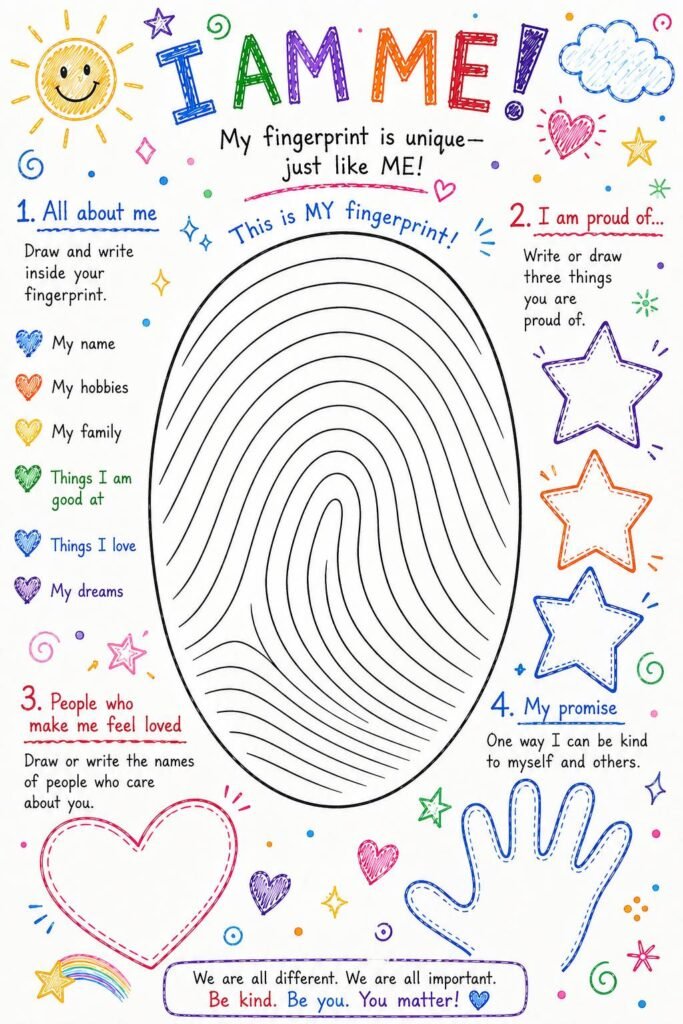
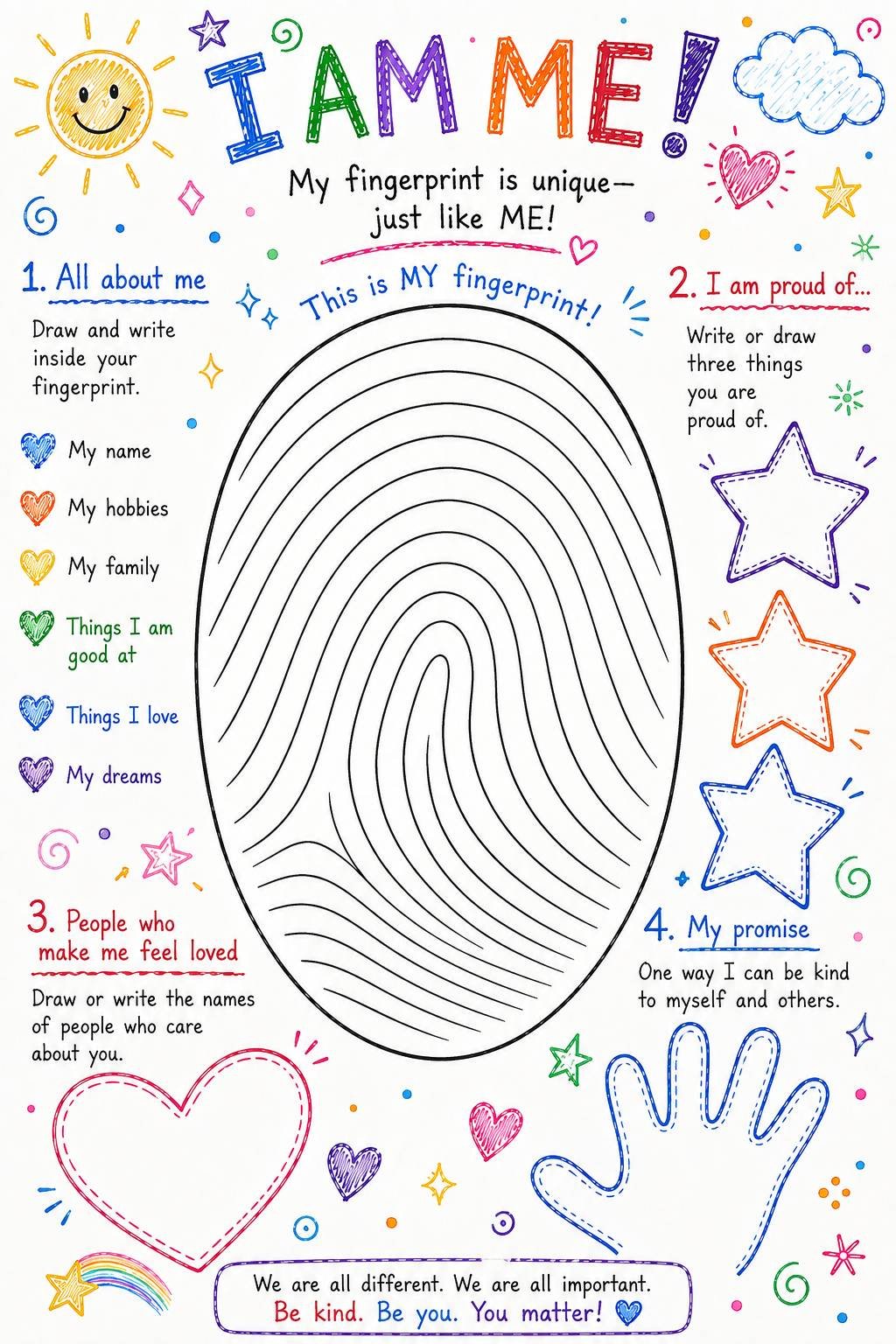
The worksheet below — I Am Me — is a free resource you can use with your child today. It is suitable for children aged approximately 5 to 12, and works equally well at home, in school, or in a therapeutic setting. It is joyful, colourful, and structured around four sections that move the child through the complete arc of individual identity — from the specific contents of who they are, through what they are proud of, through who loves them, to the promise they make to themselves and others.
At the centre of the page sits a large, beautifully detailed fingerprint — the child’s own, in symbolic form — waiting to be filled. The instruction is direct and entirely personal: draw and write inside your fingerprint. Six prompts guide what goes in: my name, my hobbies, my family, things I am good at, things I love, my dreams.
The four sections surrounding the fingerprint complete the therapeutic picture:
- I am proud of — three stars for three things the child is proud of, written or drawn
- People who make me feel loved — a heart for the names or drawings of people who care about them
- My promise — one way the child can be kind to themselves and others
- The central fingerprint itself — the visual and symbolic container for everything that makes them specifically, irreducibly them
And at the bottom, the closing message delivers the therapeutic heart of the entire exercise in five words: we are all different. We are all important. Be kind. Be you. You matter.
What makes this one of the most effective individuality worksheets for kids is the combination of the interior and the relational. The fingerprint section asks what is inside the child — their qualities, their loves, their dreams. The people who make me feel loved section asks who holds them from the outside — the relational context within which their individuality is seen and valued. Together, these two dimensions reflect the developmental reality that identity is always both individual and relational: it emerges from within and is shaped by the quality of the relationships that receive it.
How to Use It
Place the worksheet in front of your child with a warm, open introduction — genuinely curious rather than instructional: “This is your fingerprint — and no one else in the world has one exactly like it. We’re going to fill it with everything that makes it yours. Because what’s inside is just as unique as the lines themselves.” Then step back. Give the child time and space to draw and write without commentary or direction.
The fingerprint section should be completed before the surrounding sections — because it establishes the child’s identity as the centre of gravity from which everything else radiates. Give it proper time. Some children will fill it quickly and confidently. Others will sit with the prompts, considering each one carefully before committing to the page. Both responses are entirely right — and the child who takes longer is not struggling. They are doing something more careful and more honest.
Once the fingerprint is complete and the four surrounding sections are filled in, explore the worksheet together with open, unhurried questions:
- Of everything in your fingerprint, which part feels most like you?
- Which of the three things you are proud of took the most courage or effort?
- Is there someone in your people who make me feel loved heart who knows how important they are to you?
- What does your promise mean to you — is it something you find easy or something you are still working on?
- If someone who had never met you saw this fingerprint, what do you think they would know about you?
That last question is worth sitting with. A child who can articulate what their fingerprint communicates about them — who can stand outside their own identity for a moment and see it as something worth knowing — has developed a degree of self-awareness and self-regard that no amount of external praise can produce. The most important thing is not the answers. It is the quality of attention you bring to hearing them.
What the Research Says About Individuality and Child Wellbeing
The research on individuality, authenticity, and child wellbeing is consistent and compelling — and considerably richer than popular discourse about uniqueness tends to suggest.
Research by Christopher Niemiec and others on self-determination theory has demonstrated that the experience of authenticity — living and acting in accordance with one’s own values, interests, and identity rather than in conformity with external expectations — is one of the strongest predictors of psychological wellbeing across the lifespan. Children who are supported in developing and expressing their individual identity, rather than suppressing it in favour of social conformity, demonstrate greater resilience, stronger intrinsic motivation, more robust self-esteem, and greater capacity for genuine connection with others.
The apparent paradox — that embracing one’s individuality makes a person more rather than less capable of genuine social connection — is well supported in the developmental literature. A child who knows who they are does not need to perform a version of themselves for social acceptance. They can bring their actual self into relationship — which is the only basis on which genuine connection, as distinct from social approval, is possible.
And the research on social comparison — one of the primary mechanisms through which children’s sense of individuality is eroded — shows consistently that children who have a stable, specific, internally grounded sense of their own identity are significantly more resistant to the negative effects of social comparison than those whose self-concept is less defined. The child who knows clearly what is in their fingerprint does not need to measure it against anyone else’s.
For Deeper Work: The Play Therapy Toolbox
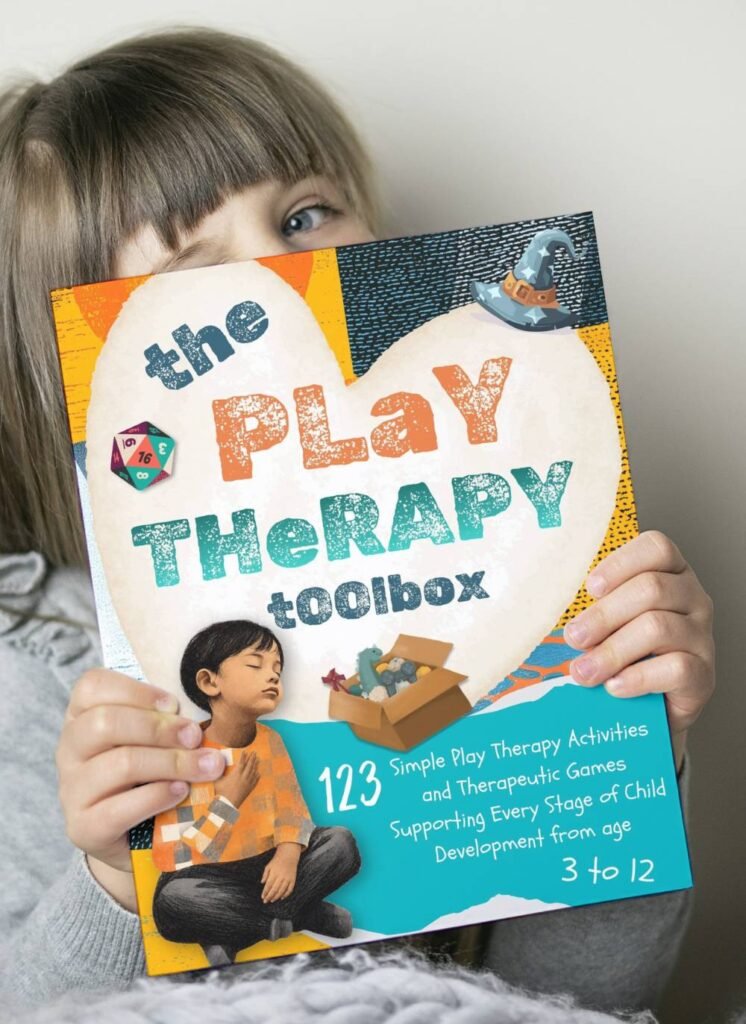
I Am Me is one example of the kind of identity-centred, strengths-based, relationally grounded tool that sits at the heart of The Play Therapy Toolbox: 123 Simple Play Therapy Activities and Therapeutic Games Supporting Every Stage of Child Development from Age 3 to 12 — a book built around the understanding that children speak in a language adults often forget they once spoke fluently themselves.
The book contains 123 activities spanning role-play, enactment, fantasy storytelling, somatic exercises, and gamified experiences, alongside 75+ printable, downloadable, full-colour worksheets designed to support and extend each activity. Every activity comes with a therapeutic rationale grounded in peer-reviewed research, step-by-step guidance on how to conduct the session and what to say, questions to use with the child, and a parent guidance note written in the same warm, accessible language as this article.
The identity, individuality, and self-esteem chapters address the full range of presentations children bring — social comparison and conformity pressure, perfectionism and people-pleasing, shame and the fear of being different, the particular challenges of neurodivergent identity, and the experience of navigating a social world that does not always celebrate what makes a child most genuinely themselves. Every activity is cross-referenced in a comprehensive annex by presenting condition, age group, and page number — so you can navigate directly to the right tool for the right child at the right moment, without searching.
Three Things Worth Knowing Before You Begin
Individuality is discovered, not declared.
The best individuality worksheets for kids work from this position: the goal is not to tell the child they are unique — they will not believe it if it comes only from outside — but to create the conditions under which they discover it for themselves, through the specific, personal, unhurried act of naming what is in their fingerprint. A child who has filled that shape with their own particular contents knows something about themselves that no amount of external praise could have delivered, because they built it themselves.
The relational dimension is as important as the individual one.
The people who make me feel loved heart is not supplementary to the fingerprint. It is the other half of the therapeutic act. Individuality does not develop in isolation. It develops within relationships — specifically, within relationships in which the child’s particular way of being is received with genuine interest and warmth. A child whose individuality is seen and valued by the people in their heart has a far more resilient sense of self than one whose fingerprint has never been looked at with care.
You are the most important tool in the room.
The fingerprint holds what is unique. You are the reason the child believes it is worth filling in. Children develop a secure sense of their own individuality primarily through the experience of being seen specifically — not generically praised but genuinely, particularly known — by the adults who matter most to them. Fill in your own fingerprint. Show them yours. Let them see that even grown-ups are still discovering what is in theirs — and that the discovering, at every age, is one of the most worthwhile things a person can do.
Available Now for $5.99 — For a Limited Time
If this free individuality worksheet for kids gave you a sense of what becomes possible when children are helped to see that who they are is not a problem to be solved but a fingerprint to be filled — The Play Therapy Toolbox gives you 123 more tools built on the same foundation. The ebook is available now on Amazon at $5.99 for a limited time — with immediate access to 123 activities and 75+ full-colour printable worksheets for children aged 3 to 12.
Play is not preparation for life. It is life — in its most honest, most essential, most healing form.

Disclaimer: This article is intended as an educational and supportive resource for parents, caregivers, educators, and mental health professionals. It is not intended to diagnose, treat, or replace professional therapeutic or medical care. If a child is experiencing significant emotional, behavioural, or developmental difficulties, please seek guidance from a qualified mental health professional.

Rostislava Buhleva-Simeonova is a psychologist, art therapist, and gamificator. She has worked with children, adults, and the elderly within various therapeutic programmes over the past eight years, all the while providing the much-needed playful twist that art and gamified experiences can bring to this sometimes uneasy setting. But it wasn’t until the birth of her daughter, Aurora, that this work took on an even deeper personal meaning. With her academic and real-life experience, honed through numerous trainings and sessions, she is currently authoring books and articles in the field of child psychology and development, offering expertise in art and play therapy to guide parents and caregivers, as well as professionals in the fields of social work and mental health, throughout various pivotal moments in children’s lives. Last but not least, all of her books have been “peer-reviewed” by her daughter, who testifies to the efficiency of these methods.