
Every parent has had that moment — your child is struggling, shutting down, acting out, or simply unable to tell you what they need, and you are doing your best but wishing you had a little more to go on.
The meltdown that came from nowhere. The long silence after something happened. The quieter worry at the end of the day, wondering whether you responded the right way. These moments do not mean you are failing. They mean you are paying attention. And paying attention, as it turns out, is exactly where good parenting begins.
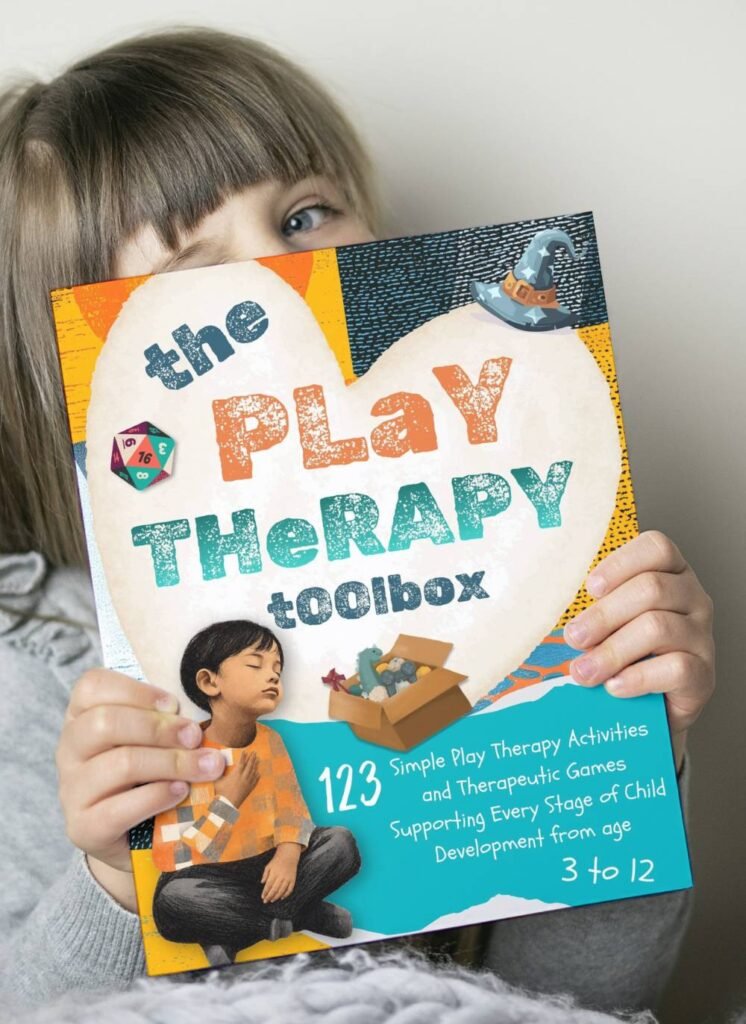
In this article, you will find a free inner critic worksheet drawn directly from The Play Therapy Toolbox: 123 Simple Play Therapy Activities and Therapeutic Games Supporting Every Stage of Child Development from Age 3 to 12. It is a practical, research-grounded tool you can use at home or in a clinical setting — and it comes with everything you need to understand why it works.
Why Play Is the Language Children Were Born Speaking
Play is not something children do in between the important moments of development. Play is the important moment. It is the primary language of childhood — the medium through which children explore who they are, rehearse who they might become, and work through everything that confuses, frightens, or overwhelms them.
Children do not process the world the way adults do. They do not sit with a difficulty, name it, reflect on it, and arrive at a conclusion. They play it out. They draw it, build it, enact it, give it a character, send it on a journey, and let it resolve in the way that stories resolve — through movement, through metaphor, through the particular safety of something that is real and not real at the same time. This is not avoidance. It is the most sophisticated emotional processing available to a developing mind.
The developing brain processes emotional experience through the right hemisphere long before the left hemisphere’s language centres are mature enough to put it into words. As a result, play bypasses the need for that translation entirely. When a caregiver or professional learns to receive play as communication rather than entertainment, an entirely different kind of conversation becomes possible.
What Is an Inner Critic — and Why Does It Matter for Children?
Most adults are familiar with their inner critic — the voice that says you are not good enough, that everyone is judging you, that failure is inevitable. What many parents do not realise is that this voice can begin forming in childhood, often between the ages of four and twelve, precisely when children are developing their sense of self and their relationship to achievement, belonging, and worth.
For children at this age, the inner critic is not yet a fixed belief. It is a pattern in formation — which is exactly why early intervention matters. An inner critic worksheet gives children a concrete, playful, and non-threatening way to externalise this voice: to take it out of their heads, give it a form, and begin to see it as something separate from who they are.
This approach is grounded in narrative therapy, cognitive behavioural therapy, and expressive arts — three of the evidence-based frameworks woven throughout The Play Therapy Toolbox. The principle is simple but clinically powerful: a thought you can see is a thought you can examine. And a thought you can examine is no longer running the show unnoticed.
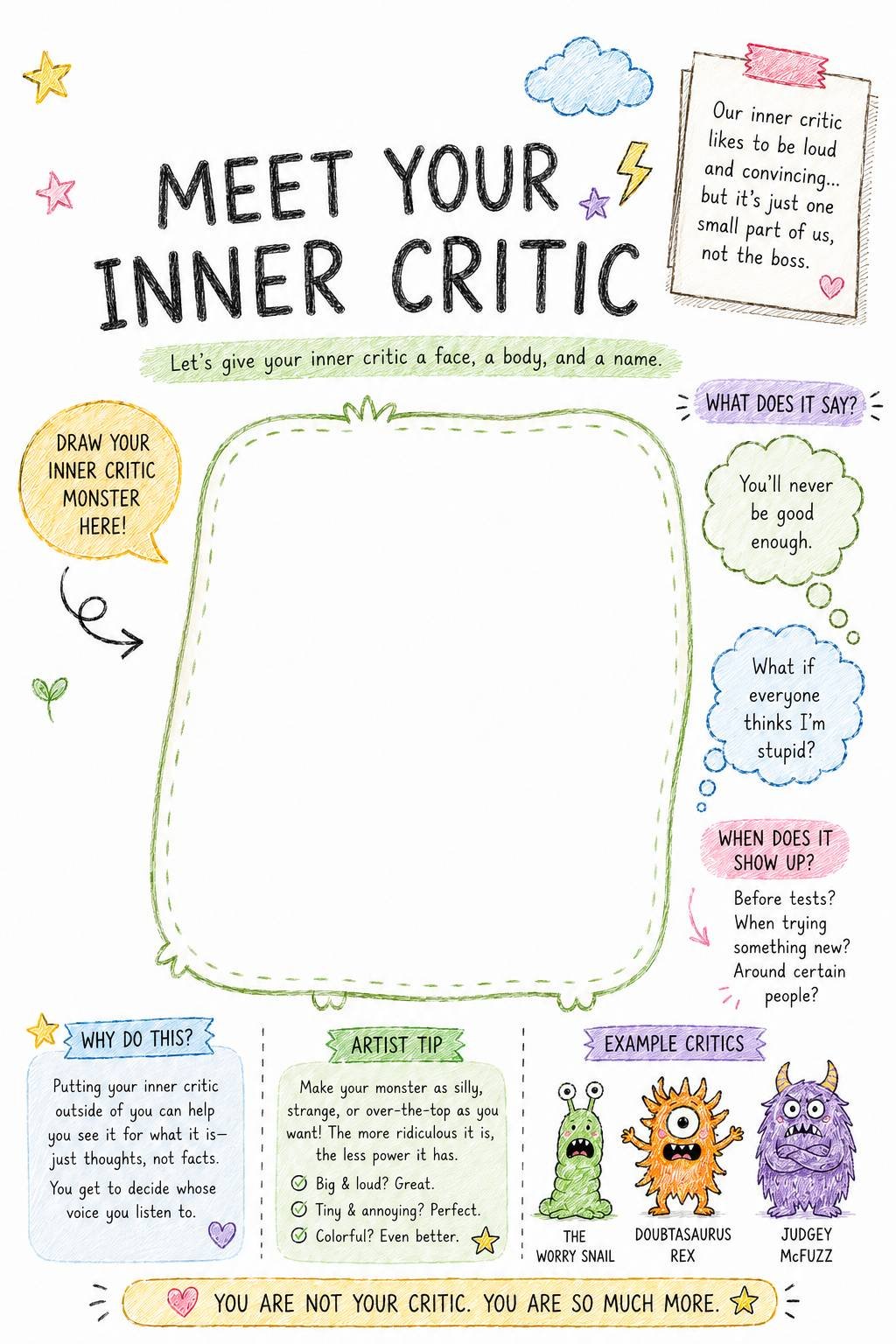
The following activity is reproduced directly from The Play Therapy Toolbox — Activity 55, Meet Your Inner Critic, designed for ages 4 to 6 but adaptable for older children with strong visual or creative preferences. It is one of the most immediately engaging activities in the book, and one of the most clinically versatile.
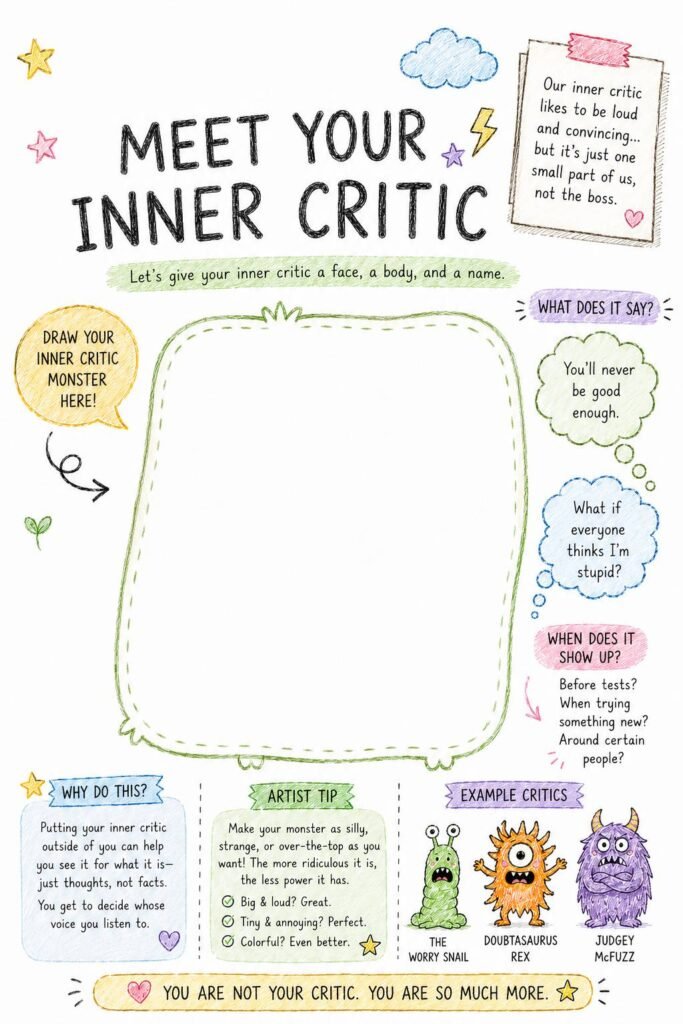
Activity 55 — Meet Your Inner Critic
Age: 4–6 (adaptable for older children)
Materials: The Meet Your Inner Critic worksheet; crayons, coloured pencils, or markers
Therapeutic Rationale
At four to six, children are beginning to internalise the voices of the people and experiences around them — and some of those voices are not kind. The inner critic at this age is not yet a fixed cognitive structure; it is a pattern in formation, frequently loud and frequently believed. By giving the inner critic a visual form — a monster with a face, a body, and a name — the child takes their first step toward recognising it as something separate from themselves. This externalisation is the therapeutic mechanism: a critic that has a shape is a critic that can be looked at, talked to, and ultimately refused. The activity draws on narrative therapy’s technique of externalising the problem, expressive arts therapy’s use of creative making as emotional processing, and the cognitive behavioural principle that examining a thought changes one’s relationship to it.
Step-by-Step
Begin by introducing the concept warmly and without clinical language: “Did you know that most people have a little voice inside them that sometimes says not-very-nice things? Things like ‘you’re not good enough’ or ‘everyone thinks you’re silly’? Today we’re going to meet yours.”
Place the inner critic worksheet in front of the child. Introduce the drawing space: “This is where your inner critic lives. Your job is to draw it — give it a face, a body, and a name. It can look however it wants. Big, small, silly, scary, weird. You decide.”
Give the child genuine time and freedom to draw. Stay present and curious without directing or suggesting what the critic should look like. The act of drawing is itself therapeutic — the child is doing the work of externalisation through the making.
Once the monster is drawn and named, explore what it says: “What does your critic say most often? What does it say when you make a mistake? What does it say when you try something new?” The child can write or draw the critic’s words on the worksheet.
Explore when it shows up: “When does your critic get loudest? Before a test? When you’re trying something for the first time? When you’re around certain people?”
Close by introducing the most important reframe — gently, and without dismissing the child’s experience: “Your critic is just one part of you — and it’s a small part. It likes to be loud, but that doesn’t mean it’s the boss. You are so much more than what your critic says.”
Questions to Ask
• What is your critic’s name — and why did you choose that name?
• Does your critic sound like anyone you know, or is it a voice all its own?
• What would you say back to your critic if you could?
• Is your critic ever right about anything — and is it right about everything?
Parent guidance: Your child’s inner critic is not something to argue with directly or dismiss as wrong. The most powerful thing you can do at home is model your own relationship to your inner critic — naming it out loud, treating it with wry curiosity rather than belief, and showing your child that even adults have this voice and have learned not to let it run the show. When you hear your child’s critic speaking through them — “I’m stupid,” “I can’t do anything right” — try responding to the critic rather than the statement: “Oh, the critic is being loud today. What can you tell them when they are being that loud?”
Essence: Children discover that the voice telling them they are not enough is not their own true voice — building, through the act of drawing and naming their inner critic, the first and most important distance between who they are and what the critic says.
What Else Is Inside The Play Therapy Toolbox?
The Meet Your Inner Critic activity is one of 123 in the book — and it is representative of the approach throughout: grounded in evidence, designed with clinical precision, and genuinely engaging for the child in front of you. Each activity comes with a therapeutic rationale, step-by-step guidance, questions to use with the child, and a parent guidance note written for the adults at home.
The book covers every major developmental stage from ages 3 to 12, with dedicated chapters for each age group and a comprehensive annex by condition that lets you navigate directly to the right activity for the presenting need. Whether you are working with a child experiencing anxiety, grief, ADHD, family transition, bullying, or identity challenges — the annex will take you there in seconds.
Alongside activities like the inner critic worksheet, the book includes 75+ full-colour printable worksheets and therapeutic game resources — all designed to grow with the child. A worksheet for a four-year-old looks and works very differently from one for an eleven-year-old. The complexity, the language, and the emotional depth increase as the child’s capacity grows.
Who Is This Book For?
The Play Therapy Toolbox was written for two kinds of reader.
For parents and caregivers who are looking for practical, evidence-based ways to support their child’s emotional development at home — without needing a clinical background to use the tools effectively. The milestone activities throughout the book are designed precisely for this reader: accessible, warm, and grounded in what actually helps.
And for professionals — play therapists, school counsellors, child psychologists, art therapists, and educators — who need a clinically grounded, practically structured, and genuinely versatile resource they can reach for in any session, with any child, at any developmental stage.
Both readers will find what they are looking for. And both will find the free inner critic worksheet above a useful starting point for understanding what the book offers.
Ready to Explore the Full Toolbox?
“The Play Therapy Toolbox: 123 Simple Play Therapy Activities and Therapeutic Games Supporting Every Stage of Child Development from Age 3 to 12” is available now on Amazon. Take advantage of the limited time offer and get the ebook for $5.99. With it you will get access to everything that the book has to offer and receive the link to download and print all the 75+ worksheets and resources accompanying the book.

Disclaimer: This article and the activities contained within are intended as educational and supportive resources for parents, caregivers, educators, and mental health professionals. They are not intended to diagnose, treat, or replace professional therapeutic or medical care.

Rostislava Buhleva-Simeonova is a psychologist, art and play therapist, and gamificator. She has worked with children, adults, and the elderly within various therapeutic programmes over the past eight years, all the while providing the much-needed playful twist that art and gamified experiences can bring to this sometimes uneasy setting. But it wasn’t until the birth of her daughter, Aurora, that this work took on an even deeper personal meaning. With her academic and real-life experience, honed through numerous trainings and sessions, she is currently authoring books and articles in the field of child psychology and development, offering expertise in art and play therapy to guide parents and caregivers, as well as professionals in the fields of social work and mental health, throughout various pivotal moments in children’s lives. Last but not least, all of her books have been “peer-reviewed” by her daughter, who testifies to the efficiency of these methods.