
Every parent has had that moment — your child is struggling, shutting down, acting out, or simply unable to tell you what they need, and you are doing your best but wishing you had a little more to go on. The meltdown that came from nowhere. The long silence after something happened. The quieter worry at the end of the day, wondering whether you responded the right way.
These moments do not mean you are failing. They mean you are paying attention. And paying attention is exactly where good parenting begins.
Most children — particularly younger ones — do not yet have the emotional vocabulary to name what is happening inside them. The feelings are enormous. The language is still catching up. And that gap, between what a child feels and what they can say, is precisely where the right kids emotional regulation worksheet can make a genuine difference — not because it resolves everything, but because it gives the feeling somewhere to go.
What Emotional Regulation Actually Is
Emotional regulation is not about keeping calm. It is the capacity to notice what you are feeling, understand something of where that feeling is coming from, and respond in a way that does not overwhelm you or the people around you. In children, this capacity is built gradually — across years of experience, relationship, and patient practice — and it does not develop automatically. It needs to be taught, modelled, and practised, ideally within the context of a warm, attuned relationship with a trusted adult.
The neuroscience here is straightforward. When a child names an emotion — even approximately, even through colour or drawing rather than words — the prefrontal cortex becomes more active and the amygdala’s stress response reduces. The feeling does not disappear. But it becomes more manageable. This is why a well-designed kids emotional regulation worksheet is not just a craft activity, but a profound emotional intelligence tool.
The Language Children Were Born Speaking
Children do not process the world the way adults do. They do not sit with a difficulty, name it, reflect on it, and arrive at a conclusion. They play it out. They draw it, build it, enact it, give it a character, send it on a journey, and let it resolve in the way that stories resolve — through movement, through metaphor, through the particular safety of something that is real and not real at the same time. This is not avoidance. It is the most sophisticated emotional processing available to a developing mind.
Play is the first language every child speaks fluently. Long before they have words for fear, grief, or confusion, they have ways of showing it. Meeting children in that language — rather than asking them to translate into ours — is what makes play-based tools, including the right kids emotional regulation worksheet, so effective.
The developing brain processes emotional experience through the right hemisphere long before the left hemisphere’s language centres are mature enough to put it into words. Play bypasses the need for that translation entirely. When we ask a child to “use their words” in a moment of genuine emotional overwhelm, we are asking them to access the part of the brain least available to them in that moment. When we offer a creative, visual, play-based tool instead, we meet them where they actually are.
Free Kids Emotional Regulation Worksheet: Our Feelings in Color
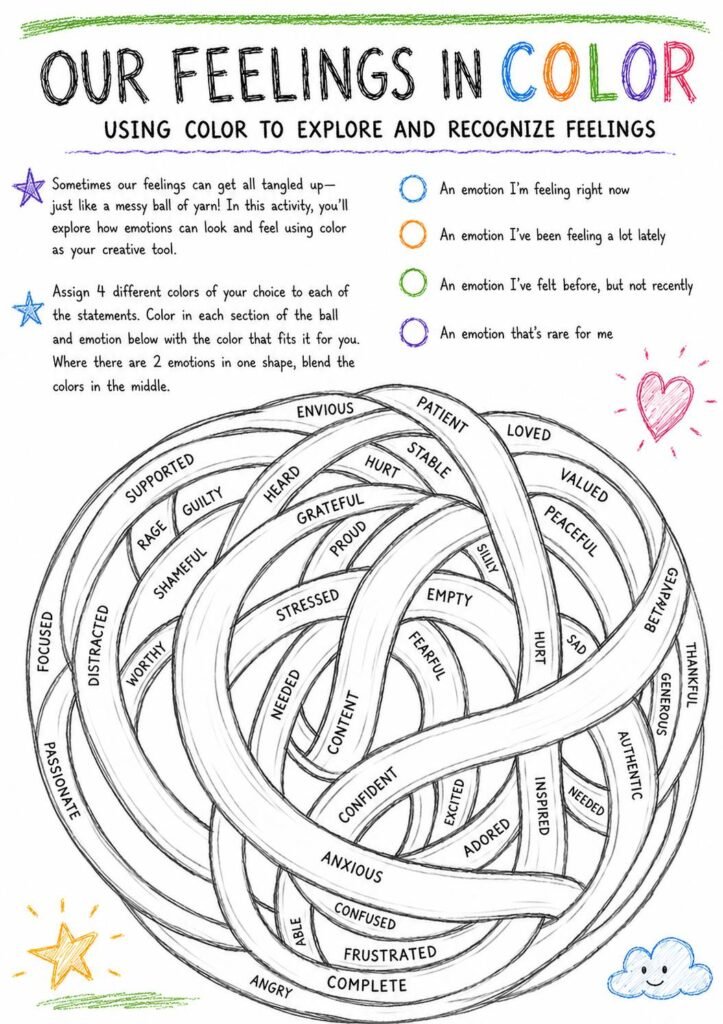
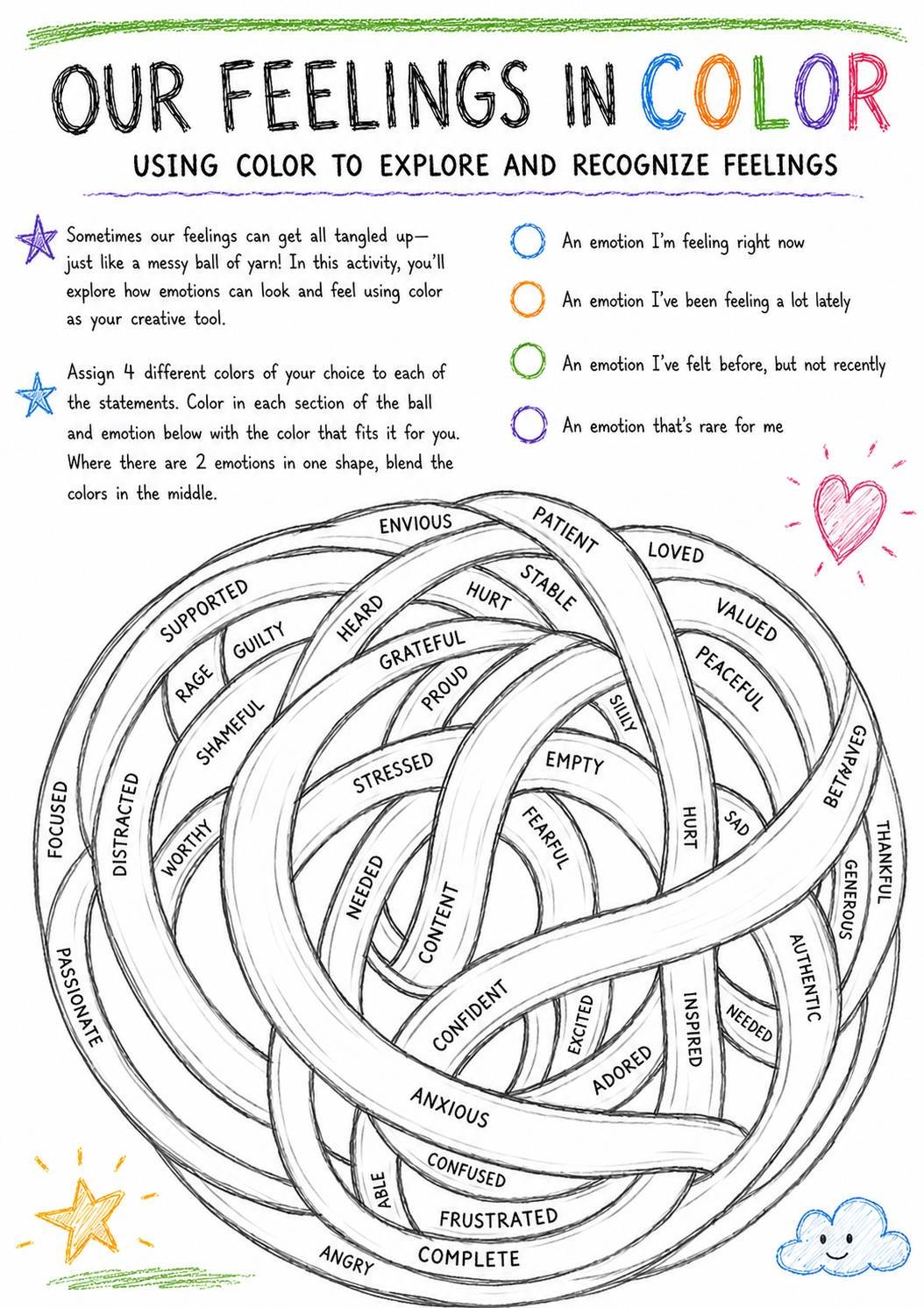
The worksheet below — Our Feelings in Color — is a free resource you can use with your child today. It is suitable for children aged approximately 6 to 12 and works equally well at home, in school, or in a clinical setting. It is concrete, visual, non-threatening, and designed to open a conversation rather than close one.
The premise is simple. The child is presented with a large tangled ball of yarn shapes, each labelled with a different emotion. They choose four colours — one for a feeling they are experiencing right now, one for a feeling they have been experiencing a lot lately, one for a feeling they have felt before but not recently, and one for a feeling that is rare for them. They colour each section of the ball accordingly. Where two emotions share a shape, they blend the colours.
What makes this a genuinely effective kids emotional regulation worksheet is not the colouring on its own. It is what the colouring makes possible. A child who has worked through the ball has already done the emotional mapping — quietly, without pressure, on their own terms. The adult’s job afterwards is simply to be curious about what they find.
How to Use It
Sit with your child and place the worksheet between you. Introduce it simply and without clinical language: “This is a feelings ball — like a big ball of yarn all tangled up. Inside it are lots of different feelings. We are going to give each feeling a colour and find out what is in your ball today.”
Go through the four colour categories together. Give your child time to look at each emotion word and decide where it belongs. Do not correct or redirect — there are no wrong answers, and the answers that surprise you are often the most useful ones. Some children will work quickly. Others will need to sit with a word for a moment before they can place it. Both are fine.
Once the ball is coloured, explore it together:
• Which colour appears most often?
• Was there any feeling that surprised you — one you didn’t expect to find?
• Is there a feeling in there you would like less of?
• Is there one you would like more of?
The most important thing is not the answers. It is the quality of attention you bring to hearing them.
For Deeper Work: The Play Therapy Toolbox
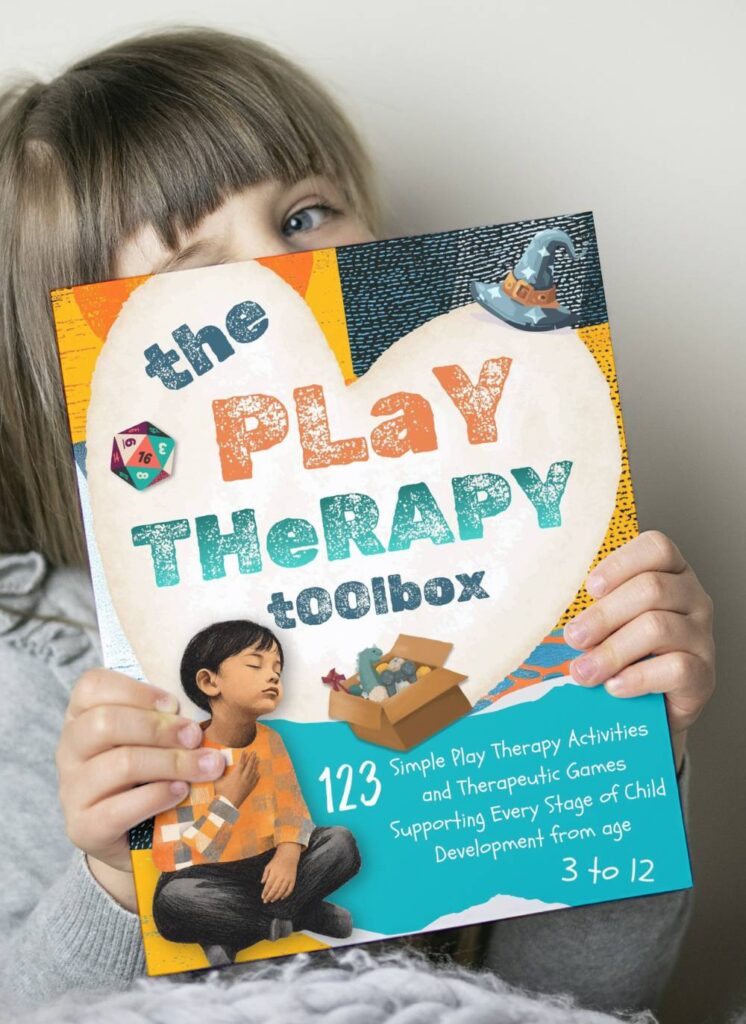
Our Feelings in Color is a strong standalone tool. But if you are looking for a more comprehensive and clinically grounded resource — something that covers every major presenting need from ages 3 to 12, with activities that grow with the child and are grounded in decades of developmental research — that is what The Play Therapy Toolbox: 123 Simple Play Therapy Activities and Therapeutic Games Supporting Every Stage of Child Development from Age 3 to 12 was built to provide.
The book contains 123 activities spanning role-play, enactment, fantasy storytelling, somatic exercises, gamified experiences, and carefully designed worksheets that address emotional regulation at every developmental stage. Each activity comes with a therapeutic rationale drawn from peer-reviewed research, step-by-step guidance, questions to use with the child, and a parent guidance note written in the same plain, warm, practical language as this article.
The activities grow with the child. A three-year-old and an eleven-year-old are both navigating big feelings — but the way in, the language, and the emotional depth of the tool need to be completely different. The book is built around that understanding, with dedicated chapters for each age group and a comprehensive annex that lets you navigate directly to the right activity for the right child at the right moment.
Three Things Worth Knowing Before You Begin
The worksheet is the door, not the destination
Any kids emotional regulation worksheet — including this one — is most powerful when it opens a conversation rather than substituting for one. Stay curious, stay unhurried, and let the child lead.
Regular use builds more than crisis use
Emotional regulation tools work best when used consistently rather than only in moments of overwhelm. A child who uses a feelings worksheet regularly — not because something is wrong, but as an ordinary part of their emotional life — builds vocabulary and self-awareness week by week. By the time something genuinely difficult arrives, the language is already there.
You are the most important tool in the room
Children learn emotional regulation primarily through co-regulation — through the experience of being alongside a calm, attuned adult whose nervous system offers theirs a reference point for safety. When you sit with your child and pick up a pencil yourself, you are not just modelling. You are offering your regulated presence as a resource. That, more than any worksheet, is what builds the skill over time.
Ready to Go Further?
If this free kids emotional regulation worksheet gave you a sense of what becomes possible when children are met in their own language — The Play Therapy Toolbox gives you 123 more tools built on the same foundation. The ebook is available now on Amazon at $5.99 for a limited time. It will provide you access to 123 activities and 75+ printable downloadable worksheets and resources in full colour.

Disclaimer: This article is intended as an educational and supportive resource for parents, caregivers, educators, and mental health professionals. It is not intended to diagnose, treat, or replace professional therapeutic or medical care. If a child is experiencing significant emotional, behavioural, or developmental difficulties, please seek guidance from a qualified mental health professional.

Rostislava Buhleva-Simeonova is a psychologist, art and play therapist, and gamificator. She has worked with children, adults, and the elderly within various therapeutic programmes over the past eight years, all the while providing the much-needed playful twist that art and gamified experiences can bring to this sometimes uneasy setting. But it wasn’t until the birth of her daughter, Aurora, that this work took on an even deeper personal meaning. With her academic and real-life experience, honed through numerous trainings and sessions, she is currently authoring books and articles in the field of child psychology and development, offering expertise in art and play therapy to guide parents and caregivers, as well as professionals in the fields of social work and mental health, throughout various pivotal moments in children’s lives. Last but not least, all of her books have been “peer-reviewed” by her daughter, who testifies to the efficiency of these methods.