
Every parent has had that moment — your child comes home from school and tells you, with a particular kind of quiet satisfaction, that they helped someone today. Not because they were asked to. Not because there was a reward attached. It is one of the most quietly extraordinary things a child can do — and one of the most developmentally significant. Because kindness, in children, is not simply a pleasant personality trait. It is a cognitive, emotional, and social achievement — one that requires empathy, perspective-taking, impulse regulation, and the capacity to hold another person’s experience alongside one’s own.
And it is also, as the research consistently shows, one of the most reliable contributors to a child’s own wellbeing. Children who regularly perform acts of kindness demonstrate measurably higher levels of happiness, stronger peer relationships, greater social acceptance, and more robust emotional resilience than those who do not. Kindness is not a sacrifice. It is, in the deepest sense, a gift the child gives to themselves as much as to anyone else.
A well-designed kindness worksheet for kids does not lecture about kindness or produce a list of instructions. It invites the child to discover — through reflection, through memory, through the specific and personal — what kindness feels like from the inside, and what it makes possible in the world around them.
What Kindness Actually Is in Child Development
Kindness is not the same as compliance, and it is not the same as conflict avoidance. At its developmental root, kindness is a prosocial behaviour — an action directed toward the wellbeing of another person — that requires genuine empathy: the capacity to feel something of what another person is feeling and to be moved by that feeling toward action.
This is a developmentally complex achievement. Genuine empathy — as distinct from emotional contagion, which is the automatic sharing of another person’s emotional state — requires theory of mind, the ability to distinguish one’s own emotional state from another’s, and the capacity to regulate one’s own emotional response sufficiently to focus on the other person’s need rather than being overwhelmed by the feeling itself. These capacities develop gradually across childhood, with the foundations laid in infancy and the full expression emerging across middle childhood and beyond.
What this means practically is that kindness cannot be effectively taught through instruction alone. A child who is told to be kind will not develop genuine kindness nearly as effectively as a child who has repeated, supported, emotionally grounded experiences of noticing another person’s need, choosing a response, and feeling the particular satisfaction — warm, specific, and distinctly different from any external reward — that genuine prosocial action produces. A kindness worksheet for kids that builds this internal experience is not simply a nice activity. It is a developmental tool.
The Ripple Effect — and Why Children Need to See It
One of the most therapeutically and developmentally significant aspects of the worksheet we are introducing today is its central metaphor: kindness does not simply travel from one person to another. It circulates. It comes back. It keeps moving forward. This is not wishful thinking — it is a well-documented social phenomenon. Research on prosocial behaviour consistently shows that witnessed kindness generates kindness in observers, that being the recipient of a kind act increases the likelihood of performing one, and that the effects of a single act of kindness can ripple through a social network in ways that extend far beyond the original transaction.
For children, making this visible is therapeutically important for several reasons. A child who understands that kindness circulates — that what they send out comes back, that their action is part of a larger pattern of social connection and mutual care — develops a relationship to prosocial behaviour that is qualitatively different from one based on compliance or external reward. They are not being kind because they were told to. They are being kind because they understand, at a level that is both cognitive and felt, that kindness is the mechanism through which the social world works best — and that they are an active participant in that mechanism.
This understanding is also a powerful contributor to a child’s sense of agency and significance. A child who believes that their actions matter — that what they do ripples outward in ways they cannot always see but can trust — is a child with a fundamentally different relationship to the social world than one who believes their actions are insignificant or unnoticed.
Free Kindness Worksheet for Kids: What Comes Around Goes Around
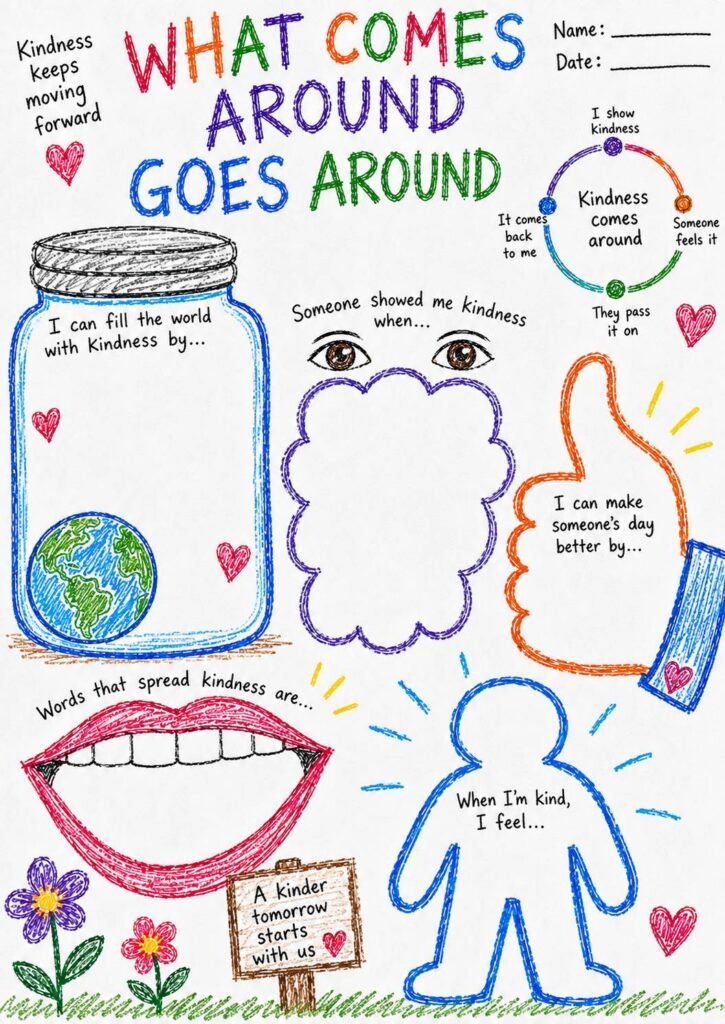
The worksheet below — What Comes Around Goes Around — is a free resource you can use with your child today. It is suitable for children aged approximately 6 to 12, and works equally well at home, in school, or in a therapeutic setting. It is colourful, visually rich, and structured around six distinct prompts that move the child through the full experience of kindness — as recipient, as giver, as participant in a larger cycle — and close with the internal dimension that matters most: how kindness feels from the inside.
What makes this one of the most effective kindness worksheets for kids is the combination of the personal and the systemic. The child is not simply asked to generate a list of kind acts. They are asked to remember a specific experience of receiving kindness, to name the words and actions through which they give it, to feel it in their body, and to see it as part of a cycle that extends beyond any single exchange. That combination — the particular and the universal, the felt and the conceptual — is what gives the exercise genuine therapeutic and developmental depth.
How to Use It
Place the worksheet in front of your child with a warm, open introduction — genuinely curious rather than instructional: “This is about kindness — not kindness in general, but your kindness specifically. The things you do, the words you use, and what it actually feels like inside when you’re kind. Let’s find out.” Then step back. Give the child time and space to engage without commentary or suggestion.
Work through the prompts at whatever pace the child sets. The someone showed me kindness when prompt deserves particular time and attention — because the specific, remembered experience of receiving kindness is both emotionally resonant and cognitively important: it anchors the abstract concept of kindness in real, personal, embodied experience, and it reminds the child that they have been on the receiving end of the cycle they are now participating in.
Once the worksheet is complete, explore it together with open, unhurried questions:
- Of all the ways you can fill the world with kindness, which one feels most like you?
- When someone showed you kindness — how did it change your day?
- Is there someone in your life who is particularly good at spreading kindness? What do they do?
- When you are kind, where in your body do you feel it?
- Is there a kindness you have been thinking about doing but haven’t done yet?
That last question is worth sitting with. A child who can name a kindness they have been thinking about but have not yet acted on — and who, in naming it, moves one step closer to doing it — has already experienced something of the gap between intention and action that is one of the most important things any person learns to navigate. The most important thing is not the answers. It is the quality of attention you bring to hearing them.
What the Research Says About Kindness and Children’s Wellbeing
The developmental and psychological research on kindness in children is considerably richer than popular discourse suggests — and considerably more surprising.
A landmark study by Sonja Lyubomirsky and colleagues found that children who performed three acts of kindness per week over four weeks showed significant increases in subjective wellbeing and, crucially, significant increases in peer acceptance and social likeability. The kindness did not only benefit the recipients. It transformed the social position of the child who gave it — not because they were performing kindness for social reward but because genuine prosocial behaviour generates genuine social warmth in those who witness and experience it.
Research on what is sometimes called the helper’s high — the positive emotional experience associated with prosocial action — shows that this effect is neurologically grounded: performing kind acts activates the brain’s reward circuitry in ways that are qualitatively similar to receiving a reward directly. The child who helps someone is not sacrificing their own pleasure in favour of another person’s. They are generating a specific and reliable form of pleasure that is available through no other means.
And research on the ripple effect of prosocial behaviour — showing that witnessed kindness increases the likelihood of subsequent kind behaviour in observers — suggests that a single child’s act of genuine kindness in a classroom or social group can shift the prosocial climate of that environment in ways that extend far beyond the original act. The cycle on the worksheet is not a motivational metaphor. It is a social fact.
For Deeper Work: The Play Therapy Toolbox
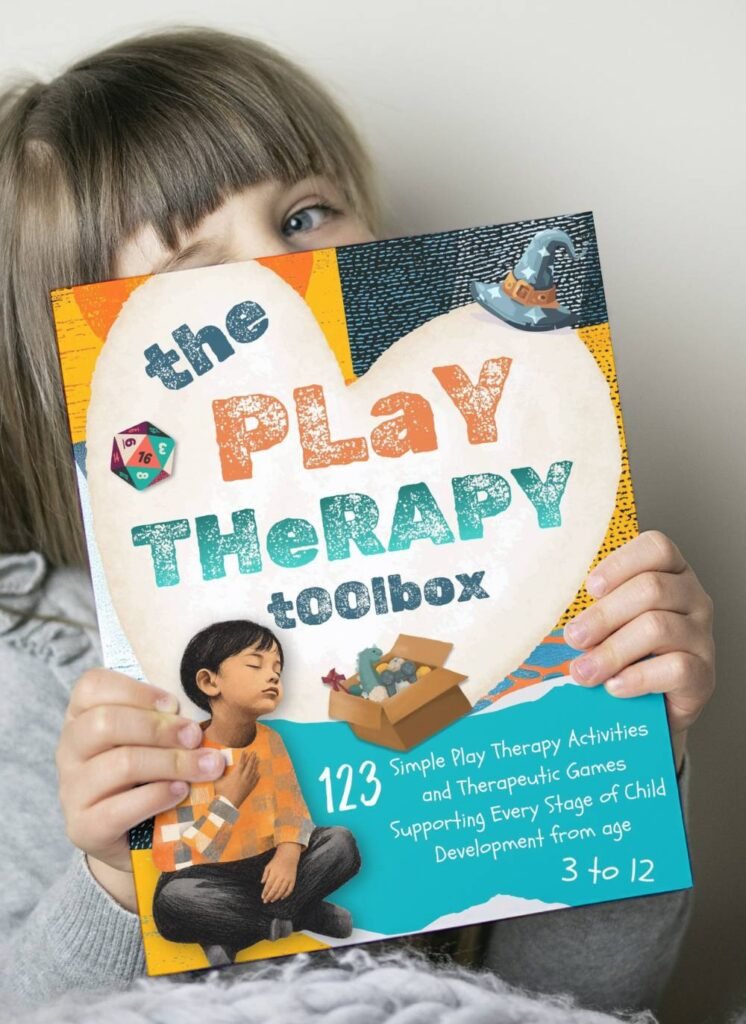
What Comes Around Goes Around is one example of the kind of prosocial, empathy-building, relationally focused tool that sits at the heart of The Play Therapy Toolbox: 123 Simple Play Therapy Activities and Therapeutic Games Supporting Every Stage of Child Development from Age 3 to 12 — a book built around the understanding that children speak in a language adults often forget they once spoke fluently themselves.
The book contains 123 activities spanning role-play, enactment, fantasy storytelling, somatic exercises, and gamified experiences, alongside 75+ printable, downloadable, full-colour worksheets designed to support and extend each activity. Every activity comes with a therapeutic rationale grounded in peer-reviewed research, step-by-step guidance on how to conduct the session and what to say, questions to use with the child, and a parent guidance note written in the same warm, accessible language as this article.
The social skills, empathy, and relational chapters address the full range of presentations children bring — social anxiety and withdrawal, difficulty with perspective-taking, aggression and social exclusion, the particular challenges of neurodivergent social processing, and the experience of navigating a social world that does not always model the kindness it asks children to demonstrate. Every activity is cross-referenced in a comprehensive annex by presenting condition, age group, and page number — so you can navigate directly to the right tool for the right child at the right moment, without searching.
Three Things Worth Knowing Before You Begin
Kindness must be felt, not just performed.
The best kindness worksheets for kids work from this position: the goal is not a list of kind behaviours but the internal experience of kindness — the specific, bodily, emotionally resonant feeling that genuine prosocial action produces. A child who has located that feeling and can recognise it has something far more durable than a set of instructions. They have an internal compass that will guide them toward kind action in situations no worksheet could have anticipated.
Receiving kindness is as important as giving it.
The “someone showed me kindness when” prompt is not a warm-up to the real exercise. It is one of the most therapeutically significant elements of the entire worksheet — because a child who cannot receive kindness, who deflects or minimises it or does not notice it arriving, is a child whose relationship to the kindness cycle is incomplete. Learning to receive kindness with openness and genuine recognition is a skill worth developing alongside the capacity to give it.
You are the most important tool in the room.
The worksheet maps the cycle. You are the reason the child believes they are part of it. Children develop genuine prosocial behaviour most reliably within the context of warm, attuned relationships with adults who model kindness — not as a performance or an instruction but as a natural, everyday expression of how they move through the world. Fill in your own worksheet. Share your own memory of receiving kindness. Let them see that the cycle includes you — and that a kinder tomorrow really does start with all of us.
Available Now for $5.99 — For a Limited Time
If this free kindness worksheet for kids gave you a sense of what becomes possible when children are helped to see themselves as active participants in the kindness that moves through the world around them, The Play Therapy Toolbox gives you 123 more tools built on the same foundation. The ebook is available now on Amazon at $5.99 for a limited time — with immediate access to 123 activities and 75+ full-colour printable worksheets for children aged 3 to 12.
Play is not preparation for life. It is life — in its most honest, most essential, most healing form.

Disclaimer: This article is intended as an educational and supportive resource for parents, caregivers, educators, and mental health professionals. It is not intended to diagnose, treat, or replace professional therapeutic or medical care. If a child is experiencing significant emotional, behavioural, or developmental difficulties, please seek guidance from a qualified mental health professional.

Rostislava Buhleva-Simeonova is a psychologist, art therapist, and gamificator. She has worked with children, adults, and the elderly within various therapeutic programmes over the past eight years, all the while providing the much-needed playful twist that art and gamified experiences can bring to this sometimes uneasy setting. But it wasn’t until the birth of her daughter, Aurora, that this work took on an even deeper personal meaning. With her academic and real-life experience, honed through numerous trainings and sessions, she is currently authoring books and articles in the field of child psychology and development, offering expertise in art and play therapy to guide parents and caregivers, as well as professionals in the fields of social work and mental health, throughout various pivotal moments in children’s lives. Last but not least, all of her books have been “peer-reviewed” by her daughter, who testifies to the efficiency of these methods.