
Every parent has had that moment — your child is struggling, shutting down, acting out, or simply unable to tell you what they need, and you are doing your best but wishing you had a little more to go on. The meltdown that came from nowhere. The long silence after something happened. The quieter worry at the end of the day, wondering whether you responded the right way. These moments do not mean you are failing. They mean you are paying attention. And paying attention is exactly where good parenting begins. This is also where a well formulated mood monster printable worksheet for kids can come in handy.
Why Monster Make Such Good Emotional Containers
There is nothing arbitrary about the monster as a therapeutic vehicle for children’s emotional work. They are creatures to whom enormous, untidy, complicated feelings can be attributed without any of the vulnerability that comes from claiming those feelings directly. A child who cannot say “I feel angry and sad and confused all at the same time” can very often draw a monster who feels exactly that — and in drawing it, begin to understand it.
This is the same principle that underpins sandtray therapy, art therapy, and narrative therapy: give the internal experience a form, externalise it into something visible and workable, and the thing that was overwhelming inside becomes something the child can look at from the outside. The monster is not a metaphor. It is a container. And a well-designed mood monster printable worksheet makes that container available to every child, without clinical expertise, without specialist materials, and without asking the child to do anything other than draw.
The Language Children Were Born Speaking
Children do not process the world the way adults do. They do not sit with a difficulty, name it, reflect on it, and arrive at a conclusion. They play it out. They draw it, build it, enact it, give it a character, send it on a journey, and let it resolve the way that stories resolve — through movement, through metaphor, through the particular safety of something that is real and not real at the same time. This is not avoidance. It is the most sophisticated emotional processing available to a developing mind.
The developing brain processes emotional experience through the right hemisphere long before the left hemisphere’s language centres are mature enough to put it into words. In early childhood, the limbic system is highly active while the prefrontal cortex — governing language, logic, and self-reflection — is still very much under construction. The feeling is enormous. The vocabulary is small. The gap between the two is precisely where play lives, and where tools like a mood monster printable worksheet do their most important work.
This is also why asking a child to “use their words” in a moment of genuine emotional overwhelm so often fails. In that moment, language is the part of the brain least available to them. When we offer a creative, visual, imaginative tool instead, we meet them where they actually are — not where we wish they were.
Free Mood Monster Printable Worksheet: My Mood Monster
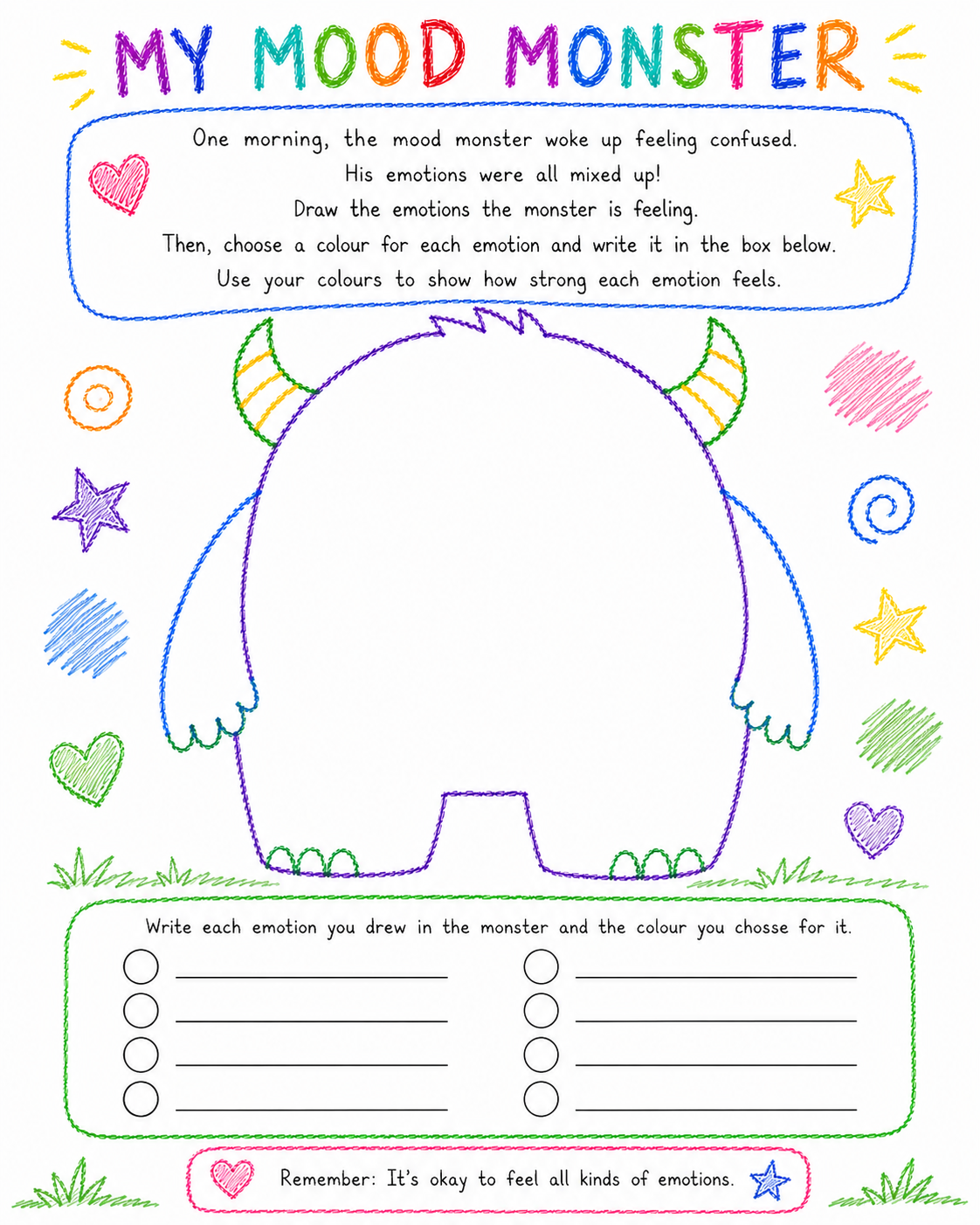
The worksheet below — My Mood Monster — is a free resource you can use with your child today. It is suitable for children aged approximately 5 to 10, and works equally well at home, in school, or in a therapeutic setting. It is colourful, inviting, and built around one of the most therapeutically effective mechanisms available to children: giving a difficult feeling a creature to live inside.
The premise is simple and immediately compelling. One morning, the mood monster woke up feeling confused — his emotions were all mixed up. The child’s task is to draw the emotions the monster is feeling inside his large, open body, then choose a colour for each emotion and record it in the key below. The size and intensity of the colour used shows how strong each feeling is.
A child who has filled their monster has already done the emotional mapping — quietly, without pressure, without exposure, and on their own terms. The monster holds the feeling first, so that the child does not have to hold it alone.
How to Use It
Sit with your child and place the worksheet between you. Introduce it simply, without clinical framing: “This is a mood monster — and this morning he woke up with all his feelings mixed up together. He needs some help figuring out what is in there. Shall we draw his feelings for him?”
Let the child lead entirely. Accept every emotion they choose for the monster without redirection. The feelings that surprise you are often the most useful ones — and the intensity a child gives a particular colour tells you something that a direct question rarely could.
Once the monster is filled in and the colour key is complete, explore it together with open, unhurried curiosity:
- Which feeling takes up the most space in the monster today?
- Is there a feeling in there that surprised you — one you didn’t expect to find?
- Does the monster ever feel more than one feeling at the same time? What is that like for him?
- Is there a feeling in there that you recognise — one that feels a little bit like yours?
That last question is offered gently, and never pressed. Some children will answer it immediately and with relief. Others will stay safely inside the monster’s experience and never claim the feelings as their own — and both are entirely right. The protective distance of the monster is not something to dismantle. It is what makes the exercise safe enough to be honest.
The most important thing is not the answers. It is the quality of attention you bring to hearing them.
This Worksheet and the Play Therapy Toolbox
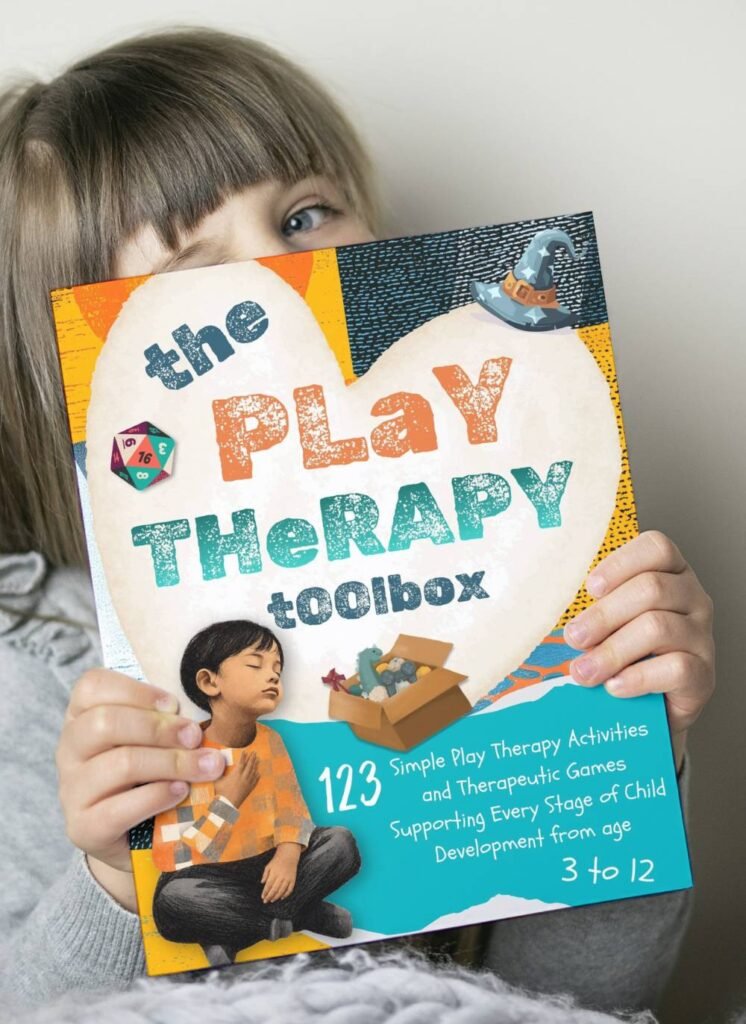
My Mood Monster is one example of the kind of tool that sits at the heart of The Play Therapy Toolbox: 123 Simple Play Therapy Activities and Therapeutic Games Supporting Every Stage of Child Development from Age 3 to 12 — a book built around the understanding that children speak in a language adults often forget they once spoke fluently themselves.
The book contains 123 activities spanning role-play, enactment, fantasy storytelling, somatic exercises, and gamified experiences, alongside 75+ printable, downloadable, full-colour worksheets designed to support and extend each activity. Every activity comes with a therapeutic rationale grounded in peer-reviewed research, step-by-step guidance on how to conduct the session and what to say, questions to use with the child, and a parent guidance note written in the same warm, accessible language as this article.
The activities are built around four dedicated chapters — one for Age 3, one for Ages 4–6, one for Ages 7–9, and one for Ages 10–12 — each opening with a developmental overview that traces the key milestones, common emotional challenges, and neurological realities most relevant to that stage. The worksheets increase in complexity, abstraction, and emotional depth as the child’s capacity grows. And a comprehensive annex cross-references all 123 activities by presenting condition, age group, and page number — so you can navigate directly to the right tool for the right child at the right moment, without searching.
Three Things Worth Knowing Before You Begin
The monster is the door, not the destination.
Any mood monster printable worksheet — including this one — is most powerful when it opens a conversation rather than substituting for one. The monster creates a safe distance from which a child can speak about feelings that would otherwise be too exposed to name directly. That distance is therapeutic, not evasive. Stay curious, stay unhurried, and let the child lead.
Regular use builds more than crisis use.
Emotional literacy tools work best when used consistently — not only in moments of visible struggle but as an ordinary, unhurried part of a child’s emotional life. A child who regularly maps their feelings, even on uneventful days, builds a vocabulary and a self-awareness that will be there and ready when something genuinely difficult arrives.
You are the most important tool in the room.
The monster is a container. You are the context. Children process emotional experience most effectively within the safety of a regulated, attuned relationship with a trusted adult — a relationship in which they have repeatedly experienced the felt sense that their feelings, however large or complicated, are welcome. When you sit beside your child, pick up a pencil, and draw your own monster, you are modelling emotional literacy and offering your presence as a steady anchor.
Available Now for $5.99 — For a Limited Time
If this free mood monsters printable worksheet gave you a sense of what becomes possible when children are met in their own language, The Play Therapy Toolbox gives you 123 more tools built on the same foundation. The ebook is available now on Amazon at $5.99 for a limited time — with immediate access to 123 activities and 75+ full-colour printable worksheets for children aged 3 to 12.
Play is not preparation for life. It is life — in its most honest, most essential, most healing form.
Disclaimer: This article is intended as an educational and supportive resource for parents, caregivers, educators, and mental health professionals. It is not intended to diagnose, treat, or replace professional therapeutic or medical care. If a child is experiencing significant emotional, behavioural, or developmental difficulties, please seek guidance from a qualified mental health professional.


Rostislava Buhleva-Simeonova is a psychologist, art and play therapist, and gamificator. She has worked with children, adults, and the elderly within various therapeutic programmes over the past eight years, all the while providing the much-needed playful twist that art and gamified experiences can bring to this sometimes uneasy setting. But it wasn’t until the birth of her daughter, Aurora, that this work took on an even deeper personal meaning. With her academic and real-life experience, honed through numerous trainings and sessions, she is currently authoring books and articles in the field of child psychology and development, offering expertise in art and play therapy to guide parents and caregivers, as well as professionals in the fields of social work and mental health, throughout various pivotal moments in children’s lives. Last but not least, all of her books have been “peer-reviewed” by her daughter, who testifies to the efficiency of these methods.