
Every parent has watched impatience arrive in a child before the child has had any chance to manage it. The turn that has not come. The journey that is taking too long. The gap between wanting something and having it that, to a child’s developing nervous system, can feel less like a manageable delay and more like an unbearable injustice. The meltdown that follows is not a character flaw, and it is not a parenting failure. It is a developmentally predictable collision between a child’s genuine desire and a prefrontal cortex that is still actively constructing the capacity to wait.
Patience is not a personality trait. It is a skill — one that develops gradually across childhood, requires neurological maturation alongside deliberate practice, and is significantly more teachable than the popular view of it as something children either have or lack tends to suggest. And a well-designed patience worksheet for kids does not simply ask a child to try harder next time. It builds the specific awareness — of triggers, of body signals, of evidence that waiting is sometimes worth it — that makes the trying actually possible.
What Patience Actually Is in the Developing Brain
The capacity to wait — to tolerate the gap between impulse and gratification without becoming overwhelmed by it — is one of the most reliably predictive developmental capacities in all of child psychology. The original marshmallow studies by Walter Mischel, conducted at Stanford in the late 1960s, found that preschool children who could delay gratification for longer periods showed better outcomes across virtually every domain measured at follow-up — academic achievement, social competence, resilience under stress, and long-term wellbeing — than those who could not. Subsequent research has refined and complicated this picture, but the core finding — that the capacity to wait is one of the strongest early predictors of positive life outcomes — has proven remarkably durable.
What the patience research also confirms is that the capacity to delay gratification is not fixed. It is developed — through the combination of neurological maturation and the deliberate, supported practice of the specific cognitive and emotional strategies that make waiting manageable. A child who learns to notice what their body does when they are impatient, who can identify what they are waiting for and why it matters, and who has a repertoire of calming strategies to deploy in the waiting — that child is building a fundamentally different relationship to the experience of delay than one who has never been helped to examine it.
The prefrontal cortex — the brain region responsible for impulse control, planning, and the ability to hold a future goal in mind while tolerating a present discomfort — does not complete its development until the mid-twenties. Children are being asked to be patient with a regulatory tool that is still very much under construction. A patience worksheet for kids that makes the experience of impatience visible, specific, and workable is not asking the child to do something they are neurologically incapable of. It is building the specific capacities — self-awareness, body awareness, evidence-based reflection — that give the developing prefrontal cortex something to work with.
Free Patience Worksheet for Kids: My Patience…In Progress
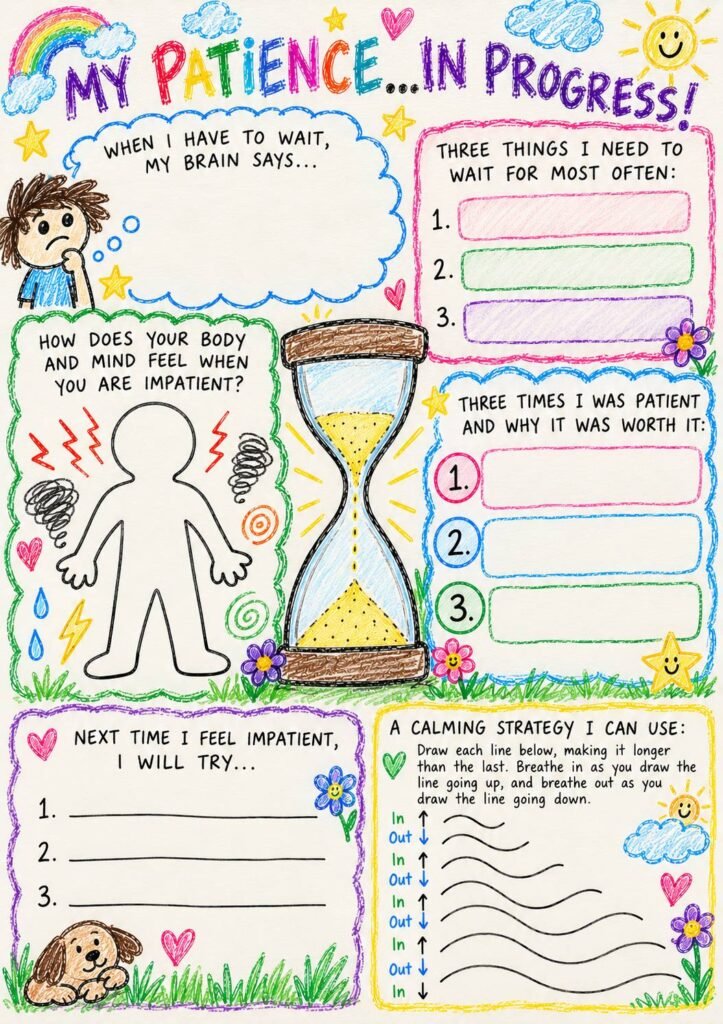
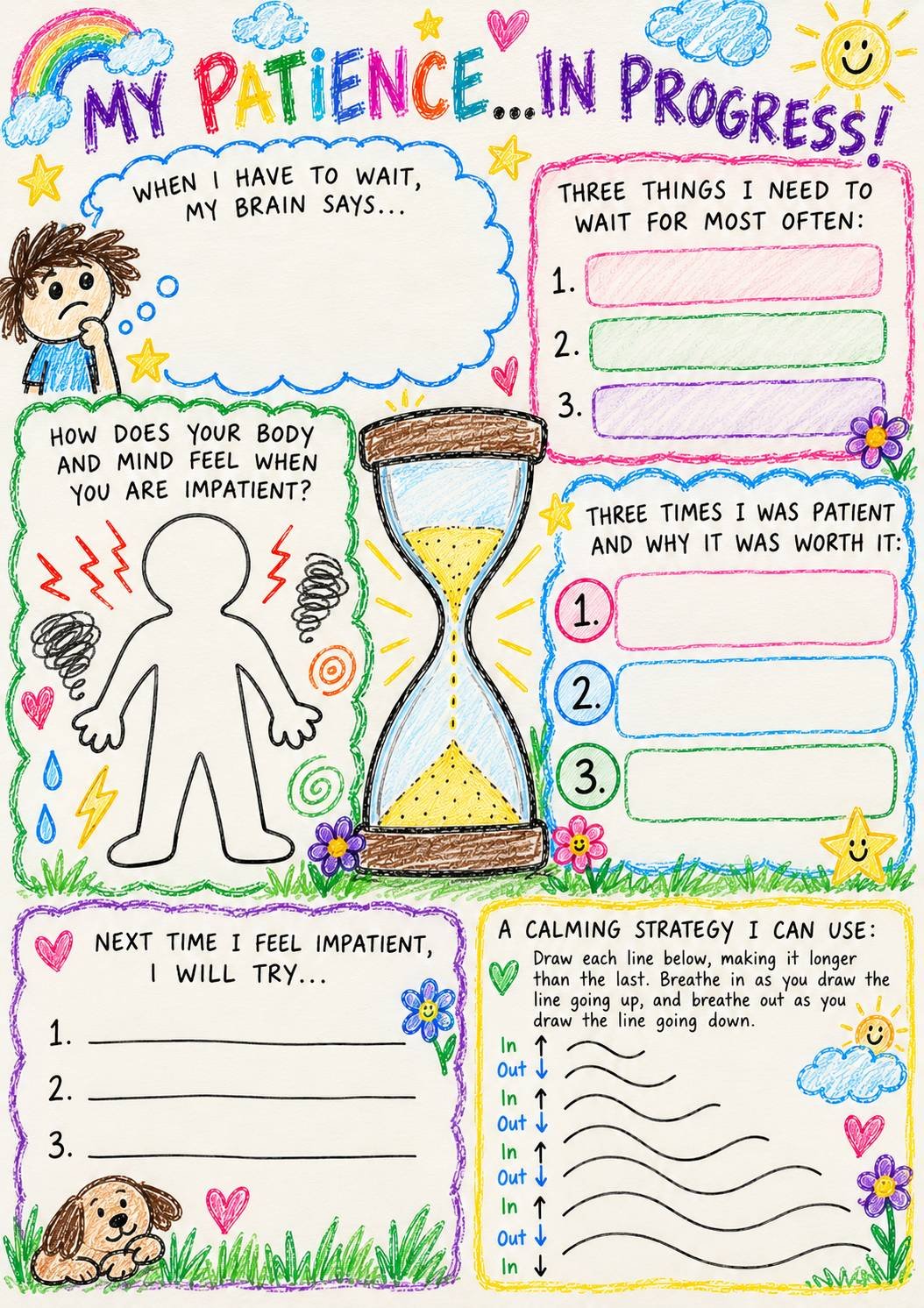
The worksheet below — My Patience…In Progress — is a free resource you can use with your child today. It is suitable for children aged approximately 6 to 12, and works equally well at home, in school, or in a therapeutic setting. It is colourful, visually engaging, and built around five distinct sections that together constitute one of the most complete patience and impulse control exercises available in a single worksheet.
The title itself is therapeutically significant. In progress rather than achieved positions patience not as a standard to be met but as a capacity being developed — which is both neurologically accurate and significantly more compassionate than the framing children most often receive around this difficulty.
How to Use It
Introduce the worksheet during a calm moment — not in the middle of or immediately after an episode of impatience, when shame is likely to be highest and genuine reflection least available. A warm, non-punitive introduction works best: “This worksheet is called My Patience…In Progress — because patience is something everyone is working on, including grown-ups. Let’s figure out how your particular patience works.”
Give the child time and space to complete each section without direction or evaluation. The body outline section in particular deserves uninterrupted time — how the child marks the figure, which symbols they choose, which parts of the body they indicate, all carry information worth holding gently.
Once the worksheet is complete, explore it together with open, unhurried questions:
- Of the three things you wait for most often, which one is hardest — and what makes it hardest?
- When you look at the body outline, which feeling do you notice first when you have to wait?
- Of the three times you were patient, which one surprised you most — the one you didn’t expect to be able to do?
- Of the three strategies you wrote for next time, which one do you think you’ll actually reach for?
- When you do the breathing exercise, where in your body do you notice it helping?
That last question is worth sitting with — because a child who can locate where the calming strategy has its effect has built the body awareness that makes the strategy genuinely available in the moment rather than only in the worksheet.
The most important thing is not the answers. It is the quality of attention you bring to hearing them — and the consistent message that impatience is not a character flaw but a developmental challenge that everyone is working on, and that the child in front of you is already, by filling in this worksheet, doing exactly that work.
For Deeper Work: The Play Therapy Toolbox
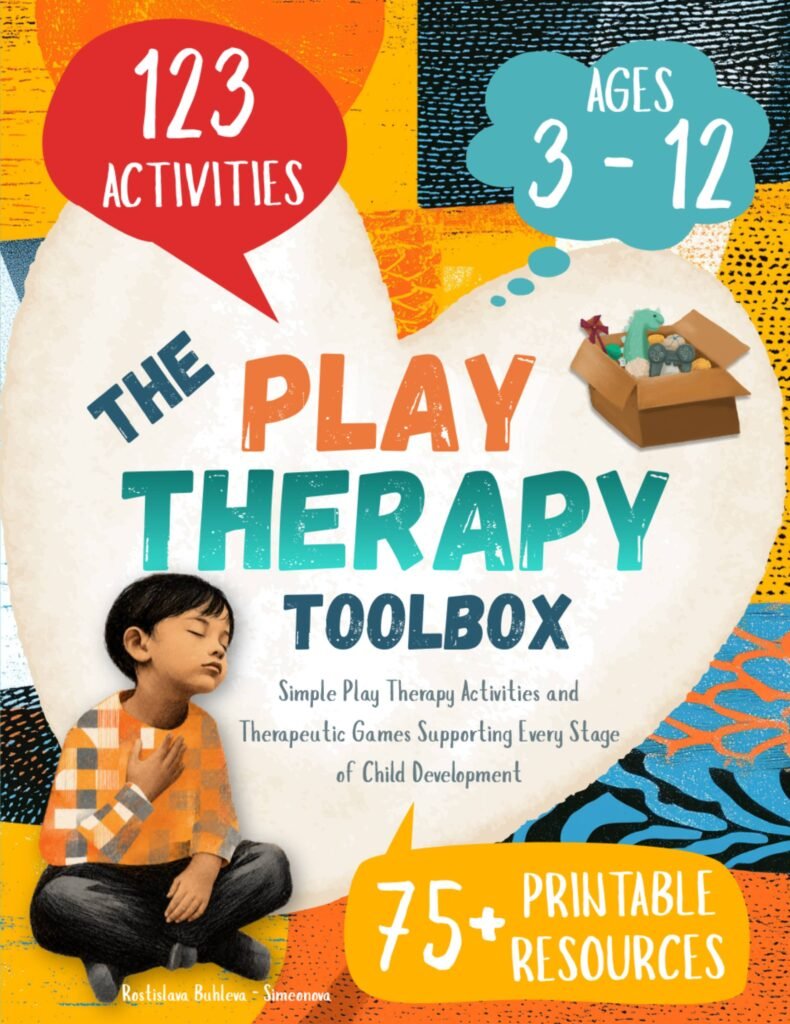
My Patience…In Progress is one example of the kind of self-regulation-building, impulse-control-developing, body-awareness-centred tool that sits at the heart of The Play Therapy Toolbox: 123 Simple Play Therapy Activities and Therapeutic Games Supporting Every Stage of Child Development from Age 3 to 12 — a book built around the understanding that children develop regulatory capacity not through instruction but through the structured, supported, experiential practice of noticing, naming, and working with their own inner states.
The book contains 123 activities spanning role-play, enactment, fantasy storytelling, somatic exercises, and gamified experiences, alongside 75+ printable, downloadable, full-colour worksheets designed to support and extend each activity. Every activity comes with a therapeutic rationale grounded in peer-reviewed research, step-by-step guidance on how to conduct the session and what to say, questions to use with the child, and a parent guidance note written in the same warm, accessible language as this article.
The emotional regulation and impulse control chapters address the full range of what patience difficulties look like in children: the child whose nervous system is genuinely more reactive than average, the one whose impatience has been reinforced by environments that consistently gave way to it, the one with ADHD or sensory differences for whom waiting is neurologically more demanding than it is for most, and the one who has simply never been helped to build the specific awareness and strategy repertoire that the experience of waiting requires. Every activity is cross-referenced in a comprehensive annex by presenting condition, age group, and page number — so you can navigate directly to the right tool for the right child at the right moment, without searching.
Before You Begin: A Note on Professional Support
Before attempting any impulse control or emotional regulation activities at home with a child whose impatience is significantly impairing their daily functioning or relationships, I would sincerely recommend consulting a qualified mental health professional. Where patience difficulties are accompanied by significant distress, frequent meltdowns, or presentations consistent with ADHD or other neurodevelopmental differences, professional assessment is essential.
Three Things Worth Knowing
Patience is a skill, not a personality trait.
The most important reframe any adult can offer a child who struggles with patience is this: not being able to wait easily is not a sign of who you are. It is a sign of where your regulatory development currently sits — and regulatory development is something that changes with practice, with support, and with the specific kind of deliberate awareness-building that this worksheet provides. A child who understands that patience is in progress — not absent, not failed, but actively developing — has a fundamentally different relationship to their own difficulty than one who has been told, explicitly or implicitly, that they simply lack self-control.
Evidence from the past is the best preparation for the future.
The three times I was patient section is the most therapeutically significant part of the worksheet — and the one most likely to be rushed. Give it proper time. The child who can name three specific instances of their own patience has built something that no amount of instruction or encouragement can provide: the internal evidence that they have already done the thing that feels impossible. That evidence is available to them in the next moment of impatience — not as an abstract reassurance but as a specific, remembered, personally verified fact. You have waited before. You know what it felt like when it was worth it.
You are the most important tool in the room.
The worksheet builds the awareness. You are the co-regulatory presence that makes the awareness feel safe. A child who is working on patience alongside an adult who is themselves regulated, warm, and genuinely curious about the child’s experience — rather than frustrated by it, or anxious about it, or rushing through the exercise to get to the solution — is receiving the most powerful patience-building intervention available. The worksheet is the structure. Your steady, unhurried presence is what makes the structure therapeutic rather than simply instructional.
Available Now for $5.99 — For a Limited Time
If this free patience worksheet for kids gave you a sense of what becomes possible when children are helped to understand their own impatience rather than simply manage its consequences, The Play Therapy Toolbox gives you 123 more tools built on the same foundation. The ebook is available now on Amazon at $5.99 for a limited time — with immediate access to 123 activities and 75+ full-colour printable worksheets for children aged 3 to 12.
Play is not preparation for life. It is life — in its most honest, most essential, most healing form.

Disclaimer: This article is intended as an educational and supportive resource for parents, caregivers, educators, and mental health professionals. It is not intended to diagnose, treat, or replace professional therapeutic or medical care. If a child is experiencing significant emotional, behavioural, or developmental difficulties, please seek guidance from a qualified mental health professional.

Rostislava Buhleva-Simeonova is a psychologist and game design specialist. She has worked with children, adults, and the elderly within various therapeutic programmes over the past eight years, all the while providing the much-needed playful twist that art and gamified experiences can bring to this sometimes uneasy setting. But it wasn’t until the birth of her daughter, Aurora, that this work took on an even deeper personal meaning. With her academic and real-life experience, honed through numerous trainings and sessions, she is currently authoring books and articles in the field of child psychology and development, offering expertise in art and play therapy to guide parents and caregivers, as well as professionals in the fields of social work and mental health, throughout various pivotal moments in children’s lives. Last but not least, all of her books have been “peer-reviewed” by her daughter, who testifies to the efficiency of these methods.