
Self-care is not a concept that belongs only to adults. It is a developmental capacity — the ability to recognise one’s own needs, to treat those needs as legitimate, and to take some active role in meeting them. And like every developmental capacity worth building, it does not emerge automatically. It needs to be taught, modelled, and practised — ideally through the medium that children find most natural and most honest: play, drawing, and imaginative reflection.
A well-designed self care worksheet for kids does not teach a child to recite a list of self-care strategies. It asks them something more fundamental and more revealing: if you could give yourself anything in the world — real or imaginary — what would it be, and why?
What Self-Care Actually Means for Children
Self-care in childhood is not bubble baths and early bedtimes, though both have their place. At its developmental root, self-care is the capacity for self-compassion — the ability to treat oneself with the same warmth, patience, and concern that one would extend to a friend in difficulty. This capacity does not come naturally to many children, and for good reason: most of what children are taught about care is directed outward. Share with others. Be kind. Think about how your actions affect the people around you.
All of this is important. But it leaves a gap — a developmental blind spot in which the child learns to attend to every emotional need in their environment except their own. A child who has never been asked what they need, who has never been invited to treat their own wellbeing as a legitimate priority, gradually internalises the belief that it is not one.
Erik Erikson’s framework of industry versus inferiority captures something of this dynamic: the child who has not developed a secure sense of their own worth and capability defaults, under pressure, to inferiority — to the belief that what they bring is not enough, that their needs are not important, that asking for what they need is somehow a risk not worth taking. A self care worksheet for kids used consistently and with genuine curiosity begins to address this at its root — not by telling the child that their needs matter, but by asking them to identify what those needs are, and discovering through the process that the question itself was worth asking.
The Language Children Were Born Speaking
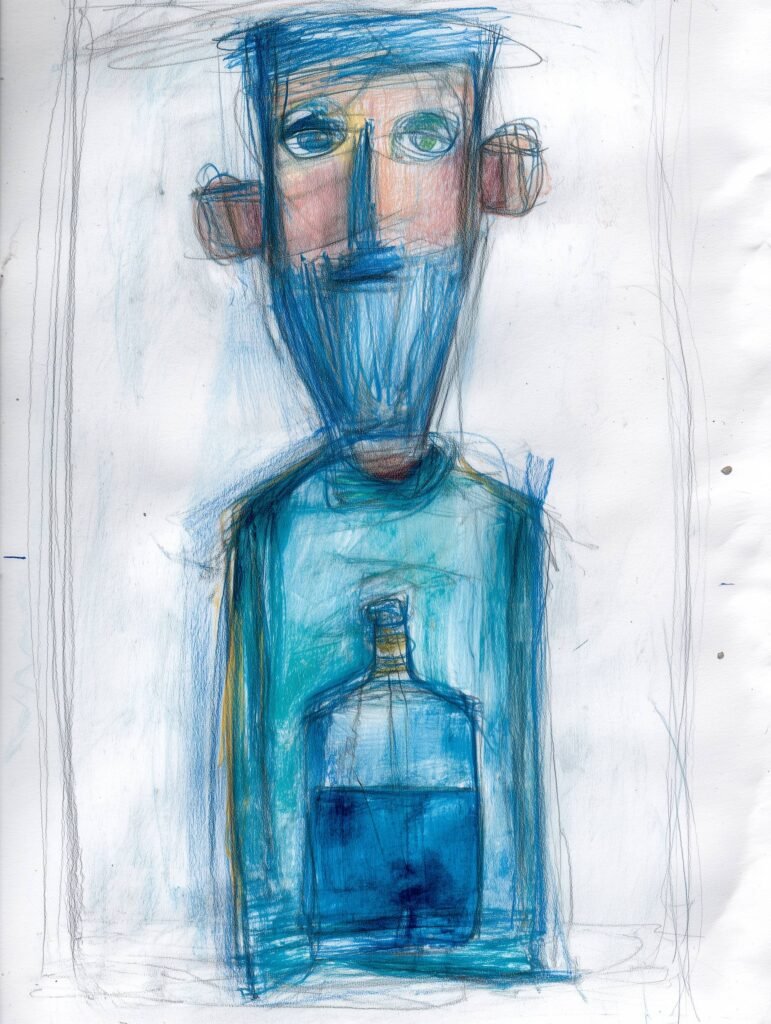
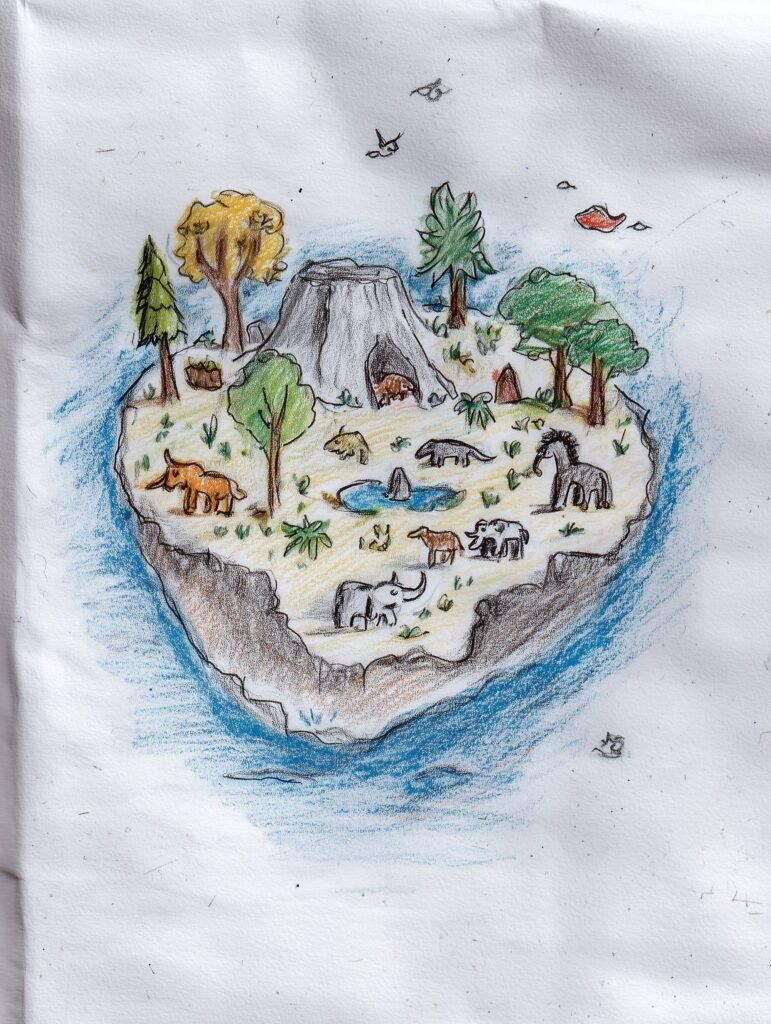
Children do not access self-compassion through instruction. They access it through imagination — through the creative, playful, slightly sideways approach to inner experience that is the hallmark of childhood emotional processing. Ask a child directly “what do you need right now?” and the question may feel too large, too exposing, too closely related to admitting that something is wrong. Ask them “if you could give yourself any gift in the world, what would it be?” and something entirely different becomes possible.
The gift frame is therapeutically elegant precisely because it is not asking about needs at all — at least not on the surface. It is asking about wishes, about imagination, about the pleasures and comforts and experiences the child finds most compelling. And yet the answers it produces are almost always deeply revelatory of what the child actually needs, expressed in the protective language of wanting rather than lacking.
The developing brain processes emotional experience through the right hemisphere long before the left hemisphere’s language centres are mature enough to name it directly. A self care worksheet for kids built around drawing, imagining, and reflecting — rather than answering clinical questions about emotional needs — honours this completely. It meets the child where they are, in the language that is most natural to them, and lets the real answer emerge from within the imaginative frame rather than being demanded of it.
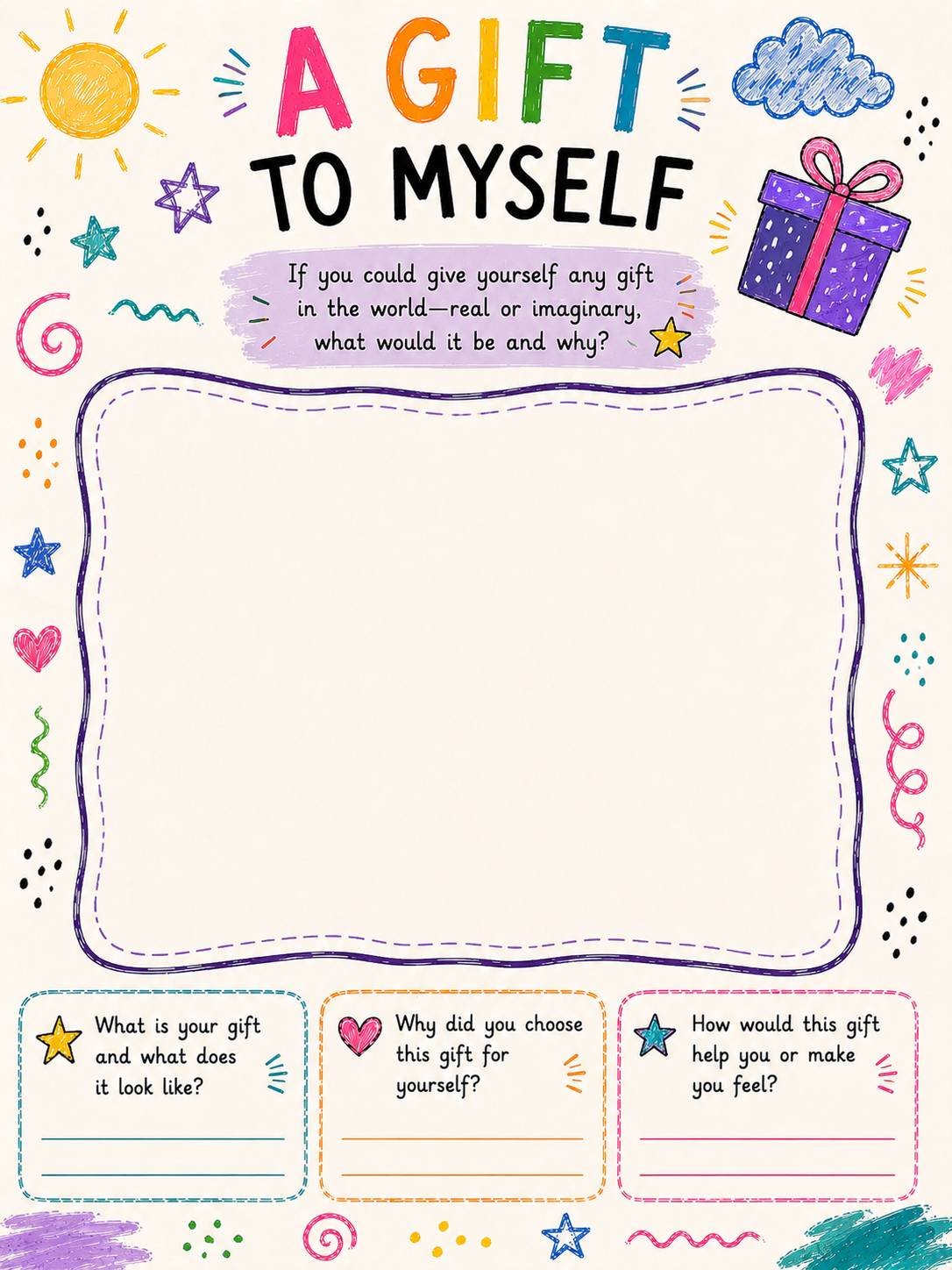
Free Self-Care Worksheet for Kids: A Gift to Myself
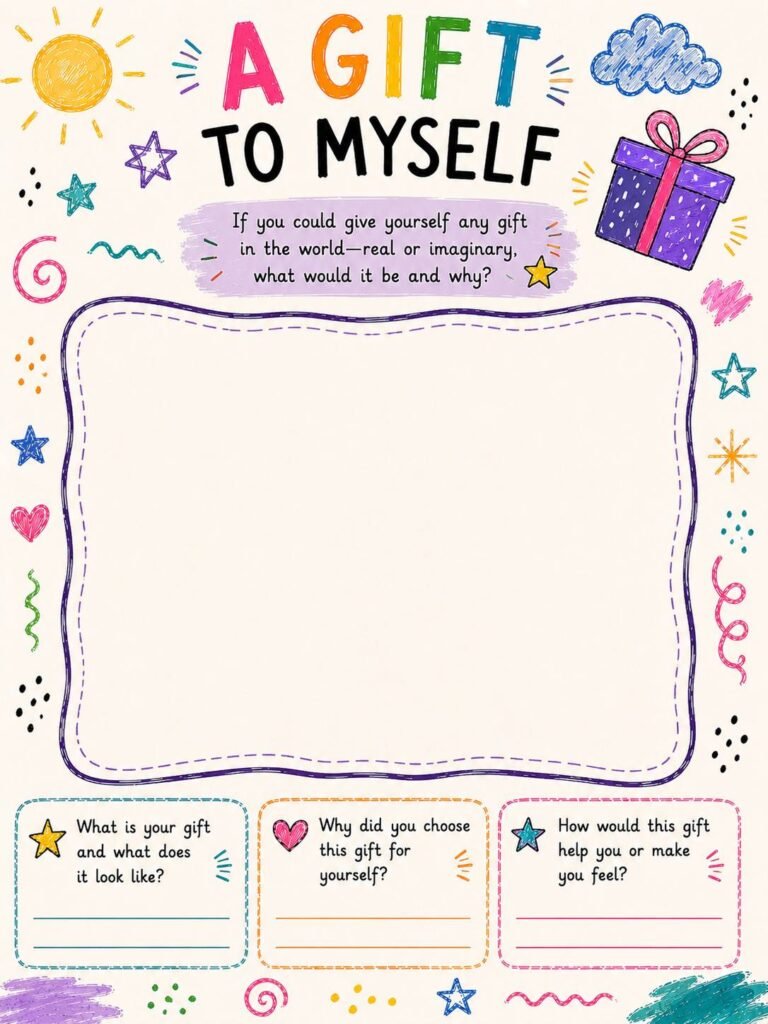
The worksheet below — A Gift to Myself — is a free resource you can use with your child today. It is suitable for children aged approximately 4 to 12, and works equally well at home, in school, or in a therapeutic setting. It is warm, inviting, and built around a single question so open and so genuinely curious that the child’s answer almost always surprises both of them: if you could give yourself any gift in the world — real or imaginary — what would it be and why?
What makes this one of the most effective self care worksheets for kids is the cumulative effect of the three questions it asks. A child who has drawn their gift, described it, explained why they chose it for themselves specifically, and articulated how it would help them or make them feel has — without any clinical framing and without any sense of being assessed — produced a detailed, honest account of what they need. That account is far more therapeutically useful than a direct answer to a direct question, because it was arrived at freely, imaginatively, and entirely on the child’s own terms.
How to Use It
Place the worksheet in front of your child with a warm, open introduction — genuinely curious rather than instructional: “This is one of my favourite questions. If you could give yourself any gift in the world — anything at all, real or made-up — what would you choose? Draw it here, exactly as you imagine it.” Then step back. Give the child time and space to draw and reflect without commentary or suggestion. The drawing phase is not a warm-up to the real activity — it is the real activity. What the child draws, how they draw it, what they include and what they leave out — all of it is information worth holding gently. You can prompt with gentle open-ended questions if needed, but do not try to direct the course of the session or tell the child what it should or should not draw.
Once the drawing is complete and the three prompts are answered, explore the gift together with open, unhurried curiosity:
- Tell me about your gift — what is happening in there?
- Why did you choose this for yourself specifically — not for anyone else, just for you?
- Is there something about this gift that you already have a little bit of, somewhere in your life?
- If you couldn’t have the exact gift, what is the smallest version of it you could give yourself today?
- Is there someone in your life who helps you feel the way this gift would make you feel?
That fourth question is worth sitting with. A child who can identify the smallest version of what they need — the quiet ten minutes, the particular person they want to sit next to, the single thing that makes the day feel more manageable — has already begun to move from recognising a need to taking some active role in meeting it. That movement, however small, is the beginning of genuine self-care.
The most important thing is not the answers. It is the quality of attention you bring to hearing them.
For Deeper Work: 101 Art Therapy Exercises for Children
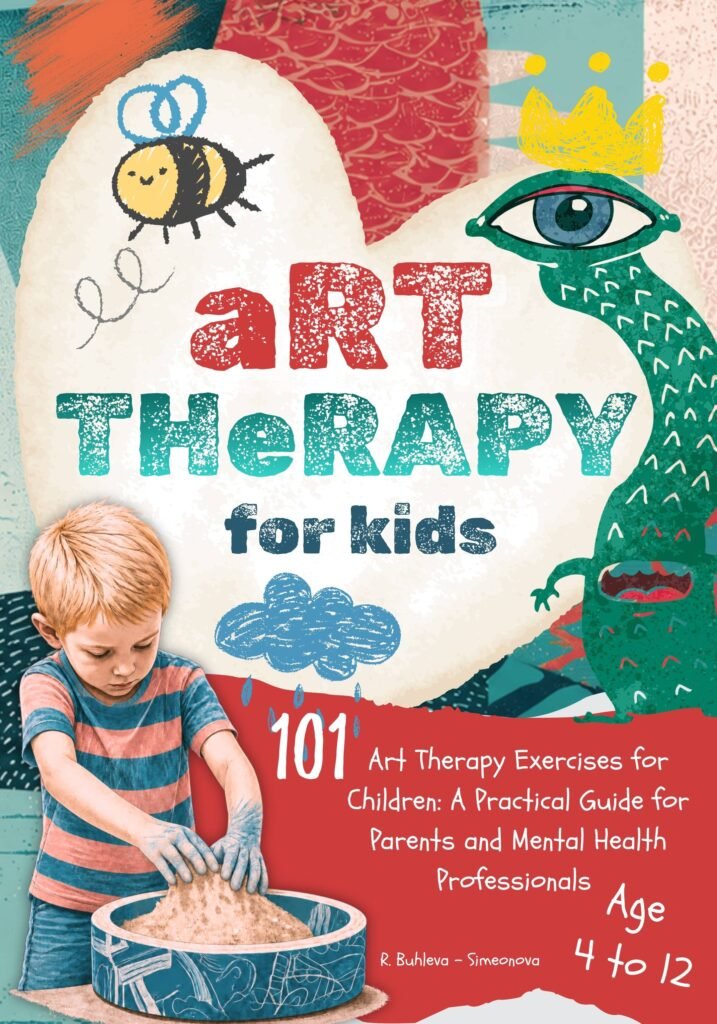
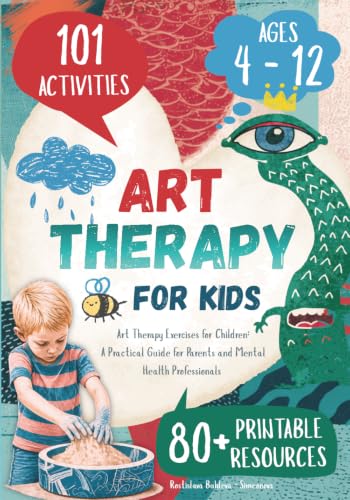
A Gift to Myself is one example of the kind of self-compassion-centred, emotionally reflective tool that sits at the heart of 101 Art Therapy Exercises for Children: A Practical Guide for Parents and Mental Health Professionals — a book built around the understanding that healing, growth, and genuine self-understanding often begin not with words, but with a simple mark on paper.
The book contains 101 art therapy exercises structured across three age groups — 4 to 6, 7 to 9, and 10 to 12 — each activity informed by validated research demonstrating how creative engagement alters brain physiology, strengthens neural flexibility, and enhances emotional regulation. Every session comes with a clear therapeutic rationale, step-by-step guidance, reflection questions, and guidance on how to observe and respond to what emerges — without diagnosis, without pressure, and without losing sight of the child as the author of their own experience.
The book serves a dual function: it is both a therapeutic toolkit and a preventative resource. Rather than waiting for emotional or behavioural difficulties to escalate before responding, the activities provide a proactive, ongoing means of supporting emotional processing — giving parents, educators, and professionals gentle, non-intrusive methods to stay attuned to a child’s inner world over time. Many exercises invite the caregiver to participate alongside the child — because shared creative experience is itself one of the most reliable builders of the trust and attunement that make conversations about needs, wishes, and self-care genuinely possible.
Three Things Worth Knowing Before You Begin
The gift is always about something real.
The best self care worksheets for kids work from this position: the gift a child imagines for themselves — however fantastical, however far from the possible — is always pointing toward something genuine. A wish is not simply a wish. It is a window. Receive whatever appears in the drawing space with genuine interest.
Regular use builds more than crisis use.
Self-compassion is not a skill that arrives fully formed in a moment of need. It is built through the patient, consistent accumulation of experiences in which the child is invited to attend to their own needs — to treat those needs as legitimate, to practise the gentle, curious attention toward themselves that we so readily extend to others. A self care worksheet for kids used as an ordinary, unhurried part of emotional life — not only when something is visibly wrong — builds this capacity gradually and durably.
You are the most important tool in the room.
Children develop the capacity for self-compassion primarily through the experience of being treated with compassion by the adults who matter most to them — through the repeated, specific, genuine experience of having their needs noticed, taken seriously, and met with warmth rather than dismissal. Fill in your own worksheet. Draw your own gift. Let them see that even grown-ups have things they need — and that naming those needs is not weakness. It is the beginning of knowing how to help yourself.
Ready to Go Further?
If this free self care worksheet for kids gave you a sense of what becomes possible when children are invited to attend to their own inner world with the same curiosity and warmth they extend to everyone else, 101 Art Therapy Exercises for Children: A Practical Guide for Parents and Mental Health Professionals gives you 101 more tools built on the same foundation — grounded in neuroscience, informed by developmental research, and written for every adult who has ever sat beside a child and wished they had something more to offer than words.
Disclaimer: This article is intended as an educational and supportive resource for parents, caregivers, educators, and mental health professionals. It is not intended to diagnose, treat, or replace professional therapeutic or medical care. If a child is experiencing significant emotional, behavioural, or developmental difficulties, please seek guidance from a qualified mental health professional.

Rostislava Buhleva-Simeonova is a psychologist, art therapist, and gamificator. She has worked with children, adults, and the elderly within various therapeutic programmes over the past eight years, all the while providing the much-needed playful twist that art and gamified experiences can bring to this sometimes uneasy setting. But it wasn’t until the birth of her daughter, Aurora, that this work took on an even deeper personal meaning. With her academic and real-life experience, honed through numerous trainings and sessions, she is currently authoring books and articles in the field of child psychology and development, offering expertise in art and play therapy to guide parents and caregivers, as well as professionals in the fields of social work and mental health, throughout various pivotal moments in children’s lives. Last but not least, all of her books have been “peer-reviewed” by her daughter, who testifies to the efficiency of these methods.