
Every parent has had that moment. Your child looks at something they made and says it is not good enough. They hang back at the edge of a group, certain they do not belong. They brush off a compliment, or turn a small mistake into proof of something much larger.
These moments are painful to witness. And they are also, in a quiet way, entirely normal. Self-esteem in children is not fixed. It is not something a child either has or does not have. It is something that is built — slowly, carefully, through experience and relationship and the gradual accumulation of evidence that they matter, that they are capable, and that the world is glad they are in it.
That is exactly what a well-designed self-esteem worksheet for kids can help you build.
What Self-Esteem Actually Is — and Is Not
Self-esteem is not confidence. It is not the absence of self-doubt, and it is not the result of telling a child they are wonderful often enough. True self-esteem is something more durable than that. It is a child’s settled, internal sense that they are worthy of love and capable of doing hard things — even when they fail, even when they struggle, even when the evidence is temporarily pointing the other way.
Building it requires more than reassurance. It requires practice — the repeated experience of noticing one’s own strengths, acknowledging one’s own achievements, and learning to speak to oneself with the same kindness one would offer a friend. A self-esteem worksheet for kids makes that practice concrete and accessible. It gives the internal work somewhere to go.
The Language Children Were Born Speaking
Children do not build self-esteem through abstract reflection. They process the world not by thinking about it quietly but by engaging with it directly, creatively, and on their own terms.
This is not a limitation. It is, in fact, the most sophisticated learning available to a developing mind.
Play is the first language every child speaks fluently. Long before they have words for self-worth — or for its absence — they have ways of showing what they value about themselves, what they are proud of, what they reach for when they need steadying. Meeting children in that language, rather than asking them to translate everything into ours, is what makes activity-based tools so genuinely effective.
A self-esteem worksheet for kids designed around drawing, colouring, and personal reflection honours this. It does not ask a child to produce the right answer. It asks them to look at their own life and notice what is already there.
Free Self-Esteem Worksheet for Kids: Building Self-Esteem
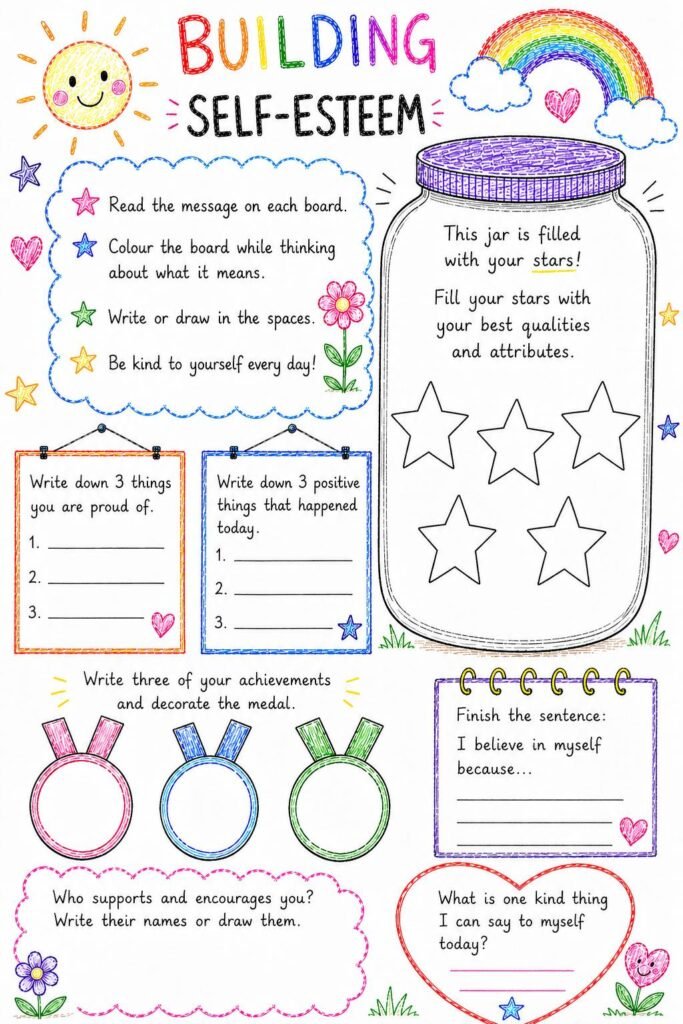
The worksheet below — Building Self-Esteem — is a free resource you can use with your child today. It is suitable for children aged approximately 6 to 12 and works equally well at home, in school, or in a therapeutic setting. It is warm, visual, and carefully structured to move a child gently toward a clearer, kinder picture of themselves.
The worksheet is built around seven distinct activities, each one approaching self-worth from a slightly different angle. Together, they form a complete picture — not of a perfect child, but of a real one, with real strengths, real achievements, and real people in their corner.
What makes this a genuinely effective self-esteem worksheet for kids is not any single activity on its own. It is the cumulative effect of moving through all seven — the quiet, growing sense, by the end, that there is rather a lot to be said for this particular child.
How to Use It
Sit with your child and place the worksheet between you. Introduce it simply and without pressure: “This is a sheet all about you — the good stuff, the things you’ve done, the people who love you. Let’s fill it in together.”
Encourage your child to read each section, colour it while thinking about what it means, and then write or draw their responses. There is no right order, and there are no wrong answers. Some sections will come easily. Others — particularly the star jar and the kind self-talk — may need a little more time. That is not a problem. The pause before the answer is often where the real work is happening.
Once the worksheet is complete, explore it together:
- Which part was your favourite to fill in?
- Was there a quality you put in your star jar that surprised you?
- Which achievement are you most proud of — and why?
- Could you say that kind thing to yourself again tomorrow?
The most important thing is not the answers. It is the quality of attention you bring to hearing them.
For Deeper Work: The Play Therapy Toolbox
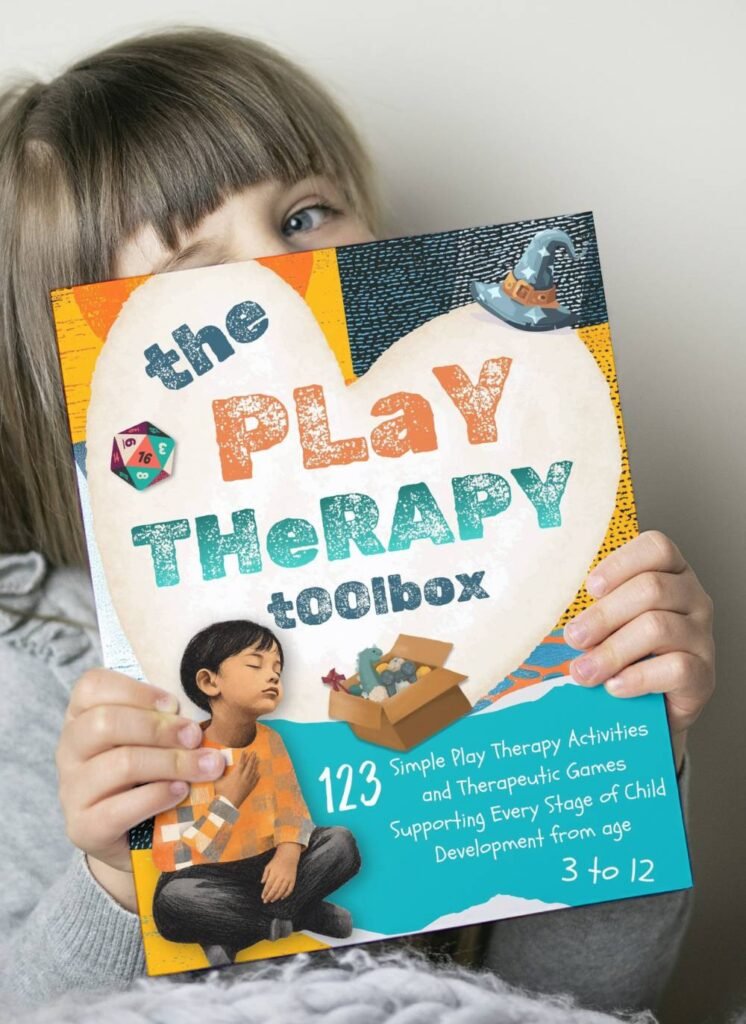
Building Self-Esteem is a strong standalone tool. But if you are looking for something more comprehensive — a clinically grounded resource that covers every major emotional and developmental need from ages 3 to 12 — that is what The Play Therapy Toolbox: 123 Simple Play Therapy Activities and Therapeutic Games Supporting Every Stage of Child Development from Age 3 to 12 was built to provide.
The book contains 123 activities spanning role-play, enactment, fantasy storytelling, somatic exercises, gamified experiences, and carefully designed worksheets. Each activity comes with a therapeutic rationale drawn from peer-reviewed research, step-by-step guidance, questions to use with the child, and a parent guidance note written in the same warm, practical language as this article. The activities grow with the child — because a six-year-old and an eleven-year-old are both navigating questions of self-worth, but the way in needs to be completely different.
Three Things Worth Knowing Before You Begin
The worksheet is the door, not the destination.
Any self-esteem worksheet for kids — including this one — is most powerful when it opens a conversation rather than substituting for one. Stay curious, stay unhurried, and let the child lead. What they choose to write in their star jar will tell you things they might not yet have words for any other way.
Regular use builds more than crisis use.
Self-esteem tools work best when used consistently, not only in moments of struggle. A child who revisits their achievement medals, adds to their star jar, and practises daily self-kindness regularly — as an ordinary, enjoyable ritual — builds something durable. By the time something genuinely hard arrives, that foundation is already there.
You are the most important tool in the room.
Children build self-esteem primarily through their relationships with the adults who matter most to them. When you sit beside your child, fill in your own star jar, and name your own achievements out loud, you are not just modelling. You are offering your presence — warm, genuine, and certain of their worth — as the most powerful resource of all.
Ready to Go Further?
If this free self-esteem worksheet for kids initiated a meaningful conversation with your child, The Play Therapy Toolbox gives you 123 more tools built on the same foundation. The ebook is available now on Amazon at $5.99 for a limited time, with access to 123 activities and 75+ printable downloadable worksheets and resources in full colour.
Disclaimer: This article is intended as an educational and supportive resource for parents, caregivers, educators, and mental health professionals. It is not intended to diagnose, treat, or replace professional therapeutic or medical care. If a child is experiencing significant emotional, behavioural, or developmental difficulties, please seek guidance from a qualified mental health professional.


Rostislava Buhleva-Simeonova is a psychologist, art and play therapist, and gamificator. She has worked with children, adults, and the elderly within various therapeutic programmes over the past eight years, all the while providing the much-needed playful twist that art and gamified experiences can bring to this sometimes uneasy setting. But it wasn’t until the birth of her daughter, Aurora, that this work took on an even deeper personal meaning. With her academic and real-life experience, honed through numerous trainings and sessions, she is currently authoring books and articles in the field of child psychology and development, offering expertise in art and play therapy to guide parents and caregivers, as well as professionals in the fields of social work and mental health, throughout various pivotal moments in children’s lives. Last but not least, all of her books have been “peer-reviewed” by her daughter, who testifies to the efficiency of these methods.