
The capacity to name one’s feelings — to have specific, differentiated language for the full range of emotional experience rather than a handful of broad categories — is one of the most reliably impactful developmental capacities available in the child psychology literature. It predicts better mental health outcomes, stronger peer relationships, more effective conflict resolution, greater academic engagement, and — perhaps most significantly — a measurably better capacity to regulate the emotions that have been named. The child who can say I am disappointed and frustrated and also a little embarrassed is in a fundamentally different position than the child who can only say I feel bad. Not because the feeling is different. Because the map is more detailed. And a more detailed map makes navigation possible in ways that a vague one does not.
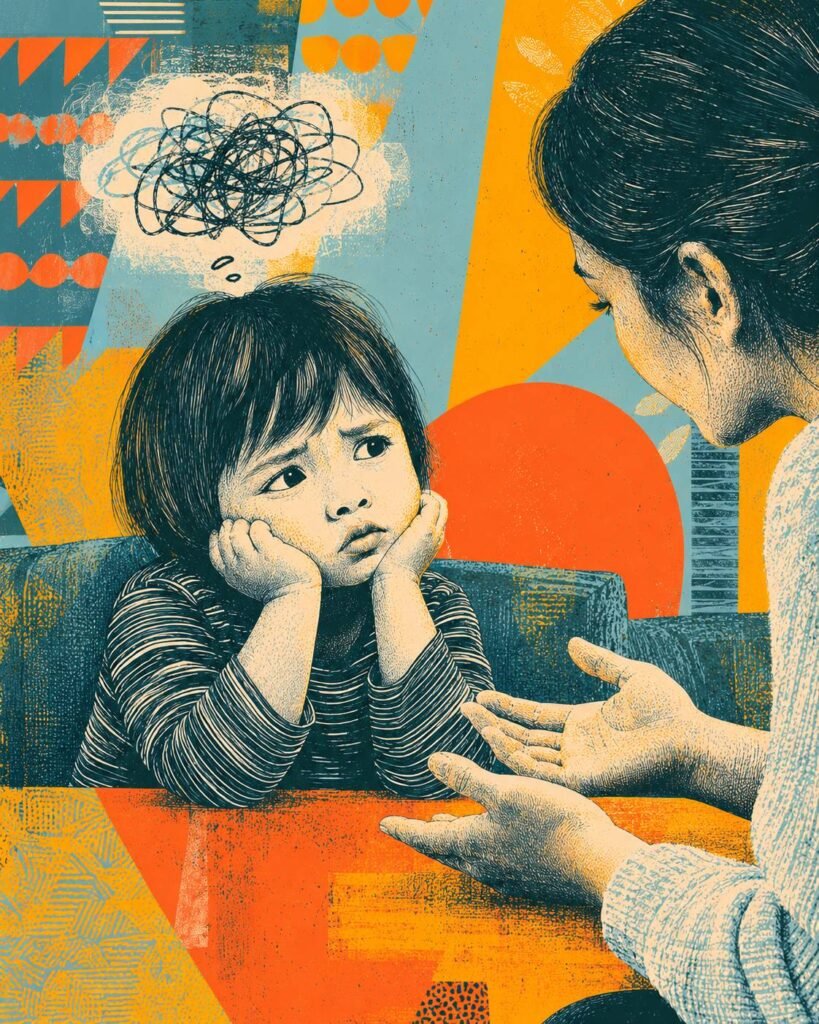
The Science of Naming Feelings
The neuroscientific case for teaching children to name their feelings is one of the most compelling in all of developmental psychology — and one of the most practically accessible, because the research does not simply confirm that naming feelings is beneficial. It explains precisely why, at the level of what happens in the brain when a feeling receives a word.
The most influential framework comes from the work of Matthew Lieberman and colleagues at UCLA, who coined the phrase affect labelling to describe the specific process by which putting a feeling into words reduces its neurological intensity. In a series of neuroimaging studies published from 2007 onward, Lieberman’s team confirmed that when participants labelled an emotional stimulus — attached a word to a facial expression or a feeling — amygdala activation decreased measurably. The threat-detection system became less active. The prefrontal cortex became more active. The physiological urgency of the emotion reduced.
This is the neuroscientific foundation of what Daniel Siegel, in his work on interpersonal neurobiology, has called name it to tame it — the clinical principle that emotion regulation begins with emotion naming. Siegel’s framework, drawing on attachment theory, neuroscience, and mindfulness traditions, proposes that the narrative act of naming an experience — giving it a word, placing it in a sentence, making it available to language — is itself a regulatory act, not simply a descriptive one. The name does not merely label the feeling. It changes what the feeling does in the nervous system.
This finding has direct practical implications. The child who says I am so angry right now is not simply communicating information. They are doing neurological work — activating the prefrontal cortex, reducing amygdala firing, and creating the conditions under which self-regulation becomes possible in a way that it is not when the feeling is wordless and overwhelming. Teaching children to name their feelings is not simply good emotional education. It is neurological intervention in its most accessible, most natural, and most developmentally appropriate form.
Emotional Granularity — Why Precision Matters
One of the most important concepts in contemporary emotion science — and one of the most directly relevant to the design of good feelings charts for kids — is emotional granularity: the degree of specificity and differentiation with which a person experiences and represents their own emotional states.
Research by Lisa Feldman Barrett and colleagues has confirmed that people differ substantially in their emotional granularity — in how finely they can distinguish between related emotional states. A low-granularity person experiences anger, frustration, irritation, and disappointment as variations of the same undifferentiated bad feeling. A high-granularity person experiences each as a distinct state with its own quality, its own causes, and its own implications for what to do next. And high emotional granularity is not simply an interesting psychological characteristic — it is a measurable predictor of better emotion regulation, lower rates of anxiety and depression, more adaptive responses to stress, and healthier social relationships.
The mechanism is straightforward: you cannot regulate what you cannot distinguish. The child who experiences all negative arousal as simply feeling bad has no information about what the feeling is, what caused it, or what might help. The child who can distinguish between frustrated — I want something and I can’t get it — and disappointed — I expected something and it didn’t happen — and embarrassed — something happened that I don’t want others to know about — has actionable information about their own inner state. They can begin to address the cause, to seek the right kind of support, and to regulate in ways that are specific to the feeling rather than simply general.
A feelings chart for kids that includes a wide, differentiated, developmentally accessible range of emotional vocabulary is not overcomplicating the emotional landscape for children. It is giving them a map precise enough to navigate it.
The Theoretical Frameworks That Shape How We Teach Emotions
Three foundational frameworks have shaped how developmental psychologists and therapists understand and teach emotional literacy in children — and each one has direct implications for what a good feelings chart should include and how it should be used.
Paul Ekman’s Basic Emotions — the theory that six emotions are universal across cultures, expressed in recognisable facial configurations, and therefore foundational to emotional understanding — provides the starting point for most feelings literacy work with children. Happiness, sadness, anger, fear, disgust, and surprise are Ekman’s six basic emotions, later extended by some researchers to include contempt. The basic emotions framework gives children the core vocabulary from which more differentiated emotional language grows — and the facial expression element makes it particularly accessible for visual reference tools like feelings charts.
Robert Plutchik’s Wheel of Emotions extends Ekman’s framework into a more complete map of the emotional landscape. Plutchik proposed eight primary emotions — joy, trust, fear, surprise, sadness, disgust, anger, and anticipation — arranged in a wheel that shows how emotions combine to produce more complex secondary and tertiary states. Love, for example, is a combination of joy and trust. Remorse is a combination of sadness and disgust. The wheel provides both a vocabulary and a structure — showing children that emotions are not random but patterned, not isolated but related, and that the complex feelings they experience have names even when those names are not immediately obvious.
Daniel Siegel’s Interpersonal Neurobiology provides the developmental and relational framework within which both of the above theories are most usefully applied to children. Siegel’s concept of integration — the linking of differentiated elements into a coordinated whole — proposes that emotional health consists not in the suppression or management of difficult emotions but in their integration: the capacity to experience, name, and process the full range of emotional states as part of a coherent, regulated inner life. The feelings chart, in Siegel’s framework, is not simply a vocabulary tool. It is an integration tool — one that helps the child develop the differentiated emotional map that genuine integration requires.
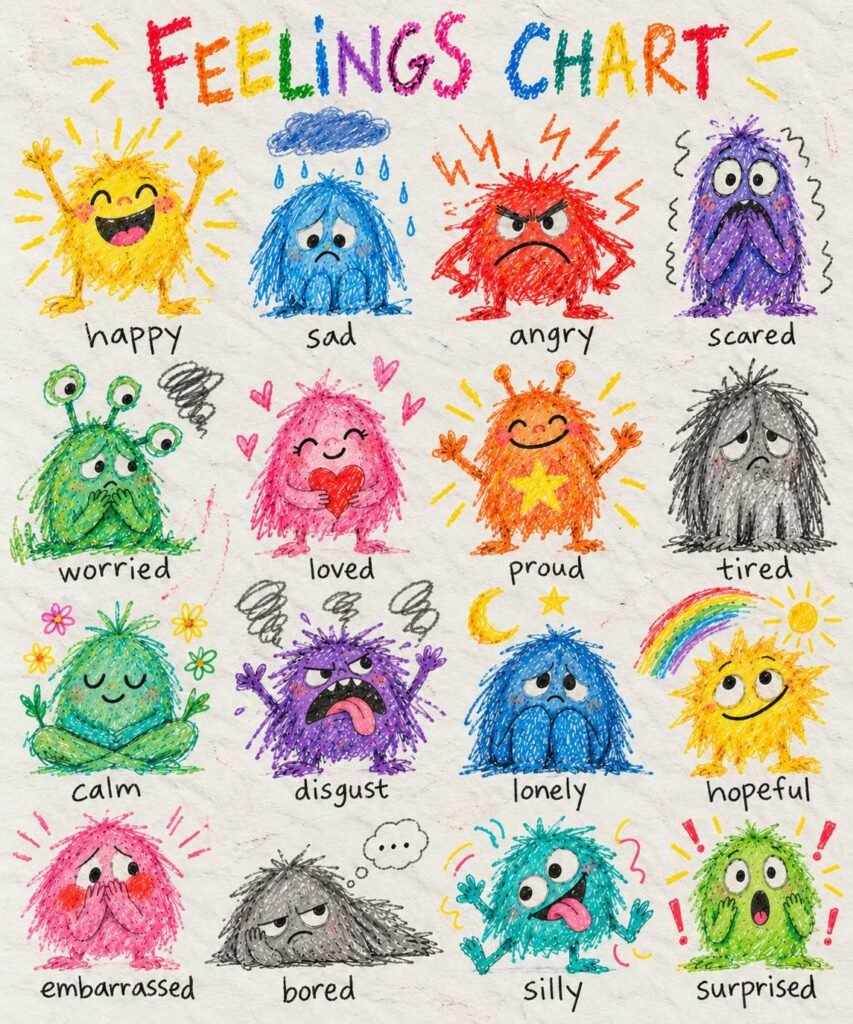
What a Feelings Chart for Kids Should Include
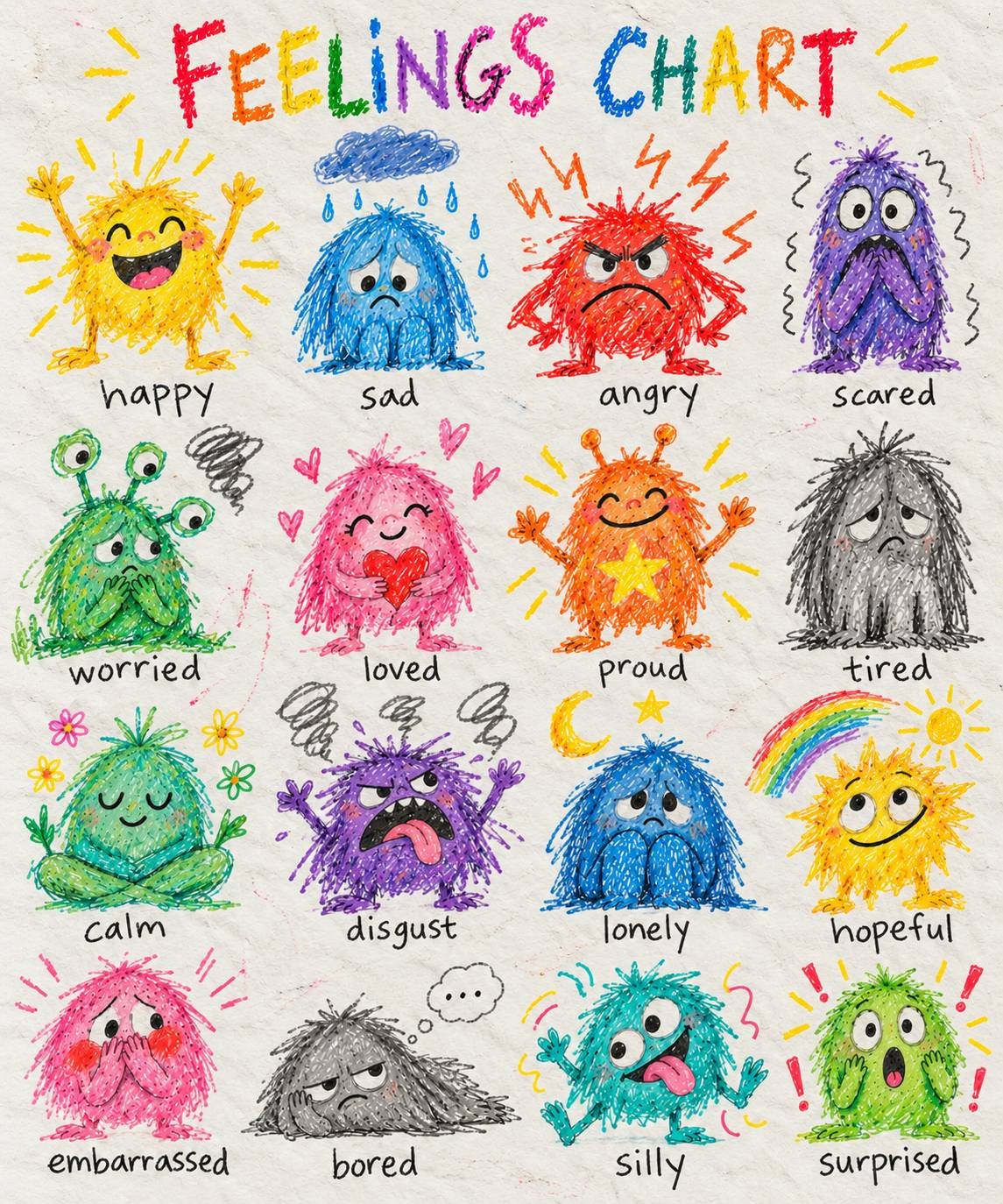
A good feelings chart for kids is not simply a list of emotion words. It is a visual reference tool — one that gives the child something to point to when the word is not yet available, something to return to when the feeling is too large to name without support, and something to browse in calm moments to build the vocabulary that will be available in difficult ones.
The most effective feelings charts for children share several specific features.
They include a genuinely wide range of emotions — not only the obvious ones but the subtler and more complex states that children frequently experience and rarely have words for. Overwhelmed. Embarrassed. Proud. Relieved. Left out. Nervous. Bored. Surprised. Hopeful. Lonely. Jealous. Grateful. The child who has encountered these words on a chart before they need them in a moment of distress is a child who can reach for them rather than struggling to generate them under pressure.
They use visual representation — faces, colours, or body-based indicators — alongside the words, because the visual element makes the chart accessible to children who are not yet strong readers, to children whose linguistic access is reduced in moments of emotional activation, and to children with neurodevelopmental differences for whom visual reference supports verbal comprehension.
They are organised in a way that reflects emotional relationships — grouping related emotions, showing gradations of intensity, or mapping the connections between feelings — rather than simply presenting an alphabetical or random list. Organisation supports learning: a child who understands that angry, furious, irritated, and frustrated are related states with different intensities has learned something about the emotional landscape rather than simply memorised a list.
And they invite the child to use the chart actively — to point, to circle, to copy the word, to draw the face — rather than simply looking at it passively. The active, embodied engagement with the chart produces better learning and better accessibility in subsequent moments than passive exposure alone.
How to Introduce and Use a Feelings Chart
The feelings chart is most powerful when it is introduced in calm, low-stakes moments rather than only reached for during emotional crises — because the calm-moment introduction builds the familiarity that makes the chart genuinely accessible when the emotional stakes are high.
Introduce the chart as a reference tool rather than a diagnostic one: “This is a map of feelings — all kinds of feelings that people have. Let’s look at it together and see which ones you recognise.” Browse it together. Ask the child which feelings they have had recently. Name some of your own. Make it a shared exploration rather than an assessment.
Then begin to use it at natural transition points — at the end of the school day, at bedtime, after something significant has happened — as a gentle, low-pressure invitation: “Can you find something on the feelings chart that matches how you felt today? Or maybe two things at once?” The chart normalises emotional complexity — the experience of feeling multiple things simultaneously — in a way that direct questioning often does not.
During moments of emotional activation, the chart offers something particularly valuable: a route into naming that does not require the child to generate the word from scratch. “Let’s look at the chart together — can you point to anything that feels close?” The pointing is a significant step. It gives the feeling a location outside the child’s body — a label that exists independently of the child’s current regulatory capacity — and that externalisation is itself the beginning of the naming that to tames.
For Deeper Work: The Play Therapy Toolbox
The feelings chart is a reference tool — one piece of the emotional literacy infrastructure that children need to build across the childhood years. The Play Therapy Toolbox: 123 Simple Play Therapy Activities and Therapeutic Games Supporting Every Stage of Child Development from Age 3 to 12 provides the structured, developmentally appropriate activities that bring that infrastructure to life.
The emotional literacy and self-awareness chapters draw extensively on affect labelling research, Siegel’s name it to tame it framework, and Plutchik’s emotion wheel to provide activities that build emotional vocabulary, emotional granularity, and the specific regulatory capacities that naming makes possible — across the full developmental range from age three to twelve.
Every activity comes with a therapeutic rationale grounded in peer-reviewed research, step-by-step guidance on how to conduct the session and exactly what to say, questions to use with the child, and a parent guidance note — because the research is clear that the adult’s own emotional vocabulary, modelled genuinely in the course of daily life, is one of the most powerful emotional literacy interventions available to any child. A parent who names their own feelings — I’m a bit frustrated right now, I’m feeling really proud of you, I was nervous about that meeting today — is delivering an emotional literacy education that no chart alone can replicate.
Before You Begin: A Note on Professional Support
Before attempting any emotional literacy activities at home with a child who is experiencing significant emotional, behavioural, or developmental difficulties, I would sincerely recommend consulting a qualified mental health professional. The reference tools and frameworks described in this article are offered as a supportive resource — not as a replacement for clinical assessment and ongoing therapeutic care.
Three Things Worth Knowing
Naming feelings is not the same as expressing them.
One of the most important distinctions in all of emotional literacy work is this: helping a child name what they feel is not the same as encouraging them to express it unfiltered. A child who can say I am furious right now is in a better regulatory position than one who cannot name the feeling — but naming does not mean acting on it or dumping it on another person. The goal of emotional vocabulary is not emotional expression for its own sake. It is the development of the internal map that makes regulation, communication, and genuine self-understanding possible.
Complex feelings deserve complex words.
The child who is simultaneously proud of something and embarrassed about being proud, or relieved that something is over and sad that it is gone, or angry and frightened in the same moment — that child needs a chart that includes all of those words. Emotional complexity is not a sign of something wrong with the child. It is the texture of genuine emotional experience, at every age. A feelings chart that only offers happy, sad, angry, and scared is telling the child, implicitly, that what they actually feel is more than they are supposed to. A chart that includes overwhelmed, conflicted, nostalgic, and ambivalent is telling them something different: that the complexity of what they feel has a name, and that naming it is possible.
You are the most important feelings chart in the room.
Every time an adult names their own feeling accurately — in a child’s presence, without drama, as a natural part of conversation — they are delivering the most powerful emotional literacy lesson available. You don’t need a chart for this. You need the habit. The parent who says I’m feeling a bit disappointed that we can’t go today, I was looking forward to it is showing a child, in real time, what emotional granularity looks like in practice. The chart gives the vocabulary. You give the model. Both are necessary, and the model is the one that lasts.
Available Now for $5.99 — For a Limited Time
If this exploration of why naming feelings changes everything gave you a sense of what emotional literacy actually builds — and what it makes possible — The Play Therapy Toolbox gives you 123 activities designed to build exactly that, across every developmental stage from age three to twelve. The ebook is available now on Amazon at $5.99 for a limited time — with immediate access to 123 activities and 75+ full-colour printable worksheets.
Play is not preparation for life. It is life — in its most honest, most essential, most healing form.


Disclaimer: This article is intended as an educational and supportive resource for parents, caregivers, educators, and mental health professionals. It is not intended to diagnose, treat, or replace professional therapeutic or medical care. If a child is experiencing significant emotional, behavioural, or developmental difficulties, please seek guidance from a qualified mental health professional.

Rostislava Buhleva-Simeonova is a psychologist and game design specialist. She has worked with children, adults, and the elderly within various therapeutic programmes over the past eight years, all the while providing the much-needed playful twist that art and gamified experiences can bring to this sometimes uneasy setting. But it wasn’t until the birth of her daughter, Aurora, that this work took on an even deeper personal meaning. With her academic and real-life experience, honed through numerous trainings and sessions, she is currently authoring books and articles in the field of child psychology and development, offering expertise in art and play therapy to guide parents and caregivers, as well as professionals in the fields of social work and mental health, throughout various pivotal moments in children’s lives. Last but not least, all of her books have been “peer-reviewed” by her daughter, who testifies to the efficiency of these methods.