
Every parent has watched it happen — the child who cannot sleep before the first day of school, who circles the same worry until it has worn a groove, who stands at the edge of a social situation they cannot quite bring themselves to enter, who catastrophises so reliably and so thoroughly that the what-ifs arrive before the actual event has had a chance to unfold. Some anxiety in children is not only normal but developmentally useful — a signal system that prepares the child for genuine challenge and keeps them appropriately cautious in unfamiliar situations.
But something has shifted in the scale of childhood anxiety. The numbers are no longer the numbers of a normative developmental experience. They are the numbers of a generation of children whose nervous systems are operating at a level of persistent activation that is interfering with their capacity to learn, to connect, to sleep, and to move through their own lives with anything resembling ease.
Play therapy for anxiety in children is not a new idea. But the evidence base supporting it — and the neuroscientific understanding of why it works — has never been stronger. And for the parents and professionals standing alongside anxious children every day, that evidence is worth knowing.
The Scale of Childhood Anxiety
The research on the prevalence of anxiety in children is now consistent across countries, age groups, and methodologies — and the trends it reveals are not reassuring.
According to the most recent CDC data from 2023 to 2024, eleven percent of children aged three to seventeen in the United States have a current, diagnosed anxiety disorder — ten percent of males and thirteen percent of females. Anxiety disorders, depression, and behaviour disorders are the most commonly diagnosed mental disorders in children.
That figure represents diagnosed disorders — children whose anxiety has become severe enough and persistent enough to meet clinical threshold. The number of children experiencing clinically significant anxiety symptoms without a formal diagnosis is considerably larger. A 2025 study found a 53.6% increase in the prevalence of anxiety among children aged three to seventeen between 2016 and 2022, alongside a 48.4% increase in depression — with older age and higher poverty associated with higher odds of each condition.
A 2024 meta-analysis found the global prevalence of social anxiety disorder to be 4.7% in children, 8.3% in adolescents, and 17% in youth — indicating a progressive increase across developmental stages. And a systematic review published in 2025 found pooled rates of anxiety varying from 13% to 25% across various countries and contexts in children and adolescents.
Anxiety disorders rank as the second foremost contributor to disability-adjusted life years globally — and research confirms that adolescent anxiety disorders significantly increase the probability of adult anxiety disorders. The child who does not receive appropriate support for their anxiety is not simply a worried child. They are a child whose trajectory is being shaped, in measurable and lasting ways, by an experience they did not choose and cannot manage alone.
What Anxiety Actually Is in the Developing Child
Before exploring play therapy for anxiety in children, it is worth establishing what childhood anxiety actually is at the neurological level — because the treatment logic follows directly from the biological reality.
Anxiety is not simply worry. It is a state of physiological activation — a nervous system response to perceived threat that is, in its original design, entirely adaptive. The amygdala detects something that might be dangerous. The sympathetic nervous system activates. The body prepares for action. And the prefrontal cortex — responsible for rational evaluation, perspective, and the capacity to distinguish genuine threat from imagined one — is temporarily deprioritised in favour of speed.
In a child with a well-regulated nervous system, this response fires appropriately and returns to baseline relatively quickly once the perceived threat has passed. In a child whose nervous system has become chronically activated — through temperament, through accumulated experience, through exposure to stress or adversity, or through the particular pressures of a childhood environment that does not consistently feel safe — the response fires more readily, more intensely, and does not reliably return to baseline at all. The result is a child who is, at a neurological level, living in a world that feels persistently more threatening than it objectively is.
A 2025 paper integrating polyvagal theory into early childhood education confirmed that emotion regulation strategies are core social-emotional learning skills — and that the developmental appropriateness of how these skills are taught is critical to their effectiveness. This is not simply a pedagogical point. It is a neurological one. A child whose nervous system is in a state of activation is not available for the kind of verbally mediated, cognitively directed learning that most anxiety interventions for adults depend on. Meeting the anxious child where their nervous system actually is — in the body, in the imagination, in the particular medium of play — is not a concession to developmental limitation. It is the most clinically sophisticated response available.

What Anxiety Looks Like in Children — and Why It Is So Often Missed
One of the most consistent findings in the clinical literature on childhood anxiety is how frequently it is misidentified — or missed entirely. Adult anxiety tends to look like anxiety: it involves visible worry, avoidance, and the subjective experience of fear that the person can usually articulate. Childhood anxiety tends to look like something else entirely.
The anxious child may present as irritable, oppositional, or difficult. They may have frequent physical complaints — stomachaches and headaches — with no identifiable medical cause. They may struggle to concentrate in school in ways that look like ADHD. They may be clingy, or they may be unusually self-reliant in a way that reflects an anxious avoidance of dependence rather than genuine confidence. They may have nightmares, sleep difficulties, or a persistent reluctance to separate from caregivers that is read as manipulative rather than genuinely distressing.
The child who stands at the edge of the playground and does not join in may not be introverted. They may be terrified. The child who melts down when plans change may not be spoiled. They may be a child whose nervous system has come to depend on predictability as a regulatory strategy and cannot manage the activation that uncertainty produces. And the child who says they have a stomach ache every Monday morning is not, in most cases, fabricating — they are accurately reporting the physical reality of an anxiety response that their body is producing before their mind has had a chance to name what is happening.
Understanding childhood anxiety as a nervous system state rather than a character trait — or a choice, or a parenting failure — is the foundation on which all effective support, including play therapy for anxiety in children, rests.
Why Play Is the Right Medium for Anxious Children
The most important thing to understand about play therapy for anxiety in children is why play — rather than conversation, cognitive restructuring, or direct instruction in coping strategies — is the medium most reliably available to an anxious child’s nervous system.
Language and conscious cognitive reflection are prefrontal cortex functions. They require a level of cortical availability that anxiety specifically compromises. A child whose amygdala is activated — who is in a state of anxious arousal — does not have reliable access to the parts of the brain that verbal therapeutic approaches most depend on. Asking them to identify their anxious thoughts and examine the evidence for them is asking them to access a cognitive resource that their current neurological state has made less available. The instruction to use their words is often, for an anxious child in the grip of their anxiety, like asking them to lift something with a muscle that is currently in spasm.
Play bypasses the need for that translation. It operates through the right hemisphere — through image, symbol, sensation, and story — in the same mode that the anxious nervous system is already using. Recent studies have shown that creative play methods promote neuroplasticity through their interplay with perception, cognition, emotion, and behaviour — and that play therapy activates mirror neurons and promotes the formation of new neural circuits. The anxious child who plays out a scenario in which the feared thing is approached, survived, or mastered is not simply pretending. They are doing genuine neurological work — creating new associations between the feared stimulus and the experience of safety, and building the neural pathways that will, over time, make the anxious response less automatic and less overwhelming.
A controlled trial found that children who received child-centred play therapy significantly decreased their overall levels of anxiety and worry — and concluded that child-centred play therapy may be considered a developmentally appropriate treatment for young children who are anxious. The finding that traditional methods of treating anxiety have been less effective with young children, and that play therapy offers a more developmentally aligned alternative, reflects exactly the neurological reality described above.
The Evidence for Play Therapy for Anxiety in Children
The research on the effectiveness of play therapy for anxiety in children has accumulated substantially in recent years — across different settings, populations, and methodological approaches.
A 2023 meta-analysis found that play therapy was highly effective on anxiety in children, with a standardised mean difference of 1.339 and a statistically significant effect across 17 included studies — indicating that play therapy has very positive effects on anxiety and life skills in children and positively affects the mental health of individuals.
A 2025 meta-analysis published in the Journal of Pediatric Nursing found that cognitive-behavioural interventions are significantly effective in reducing anxiety levels in children with anxiety disorders — and that among the various types of CBT, cognitive behavioural play therapy emerged as the most effective in reducing anxiety, with a standardised mean difference of 2.41. This is a clinically significant finding: when CBT principles are integrated into a play-based delivery framework — rather than being delivered through the verbal, cognitively directed format designed for adults — their effectiveness with children increases substantially.
A 2023 randomised controlled trial found that child-centred group play therapy and narrative therapy both significantly reduced separation anxiety in children aged two and a half to four years — with the group that received a combination of both interventions showing the greatest reduction — compared to a control group that received no intervention. Separation anxiety is among the most common presenting concerns in early childhood, and the finding that play-based approaches are effective even with very young children reflects the developmental appropriateness of the medium.
A 2025 randomised controlled trial published in BMC Complementary Medicine and Therapies found a statistically significant difference in anxiety scores between children who received play therapy and those in the control group — confirming that play therapy is an effective, non-pharmacological intervention for reducing anxiety in children.
A 2024 systematic review and meta-analysis confirmed that play-based distraction interventions significantly reduced anxiety levels in children — noting that play therapy is not simply an activity where children play games, but a structured therapeutic technique to understand the emotional difficulties the child is experiencing, help them express these, and guide this process towards recovery.
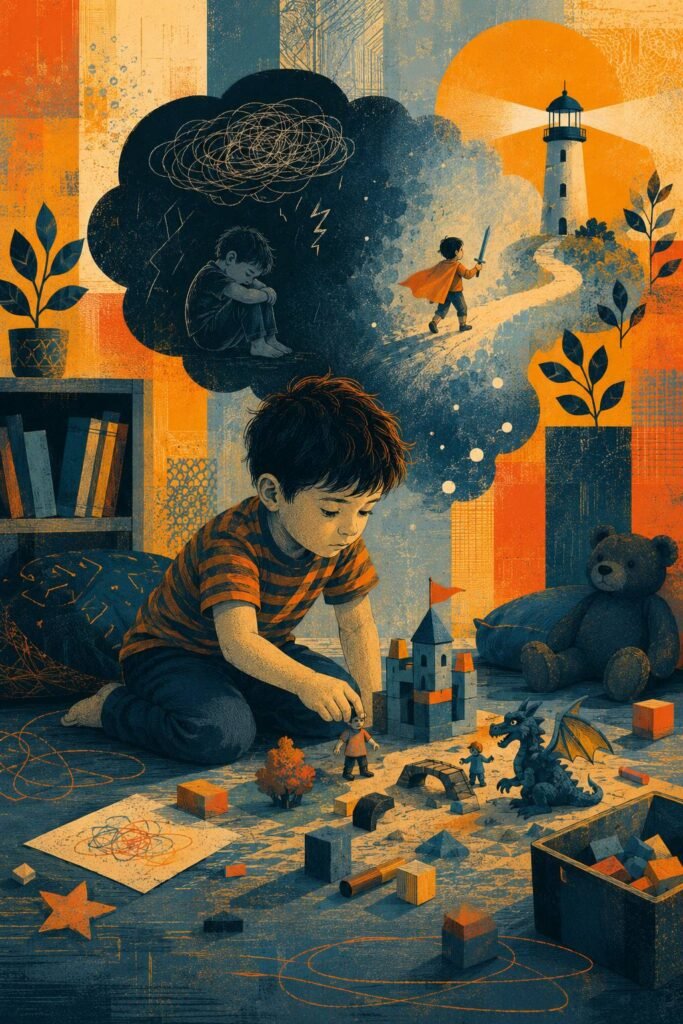
What Play Therapy for Anxiety in Children Looks Like in Practice
Play therapy for anxiety in children is not free play supervised from a distance. It is a structured, theoretically grounded, clinically directed process in which the therapist uses the child’s natural medium as the primary vehicle for therapeutic intervention.
The therapeutic relationship is the container within which all of this happens. An anxious child’s nervous system has learned, in some form and to some degree, that the world is not entirely safe — that unexpected things happen, that demands may exceed capacity, that the gap between what is required and what is possible is a place of danger. Building a therapeutic relationship that is consistently warm, predictable, genuinely curious, and non-demanding communicates something to the anxious child’s nervous system that words alone cannot: that this is a different kind of encounter, in a different kind of space, with a different kind of outcome.
Within that relationship, the therapist tracks the child’s nervous system moment to moment — reading the signs of activation and the signs of engagement, adjusting the pace and the nature of the work accordingly, and ensuring that the child’s window of tolerance is maintained. Somatic regulation exercises — breathing, movement, rhythm, sensory grounding — address the body’s anxiety response directly. Symbolic play — the worried character who finds a way through, the scared animal who discovers it is braver than it thought, the what-if machine that learns to produce more than one output — gives the anxious child a way to approach feared material from a protective distance and discover, within the safety of the story, that it can be survived.
Cognitive techniques — including the kind of cognitive restructuring that underpins CBT — are most effective with anxious children when they are delivered through play rather than through direct instruction. The child who creates a worry monster, feeds it their what-ifs, and discovers that the monster is smaller than it seemed has done genuine cognitive work. The child who fills a what-if machine and discovers that the most likely case is different from the worst case has engaged in genuine cognitive restructuring. The play is not a vehicle for the therapy. The play is the therapy.
The Role of the Parent in Supporting the Anxious Child
One of the most consistent and practically important findings in the contemporary research on childhood anxiety is the significance of parental involvement — not only as a supportive context but as an active therapeutic medium.
A recent meta-analysis concluded that parent-inclusive child therapy interventions produce significantly greater reductions in psychological symptomatology compared to child-only approaches — especially for internalising disorders such as anxiety and depression. This finding has direct implications for how play therapy for anxiety in children is most effectively delivered: the child who receives play therapy within a family system where the caregiver is also supported, informed, and actively involved in the therapeutic work has a substantially better outcome than the child whose therapy happens in isolation from the relational context within which their anxiety developed and is maintained.
Parents of anxious children often find themselves in a painful double bind. Their instinct — entirely loving, entirely understandable — is to protect the child from the situations that trigger their anxiety, to accommodate the avoidance, to smooth the path. And in the short term, this reduces the child’s distress. But in the medium and longer term, accommodation reinforces the anxious child’s belief that the feared situation is genuinely dangerous and that they are genuinely incapable of managing it. The therapeutic task for parents is not to expose the child to overwhelming anxiety without support, but to offer the kind of warm, regulated, gently encouraging presence that communicates: “I know this feels hard. I believe you can do it. I am right here.”
That presence — consistent, warm, non-accommodating without being dismissive — is the most powerful anxiety intervention available to any parent. And it is one that no worksheet or activity can substitute for, however well designed.
Before You Begin: A Note on Professional Support
Before attempting any play-based anxiety activities at home, I would sincerely recommend consulting a qualified mental health professional experienced in childhood anxiety. The tools and frameworks in this article are offered as a supportive resource for parents and caregivers — not as a replacement for the clinical assessment and ongoing therapeutic relationship that a trained professional provides. Childhood anxiety exists on a spectrum, and what is appropriate support at one point on that spectrum may be insufficient at another.
Play Therapy for Anxiety in Children: The Play Therapy Toolbox
The Play Therapy Toolbox: 123 Simple Play Therapy Activities and Therapeutic Games Supporting Every Stage of Child Development from Age 3 to 12 was built around the understanding that anxious children need tools that meet them in the language their nervous systems are actually speaking — the language of play, image, story, and sensory experience — within the safety of a warm, attuned, consistently present relationship.
The anxiety, worry, and emotional overthinking chapters address the full range of presentations children bring: the generalised worry that loops without resolution, the social anxiety that keeps the child at the edge of belonging, the separation anxiety that makes every goodbye feel permanent, the perfectionism that makes every attempt feel dangerous, the specific fears that have their own particular logic and require their own particular therapeutic approach, and the existential anxiety of the older child who has understood enough about the world to be frightened by what they understand.
Every activity comes with a therapeutic rationale grounded in peer-reviewed research, step-by-step guidance on how to conduct the session and exactly what to say, questions to use with the child, and a parent guidance note written in the same warm, accessible language as this article. The activities grow with the child — because a four-year-old and a ten-year-old may both be anxious, but the way in, the language, and the therapeutic depth of the tool need to be completely different. And a comprehensive annex cross-references all 123 activities by presenting condition, age group, and page number — so you can navigate directly to the right tool for the right child at the right moment, without searching.
Three Things Worth Knowing
Anxiety is a nervous system state, not a character trait.
The most important reframe available to any adult supporting an anxious child is this: the child who worries excessively, who avoids, who catastrophises, who cannot be reassured — that child is not choosing their experience. They are reporting accurately on the state of a nervous system that has calibrated itself to a world that feels more threatening than it objectively is. The anxiety is not the child. It is what the child is carrying. And that distinction — between what the child is and what the child is experiencing — is where all effective support begins.
Accommodation relieves but does not treat.
Every time a caregiver removes the feared situation, smooths the anxious child’s path, or absorbs the distress that the child needs to learn to tolerate, they offer genuine short-term relief — and inadvertently reinforce the belief that the feared thing is genuinely dangerous and the child genuinely incapable. The therapeutic goal is not the elimination of all anxiety. It is the gradual, supported development of the child’s capacity to experience anxiety and discover, through repeated experience, that it is survivable. That discovery cannot happen if the child is never given the opportunity to make it.
You are the most important tool in the room.
Play therapy for anxiety in children is not delivered by techniques. It is delivered through the quality of the relationship in which those techniques are offered. A regulated, warm, genuinely curious adult presence — one that communicates, through small consistent acts of attuned attention, that the child is capable and that the world is safe enough — is the most powerful anxiety intervention available. The activities in the Toolbox are the invitation. You are the reason the anxious child is willing to accept it.

Disclaimer: This article is intended as an educational and supportive resource for parents, caregivers, educators, and mental health professionals. It is not intended to diagnose, treat, or replace professional therapeutic or medical care. If a child is experiencing significant emotional, behavioural, or developmental difficulties, please seek guidance from a qualified mental health professional.

Rostislava Buhleva-Simeonova is a psychologist and game design specialist. She has worked with children, adults, and the elderly within various therapeutic programmes over the past eight years, all the while providing the much-needed playful twist that art and gamified experiences can bring to this sometimes uneasy setting. But it wasn’t until the birth of her daughter, Aurora, that this work took on an even deeper personal meaning. With her academic and real-life experience, honed through numerous trainings and sessions, she is currently authoring books and articles in the field of child psychology and development, offering expertise in art and play therapy to guide parents and caregivers, as well as professionals in the fields of social work and mental health, throughout various pivotal moments in children’s lives. Last but not least, all of her books have been “peer-reviewed” by her daughter, who testifies to the efficiency of these methods.
References
Abdi, F., Karamoozian, A., Lotfilou, M., Gholami, F., Shaterian, N., Abasi Niasar, A., Aghapour, E., & Jandaghian-Bidgoli, M. (2025). Effect of play therapy and storytelling on the anxiety level of hospitalized children: A randomized controlled trial. BMC Complementary Medicine and Therapies, 25(1), 1–9. https://doi.org/10.1186/s12906-025-04767-4
Casseus, M., et al. (2025). Trends in childhood anxiety and depression 2016–2022. Infant and Child Development.
Centers for Disease Control and Prevention. (2025). Children’s mental health: Anxiety and depression. https://www.cdc.gov/childrensmentalhealth
Dişsiz, M., et al. (2025). The effect of cognitive behavioral interventions applied to children with anxiety disorders on their anxiety level: A meta-analysis study. Journal of Pediatric Nursing. https://doi.org/10.1016/j.pedn.2024.12.020
Ray, D. C., Groves, M., Vonk, J., & Malone, H. (2015). Child-centered play therapy with young children who are anxious: A controlled trial. School Psychology Quarterly, 30(3), 395–408.
Salari, N., et al. (2024). Global prevalence of social anxiety disorder in children, adolescents, and youth: A meta-analysis. Journal of Prevention.
ScienceDirect. (2025). Polyvagal theory and emotion regulation in early childhood education.
Strang, J. (2024). Neuroscience of creativity-based interventions and play therapy. Referenced in: Therapas. (2025). 2025 literature summary: Play therapy for psychologists and OTs. https://therapas.com.au/literature-summary-play-therapy/
Uzunpınar, S., et al. (2023). The effect of play therapy on anxiety and life skills in children: A meta-analysis study. East Black Sea Journal of Health Sciences. https://dergipark.org.tr/en/pub/ebshealth
Zarra-Nezhad, M., Pakdaman, F., & Moazami-Goodarzi, A. (2023). The effectiveness of child-centered group play therapy and narrative therapy on preschoolers’ separation anxiety disorder and social-emotional behaviours. Early Child Development and Care, 193(6), 841–853. https://doi.org/10.1080/03004430.2023.2167987
Zhang, X., Wang, Y., & Abdullah, A. (2024). Play-based interventions for anxiety reduction in children undergoing medical procedures: A systematic review and meta-analysis.