
Every parent has had that moment — your child is struggling, shutting down, acting out, or simply unable to tell you what they need, and you are doing your best but wishing you had a little more to go on. The meltdown that came from nowhere. The long silence after something happened. The quieter worry at the end of the day, wondering whether you responded the right way. These moments do not mean you are failing. They mean you are paying attention. And paying attention is exactly where good parenting begins.
What Play Therapy for Kids Actually Is
Play therapy is not play with a clinical label attached. It is a structured, evidence-based approach to child psychology that uses play — in all its forms — as the primary medium for emotional processing, communication, and healing. It draws on decades of developmental research and a wide range of theoretical traditions: cognitive behavioural therapy, attachment theory, narrative therapy, expressive arts, polyvagal theory, and the contemporary neuroscience of trauma and interpersonal regulation.
The core insight is both simple and profound. Children do not process the world the way adults do. They do not sit with a difficulty, name it, reflect on it, and arrive at a conclusion. They play it out. They draw it, build it, enact it, give it a character, send it on a journey, and let it resolve the way that stories resolve — through movement, through metaphor, through the particular safety of something that is real and not real at the same time. This is not avoidance. It is the most sophisticated emotional processing available to a developing mind.
Play is not something children do in between the important moments of development. Play is the important moment. It is the primary language of childhood — the medium through which children explore who they are, rehearse who they might become, and work through everything that confuses, frightens, or overwhelms them.
The Science Behind Play Therapy for Kids
The research base for play therapy for kids is more substantial than it might appear. Play activates the brain’s reward circuitry, releases dopamine in ways that reinforce exploration and social engagement, reduces cortisol, and strengthens the prefrontal cortex — the region responsible for planning, impulse control, and emotional regulation. Children who engage in regular, varied play demonstrate stronger executive functioning, greater emotional resilience, and more sophisticated social skills than those whose play is restricted.
The developing brain processes emotional experience through the right hemisphere long before the left hemisphere’s language centres are mature enough to put it into words. In early childhood, the limbic system is highly active while the prefrontal cortex — governing language, logic, and self-reflection — is still under construction. The feeling is enormous. The vocabulary is small. The gap between the two is where play lives.
This is why asking a child to “use their words” in a moment of genuine emotional overwhelm so often fails. In that moment, language is the part of the brain least available to them. When we offer a creative, visual, movement-based, or imaginative tool instead, we meet them where they actually are. For children who have experienced stress, trauma, or relational disruption, this matters even more. Trauma is stored not just in memory but in the body — in the nervous system, in the reflexive patterns of activation and shutdown. Sensory and movement-based play offers one of the most powerful routes back into a regulated state.
Why Children Communicate Through Play Instead of Words
Ask a four-year-old how they feel about their new baby sibling and you may get a shrug or a subject change. Watch that same child with a dollhouse and two figures and you may see the whole story unfold with a clarity that words could not have produced.
Symbolic play — letting one thing stand for another — emerges around eighteen months and becomes the primary medium of childhood emotional processing. When a therapist, parent, or educator learns to receive play as communication rather than entertainment, an entirely different kind of conversation becomes possible.
What sandtray, art, role-play, and therapeutic storytelling all share is their reliance on symbol and metaphor as the primary therapeutic medium. The skill lies not in interpreting these symbols for the child — that risks projection — but in staying curious alongside them, allowing the child to be the author of their own meaning.

The Play Therapy Toolbox: A Complete Resource for Every Stage
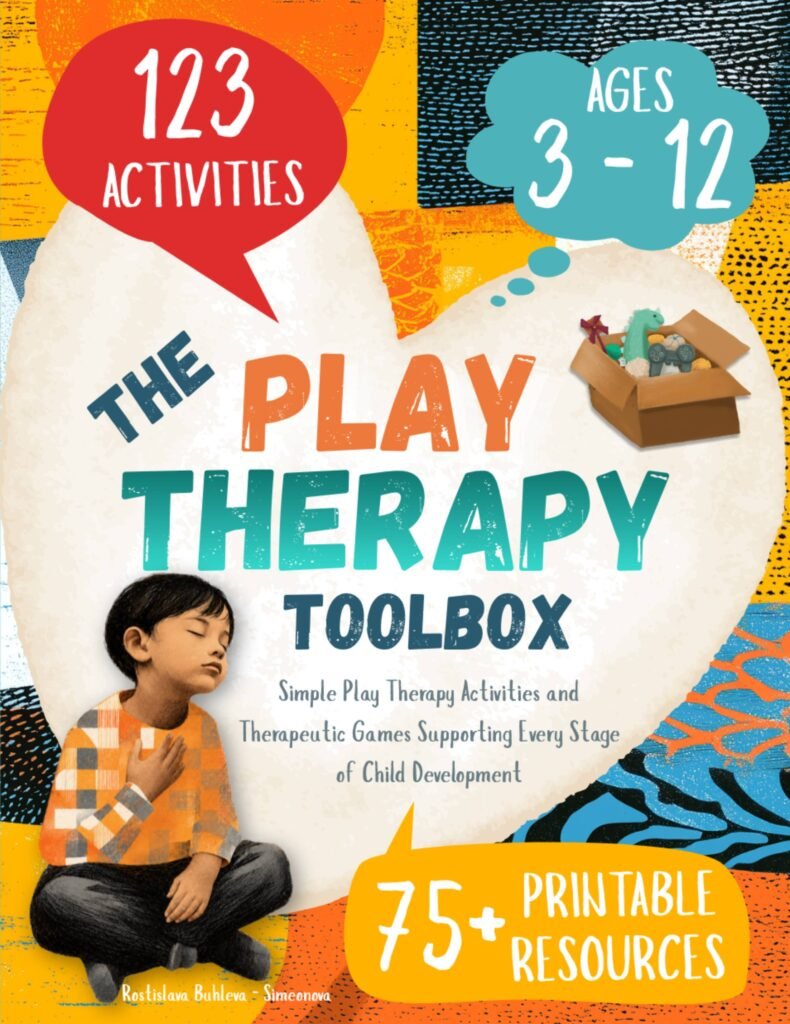
The Play Therapy Toolbox: 123 Simple Play Therapy Activities and Therapeutic Games Supporting Every Stage of Child Development from Age 3 to 12 was written for two audiences who share the same goal. Parents and caregivers looking for practical, evidence-based ways to support their child at home. And professionals — therapists, counsellors, school psychologists, educators, and social workers — looking for a clinically grounded resource they can reach for across every presenting need and every developmental stage.
The book is built around four dedicated chapters — one for Age 3, one for Ages 4–6, one for Ages 7–9, and one for Ages 10–12 — each opening with a developmental overview that traces the key milestones, common emotional challenges, and neurological realities most relevant to that stage. Because a three-year-old and an eleven-year-old are both navigating big feelings — but the way in, the language, and the emotional depth of the tool need to be completely different. Development is not a checklist. It is a living, relational process — and every activity in this book is built around that understanding.
What You Will Find Inside
The Toolbox contains 123 activities spanning role-play, enactment, fantasy storytelling, somatic exercises, and gamified experiences, alongside 75+ printable, downloadable, full-colour worksheets and therapeutic game resources designed to support and extend each activity.
The theoretical foundation draws on cognitive behavioural therapy, narrative therapy, acceptance and commitment therapy, attachment-based approaches, expressive arts therapy, and contemporary neuroscience — including polyvagal theory and trauma-informed practice. Somatic activities engage the nervous system directly, rather than relying on verbal processing alone, because regulation always comes before reflection. A child in high sympathetic activation may need physical release before they are available for reflective work. A child in dorsal vagal shutdown may need gentle, rhythmic, low-demand sensory input before they can re-emerge into connection.
Every activity comes with a therapeutic rationale grounded in peer-reviewed research, step-by-step guidance including what to say and how to conduct the session, questions to use with the child, and a parent guidance note written in the same plain, warm, practical language as this article. The activities grow with the child — a character introduced at age three may still accompany the therapeutic journey at ages seven to nine. The worksheets increase in complexity, abstraction, and emotional depth as the child’s cognitive and emotional capacity grows. And a comprehensive annex cross-references all 123 activities by presenting condition, age group, and page number — so you can navigate directly to the right tool for the right child at the right moment, without searching.

The Approach Behind the Book
The Toolbox does not take a single theoretical position and apply it uniformly across every child and every age. It draws instead on the full range of approaches that contemporary research and clinical practice have shown to be effective — and applies them with developmental specificity, because the approach is always in service of the child. Never the other way around.
Directive and non-directive approaches are used alongside each other, reading the child’s cues and adjusting accordingly. For parents using activities at home, the principle is simple: offer the prompt, then step back. The most powerful thing you can do is stay present, stay curious, and resist the urge to fill the silence.
The worksheets are full-colour, printable, and designed to be genuinely engaging for children rather than clinical in appearance. And the language throughout is accessible without being simplified. The theory is present without being a lecture.
Three Things Worth Knowing Before You Begin
Play therapy for kids works best as a relationship, not a technique.
Every activity in this book is only as powerful as the relational safety within which it is offered. Building that safety — patiently, consistently, through the simple act of being present and genuinely interested — is always the first task. Co-regulation must precede self-regulation. A child cannot manage their own emotional states until they have repeatedly experienced being regulated from the outside in, by a calm, attuned adult.
Regular use builds more than crisis use.
Play therapy tools work best when used consistently rather than only in moments of struggle. A child who draws, plays, and reflects regularly — as an ordinary, unhurried part of their emotional life — builds vocabulary and self-awareness week by week. By the time something genuinely difficult arrives, the language is already there.
You do not need to be a therapist to use these tools.
Many of the most powerful applications of play therapy for kids happen at home, at the kitchen table, in the car on the way back from school. What matters is not professional credentials. It is attentiveness, warmth, and a willingness to get on the floor and simply play alongside your child without an agenda.
Available Now for $5.99 — For a Limited Time
The Play Therapy Toolbox is available now as a Kindle ebook on Amazon at $5.99 for a limited time — giving you immediate access to 123 activities, 75+ full-colour printable worksheets, and a complete, developmentally structured resource for supporting children from age 3 to 12.
Play is not preparation for life. It is life — in its most honest, most essential, most healing form.

Disclaimer: This article is intended as an educational and supportive resource for parents, caregivers, educators, and mental health professionals. It is not intended to diagnose, treat, or replace professional therapeutic or medical care. If a child is experiencing significant emotional, behavioural, or developmental difficulties, please seek guidance from a qualified mental health professional.

Rostislava Buhleva-Simeonova is a psychologist, art and play therapist, and gamificator. She has worked with children, adults, and the elderly within various therapeutic programmes over the past eight years, all the while providing the much-needed playful twist that art and gamified experiences can bring to this sometimes uneasy setting. But it wasn’t until the birth of her daughter, Aurora, that this work took on an even deeper personal meaning. With her academic and real-life experience, honed through numerous trainings and sessions, she is currently authoring books and articles in the field of child psychology and development, offering expertise in art and play therapy to guide parents and caregivers, as well as professionals in the fields of social work and mental health, throughout various pivotal moments in children’s lives. Last but not least, all of her books have been “peer-reviewed” by her daughter, who testifies to the efficiency of these methods.