
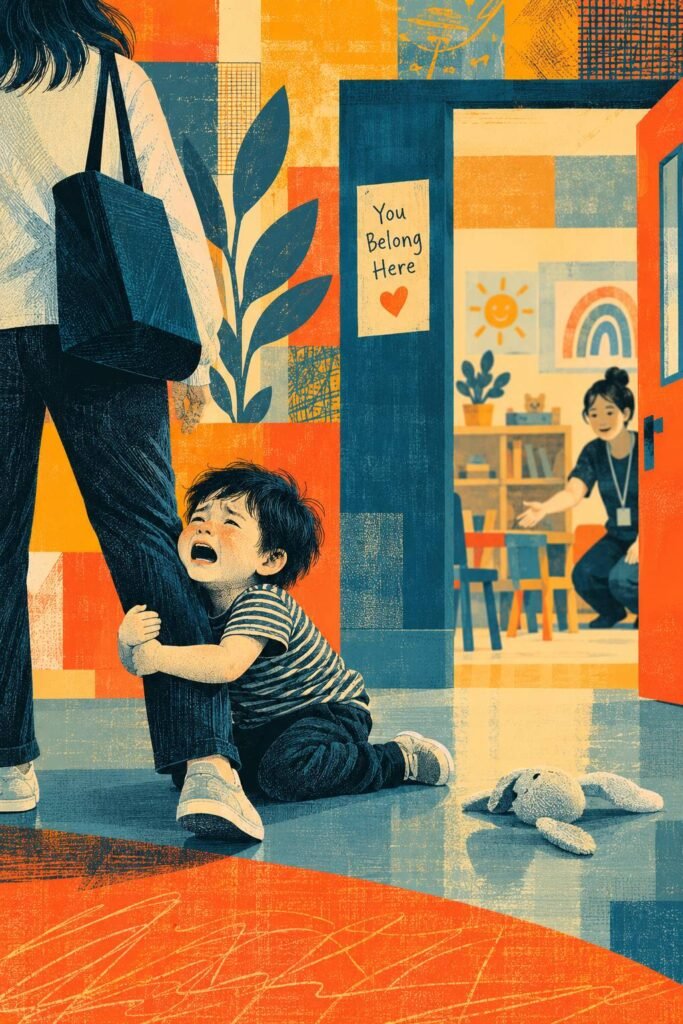
Every parent has stood at a school gate or a nursery door with a child who cannot let go. Not the ordinary reluctance of a child who would rather stay home — but the full, distressing, physically urgent experience of a child whose nervous system has genuinely concluded that separation is dangerous. The clinging that does not resolve. The distress that does not settle even after the parent has gone. The child who, days and weeks and months into a school year, is still experiencing drop-off as though the separation were a threat to their survival rather than a temporary parting from someone who will reliably return.
Separation anxiety in children is one of the most common and most misunderstood presentations in early childhood. It is also one of the most distressing — both for the child, whose suffering is entirely real, and for the parent, who leaves each morning carrying the weight of that distress alongside the guilt of having caused it. And it is one of the presentations for which the research on play-based, attachment-informed therapeutic approaches has become most specifically and most usefully clear.
Play therapy for separation anxiety works. Not because it distracts the child from their fear. Because it addresses, at the level of the attachment system where that fear actually lives, the fundamental belief that separation is not survivable — and gradually, through the quality of the therapeutic relationship and the specific mechanisms of play-based intervention, provides the child with new and reliable evidence that it is.
What Separation Anxiety Actually Is
Separation anxiety disorder is the most common anxiety disorder in childhood — affecting between four and five percent of children under twelve, and representing the most frequent anxiety diagnosis in preschool and early school-age populations. It is characterised by excessive and developmentally inappropriate fear or anxiety about separation from attachment figures — typically parents — that significantly impairs the child’s daily functioning and is not better explained by another condition.
The word excessive is clinically important. Some degree of separation distress is entirely normative in infancy and toddlerhood — it reflects the healthy functioning of the attachment system, which is designed to keep the child close to their primary caregiver during the developmental period when they are most vulnerable. The distress of the typically developing child tends to peak between approximately eight and fourteen months and gradually diminishes across the toddler and preschool years as the child develops object permanence — the understanding that the caregiver continues to exist when not visible — and the internal working model of the attachment figure as reliably available and reliably returning.
Separation anxiety disorder represents a disruption of this developmental process. The child has not yet built, or has lost confidence in, the internal working model of the caregiver as reliably available. The nervous system continues to treat separation as threat — not because the child is choosing to be difficult but because their attachment system is operating on a model of the world in which that threat is real.
This is the neurological reality that makes play therapy for separation anxiety so specifically well-suited: the problem is located in the attachment system, and the attachment system is most directly reached not through cognitive argument but through the repeated, embodied experience of safe, attuned, reliably available relationship.
What the Research Shows
The research on play therapy for separation anxiety has grown substantially in the past three years — with a cluster of well-designed studies providing increasingly specific evidence about which approaches work, for which children, and through which mechanisms.
A 2024 study published in the Journal of Psychological Science compared the effectiveness of attachment-based play therapy and parent-child relationship therapy on the psychological wellbeing of children aged five to six with separation anxiety disorder. Both approaches produced significant improvements in psychological wellbeing — confirming that play-based, attachment-informed interventions are effective for this presentation across two distinct therapeutic modalities. The study identified the therapeutic relationship and parental involvement as active ingredients of change — findings that align directly with the broader play therapy literature’s consistent finding that the relationship is the intervention.
A 2025 comparative study published in the International Journal of Body, Mind and Culture compared attachment-based play therapy and cognitive behavioural therapy in children aged six to eight with clinically diagnosed separation anxiety disorder. Both interventions significantly reduced separation anxiety symptoms and improved parent-child relationship scores compared to the control group. Crucially, attachment-based play therapy produced improvements in the parent-child relationship that were not only statistically significant but maintained at one-month follow-up — confirming that the attachment-focused approach addresses not only the child’s anxiety symptoms but the relational substrate from which those symptoms grow.
A 2025 study published in the Journal of Childhood Health and Education compared attachment-centred Theraplay and child-parent relationship play therapies on emotion regulation in children with separation anxiety disorder — finding significant improvements in emotion regulation across both play-based approaches, with gains maintained at follow-up. A 2023 randomised controlled trial examining child-centred group play therapy and narrative therapy with preschool children aged two and a half to four found that both interventions significantly reduced separation anxiety levels compared to control — with the combined intervention producing the greatest reductions.
A 2026 scoping review published in the Journal of Paediatrics and Child Health, examining therapeutic and educational interventions for childhood separation anxiety across studies from 2005 to 2025, confirmed that interventions including child-centred group play therapy, attachment-based play, art therapy, and storytelling effectively reduced separation anxiety symptoms — and also improved social-emotional skills, resilience, and parent-child relationships. The breadth of this finding is significant: play therapy for separation anxiety is not simply reducing a symptom. It is improving the relational and social-emotional foundation from which the symptom grew.
And a 2024 study examining sandplay therapy with children aged seven to twelve with separation anxiety disorder confirmed that sandplay therapy significantly improved social skills and adjustment — adding to the picture of a diverse, converging evidence base that supports play-based approaches across modalities, age groups, and presenting severities.
Why Attachment-Based Approaches Work
Understanding play therapy for separation anxiety requires understanding what separation anxiety is at the level of the attachment system — and why approaches that specifically target that system produce outcomes that symptom-focused approaches cannot fully replicate.
Attachment theory, developed by John Bowlby and substantially extended by Mary Ainsworth, proposes that the child’s security of attachment is determined by the reliability, sensitivity, and availability of the primary caregiver’s response to the child’s signals of need. A child whose caregiver has responded consistently and sensitively develops a secure attachment — an internal working model of the caregiver as reliably available, and of the self as worthy of that reliable availability. A child whose caregiver has been inconsistent, unavailable, or frightening develops an insecure attachment — an internal working model organised around uncertainty about whether the caregiver will be there when needed.
Separation anxiety disorder typically reflects some degree of insecurity in this internal working model — not necessarily because of inadequate parenting but because of temperament, early experiences, environmental stressors, or the disruption of the attachment relationship by illness, loss, or family transition. The child who panics at separation is a child whose internal working model does not yet contain sufficient evidence that the caregiver will reliably return — or that, in the caregiver’s absence, the child has the internal resources to manage.
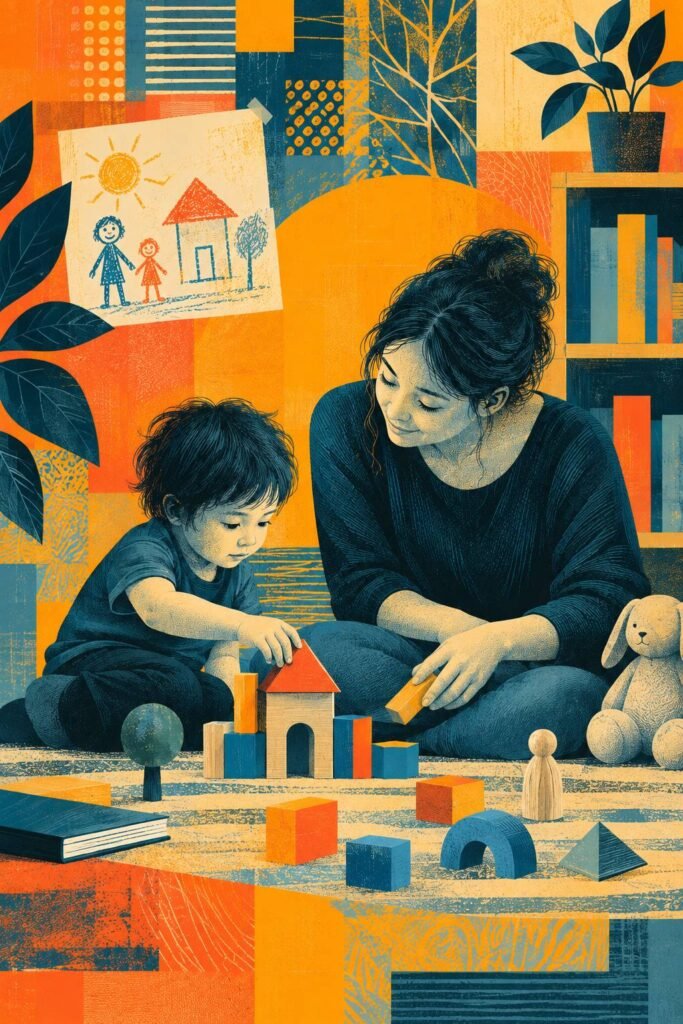
Attachment-based play therapy addresses this directly. By creating, within the therapeutic relationship, the experience of a consistently available, consistently attuned, consistently responsive adult — and by involving the parent in the therapeutic process in ways that repair and strengthen the primary attachment relationship — it provides the child with the specific relational evidence their internal working model is missing. Not through explanation. Through experience. Repeated, embodied, emotionally resonant experience of safety within relationship.
The Role of the Parent
One of the most consistent findings across the research on play therapy for separation anxiety is the significance of parental involvement — not simply as a supportive context but as an active therapeutic ingredient.
Separation anxiety is, by definition, a relational presentation. It exists at the interface between the child’s internal working model and the parent-child relationship that model is built on. An intervention that addresses only the child’s symptom — without attending to the relational dynamic that maintains it — is working on one half of a two-sided system. The most effective play-based approaches for separation anxiety consistently involve the parent directly: in Theraplay, in child-parent relationship therapy, in filial therapy, and in the attachment-based play therapy approaches that the 2024 study confirms are effective.
The parent who participates in the therapeutic work alongside their child is not simply observing or supporting. They are the primary therapeutic medium. The child’s attachment system is calibrated to the specific signals of their specific primary caregiver — and the most powerful update to the internal working model that predicts reliable availability is the direct, repeated, felt experience of that caregiver being reliably available, sensitively responsive, and genuinely engaged in the therapeutic play.
This is why every activity in The Play Therapy Toolbox includes a parent guidance note — because the research is unambiguous that the adult’s involvement in play-based therapeutic work is not supplementary. It is central. The parent who understands what the activity is doing and why, who can bring the right quality of attuned presence to the session, and who carries the therapeutic principles into the ordinary moments of daily life, is providing something that no amount of clinical skill alone can replicate.
What Play Therapy for Separation Anxiety Looks Like in Practice
Play therapy for separation anxiety addresses the presenting difficulty at several levels simultaneously — the child’s anxious cognitions, their regulatory capacity, their internal working model of the attachment figure, and the quality of the parent-child relationship itself.
At the most immediate level, play activities that involve the gradual, supported, positively associated experience of brief separations and reliable reunions within the therapeutic context directly address the core fear. The child who experiences, within the safety of the play frame, that the trusted adult goes and comes back — and that the going is survivable and the coming back is reliable — is accumulating exactly the evidence their internal working model requires.
At the relational level, activities that strengthen the parent-child bond — that create shared positive experiences, that attune parent and child to each other’s signals, that provide the parent with the specific skills for responding sensitively to the child’s attachment cues — address the relational substrate of the anxiety rather than simply the symptom.
At the regulatory level, somatic and sensory activities that engage the body’s parasympathetic system — rhythm, physical contact, predictable routines, the sensory grounding of familiar materials — directly regulate the nervous system’s threat-detection activation and create the conditions of safety within which genuine therapeutic work becomes possible.
And at the narrative level, stories and play themes that involve characters who are temporarily separated and reliably reunited, who manage brief aloneness and discover internal resources, who return to find the attachment figure waiting — provide the child with the symbolic processing of their fear in the most developmentally accessible medium available.

Before You Begin: A Note on Professional Support
Before attempting any play-based activities at home with a child whose separation anxiety is significantly impairing their daily functioning, I would sincerely recommend consulting a qualified mental health professional experienced in childhood anxiety and attachment-based approaches. The research confirms that play therapy for separation anxiety is most effective when delivered within a structured therapeutic framework — and particularly when parental involvement is guided by a professional who can assess the specific attachment dynamics at play and support the caregiver in responding most helpfully to the child’s signals.
Play Therapy for Separation Anxiety: The Play Therapy Toolbox
The Play Therapy Toolbox: 123 Simple Play Therapy Activities and Therapeutic Games Supporting Every Stage of Child Development from Age 3 to 12 was built around the understanding that separation anxiety, like all anxiety presentations in children, needs to be addressed at the level where it actually lives — in the attachment system, in the nervous system, and in the relational field between child and caregiver — rather than simply at the level of the visible symptom.
The anxiety and attachment chapters address the full range of what separation anxiety looks like across the developmental stages: the preschooler for whom every goodbye is a crisis, the school-age child whose anxiety has begun to impair attendance and social functioning, the child whose separation anxiety is rooted in a specific loss or disruption, and the child whose anxiety is maintained by an interactional pattern between parent and child that, without professional support, inadvertently reinforces the very fear it is trying to soothe.
Every activity comes with a therapeutic rationale grounded in peer-reviewed research, step-by-step guidance on how to conduct the session and exactly what to say, questions to use with the child, and a parent guidance note that translates the therapeutic principles into the language of everyday parenting — because the research is clear that the work that happens in the session is only as effective as the relational environment that surrounds it. And a comprehensive annex cross-references all 123 activities by presenting condition, age group, and page number — so you can navigate directly to the right tool for the right child at the right moment, without searching.
Three Things Worth Knowing
Separation anxiety is an attachment system response, not a behavioural choice.
The most important reframe available to any adult supporting a child with separation anxiety is this: the child who panics at separation is not manipulating, performing, or choosing to be difficult. Their nervous system has genuinely concluded, based on the best evidence available to it, that separation is dangerous. The therapeutic task is not to change the behaviour — it is to provide the nervous system with new, reliable, embodied evidence that safety is available both within and beyond the primary attachment relationship. Play therapy for separation anxiety works because it delivers that evidence in the only medium that the attachment system actually receives: relational experience.
The parent’s regulated presence is the most powerful intervention available.
Every piece of research reviewed in this article converges on the same finding: parental involvement is an active ingredient of effective play therapy for separation anxiety, not a supplementary factor. The parent who can remain regulated, warm, and genuinely confident — rather than anxious themselves about the child’s distress — at the moment of separation is providing their child’s nervous system with co-regulatory information that is more powerful than any technique. The child who sees that the parent can hold the separation calmly has evidence that the separation is survivable. That evidence, accumulated across many small moments of calm, confident parting, is what gradually recalibrates the anxiety.
Reunion matters as much as separation.
One of the most consistent findings in the attachment and separation anxiety research is that what happens at reunion is as therapeutically significant as what happens at separation. A reunion that is warm, specific, and genuinely attuned — one that communicates I was thinking of you and I am glad to be back — provides the child with the most direct possible evidence that the attachment figure reliably returns and that the return is worth waiting for. The activities in the Toolbox are the structure. You are the reunion that makes the separation worth surviving.
Available Now for $5.99 — For a Limited Time
If this exploration of play therapy for separation anxiety gave you a sense of what becomes possible when a child’s attachment system is given the specific relational evidence it has been missing, The Play Therapy Toolbox gives you 123 more tools built on the same foundation. The ebook is available now on Amazon at $5.99 for a limited time — with immediate access to 123 activities and 75+ full-colour printable worksheets for children aged 3 to 12.
Play is not preparation for life. It is life — in its most honest, most essential, most healing form.


Rostislava Buhleva-Simeonova is a psychologist and game design specialist. She has worked with children, adults, and the elderly within various therapeutic programmes over the past eight years, all the while providing the much-needed playful twist that art and gamified experiences can bring to this sometimes uneasy setting. But it wasn’t until the birth of her daughter, Aurora, that this work took on an even deeper personal meaning. With her academic and real-life experience, honed through numerous trainings and sessions, she is currently authoring books and articles in the field of child psychology and development, offering expertise in art and play therapy to guide parents and caregivers, as well as professionals in the fields of social work and mental health, throughout various pivotal moments in children’s lives. Last but not least, all of her books have been “peer-reviewed” by her daughter, who testifies to the efficiency of these methods.
Disclaimer: This article is intended as an educational and supportive resource for parents, caregivers, educators, and mental health professionals. It is not intended to diagnose, treat, or replace professional therapeutic or medical care. If a child is experiencing significant emotional, behavioural, or developmental difficulties, please seek guidance from a qualified mental health professional.
References
Kaviani, R., & Hekmatipur, N. (2024). Effect of Theraplay-based play therapy on separation anxiety in elementary school girls: A randomized controlled trial. Journal of Gorgan University of Medical Sciences, 26(4), 29–37.
Kavoussi, P., & Moghadam, H. E. (2024). The effect of art therapy on problem-solving skills, self-concept, and interpersonal relationships in children with separation anxiety disorder in Tehran. Iranian Journal of Neurodevelopmental Disorders, 3(4), 90–98.
Mehrabi, A., et al. (2024). The effectiveness of sand play therapy on social skills and adaptation of children with separation anxiety. Iranian Journal of Educational Research, 3(2), 145–156. https://doi.org/10.22034/3.2.145
Najmi, M., et al. (2024). Comparing the effectiveness of attachment-based play therapy and parent-child relationship therapy on the psychological well-being of children with separation anxiety disorder. Journal of Psychological Science, 23(140), 123–144. https://doi.org/10.61186/jps.23.140.123
Najmi, M., Ghorban Jahromi, R., Sadipour, E., & Karimzadeh, M. (2025). Comparing the effectiveness of attachment-centred Theraplay and child-parent relationship play therapies on emotion regulation in children with separation anxiety disorder. Journal of Childhood Health and Education, 5(4), 184–195.
Qutishat, M., et al. (2026). Effectiveness of therapeutic and educational interventions for childhood separation anxiety: A scoping review. Journal of Paediatrics and Child Health. https://doi.org/10.1111/jpc.70492
Razzaghi, S., et al. (2025). Comparative effectiveness of attachment-based play therapy and cognitive behavioral therapy on separation anxiety and parent-child relationship in children. International Journal of Body, Mind and Culture, 12(5). https://ijbmc.org/index.php/ijbmc/article/view/928
Zarra-Nezhad, M., Pakdaman, F., & Moazami-Goodarzi, A. (2023). The effectiveness of child-centered group play therapy and narrative therapy on preschoolers’ separation anxiety disorder and social-emotional behaviours. Early Child Development and Care, 193(6), 841–853. https://doi.org/10.1080/03004430.2023.2167987