
Every parent has sat with a child who is clearly carrying something and cannot find the words for it. Not because they are unwilling to talk. Not because they lack the intelligence. But because what they are carrying was never stored in language in the first place — it arrived before words were available, or through an experience so overwhelming that the thinking, talking part of the brain was simply not the part most involved.
What Sandplay Therapy for Children Actually Is
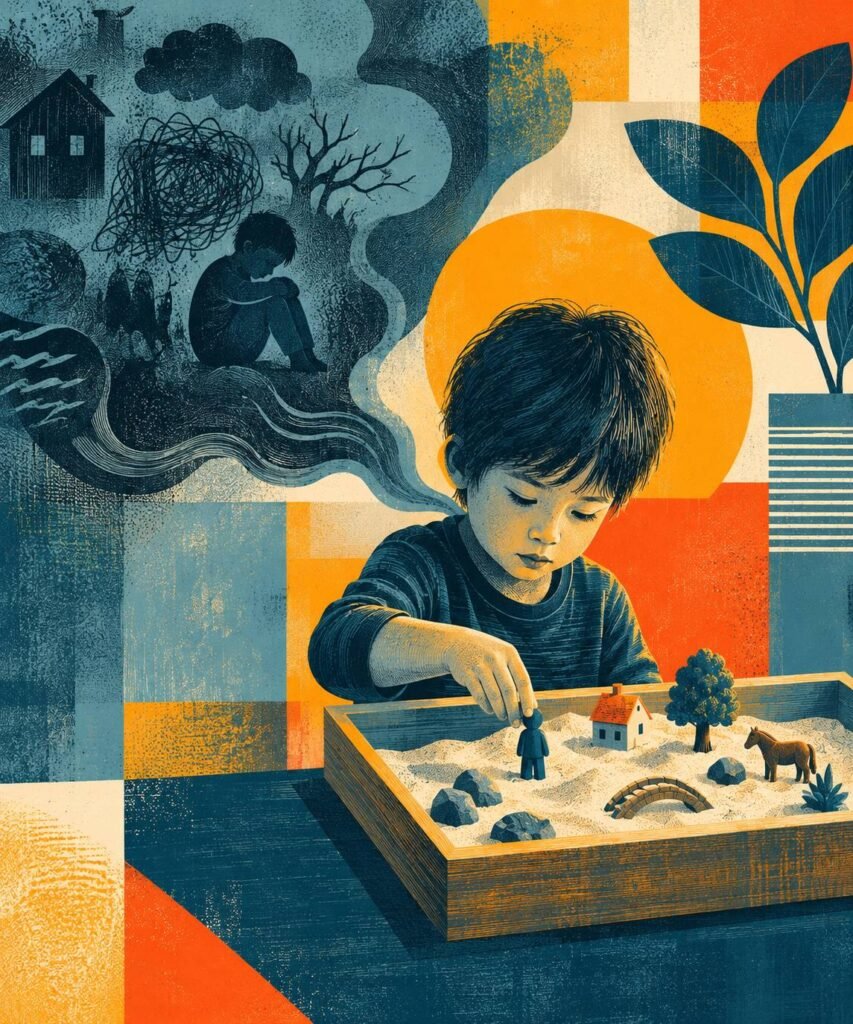
Sandplay therapy is a play-based therapeutic approach developed by Dora Kalff in the 1950s and 1960s, drawing on Jungian psychology, Lowenfeld’s World Technique, and influences from Eastern philosophy. In practice, it provides the child with a tray of sand and a collection of miniature figures — people, animals, trees, houses, vehicles, bridges, mythical creatures, natural objects — and invites them to create a world.
That invitation is the whole of the approach, and it is considerably more than it appears. The world the child creates is not simply a creative exercise. It is the primary therapeutic medium for children whose most significant experiences are not yet available in words — who carry something that is shaping their behaviour, their sleep, their relationships, and the quality of their watchfulness, but that they cannot yet bring into the room through language.
The sand is sensory and grounding. The figures provide symbolic form — a way of representing people, relationships, threats, and possibilities without having to name them directly. The tray provides a bounded container — a defined space that is distinct from both the child’s inner world and the outer environment, making it safe enough to put difficult things in. And the non-directive approach — the child decides everything about the world they create — restores to them the sense of agency that overwhelming experience most reliably removes.
A 2025 review published in ScienceDirect, examining forty years of sandplay therapy research, confirmed that sandplay therapy is effective with children across a wide range of presentations — particularly in trauma recovery, developmental concerns, adolescent social functioning, and self-awareness. The growing use of randomised controlled trials in sandplay research has brought increasing methodological rigour to what was previously a largely qualitative evidence base.
The Research Finding That Matters Most
A 2026 paper published in Human Arenas by Springer Nature made an argument that is important for any parent or professional trying to understand why sandplay therapy works — and why it works for children for whom other approaches have not.
The paper argued that what a child cannot say about their experience is not necessarily out of reach therapeutically. The assumption that the route into a child’s inner world must go through language has shaped therapeutic practice in ways that consistently disadvantage the children who most need support: the youngest, the most severely affected, and those whose experience was most overwhelming and most pre-verbal in nature.
Sandplay provides a different route. It works through three specific mechanisms that are worth understanding in plain language.
The first is giving the experience a form. When a child places a figure in the sand, buries something, builds a barrier, or arranges a scene — they are representing something from their inner world in a visible, workable form outside their body. They do not need to know what they are representing. The act of making something visible is itself therapeutic — it moves the experience from inside, where it is formless and overwhelming, to outside, where it has edges and can be approached.
The second is protective distance. The child in a sandtray is working with it — the figure, the scene, the world in the tray — not with I. That distance is not avoidance. It is the condition that makes genuine engagement with difficult material possible. A child who cannot approach a frightening experience directly can very often approach it through a figure — and that approach, however indirect, is real therapeutic work.
The third is restored agency. Trauma removes the child’s sense of control — something happened that they could not stop or escape. In the sandtray, this is reversed. The child is the maker and modifier of their own world. They decide what goes in, what happens, and what changes. That reversal — from the person to whom things happened, to the person who authors what happens — is one of the most powerful things sandplay offers. And it is something that verbal approaches alone cannot replicate with the same directness.
What the Research Confirms
The evidence base for sandplay therapy for children has grown substantially in the past few years — across diverse populations, types of trauma, and clinical settings.
A 2022 meta-analysis of sandplay therapy outcomes, published by the Association for Play Therapy, found meaningful treatment effects across the range of presentations most commonly brought to sandplay: trauma, anxiety, emotional and behavioural difficulties, and developmental concerns. The analysis confirmed sandplay therapy as a legitimate, evidence-supported intervention with measurable outcomes across diverse child populations.
A 2024 systematic review published in the World Journal for Sand Therapy Practice examined sandplay and sandtray therapy specifically for trauma in children and adolescents. The review confirmed significant improvements in post-traumatic symptoms, internalising problems such as anxiety and withdrawal, and externalising problems such as aggression and acting out — as well as improved wellbeing in children who had experienced collective trauma including natural disasters and conflict.
A 2026 randomised controlled trial — among the most rigorous sandplay studies yet conducted — examined sandplay therapy and art therapy for PTSD in Syrian refugee children in Jordan. One hundred and two children aged five to thirteen with clinically diagnosed PTSD were randomly allocated across three groups. Both sandplay therapy and art therapy produced significant reductions in PTSD symptoms compared to the control group — with sandplay therapy producing particularly strong effects for the youngest children and for those whose traumatic experience was most acute and most recent.
A 2023 study published in Medicine examined school-based sandplay group therapy for children who were victims of cyberbullying — confirming meaningful improvements in psychological wellbeing and social functioning, and extending the evidence base for sandplay therapy beyond acute trauma into the domain of relational and social harm.
Why Sandplay Reaches What Words Cannot
The research on sandplay therapy for children is consistent on the question of why it works — and the answer connects directly to what we know about how children process and store overwhelming experience.
When something frightening or overwhelming happens to a child, it is processed primarily through the parts of the brain that govern the body’s threat response — not through the parts that generate language and narrative. This means the experience is stored as sensation, image, and felt sense rather than as story. A child who has experienced something traumatic does not primarily hold it as a memory they can tell. They hold it as a physical reality — a tightness, a watchfulness, a set of body-based responses that arrive without warning and do not respond well to explanation or reassurance.
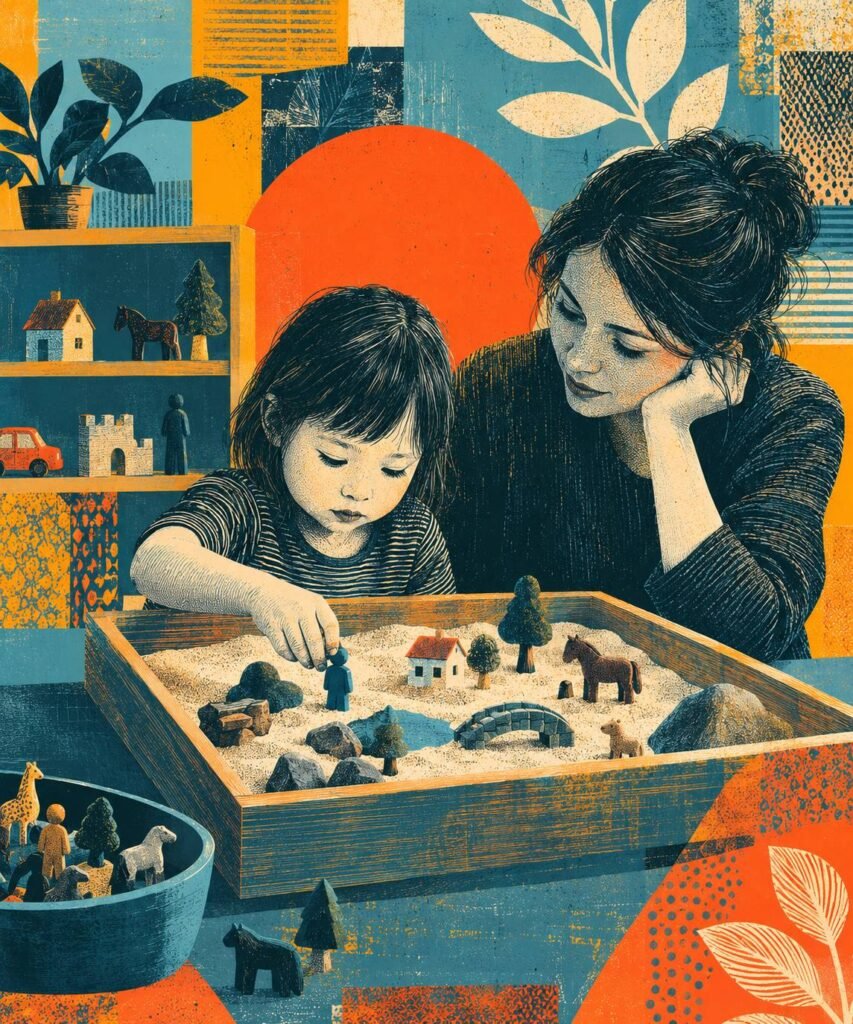
Sandplay therapy reaches this material not by going around it but by working in the same register — sensory, symbolic, spatial, and embodied rather than verbal. The child who cannot talk about what happened can very often show it. And showing it — externalising it in the sand, giving it form, moving the figures, changing what happens in the tray — is genuine therapeutic processing, not a workaround for the real work.
This is why sandplay therapy is particularly effective for young children, for children who have experienced early or relational trauma, and for children who have been through overwhelming events that exceeded the capacity of language to hold. It is also why it can be valuable alongside verbal therapeutic approaches — not as a replacement but as a route into material that verbal processing can then build on as the child becomes more ready and more able.
Sandplay Therapy for Children and The Play Therapy Toolbox
The Play Therapy Toolbox: 123 Simple Play Therapy Activities and Therapeutic Games Supporting Every Stage of Child Development from Age 3 to 12 draws on the sandplay tradition throughout — and specifically on the understanding that symbolic distance, externalisation, and the child’s authorship of their own symbolic world are among the most powerful therapeutic mechanisms available for children whose experience has not yet found its way into words.
The sandplay and symbolic play activities across the Toolbox are built around these principles — providing structured, age-appropriate, developmentally responsive activities that give children a bounded symbolic medium within the safety of a warm, attuned, consistently present adult relationship. Every activity comes with a therapeutic rationale grounded in peer-reviewed research, step-by-step guidance on how to conduct the session and exactly what to say, questions to use with the child, and a parent guidance note that translates the therapeutic principles into the language of everyday parenting.
The trauma and adverse childhood experiences chapters address the full range of presentations that sandplay therapy is most specifically equipped to reach: the pre-verbal experience of very young children, the collective trauma of children who have experienced disaster or conflict, the relational disruption of children whose attachment relationships have been difficult or harmful, and the fragmented experience of children for whom coherent verbal narrative is simply not yet available.
Before You Begin: A Note on Professional Support
Before attempting any sandplay or symbolic play activities at home with a child who has experienced significant trauma, I would sincerely recommend consulting a qualified mental health professional. Sandplay therapy is most safely and most effectively delivered within a professional therapeutic relationship — one that can hold and respond to what emerges from the child’s symbolic world with the clinical training that complex trauma material requires. The activities in the Toolbox are designed to be accessible to non-specialist adults, but they work best as part of a broader support plan that includes professional guidance where it is needed.
Three Things Worth Knowing
What a child cannot say, they can often show.
The most important thing any adult can understand about sandplay therapy for children is that the absence of words does not mean the absence of access. A child who cannot talk about what happened can very often place something in a tray that represents it — and that placing is not a lesser version of the therapeutic work. It is the therapeutic work, in the form that is most naturally available to this child at this moment. The sandtray does not wait for words. It works with what is already there.
The protective distance of the story is what makes the engagement possible.
Every adult who sits with a child in sandplay — or in any symbolic play context — needs to understand that the it rather than the I is not a barrier to be dismantled. The child who works through a figure is approaching genuine material at a distance that makes the approaching possible. That distance is the condition of the engagement, not an obstacle to it. Stay inside the world the child has created. Do not rush them toward the personal. What is in the tray is already personal enough.
You are the most important tool in the room.
The sand and the figures provide the medium. You provide the relational safety within which the medium can be used honestly. The research on sandplay therapy consistently identifies the quality of the adult’s presence — warm, non-intrusive, genuinely interested, and steady in the face of whatever the child brings into the tray — as a primary moderator of how effective the work is. The world in the sand is the child’s. Your regulated, unhurried presence is what makes it safe enough to build.
Available Now for $5.99 — For a Limited Time
If this exploration of sandplay therapy for children gave you a sense of what becomes possible when children are given a symbolic medium in which the experience that has no words can finally find a form, The Play Therapy Toolbox gives you 123 more activities built on the same foundation. The ebook is available now on Amazon at $5.99 for a limited time — with immediate access to 123 activities and 75+ full-colour printable worksheets for children aged 3 to 12.
Play is not preparation for life. It is life — in its most honest, most essential, most healing form.

Disclaimer: This article is intended as an educational and supportive resource for parents, caregivers, educators, and mental health professionals. It is not intended to diagnose, treat, or replace professional therapeutic or medical care. If a child is experiencing significant emotional, behavioural, or developmental difficulties, please seek guidance from a qualified mental health professional.

Rostislava Buhleva-Simeonova is a psychologist and game design specialist. She has worked with children, adults, and the elderly within various therapeutic programmes over the past eight years, all the while providing the much-needed playful twist that art and gamified experiences can bring to this sometimes uneasy setting. But it wasn’t until the birth of her daughter, Aurora, that this work took on an even deeper personal meaning. With her academic and real-life experience, honed through numerous trainings and sessions, she is currently authoring books and articles in the field of child psychology and development, offering expertise in art and play therapy to guide parents and caregivers, as well as professionals in the fields of social work and mental health, throughout various pivotal moments in children’s lives. Last but not least, all of her books have been “peer-reviewed” by her daughter, who testifies to the efficiency of these methods.
References
Al-Fakih, A., et al. (2026). Healing beyond words: A randomized controlled trial of sandplay and art therapies for PTSD among Syrian refugee children in Jordan. International Journal of Pediatrics. https://pmc.ncbi.nlm.nih.gov/articles/PMC13250694/
Benito Herce, N., Ochoa de Alda, I., & Gonzalo Marrodán, J. L. (2024). Sandtray and sandplay in the treatment of trauma with children and adolescents: A systemic review. World Journal for Sand Therapy Practice, 2(1). https://doi.org/10.58997/wjstp.v2i1.74
Dong, X., et al. (2025). Forty years of sandplay therapy research: A systematic review with insights into emerging digital applications. Arts in Psychotherapy. https://www.sciencedirect.com/science/article/abs/pii/S0197455625000644
Human Arenas. (2026). Beyond language: Sandplay, symbolization, and the externalization of childhood trauma. Springer Nature. https://doi.org/10.1007/s42087-026-00640-z
Lee, M. B., et al. (2023). Effects of school sandplay group therapy on children victims of cyberbullying. Medicine, 102(14), e33469. https://doi.org/10.1097/MD.0000000000033469
Narrative review of sand-based therapy in pediatrics. (2026). PubMed. https://pubmed.ncbi.nlm.nih.gov/41743441/
Parker, M. M., Hergenrather, K., Smelser, Q., & Kelly, C. T. (2020). Exploring child-centered play therapy and trauma: A systematic review of literature. International Journal of Play Therapy, 30(1), 2–13. https://doi.org/10.1037/pla0000136
Wiersma, J. K., Freedle, L. R., McRoberts, R., & Solberg, K. B. (2022). A meta-analysis of sandplay therapy treatment outcomes. International Journal of Play Therapy. https://www.researchgate.net/publication/359637073