
Every parent has had that moment. Your child is standing in front of something new — a challenge, a transition, an opportunity — and instead of reaching for it, they pull back. The child who decides they are not a maths person before they have genuinely tried. The one who says they are bad at drawing before the pencil has touched the paper. Identity is not something children arrive with fully formed. It is something they build — slowly, relationally, through the accumulated experience of being seen, being heard, and being given repeated opportunities to imagine themselves into a future that feels genuinely possible. A well-designed set of self-esteem and identity worksheets for kids does not tell a child who they are. It creates the conditions in which they can begin to work that out for themselves.
What Identity Actually Is in Childhood
Erik Erikson described the central developmental tension of middle childhood as competence versus inferiority — the child’s urgent, internal question of whether they are capable, whether they measure up, whether they belong in the world of doing, achieving and becoming. It is asked constantly, across every new encounter, every unfamiliar challenge, every moment of comparison with a peer. And the answers a child accumulates across these moments become, over time, the story they tell about themselves.
That story is not fixed. This is perhaps the most important thing to understand about identity in childhood: it is still being written. A child who currently believes they are not clever, not creative, not brave, not interesting, has not arrived at a permanent truth about themselves. They have arrived at a provisional conclusion based on the evidence available to them so far. And the right tool, used at the right moment, can introduce new evidence — quietly, through play, without argument or persuasion — that begins to revise the story from the inside.
This is precisely what self-esteem and identity worksheets for kids, at their best, are designed to do.
The Language Children Were Born Speaking
Children do not build identity through reflection alone. They build it through doing — through drawing and making and imagining, through the physical experience of putting something on paper and watching it take shape. They do not arrive at a sense of who they are by thinking about it quietly. They arrive at it through the stories they tell, the creatures they choose to become, the futures they allow themselves to draw.
The developing brain processes emotional and identity-related experience through the right hemisphere long before the left hemisphere’s language centres are mature enough to put it into words. What a child draws in a moment of genuine imaginative freedom is often closer to the truth of how they see themselves — and how they hope to see themselves — than anything they could produce in response to a direct question.
This is why self-esteem and identity worksheets for kids built around visual, imaginative, and expressive prompts are so consistently effective. They do not ask the child to analyse or explain or justify their sense of self. They ask them to draw it. And in drawing it, something shifts — because the act of giving the future a visible form is itself the beginning of believing it might be real.
Free Self-Esteem and Identity Worksheets for Kids: My Future
The worksheet below — My Future — is a free resource you can use with your child today. It is suitable for children aged approximately 6 to 12, and works equally well at home, in school, or in a therapeutic setting. It is open, spacious, and built around one of the most therapeutically rich prompts available to work with children on questions of identity and self-belief: the future self.
What makes this one of the most effective self-esteem and identity worksheets for kids is the particular therapeutic power of future-self visualisation. When a child draws their future self, they are not simply fantasising. They are constructing a narrative identity — a story about who they are in relation to who they might become. Research in narrative psychology consistently shows that the stories people tell about their future selves have measurable effects on their present motivation, resilience, and self-belief. For children, this effect is particularly pronounced, because the future self has not yet accumulated the disappointments and comparative failures that can narrow an adult’s sense of possibility.
The crystal ball, as a frame, does something additionally important. It positions the child not as someone being assessed or guided toward the right answer, but as someone who already has access to something the adult does not — a private, magical window into a future that belongs entirely to them. That repositioning of authority, from adult to child, is itself therapeutically significant.

How to Use It
Place the worksheet in front of your child with a simple, open introduction — something warm and genuinely curious, without direction or suggestion: “This crystal ball shows your future. I wonder what you’ll see in there. Would you like to draw what you see? There is no right or wrong way to do it, only your way.” Then step back. If necessary, give gentle non-directive prompts in the form of a question – where is the child, who is there with them, what are they doing, how do they feel, etc. The drawing phase is not a warm-up to the real activity — it is the real activity. What the child draws, how they draw it, what they include and what they leave out, all of it is information worth holding gently.
Once the drawing is complete, explore it together with more open, unhurried questions:
- Tell me about what you drew — what is happening in there?
- Where are you in this picture?
- What does the person in the crystal ball feel like?
- Is there anything in the ball that surprised you — something you didn’t expect to draw?
- What would need to happen for this to become real?
That last question is offered gently and without pressure. For some children it will open a rich practical conversation. For others it will remain inside the frame of the magical — and both are entirely right. The crystal ball is not a goal-setting exercise. It is a space for the child to discover, through drawing, what they are already reaching toward. The most important thing is not the answers. It is the quality of attention you bring to hearing them.
What to Listen For
The crystal ball drawing is a projective exercise as much as a future-visualisation one, and learning to receive it with the right kind of attention is one of the most useful skills an attuned adult can develop.
A child who draws themselves surrounded by people — friends, family, a crowd — is telling you something about belonging and connection. A child who draws themselves alone in a vast landscape may be reaching toward freedom, autonomy, or simply quiet. A child who draws themselves doing something — performing, building, healing, creating — is telling you about the activities through which they locate their sense of worth and capability. A child who leaves the ball mostly empty, or fills it with abstract colour rather than a specific scene, may not yet have permission — internal or external — to imagine a future that feels genuinely theirs.
None of these observations should be offered directly to the child. The skill is not interpretation but curiosity — staying genuinely interested in what is in the ball without collapsing the imaginative frame by bringing it too close to the present reality. The crystal ball is a door. The adult’s job is simply to stand at the threshold and ask, with warmth and without agenda, what is on the other side.
For Deeper Work: The Play Therapy Toolbox
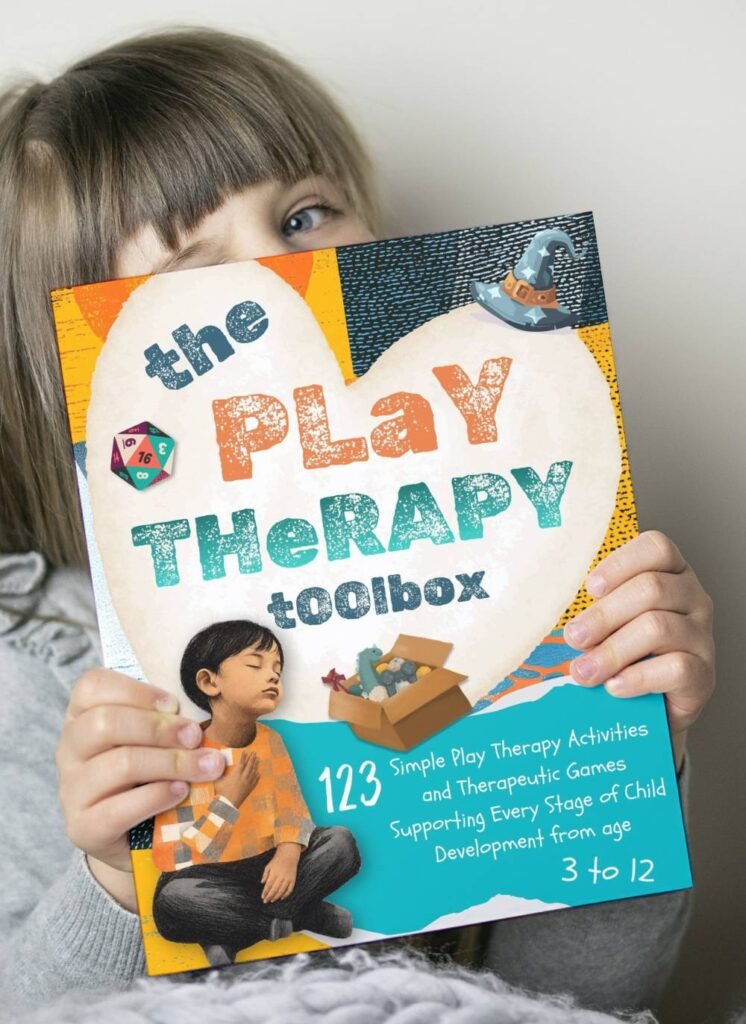
My Future is one example of the kind of identity-centred, future-focused tool that sits at the heart of The Play Therapy Toolbox: 123 Simple Play Therapy Activities and Therapeutic Games Supporting Every Stage of Child Development from Age 3 to 12 — a book built around the understanding that children speak in a language adults often forget they once spoke fluently themselves.
The book contains 123 activities spanning role-play, enactment, fantasy storytelling, somatic exercises, and gamified experiences, alongside 75+ printable, downloadable, full-colour worksheets designed to support and extend each activity. Every activity comes with a therapeutic rationale grounded in peer-reviewed research, step-by-step guidance on how to conduct the session and what to say, questions to use with the child, and a parent guidance note written in the same warm, accessible language as this article.
The activities are built around four dedicated chapters — one for Age 3, one for Ages 4–6, one for Ages 7–9, and one for Ages 10–12 — each opening with a developmental overview that traces the key milestones, common emotional challenges, and neurological realities most relevant to that stage. The worksheets increase in complexity, abstraction, and emotional depth as the child’s capacity grows. And a comprehensive annex cross-references all 123 activities by presenting condition, age group, and page number — so you can navigate directly to the right tool for the right child at the right moment, without searching.
Three Things Worth Knowing Before You Begin
The future self is already present.
Any self-esteem and identity worksheets for kids built around future visualisation work best when the adult understands what is actually happening in the drawing: the child is not imagining a stranger. They are imagining a version of themselves that already exists somewhere inside them — one that has not yet been given permission to be visible. Receiving that image with genuine interest and warmth is, in itself, a powerful act of therapeutic validation.
Regular use builds more than crisis use.
Identity is not built in a single session or a single drawing. It is built through the patient, consistent accumulation of experiences in which the child is invited to imagine themselves as capable, as worthy, as someone whose future is genuinely worth picturing. A child who returns to the crystal ball across weeks and months will find that what appears in it changes — and that those changes are some of the most reliable indicators of growth available to any adult paying attention.
You are the most important tool in the room.
Children build identity primarily through the eyes of the adults who matter most to them — through the experience of being seen clearly, being valued consistently, and being given, repeatedly and without conditions, the message that their future is something worth looking forward to. Sit down. Draw your own crystal ball. Let them see what you put in it.
Available Now for $5.99 — For a Limited Time
If these free self-esteem and identity worksheets for kids gave you a sense of what becomes possible when children are met in their own language, The Play Therapy Toolbox gives you 123 more tools built on the same foundation. The ebook is available now on Amazon at $5.99 for a limited time — with immediate access to 123 activities and 75+ full-colour printable worksheets for children aged 3 to 12.
Play is not preparation for life. It is life — in its most honest, most essential, most healing form.
Disclaimer: This article is intended as an educational and supportive resource for parents, caregivers, educators, and mental health professionals. It is not intended to diagnose, treat, or replace professional therapeutic or medical care. If a child is experiencing significant emotional, behavioural, or developmental difficulties, please seek guidance from a qualified mental health professional.



Rostislava Buhleva-Simeonova is a psychologist, art and play therapist, and gamificator. She has worked with children, adults, and the elderly within various therapeutic programmes over the past eight years, all the while providing the much-needed playful twist that art and gamified experiences can bring to this sometimes uneasy setting. But it wasn’t until the birth of her daughter, Aurora, that this work took on an even deeper personal meaning. With her academic and real-life experience, honed through numerous trainings and sessions, she is currently authoring books and articles in the field of child psychology and development, offering expertise in art and play therapy to guide parents and caregivers, as well as professionals in the fields of social work and mental health, throughout various pivotal moments in children’s lives. Last but not least, all of her books have been “peer-reviewed” by her daughter, who testifies to the efficiency of these methods.