
Every parent has encountered the moment when words are simply not enough. The child who is too activated to hear what is being said. The one who is too shut down to respond to what is being offered. The one who needs something that reaches them below the level of language — in the body, in the breath, in the movement of limbs and the sound in the throat — before any of the talking can find its way in.
Children do not live primarily in their heads. They live in their bodies — in the felt sense of what is happening right now, the physical reality of a nervous system that is activated or collapsed or somewhere in between, the urgent bodily knowledge of a feeling that does not yet have a name. And the most direct route to a child who is dysregulated is not through the mind. It is through the body itself.
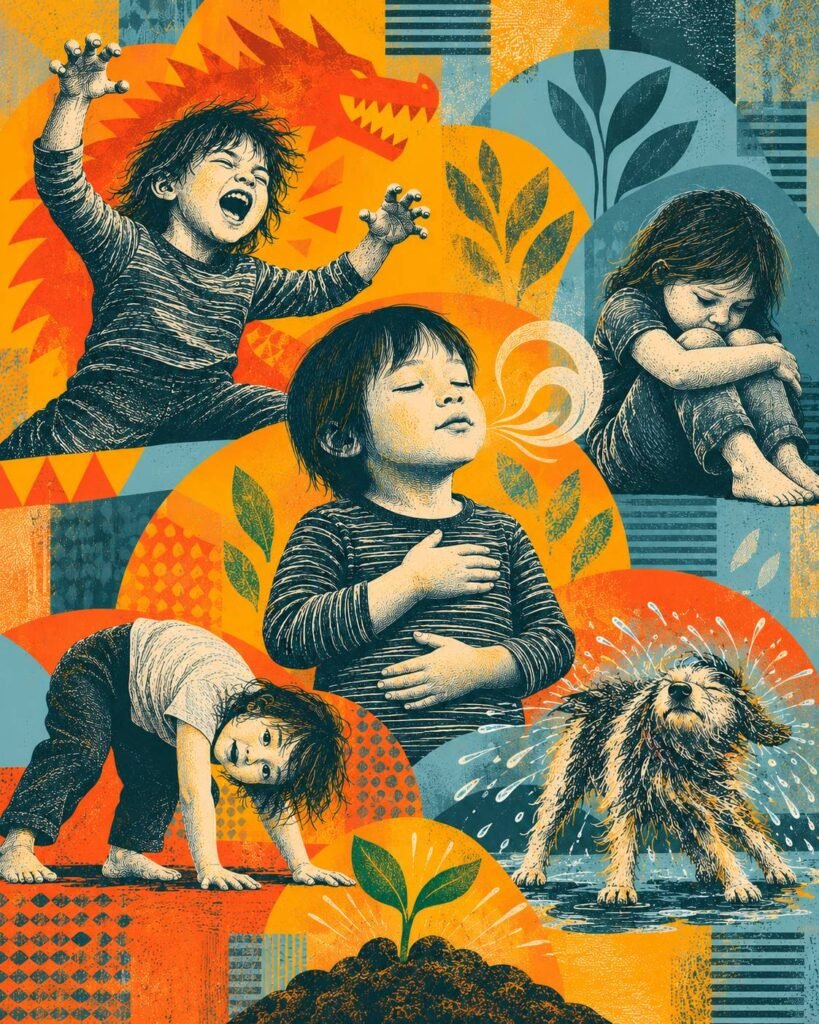
Somatic exercises for kids — body-based, movement-centred, sensory and symbolic activities that work directly with the nervous system — are one of the most evidence-supported and most underused tools available to any adult who supports children through emotional difficulty. And when those exercises are wrapped in story and symbol — when the child does not simply do a breathing technique but becomes a dragon waking from a long sleep, a seed pushing through dark earth, a wet dog shaking off the lake — something additional happens. The imagination and the body work together, each amplifying what the other produces, in the way that children have always learned best.
The four exercises in this article are drawn from the somatic play therapy tradition — rooted in Peter Levine’s Somatic Experiencing framework, Stephen Porges’ polyvagal theory, and the body-based play therapy approaches developed by Maggie Kline, Lisa Dion, and others who have brought somatic work into the playroom. Each one is a story the child enters with their whole body. Each one addresses a distinct nervous system state. And each one is designed to be offered by a non-specialist adult — a parent, a carer, an educator — in the ordinary moments of daily life.
Why the Body Comes First
The nervous system responds to experience before the thinking brain has had a chance to evaluate it. When something activating, overwhelming, or simply too big for the moment arrives, the amygdala fires, the stress hormones release, and the body prepares for action — all before a single conscious thought has formed. This is not a malfunction. It is the nervous system doing exactly what it was designed to do.
Stephen Porges’ polyvagal theory describes the autonomic nervous system as operating in a hierarchy of three states. The ventral vagal state — the state of safety, social engagement, and genuine connection — is where learning, play, and therapeutic change happen. The sympathetic state — fight or flight — is where activation, urgency, and the need for discharge live. And the dorsal vagal state — freeze and shutdown — is where collapse, withdrawal, and disconnection from the world occur.
Somatic exercises for kids work because they directly target the pathways through which the nervous system moves between these states — not through cognitive effort but through the body’s own language of breath, movement, rhythm, and physical sensation. And when those pathways are wrapped in story and symbol, they become available to children as young as three — because the story is the child’s natural cognitive medium, and the body is their natural therapeutic one.
Peter Levine and Maggie Kline, in their foundational work on somatic approaches to childhood trauma, confirmed that children who are given body-based tools for completing the stress response cycle — for discharging activation, restoring groundedness, and returning to the felt sense of safety — show measurably better regulatory outcomes than those who receive only verbal or cognitive support. The body needs to complete what it started. These four exercises help it do that.
Four Somatic Exercises for Kids
1. The Sleeping Dragon — Stomp and Roar
The somatic state it addresses: Sympathetic activation — the built-up energy of frustration, unexpressed anger, or the feeling of being too big for the space one is in. Active discharge, self-expression, and the reclamation of power.
The story:
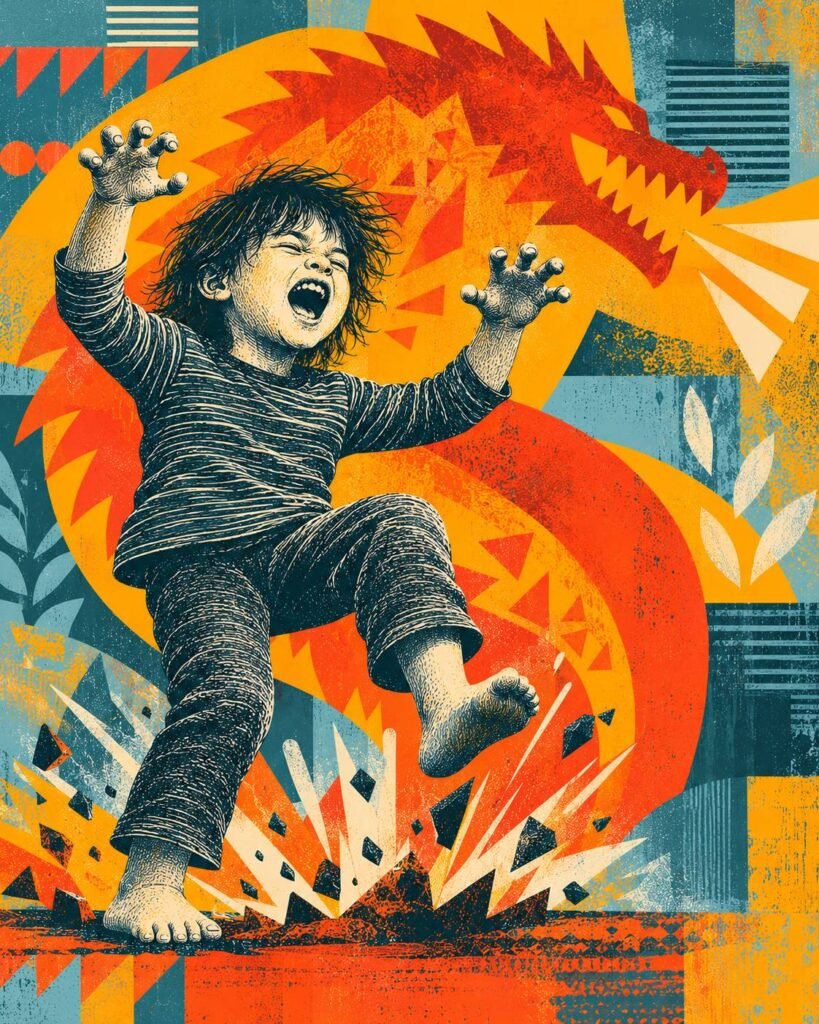
“Did you know that deep inside you, there is a dragon? Not a scary dragon — your dragon. And sometimes your dragon has been sleeping for too long, or being too quiet, or holding too still. And a dragon that has been still for too long needs to wake up.
Let’s wake your dragon up.
Start with the tail — down at your feet. Stomp once. Feel that? The dragon’s tail is moving. Now stomp again — the legs are waking up. Stomp, stomp — the belly is rumbling. Stomp, stomp, stomp — the wings are stretching. Now the neck is rising. Now the great head is lifting.
Your dragon is awake. Take a big breath in — fill all the way up — and when you are ready — ROAR.
Not because you are angry. Because you are alive. Because your dragon is awake. Because the world needs to hear your voice today.
How does your body feel now?”
Why it works: The stomping sequence completes the sympathetic activation cycle from the bottom of the body upward — following the same discharge pathway that Levine identifies in animals following threat responses. The roar discharges the vagal brake and activates the ventral vagal social engagement system simultaneously — power and voice together. Children who feel silenced, small, or overwhelmed by circumstances beyond their control find particular relief in this exercise, because it restores the embodied sense of agency and self-expression that dysregulation most reliably removes.

2. The Little Seed — Tree Pose with Storm
The somatic state it addresses: Dorsal vagal collapse — shutdown, withdrawal, the feeling of being small and overwhelmed. Grounding, interoception, and the gradual restoration of upright aliveness — with resilience built in through the storm.
The story:
“You are a tiny seed. Curl up as small as you can — right down on the ground, or sitting, or however small feels right. You are underground, in the dark, in the quiet. It is warm there. You are safe there.
But something is beginning to happen. Slowly — very slowly — something is pushing downward. Those are your roots. Feel them reaching down, down into the earth, finding their way. Now something is pushing upward too — slowly, slowly — a tiny green shoot, pushing up through the soil toward the light.
Begin to uncurl. Rise very slowly — your stem growing taller, your trunk thickening, your branches reaching out, your leaves unfurling one by one. Take your time. A tree does not rush.
Now you are fully grown. Stand tall. Roots deep. Branches wide. Feel the sun on your leaves. Feel the earth under your feet.
And now — the wind comes. A little at first — sway with it. Now stronger — bend with it. Now the full storm — the wind moves through every branch, every leaf, everything is moving — but your roots hold. They always hold. The storm cannot take you down because you are rooted.
The storm passes. The tree stands. Still rooted. Still tall. You bent — but you did not break.
How do your feet feel right now? Your roots?”
Why it works: The sequential rising from the ground upward activates the interoceptive awareness pathways from feet to head — a full-body scan embedded in a growth narrative. The grounding through the feet directly activates the proprioceptive system, which is one of the most reliable routes to dorsal vagal restoration. The storm sequence introduces what Levine calls pendulation — the oscillation between activation and resource — allowing the child to experience genuine challenge while discovering that the roots hold. That discovery is not metaphorical. It is neurological. The child who has stood through the imaginary storm has built the body-based evidence that they can withstand activation without being overwhelmed by it.
3. The Wet Dog — Shake It Out
The somatic state it addresses: Residual stress activation — the accumulated physical tension of a difficult day, a difficult feeling, or the lingering somatic signature of something that has passed but has not yet been released from the body.
The story:
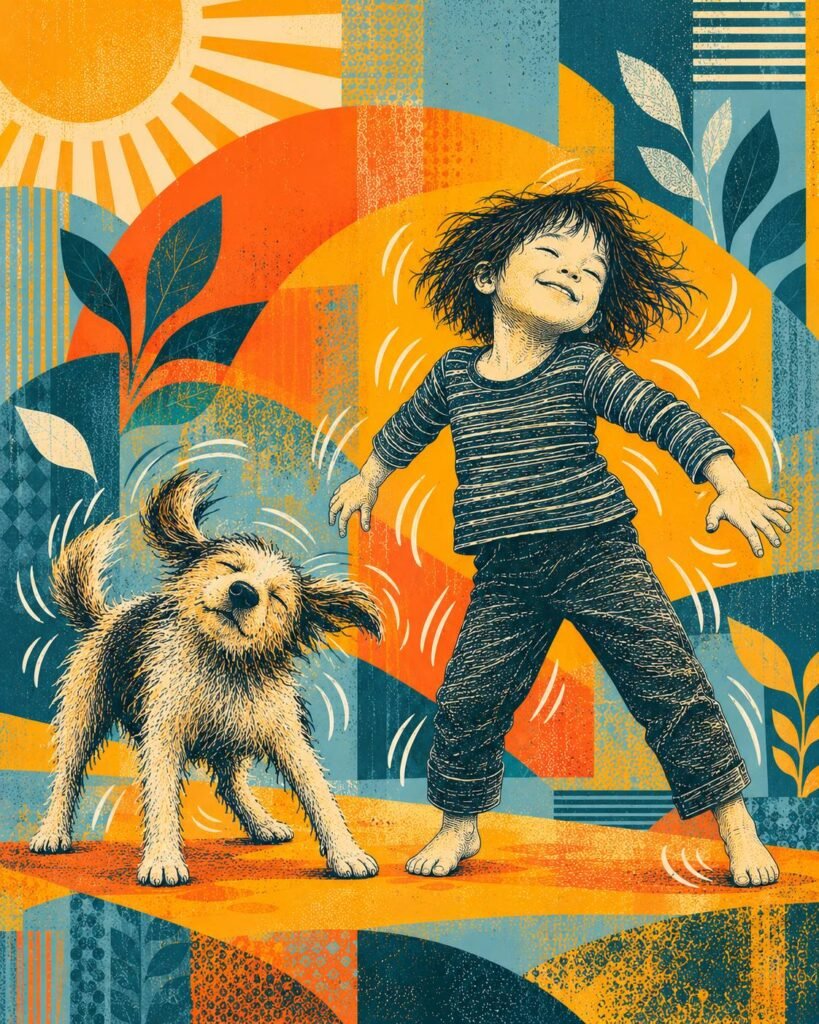
“Have you ever watched a dog shake itself dry after jumping in a lake? It starts right at the tip of the tail — and the shake moves all the way up, through the back legs, the belly, the front legs, the shoulders, the neck, the ears, right to the very end of the nose — until every single drop of water is gone and the dog feels completely, entirely itself again.
You are going to do that now. Not because you are wet — but because sometimes our bodies hold onto things that are ready to be shaken off.
Start at the very bottom — your feet. Shake them. Now your ankles. Now your legs — shake, shake. Now your belly is shaking. Now your arms — shake them all the way to your fingertips. Now your shoulders. Your neck. Your face — shake your cheeks, your nose, everything. Your whole body, all at once — shake, shake, shake, from tail to nose.
Now stop. Stand completely still.
Notice how your body feels right now — in this exact moment, after the shaking. What do you feel?”
Why it works: Shaking is the nervous system’s own natural discharge mechanism — observable across mammalian species following threat responses, and consistently identified by Levine as one of the most direct available routes for completing the interrupted stress response cycle. The bottom-to-top sequence — tail to nose — follows the neurological discharge pathway from the lower body upward, and the stillness that follows the shaking is as therapeutically significant as the shaking itself. It is in that stillness that the child registers the difference between before and after — the body’s own evidence that something has shifted.
4. The Cocoon — Self-Hug and Sway
The somatic state it addresses: The need for containment, self-soothing, and the felt sense of being held — particularly in moments of sadness, loneliness, or the particular vulnerability of a child who needs comfort and does not know how to ask for it.
The story:
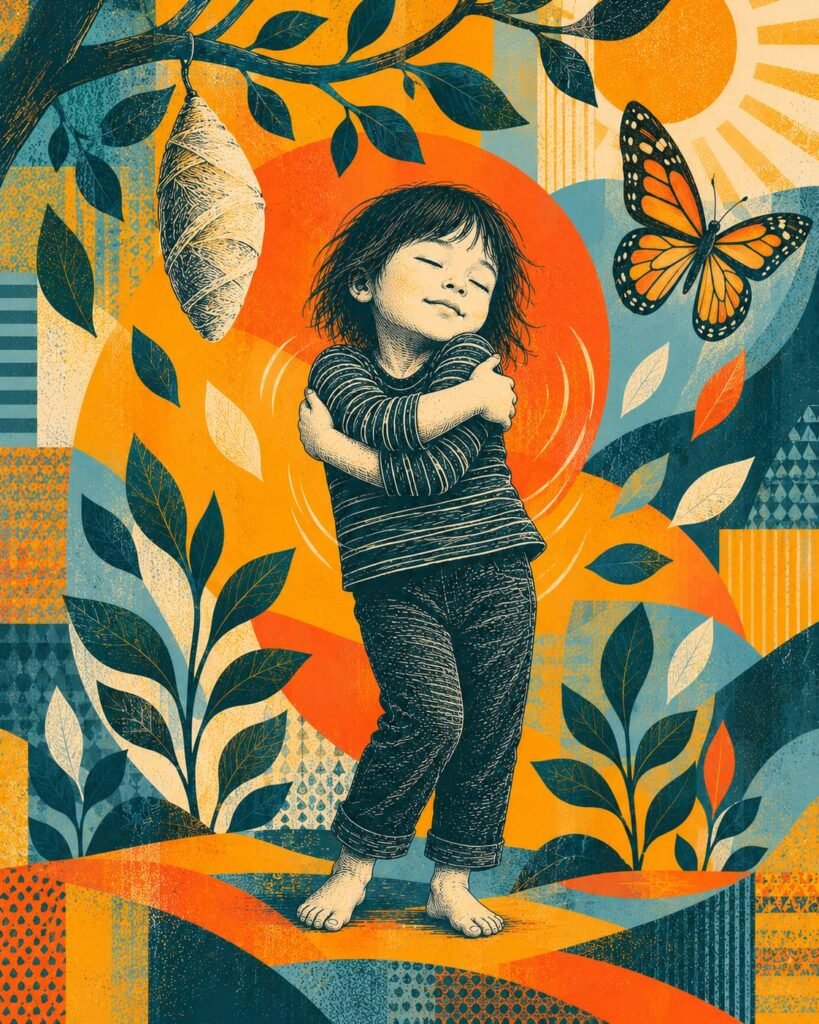
“Do you know what a caterpillar does when it needs to become something new? It wraps itself up. It makes itself a cocoon — warm, dark, safe, completely held. And inside the cocoon, something is happening. Something quiet. Something important. The caterpillar does not need to understand it. It only needs to be held while it happens.
Wrap your arms around yourself now. Hold yourself gently — or tightly, whatever feels right. Begin to sway — slowly, side to side, like a cocoon hanging from a branch in a gentle breeze.
Breathe slowly. Let yourself be held — by your own arms, by your own warmth, by the swaying. You do not need to know what is changing. You only need to be here, inside, warm, safe.
Stay as long as you need to.
When you feel ready — just a little ready, not all the way ready — begin to open. Slowly. Arms moving outward, face lifting, opening wider and wider — until you are standing open and light.
You went in as one thing. You came out as something new.
How do you feel right now — in your arms, your chest, your whole body?”
Why it works: The bilateral rhythmic sway activates the vestibular system — one of the most reliable pathways to parasympathetic regulation — while the self-compression of the hug activates the proprioceptive system, providing the sensory input of containment and physical boundary that anxious or dysregulated children most need. The transformation narrative — in as one thing, out as something new — does something additionally significant: it reframes the regulatory experience not as returning to the same state but as emerging into something new. That reframe is particularly valuable for children who are navigating genuine difficulty, for whom the idea of simply going back to how things were is insufficient. The cocoon does not return. It transforms.
How to Use These Exercises
All four exercises work best when they are introduced playfully in calm conditions — not only reached for in moments of acute distress. The child who has played the Sleeping Dragon on a Tuesday afternoon is far more likely to be able to access it on a difficult Friday morning than one who encounters it for the first time mid-meltdown.
Introduce one at a time. Do them together. Enter the story yourself — become the dragon, grow the tree, shake from tail to nose alongside the child. The adult’s embodied, genuinely playful participation is not optional. It is the co-regulatory mechanism that makes the exercise therapeutically effective rather than simply instructional.
During moments of activation, offer the exercise as an invitation rather than an instruction: “Shall we wake your dragon up?” “Would you like to be a cocoon for a bit?” The child’s sense of agency in choosing to enter the story is itself part of the regulation.
And always end with the same question, in whatever words feel natural: “How does your body feel right now?” That question — asked every time, received with genuine curiosity every time — is building the interoceptive awareness that somatic regulation depends on.
For Deeper Work: The Play Therapy Toolbox
These four body stories are drawn from the somatic and movement-based tradition that runs throughout The Play Therapy Toolbox: 123 Simple Play Therapy Activities and Therapeutic Games Supporting Every Stage of Child Development from Age 3 to 12 — a book built around the understanding that regulation always precedes reflection, and that the most effective play therapy reaches the nervous system before it reaches the mind.
The somatic and body-based activities across the Toolbox are built around polyvagal theory, Levine’s Somatic Experiencing framework, and the body-based play therapy approaches of the Synergetic Play Therapy tradition — providing structured, developmentally appropriate activities that engage the body directly, within the safety of a warm, attuned, consistently present adult relationship.
Every activity comes with a therapeutic rationale grounded in peer-reviewed research, step-by-step guidance on how to conduct the session and exactly what to say, questions to use with the child, and a parent guidance note. And a comprehensive annex cross-references all 123 activities by presenting condition, age group, and page number — so you can navigate directly to the right tool for the right child at the right moment, without searching.
Before You Begin: A Note on Professional Support
Before attempting somatic exercises at home with a child who is experiencing significant trauma, dissociation, or acute mental health difficulties, I would sincerely recommend consulting a qualified mental health professional experienced in somatic and trauma-informed approaches. For most children, the exercises described here are safe, playful, and genuinely beneficial — but for children whose nervous systems have been significantly impacted by trauma, somatic work is most safely conducted within a professional therapeutic relationship that can hold and respond to what emerges.
Three Things Worth Knowing
The story is not decoration — it is the mechanism.
The narrative frame of each exercise is not a way of making the technique more palatable for children. It is the mechanism through which the technique works most fully. The child who becomes the dragon is not performing a breathing exercise with a fun theme. They are activating the imaginative and somatic systems simultaneously — and the convergence of those two systems produces a regulatory experience that technique alone does not replicate. The story earns its place not because children need things to be fun but because children think and feel and regulate in story. It is their native language.
Regulation always comes before reflection.
The most important sequence in all somatic work with children is this: body first, then mind. A child in sympathetic activation — flooded, overwhelmed, in the grip of something too large to manage — is not available for the reflective, verbally mediated work that most therapeutic and educational approaches depend on. Offering a somatic story first — completing the physiological stress response, restoring ventral vagal access, returning the nervous system to a state in which connection and learning are possible — is not a detour around the real work. It is the essential first step that makes the real work possible.
You are the most important somatic tool in the room.
The research on co-regulation is unambiguous: the adult’s regulated, warm, embodied, genuinely present nervous system is the most powerful somatic intervention available to any child. Before offering a somatic exercise, the adult’s own regulation is the prerequisite. Your slow breath, your relaxed body, your willingness to become a dragon or a seed or a wet dog alongside the child without self-consciousness — these signals reach the child’s nervous system directly, through the social engagement system that polyvagal theory describes. The exercises are the stories. Your regulated body is what makes the stories healing.
Available Now for $5.99 — For a Limited Time
If these somatic exercises for kids gave you a sense of what becomes possible when children are given body stories that reach them where the feeling actually lives, The Play Therapy Toolbox gives you 123 more activities built on the same foundation. The ebook is available now on Amazon at $1.99 for a limited time — with immediate access to 123 activities and 75+ full-colour printable worksheets for children aged 3 to 12.
Play is not preparation for life. It is life — in its most honest, most essential, most healing form.

Disclaimer: This article is intended as an educational and supportive resource for parents, caregivers, educators, and mental health professionals. It is not intended to diagnose, treat, or replace professional therapeutic or medical care. If a child is experiencing significant emotional, behavioural, or developmental difficulties, please seek guidance from a qualified mental health professional.

Rostislava Buhleva-Simeonova is a psychologist and game design specialist. She has worked with children, adults, and the elderly within various therapeutic programmes over the past eight years, all the while providing the much-needed playful twist that art and gamified experiences can bring to this sometimes uneasy setting. But it wasn’t until the birth of her daughter, Aurora, that this work took on an even deeper personal meaning. With her academic and real-life experience, honed through numerous trainings and sessions, she is currently authoring books and articles in the field of child psychology and development, offering expertise in art and play therapy to guide parents and caregivers, as well as professionals in the fields of social work and mental health, throughout various pivotal moments in children’s lives. Last but not least, all of her books have been “peer-reviewed” by her daughter, who testifies to the efficiency of these methods.