
Every parent has stood in that moment — your child on the floor, the world apparently ending, and you standing above them trying to work out what on earth just happened and what on earth you are supposed to do about it. You have tried talking. You have tried ignoring. You have tried the firm voice and the gentle voice and the voice that is trying very hard to sound calm while feeling anything but. Sometimes one approach seems to work. Sometimes nothing does. And the uncertainty of not knowing which response to reach for — in the split second that the moment requires — is one of the most exhausting parts of parenting a young child.
What most parents are not told — and what makes an enormous practical difference once you know it — is that there are two fundamentally different events that can look almost identical from the outside, require completely opposite responses, and produce genuinely harmful outcomes when those responses are confused.
Understanding the toddler meltdown vs tantrum distinction is not a parenting nicety. It is the most practically important skill available to anyone caring for a child between the ages of two and five.
They Look the Same. They Are Not.
Both involve a child in significant distress. Both can involve crying, screaming, hitting, throwing, dropping to the floor, and a level of emotional intensity that feels completely disproportionate to whatever triggered it. Both are exhausting to witness and to navigate. And both tend to arrive at the worst possible moments — in supermarkets, at nursery drop-off, at the end of a long day when everyone’s resources are already depleted.
But beneath the surface similarity, a tantrum and a meltdown are fundamentally different neurological events. And responding to one as if it were the other does not simply fail to help. It actively makes things worse.
What a Tantrum Actually Is
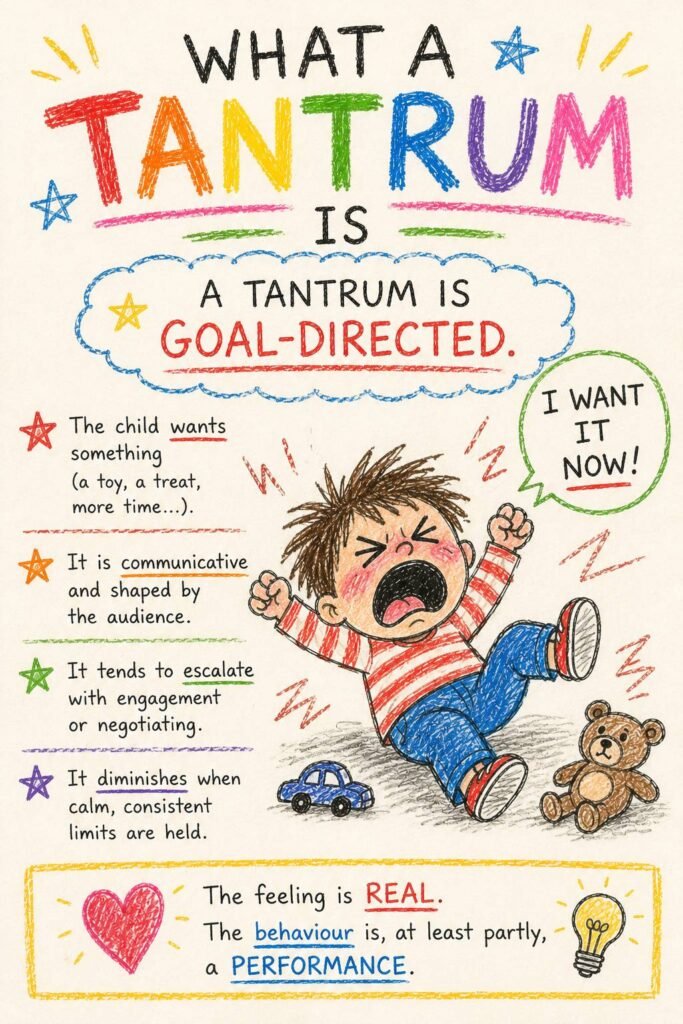
A tantrum is goal-directed. The child wants something — a biscuit, five more minutes, the toy their sibling is holding — and the distress, though entirely real, is communicative. It is shaped by the audience. It is responsive to the environment. A child in a tantrum retains some awareness of who is watching and what effect their behaviour is having. Tantrums tend to escalate when the adult engages, negotiates, or shows signs of yielding — and diminish when consistent, calm limits are maintained without drama or extended engagement.
This is important: the child in a tantrum is not manipulating in a cynical or calculated sense. They are communicating, in the most powerful way currently available to them, that they want something they are not getting. The feeling driving the tantrum is real. What is also real is that the behaviour is, at least partly, a performance — one that an audience can either reward or decline to reward, and that responds accordingly.
The appropriate response to a tantrum is calm, regulated presence — which is harder than it sounds — a clear and consistent limit, and minimal engagement until the storm has passed. Not silence, not warmth, not reasoning. Simply: the limit holds, you are here, this will end.
What a Meltdown Actually Is
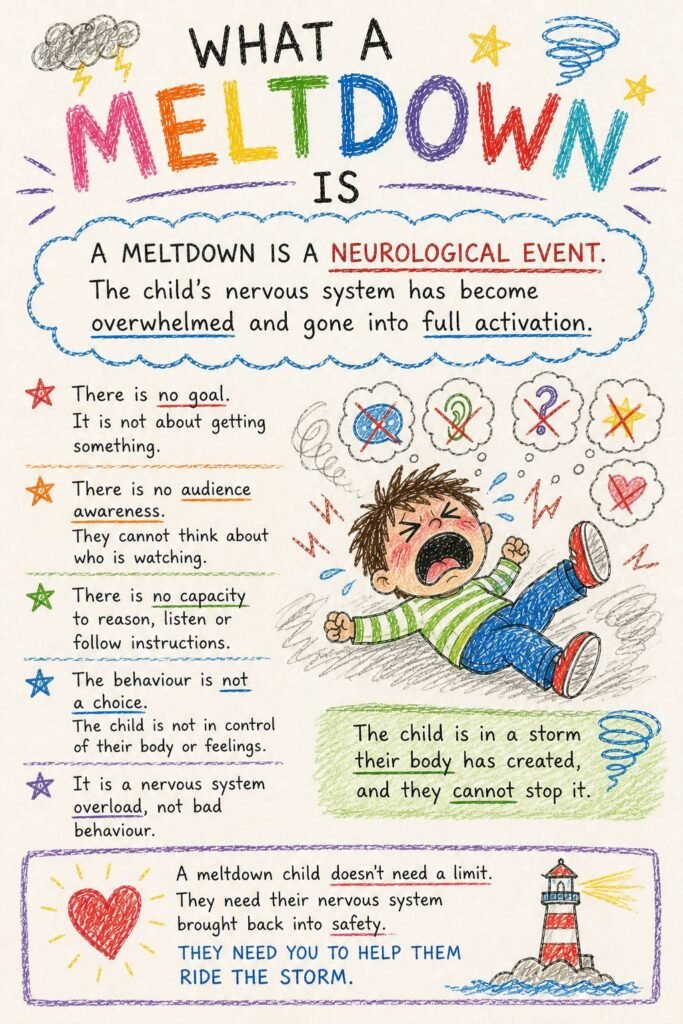
A meltdown is something else entirely. It is not a performance and it is not communicative in the same sense. It is a neurological event — the child’s nervous system has exceeded its window of tolerance and gone into full activation. In polyvagal terms, the child has moved out of the ventral vagal state of social engagement and into either sympathetic fight-or-flight or dorsal vagal shutdown. There is no goal. There is no audience awareness. There is no capacity to modulate based on consequences, reasoning, instruction, or even comfort offered in words.
The child is not choosing the behaviour. They are inside a storm their nervous system has generated — and they are as unable to stop it through an act of will as you would be able to stop yourself shivering by deciding not to.
This distinction matters enormously for how the adult responds. Applying tantrum-management strategies to a melting-down child — maintaining firm limits, minimal engagement, waiting for it to pass — intensifies the crisis rather than containing it. The child in a meltdown does not need a limit. They need their nervous system brought back into safety. And that requires something completely different.
Getting It Wrong in Either Direction
This is the part that most parenting advice misses entirely. The toddler meltdown vs tantrum distinction is not simply academic. Getting it wrong in either direction causes real harm.
Applying meltdown strategies to a tantrum — rushing in with comfort, reducing stimulation, co-regulating with warm physical presence — can inadvertently communicate that the tantrum behaviour is the route to closeness and soothing. The child learns, not through calculation but through the straightforward logic of their nervous system, that escalation produces the response they were reaching for. The tantrum becomes more frequent and more intense.
Applying tantrum strategies to a meltdown — maintaining a firm limit, reducing engagement, waiting calmly for it to stop — leaves a child whose nervous system is in genuine crisis without the co-regulatory support they need to find their way back to safety. The meltdown runs its full course without the adult’s regulated presence to shorten it. And the child emerges from it without the felt experience of having been accompanied through the storm by someone who could hold it alongside them.
Over time, repeated experiences of being left unaccompanied through neurological overwhelm erode the child’s trust in the adult as a safe base — the exact opposite of what the calm, disengaged response was intended to achieve.
How to Tell the Difference in the Moment
This is where theory meets the split second. The following signals, taken together, can help you read the event more accurately — though they are indicators, not certainties, and the same child can move between states within a single episode.
A tantrum is more likely when: the distress arrived suddenly in response to a specific denied request; the child is making eye contact or checking your reaction; the behaviour escalates when you engage and reduces when you disengage; the child can be redirected by a change in environment or a genuine distraction; and the child is able to recover relatively quickly once the limit is accepted.
A meltdown is more likely when: the child appears genuinely unreachable — not performing for an audience but absent from one; there is no clear single trigger, or the trigger seems wildly disproportionate to the response; the child cannot be redirected by anything; the distress has a quality of overwhelm rather than frustration; and the recovery, when it comes, is slow and involves a period of flatness or exhaustion rather than a quick return to normal.
With practice, and with the accumulation of experience of a specific child’s particular patterns, the distinction becomes more readable. But it is never entirely certain — and erring toward the meltdown response when in doubt is generally the safer clinical and parenting choice.
Introducing the Quiet Corner
For meltdowns specifically, one of the most effective tools available — and one that costs little to create — is a dedicated space the child has already learned to associate with safety before they ever need it in a crisis. This is called the Quiet Corner.
The Quiet Corner is not a time-out space. It is not a consequence. It is not somewhere a child is sent alone. It is a small, enclosed, dim, soft space — cushions and a heavy blanket are enough — that the adult and child build together during calm periods, visit regularly for no particular reason, and associate, through repeated positive experience, with safety, warmth, and quiet.
Inside the Quiet Corner lives a single soft, fluffy stuffed animal — chosen by the child, named by the child, and belonging permanently to the corner. Its purpose is specific and grounded in neuroscience: gentle touch activates C-tactile afferent fibres in the skin, producing a calming effect that bypasses the verbal brain and speaks directly to the body’s threat-response system. The animal is distinct from any other comfort object. It carries no emotional narrative. It is pure, consistent, reliable comfort — always in the same place, always waiting.
The Quiet Corner is built and enjoyed many times in calm moments before it is ever used during a meltdown. It must be positively associated and deeply familiar before it is needed as a refuge. Two things must be absolutely clear: the child is never sent to it alone as a consequence — the adult always accompanies. And the phrase is never used as a threat or a punishment. Its power lives entirely in what the child has already learned to associate with it.
What the Quiet Corner Does — and Does Not Do
The Quiet Corner does not stop a meltdown. Nothing stops a meltdown — the neurological event runs its course on its own timeline. What the Quiet Corner does is contain it: reduce the sensory load, provide the conditions in which the nervous system can find its own way back to regulated, and ensure the child has a warm, calm, attuned adult alongside them for the whole of the storm rather than waiting on the other side of it.
During the meltdown, the adult does not attempt verbal intervention in the conventional sense. There are no instructions, no questions, no explanations. There is only a slow, soft, accompanying voice — not to explain or to reason but simply to signal: I am here. You are safe. This will pass. The child’s nervous system registers the adult’s regulated presence long before the verbal content of any words becomes available to them.
After the meltdown, there is no consequence and no processing. The child is received with warmth and without reference to what happened. The corner is tidied together — ready for next time, with the fluffy animal waiting inside — and the session continues.
For Deeper Work: The Play Therapy Toolbox
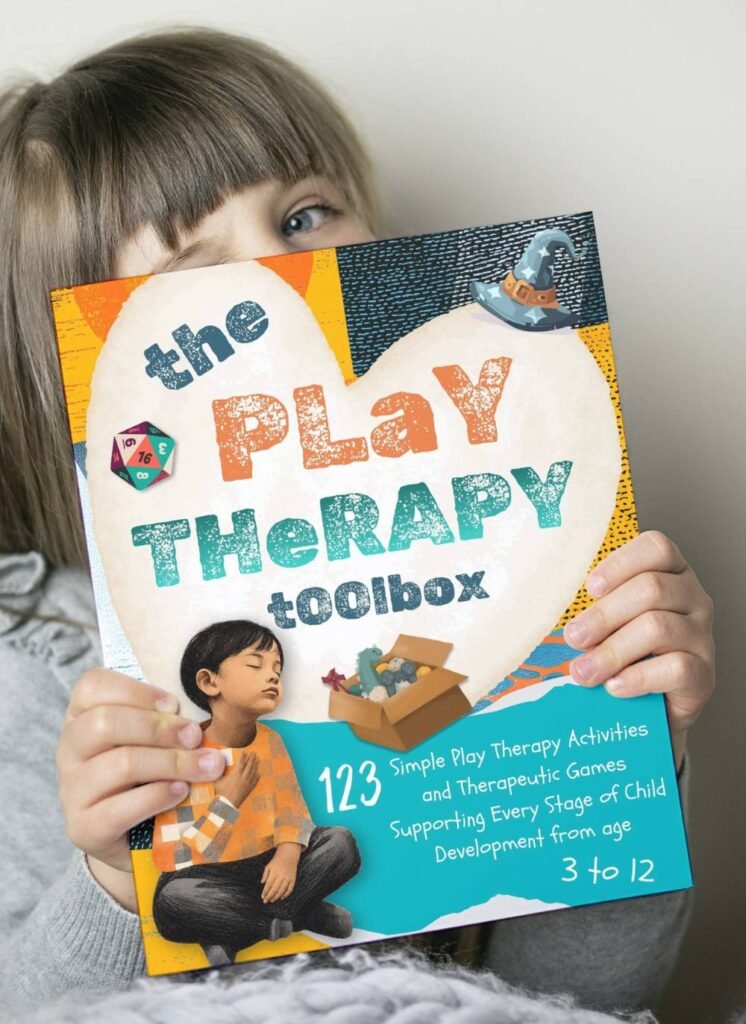
The Quiet Corner is one activity from The Play Therapy Toolbox: 123 Simple Play Therapy Activities and Therapeutic Games Supporting Every Stage of Child Development from Age 3 to 12 — a book built around the understanding that the most important clinical skill in working with young children is not knowing the right technique. It is knowing which event you are actually responding to.
The book contains 123 activities spanning role-play, enactment, fantasy storytelling, somatic exercises, and gamified experiences, alongside 75+ printable, downloadable, full-colour worksheets. Every activity comes with a therapeutic rationale grounded in peer-reviewed research, step-by-step guidance on how to conduct the session and exactly what to say, questions to use with the child, and a parent guidance note written in the same warm, accessible language as this article.
The Age 3 chapter alone covers emotional regulation and tantrums, anxiety, fear and separation, speech, social skills, and emotional expression — with dedicated developmental milestone activities and clinical activities for each presenting need, all grounded in the toddler meltdown vs tantrum distinction that underpins everything else.
Three Things Worth Knowing Before You Begin
The distinction is a skill, not a diagnosis.
Understanding the toddler meltdown vs tantrum difference does not require clinical training. It requires practice, attention, and the willingness to stay curious about what is actually happening inside your child rather than defaulting to the response that feels most natural in the moment — which is almost always the wrong one.
The Quiet Corner must be built before it is needed.
A space introduced for the first time during a crisis will not work. The nervous system registers familiarity as safety, and novelty as potential threat. Build the corner. Visit it regularly. Let it be a place of warmth and pleasure before it ever becomes a place of refuge.
You are the most important tool in the room.
The cushions and the fluffy animal matter. Your regulated presence matters more. Children return from neurological overwhelm most reliably when they have a calm, warm, attuned adult alongside them — not waiting for the storm to pass, but inside it with them, steady, unhurried, and certain that they will both come through.
Available Now for $5.99 — For a Limited Time
If this introduction to the toddler meltdown vs tantrum distinction gave you a sense of what becomes possible when you have the right framework and the right tools, The Play Therapy Toolbox gives you 123 more activities built on the same foundation. The ebook is available now on Amazon at $5.99 for a limited time — with immediate access to 123 activities and 75+ full-colour printable worksheets for children aged 3 to 12.
Play is not preparation for life. It is life — in its most honest, most essential, most healing form.

Disclaimer: This article is intended as an educational and supportive resource for parents, caregivers, educators, and mental health professionals. It is not intended to diagnose, treat, or replace professional therapeutic or medical care. If a child is experiencing significant emotional, behavioural, or developmental difficulties, please seek guidance from a qualified mental health professional.

Rostislava Buhleva-Simeonova is a psychologist, art and play therapist, and gamificator. She has worked with children, adults, and the elderly within various therapeutic programmes over the past eight years, all the while providing the much-needed playful twist that art and gamified experiences can bring to this sometimes uneasy setting. But it wasn’t until the birth of her daughter, Aurora, that this work took on an even deeper personal meaning. With her academic and real-life experience, honed through numerous trainings and sessions, she is currently authoring books and articles in the field of child psychology and development, offering expertise in art and play therapy to guide parents and caregivers, as well as professionals in the fields of social work and mental health, throughout various pivotal moments in children’s lives. Last but not least, all of her books have been “peer-reviewed” by her daughter, who testifies to the efficiency of these methods.